
Lecture
Corruption is one of the most complex and multifaceted phenomena confronting contemporary society. The term is frequently used to describe the abuse of power or official position for personal gain. Corruption, however, encompasses a multitude of aspects and manifestations that complicate its precise definition and make the problem still more tangled.
At the heart of the concept of corruption lies the notion of a breach of trust. When officials who manage public resources, or who have access to them, use their power not for the public good but for personal gain, this undermines the foundations of the rule of law and social justice. In this sense, corruption can take a wide variety of forms — from petty bribes in everyday life to large-scale schemes at the apex of the political system.
The polysemy of the concept of corruption is evident in its various types and scales. Corruption may be either individual or systemic. Individual corruption consists of the actions of particular persons who use their position to obtain undue advantages. Systemic corruption, by contrast, represents the deep penetration of corrupt practices into a country's political and economic system, where bribes and kickbacks become the norm and part of the state's everyday functioning.
Corruption can also operate through different mechanisms. These may include bribes, kickbacks, abuse of official position, favouritism, nepotism and many other forms. In every case the common element is the use of power or official position to achieve personal or corporate ends at the expense of the public interest.
From the standpoint of sociology and economics, corruption has a negative impact on every aspect of social life. It reduces trust in state institutions, deepens social inequality and impedes economic development. In countries with high levels of corruption, investors are less willing to commit capital, which slows economic growth. Corruption also leads to an inefficient allocation of resources, which aggravates poverty and lowers the quality of public services such as healthcare and education.
Combating corruption is a complex, multi-level process requiring a comprehensive approach. It involves both legislative measures and institutional reforms aimed at increasing the transparency and accountability of government bodies. The active participation of civil society and international cooperation also play a key role in creating an effective anti-corruption environment.
In international legal instruments, corruption is often defined as the abuse of power or position for personal gain. For example, the United Nations Convention against Corruption (UNCAC) describes corruption as "any act or omission directed at obtaining an unlawful benefit for oneself or for others".
Corruption is a complex phenomenon that can take different forms and operate on different scales depending on the country and culture. In some countries corruption may manifest itself as bribery and illegal exactions; in others, as abuse of official position and fraud. For instance, in some countries corruption may be more widespread in government institutions, while in others it may affect the private sector.
The first ruler recorded as having fought corruption was Urukagina, the Sumerian king of the city-state of Lagash in the second half of the 24th century BC. Despite exemplary and often cruel punishments for corruption, the struggle against it did not produce the desired results. At best it was possible to prevent the most dangerous crimes, yet at the level of petty embezzlement and bribery corruption remained widespread. The first treatise discussing corruption — the "Arthashastra" — was published under the pseudonym Kautilya by one of the ministers of Bharata (India) in the 4th century BC. In it he drew the pessimistic conclusion that "it is impossible for the king's property not to be appropriated, at least in some small measure, by those who administer it".
Similar problems were faced by the pharaohs of Ancient Egypt, where an enormous bureaucratic apparatus of officials took shape that allowed itself to commit lawlessness and arbitrary abuse against free peasants, artisans and even the military nobility. There survives an instruction by a certain Itahotel, who advises: "Bend your back before your superiors, and then your house will be in order, your salary will be paid in full, for it goes badly for him who resists his superior, but life is easy when the superior looks upon him with favour".
Particular concern was aroused by the venality of judges, since it led to the unlawful redistribution of property and to a desire to settle disputes outside the legal framework. It is no accident that the leading religions condemn, first and foremost among all forms of corruption, the bribery of judges: "…the prince asketh for gifts, and the judge judgeth for bribes, and the great men utter the evil desire of their soul and pervert the cause…"; "Take no gifts, for gifts blind the seeing and pervert the cause of the righteous" (Exodus 23:8; see also Deuteronomy 16:19); "Do not unlawfully appropriate one another's property, and do not bribe judges in order to deliberately appropriate part of other people's property" (Quran 2:188), and so forth.
In the ancient Roman Twelve Tables the term "corrumpere" begins to be used in the senses of "altering testimony in court for money" and "bribing a judge": "Would you really consider harsh the provision of the law that punishes with death the judge or arbiter who, having been appointed for the hearing [of a case], was found guilty of accepting a monetary bribe in [that] case?"
An important impetus to the understanding of corruption is provided by the works of Niccolò Machiavelli. He compared corruption to a disease, for example to consumption. At first it is difficult to detect but easier to treat. If, however, it has been left unattended, it is easy to detect but difficult to cure.
Corruption is growing, so it is time to take on the rich, the Jacobins declared on the eve of the Great Terror.
Beginning in the late 18th century, society's attitude toward corruption in the West underwent a decisive shift. Liberal reforms proceeded under the slogan that state power exists for the good of those subject to it, and that subjects therefore maintain the government in exchange for officials' strict observance of the laws. In particular, under the United States Constitution adopted in 1787, accepting a bribe is one of only two crimes explicitly named as grounds for the impeachment of the President of the United States. Society began to exert ever greater influence on the quality of the state apparatus's work. As political parties and state regulation grew stronger, episodes of collusion between the political elite and big business began to cause mounting concern. Nevertheless, the level of corruption in developed countries declined over the course of the 19th and 20th centuries relative to the rest of the world.
A new stage in the evolution of corruption in developed countries came at the turn of the 19th and 20th centuries. On the one hand, another expansion of state regulation and, correspondingly, of officials' power began. On the other, large private business was emerging which, in competitive struggle, began to resort to "state capture" — no longer to the occasional bribery of individual minor civil servants, but to the direct subordination of the activity of politicians and senior officials to the defence of capital's interests. As the importance of political parties grew in developed countries (especially in Western Europe after the Second World War), party corruption developed, whereby large firms and transnational corporations paid for the lobbying of their interests not to politicians personally but into party coffers.
In the second half of the 20th century corruption increasingly became an international problem. The bribery of senior foreign officials by corporations took on a mass character. Globalization meant that corruption in one country began to have adverse effects on the development of many others. Moreover, the countries with the highest levels of corruption were no longer confined to the third world: liberalization in the former socialist countries in the 1990s was accompanied by flagrant abuses of office. In its issue of 31 December 1995, the Financial Times declared 1995 the "year of corruption". To promote awareness of corruption, the UN established International Anti-Corruption Day (9 December).
Professor Robert Klitgaard's "corruption formula" has become widely known:
Corruption = Monopoly + Discretion − Accountability.
Aim: obtaining personal gain or circumventing lawful procedures
Obtaining contracts or tenders without competition
Speeding up bureaucratic processes (for example, the issuance of licences and permits)
Avoiding punishment or liability (for example, in court or with the police)
Access to restricted information or resources
Aim: consolidating personal power or building a loyal network
Appointing relatives or friends to positions regardless of their qualifications
Allocating resources (grants, land, subsidies) in favour of "one's own people"
Creating "pocket" structures within the state apparatus or in business
Aim: converting budget funds into cash or concealing actual expenditures
Concluding contracts at inflated prices and returning part of the funds
Setting up fictitious contractors to "absorb" the budget
Manipulation of public procurement and tenders
Aim: extending influence or retaining power
Using state resources for personal ends (transport, security details, real estate)
Pressure on the media, the courts or law enforcement agencies
Vote-buying or electoral manipulation
Aim: creating an illusion of success or concealing failures
Falsifying financial reports for investors
Distorting statistics on crime, the economy and healthcare
Concealing environmental or social problems
Aim: consolidating influence, manipulating decisions and gaining strategic advantages
Lobbying interests through bribes to diplomats or officials — for example, promoting favourable trade agreements, defence contracts or energy projects
Financing political parties or leaders in other countries — covert support for "friendly" regimes or candidates in order to install loyal governments
Manipulating international organizations (the UN, WTO, IMF and others) — bribing representatives to block resolutions, secure grants or change the rules
Corruption schemes in humanitarian aid and international projects — misappropriating funds allocated to assist developing countries through fictitious NGOs or contractors
Using offshore jurisdictions and shadow structures to conceal assets and finance operations — for example, funding intelligence work, cyberattacks or destabilization through opaque channels
Bribing journalists and media outlets in other countries — shaping the desired information environment, discrediting opponents and promoting propaganda
Bureaucratism is characterized by an excessive number of rules, procedures and administrative barriers. In such an environment decisions are made slowly, and the process of dealing with government or corporate structures becomes complicated and opaque. Excessive regulation and red tape can create conditions in which officials acquire considerable powers and control over administrative processes.
Corruption, in turn, arises when these officials begin to abuse their position for personal gain. The more complicated and convoluted the procedures, the greater the opportunities for corruption. People and organizations confronted with bureaucratic obstacles may be inclined to pay bribes or seek "workarounds" to speed up processes or avoid difficulties.
Abuse of power: Under conditions of bureaucratism, officials may use their position to obtain bribes for expediting decisions or providing special services. For example, a complicated permit-issuing system can become a source of income for corrupt officials who offer to "speed up" the process for a certain fee.
Creating artificial obstacles: Bureaucratic systems may generate artificial barriers requiring additional payments or documents. This increases the number of interactions between citizens and officials, raising the likelihood of corrupt transactions.
Lack of transparency: Bureaucratism is often accompanied by insufficient transparency in decision-making, which makes it difficult to monitor and audit officials' actions. Where matters are opaque and oversight is difficult, corruption can flourish, since detecting and proving abuses becomes harder.
Social tolerance: In societies with high levels of bureaucratism, corruption can become a social norm. Citizens grow accustomed to having to pay bribes to resolve everyday matters and begin to perceive this as a necessary evil.
Thus bureaucratism and corruption are closely linked, creating a vicious circle in which excessive administrative barriers and rules foster the growth and entrenchment of corrupt practices. Combating bureaucratism and increasing the transparency of administrative processes are important steps toward reducing corruption and improving the effectiveness of state institutions.
Corrupt practices and lobbying are complex, multifaceted phenomena that can significantly affect a society's political, economic and social systems. Corruption often manifests itself through the abuse of power for personal gain and can take various forms, including bribery, the misuse of resources and unlawful schemes for allocating public contracts. Such actions undermine citizens' trust in state structures and create serious obstacles to sustainable development and social justice.
Lobbying, on the other hand, is regarded in some countries as a legal practice that allows various groups — from businesses to civic organizations — to influence political decision-making. Ideally, lobbying makes it possible to take account of the interests of different parties and to help develop legislation that reflects society's needs. In practice, however, it frequently overlaps with corruption, when lobbyists secure decisions that benefit only particular companies or individuals and that may run counter to the public interest. Lobbying turns into an instrument of pressure when it conceals opaque financial flows and the personal interests of officials.
There is a fine line between lawful lobbying and corrupt practices, and in some cases it becomes almost imperceptible. This happens when decision-making comes to depend on financial or political pressure instead of being based on society's needs and interests. Such practice not only distorts the work of state institutions but also creates conditions for inequality and injustice, since privileged groups gain access to resources and influence unavailable to the rest of society.
In the long run, corruption and abuses in lobbying activity contribute to the creation of a system in which resources are allocated inefficiently and social and economic problems are addressed in the interests of a narrow group of people. As a result, trust in the institutions of power declines, the transparency of the state apparatus falls, and corruption schemes become part of the political culture.
The blurred boundary between lawful and unlawful lobbying creates conditions for the spread of corruption, since the private interests of particular groups may be placed above those of the public. As a result, state resources are often spent inefficiently, which leads to economic losses and a decline in citizens' quality of life.
Corruption in bodies of state and municipal administration is one of the most acute problems affecting the development of society, state institutions and citizens' standard of living. It manifests itself through the abuse of official powers, when representatives of the authorities use their position for personal gain. This may take the form of bribery, kickbacks, the unlawful allocation of state contracts, and also direct interference in the distribution of budget funds in circumvention of the law.
Corruption in local government bodies is especially dangerous, since it is precisely municipal institutions that deal directly with the population and are responsible for providing social services, developing infrastructure and ensuring citizens' well-being. When bribery and cronyism flourish at the municipal level, the public interest is relegated to second place and resources are spent inefficiently. As a result, the quality of the services provided suffers — from housing and utilities to healthcare and education — which is felt most acutely by the most vulnerable segments of the population.
Corruption in state structures undermines citizens' trust in the authorities and creates an atmosphere of legal nihilism. When people see that the laws do not apply equally to everyone and that violations go unpunished, they lose faith in the justice and effectiveness of the state. Moreover, corruption schemes at every level of administration lead to substantial financial losses and slow economic development, since public funds are not directed toward developing infrastructure and social programmes but instead end up in the hands of corrupt officials.
Addressing the problem of corruption requires a comprehensive approach that includes stiffer penalties for corruption offences, the adoption of modern technologies that ensure transparency in the work of state and municipal bodies, and the development of independent institutions capable of conducting anti-corruption audits. Increasing the accountability of public officials to society, strengthening civic oversight and actively involving citizens in decision-making can become significant steps toward reducing the level of corruption in state and municipal administration.
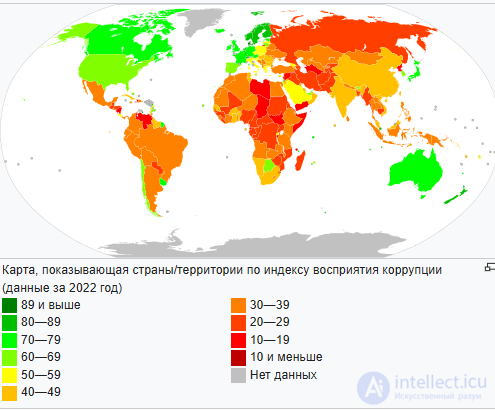
The Corruption Perceptions Index (CPI) is an indicator compiled by the international non-governmental organisation Transparency International in order to reflect assessments of perceived levels of corruption by experts and businesspeople on a hundred-point scale. It has been compiled annually since 1995. Prior to 2012 it was not comparable across years, i.e. countries' positions could only be compared within a given year's edition of the index.
Georgi Derluguian, an American historical sociologist of Armenian origin and a professor at New York University Abu Dhabi, who considers himself a faithful follower of the neo-Marxist philosopher Wallerstein, notes that corruption is extremely difficult to measure and that the rankings should not be trusted completely: "By all of Transparency International's rankings, Iceland occupied the top places," he says. "That was until we found out what its banks were really like, how they were connected with several ruling families and with the two political parties that have governed the country in recent decades. This example demonstrates just how imperfect the index is."
Some researchers express concern that, since the Corruption Perceptions Index itself substantially influences how residents of countries perceive corruption (it is constantly quoted in the media) and also reduces opportunities for economic development, it constitutes a self-fulfilling prophecy.
Although it does not directly measure how many people take or offer bribes when they are proposed, it reflects the general perception of corruption in a country. The lower the index (from 0 to 100), the higher the likelihood that a bribe will be accepted.
Low index (0–30) — high likelihood of a bribe being accepted: South Sudan, Syria, Venezuela
Medium index (40–60) — moderate likelihood: Ukraine, India, Turkey
High index (70–100) — low likelihood: Finland, Sweden, Canada
In the past the Index has been subject to methodological criticism, i.e. it has been called into question on the basis of its methodology .
According to the political scientist Dan Hough, the Index has three shortcomings :
The media often use the raw figures as a benchmark of government performance without clarifying what those figures mean. Transparency International's local chapter in Bangladesh disavowed the index results after a change in methodology led to higher scores for the country; the media reported this as an "improvement".
In a 2013 article in the journal Foreign Policy, Alex Cobham proposed scrapping the CPI for Transparency International's own good. He argues that the CPI embeds a powerful and misleading elite bias in public perceptions of corruption, potentially contributing to a vicious circle while at the same time encouraging inadequate policy responses. Cobham writes: "The index distorts perceptions to such an extent that it is difficult to find a justification for continuing to publish it."
A recent econometric analysis, which used the existence of natural experiments on levels of corruption and compared the CPI with other subjective indicators, showed that, although the CPI is not perfect, it is considered to be broadly consistent with one-dimensional measures of corruption.
In the United States many lawyers advise international businesses to consult the CPI when attempting to assess the risk of Foreign Corrupt Practices Act violations in different countries. This practice has been criticised by the Minnesota Journal of International Law, which wrote that, since the CPI may be subject to perception bias, lawyers should not treat it as a measure of actual national corruption risk.
Transparency International also publishes the Global Corruption Barometer, which ranks countries by level of corruption using direct surveys rather than the presumed opinions of experts, which is criticised for substantial bias on the part of the influential elite.
Transparency International has warned that a country with a clean CPI score may still be linked to corruption at the international level. For example, although Sweden ranked third on the CPI in 2015, one of its state-owned companies, TeliaSonera, faced bribery allegations in Uzbekistan.
Interdisciplinarity in corruption research plays a key role in gaining a deep understanding of and effectively countering this complex and multifaceted phenomenon. Corruption affects many aspects of public life, and its study therefore requires integrating knowledge from various disciplines such as political science, economics, sociology, law, psychology and others. Interdisciplinarity in corruption research is an approach that makes it possible to better understand the nature, mechanisms and consequences of this phenomenon by combining knowledge from various fields of scholarship. Corruption is a complex social, political and economic phenomenon that affects a wide spectrum of public life. Its study therefore requires interaction between such disciplines as sociology, political science, economics, psychology, law and even information technology.
Political science and economics, for their part, study corruption from the standpoint of institutions and the allocation of resources. Political scientists analyse how the political system and the character of power contribute to corruption, as well as how ineffective or weak institutions can encourage the abuse of power. Economists consider corruption through the prism of its impact on economic development, investment and income distribution. Economic models help to assess the scale of financial losses and to devise measures to minimise them.
Political scientists study corruption as a political phenomenon, analysing its impact on political institutions, democracy and public administration. They examine the mechanisms through which corruption undermines trust in state institutions, and study political strategies and reforms aimed at reducing it.
Economists study the economic consequences of corruption, such as the inefficient allocation of resources, reduced foreign investment and slower economic growth. They use economic models to analyse the impact of corruption on market processes and study the economic incentives for corrupt behaviour.
Sociology and psychology, for example, help to examine corruption through the prism of human behaviour and social norms. These disciplines focus on the motives and socio-psychological factors that contribute to the emergence of corrupt practices, such as the desire to raise one's status, the pursuit of personal gain or peer pressure. Understanding these aspects helps in devising strategies to change corporate and social culture that are aimed at combating corruption.
Sociology
Sociologists study the social determinants and consequences of corruption, including its impact on social inequality, social norms and public trust. They analyse how cultural and social factors contribute to the spread of corruption and how corruption, in turn, affects the social fabric of society.
Legal scholars study the legal aspects of corruption, developing and analysing legislative measures aimed at preventing and punishing it. They study international and national anti-corruption laws and the mechanisms for applying them, as well as legal problems relating to evidence and the prosecution of corruption offences. Jurisprudence plays a key role in combating corruption by examining the legal aspects and legal gaps that allow corrupt practices to exist and flourish. Legal analysis helps to identify weaknesses in legislation and to develop anti-corruption laws and enforcement mechanisms. In recent years digital technologies have become an integral part of anti-corruption research.
Researchers in the field of information technology develop and implement technological solutions for combating corruption, such as e-government systems, transparent databases and blockchain technologies. These tools help improve transparency, accountability and effectiveness in the fight against corruption. Information technology and digital forensics provide tools for monitoring financial transactions, automating public services and detecting anomalies associated with corrupt activity.
An interdisciplinary approach to the study of corruption makes it possible to understand its nature more comprehensively and to develop effective strategies for preventing and combating it. Collaboration between different disciplines helps to create a holistic picture of this complex phenomenon, which makes it possible to devise comprehensive, multi-level measures for overcoming it. Only through the integration of knowledge from different fields can significant success be achieved in reducing corruption and improving the quality of life in society.
The political science approach to the study of corruption, represented by such scholars as Joseph Senturia, Joseph Nye, Robert Dahl, Eva Etzioni-Halevy and Robert Theobald, focuses on the institutional and systemic aspects of corruption, treating it as a problem of political organisation and power relations.
Joseph Senturia considered corruption in the context of a society's political culture and moral values. He argued that the prevalence of corruption is closely linked to the level of civic activism and citizen participation in political processes. Senturia emphasised that weak civic institutions and a low level of political participation create conditions for the abuse of power, since citizens lack effective mechanisms for controlling those in power.
Joseph Nye approached corruption from an institutional standpoint, distinguishing corruption "from above" and "from below" as different forms of its manifestation. In his view, corruption "from below" more often arises among the lower ranks of the bureaucracy, while corruption "from above" is a phenomenon characteristic of the highest echelon of power. He also distinguished between "brokerage" corruption, in which an agent or intermediary transfers resources in exchange for influence, and "managerial" corruption, in which power is used in the interests of the ruling group. Such a differentiated approach helped to assess and distinguish manifestations of corruption more precisely according to the level of power involved.
Robert Dahl studied corruption as an element of democratic theory, focusing on questions of participation and power. He regarded corruption as one form of distortion of democratic processes, in which the interests of a minority influence decision-making, and emphasised the importance of political equality and transparency. Corruption, in Dahl's view, poses a threat to democracy, since it leads to a violation of the principle of equal participation and undermines trust in democratic institutions.
Eva Etzioni-Halevy studied corruption through the prism of social responsibility and the role of the ruling elite. She emphasised that the political elite often creates conditions for corruption by establishing unwritten rules and rituals that protect its privileges and consolidate its power. Etzioni-Halevy argued that weak oversight and the impenetrability of elite circles make corruption persistent. She also raised the question of the need for institutional reforms aimed at increasing the transparency and accountability of the elite.
Robert Theobald emphasised the political-economic aspect of corruption, arguing that it is an inevitable side effect of inequality. He noted that corruption is often used as a way of legitimising and maintaining privileges, strengthening influence and entrenching the social hierarchy. In his view, corruption not only undermines trust in institutions but also creates a vicious circle of inequality in which access to resources and power becomes concentrated in the hands of a small group.
The political science approach to corruption as taken by these authors underscores the importance of a comprehensive analysis of power relations, the role of elites, the distortion of democratic processes and the influence of institutional structures. Such an approach helps not only to understand the nature of corruption more deeply, but also to assess its long-term consequences for the political system and for democracy.
Corruption is a complex phenomenon driven by many factors, which can be classified as economic, political and organisational. Each of these categories explains in its own way why corrupt practices arise, and identifies the conditions under which corruption flourishes.
From an economic standpoint, corruption is often linked to income inequality, poverty, a lack of opportunities for social mobility and economic instability. When incomes in a society are distributed unevenly and a significant share of the population experiences financial hardship, people may seek to use any opportunity to improve their position, even if this runs counter to the law. Inadequate salaries for civil servants can also act as an incentive for bribery and abuse of office. High taxes and complicated, costly procedures for obtaining licences and permits create incentives to circumvent formal rules through bribes and illegal arrangements.
In addition, the economic causes of corruption may include the inefficient allocation of state resources, when citizens or businesses have to resort to informal channels in order to gain access to resources or funding. Weak market institutions and a low level of competition also heighten the risk of corruption, since state resources are distributed in the interests of a narrow circle of people.
From a political standpoint, corruption is conditioned by the structure and specific features of the political system itself. Authoritarian regimes and regimes with a low level of transparency and weak oversight by society are more prone to corruption, since state institutions operate in the interests of the ruling elite. In countries with limited citizen participation in political decision-making, corruption is used as a means of consolidating power and maintaining loyalty among the elite and those close to power.
Political instability, the absence of democratic institutions and of effective accountability mechanisms create favourable conditions for corruption. Under such conditions the authorities become less transparent, and citizens have limited opportunities to monitor and influence state structures. An ineffective legal system and a weak rule of law also contribute to corruption, since they fail to ensure appropriate punishment for corrupt acts and allow the authorities to manipulate laws in their own interests.
At the organisational level, corruption often arises from a lack of transparency and oversight, as well as from ineffective management and the absence of ethical standards. Corruption within organisations can flourish if the management system allows employees to make decisions without proper supervision, or if internal control and reporting mechanisms are poorly developed. Unclear boundaries of authority, the absence of regular audits and a shortage of internal disciplinary measures create conditions for abuse.
Organisational culture also plays an important role. If it is accepted practice within an organisation to use informal methods to achieve goals, or if loyalty is rewarded at the expense of professional competence, this creates fertile ground for corruption. Corruption in organisations can intensify if there are no clear ethical norms and codes governing employee conduct, or if the upper echelons of management are themselves involved in corrupt schemes.
Thus, the economic, political and organisational causes of corruption operate in an interconnected way, reinforcing one another. Corruption does not arise in a vacuum; it takes root where there are no effective institutions capable of regulating and controlling the actions of the authorities, and where public and internal oversight is absent.
Corruption as criminal behaviour consists of acts that violate laws and moral norms, in which officials use their position for personal ends. It encompasses various forms of criminal conduct, including bribery, extortion, abuse of office, fraud and misappropriation of funds. Corrupt acts cause considerable harm, since they undermine trust in state institutions, weaken the legal system and impede economic development.
Corruption can manifest itself in various forms, which often differ in severity and scale. One of the most widespread types is bribery, in which an official receives money, services or other benefits in exchange for taking decisions favourable to the bribe-giver. Fraud and abuse of office involve acts in which officials use state resources or information for personal gain. The misappropriation or embezzlement of state funds is yet another form of criminal behaviour, in which public funds are channelled to serve personal or narrow group interests.
Another important aspect is conflict of interest, when a civil servant takes decisions that bring benefit to himself or those close to him, thereby violating the principles of impartiality and accountability to society.
Corruption is considered a crime in virtually all countries, and strict criminal penalties are provided for it. The legislation of many countries singles out corruption as a particularly grave crime, since its consequences can affect the economy, politics and public welfare. Criminal punishment for corruption ranges from fines and dismissal to imprisonment, depending on the gravity of the offence. Some countries also apply additional penalties, such as confiscation of property, a ban on holding public office or a lifetime ban on working in certain sectors.
Corruption causes significant damage to the state and to society. It reduces the effectiveness of state institutions, since corrupt deals and bribes become the instrument for taking decisions that may not be in society's interests. The economic consequences of corruption are expressed in reduced investment, growing inequality and slower economic growth, since funds are redistributed in the interests of those engaged in corruption rather than for public needs. Corruption also undermines trust in the legal system, making it less fair and less transparent.
In addition, it creates a vicious circle, entrenching the conditions under which corruption becomes the norm. This is especially dangerous, since criminal acts at the level of government become less subject to control, and society loses confidence in the state's ability to protect its interests.
Effectively combating corruption as criminal behaviour requires a comprehensive approach that includes legal, organisational and public measures. Tougher penalties and greater judicial independence help to create an effective system of deterrence. An important role is also played by anti-corruption bodies and civic oversight, which help to detect and punish the guilty. Developing transparent decision-making processes, public reporting and the digitalisation of public services make it possible to reduce corruption risks.
Corruption as criminal behaviour is a threat that undermines the foundations of the rule of law and public administration, and preventing it therefore requires the concerted efforts of the state, business and society to create a transparent and accountable system of government.
Corruption as a cultural norm is a phenomenon in which corrupt practices distort social norms and values, becoming an integral part of everyday life. In societies where corruption is perceived as a customary and "natural" way of achieving goals, it ceases to be seen as something reprehensible. Under such conditions corruption can encompass a wide range of social and economic spheres and penetrate every level of interaction — from the personal to the institutional.
When corruption takes root as part of a culture, this is often linked to historical, social and economic conditions. In societies where elite rule persisted over a long period, where significant inequality was maintained and the legal system was weak, corruption could become a means of "compensation" and survival for the lower strata of the population. People begin to regard bribes, kickbacks and personal connections as a "normal" and even necessary way of resolving matters under conditions of a weak state and ineffective institutions.
Corruption can also be part of a cultural norm in societies where great importance is attached to personal and family ties (nepotism, favouritism). In such cultures, priority may be given to family or friendship obligations over public interests. As a result, relatives and friends become the priority in the distribution of resources and opportunities, and this is not perceived as a violation of morality or the law, but rather as an expression of loyalty and respect toward one's nearest and dearest.
When corruption becomes part of a cultural norm, public institutions operate with less effectiveness and often lose their primary function. The authorities may care more about their own interests than about the good of society, and key decisions begin to be taken in the interests of particular groups rather than in the interests of the public majority. This process distorts the system of meritocracy, in which advancement and access to opportunities depend not on ability and competence but on belonging to certain circles or on personal loyalty.
Under conditions where corruption is normalised, state institutions and the legal system lose their authority. Laws may be ignored, since the conviction takes root in society that corruption is a more reliable and faster way of achieving goals. This also leads to the spread of legal nihilism, when citizens begin to doubt the fairness and effectiveness of the legal system.
Corruption as a cultural norm contributes to the emergence of a vicious circle of poverty and inequality. When corruption becomes "natural", access to resources, education, medical services and opportunities is advanced through connections and money, which restricts social mobility and makes opportunities inaccessible to the majority. This leads to distrust of state institutions, a decline in civic activism and a weakening of public oversight. In a society where corruption flourishes, inequality and injustice become part of everyday reality.
Overcoming corruption as a cultural norm requires efforts at the level of public consciousness and a transformation of value orientations. An important step is the development of civil society and an increase in the level of citizens' political participation. Building an anti-corruption culture requires the active involvement of the media and of educational systems, which can shape new moral standards and reference points that increase intolerance of corruption.
An effective legal system, accessible and transparent oversight mechanisms, and strong civic institutions can also help to change society's attitude toward corruption. When citizens begin to see that corrupt acts are punished and that social justice is being restored, the attitude toward corruption as a "norm" begins to change.
Thus, corruption as a cultural norm is a serious threat that can undermine fundamental social and legal structures. To change such a perception, it is necessary to strengthen the institutions of civil society, increase the transparency and accessibility of public services, and cultivate respect for the public interest rather than for personal gain.
Corrupt behaviour can vary considerably depending on the socio-economic and cultural conditions of different regions of the world. Scholars identify three main models of corrupt behaviour, characteristic of the Asian, African and Latin American regions. Each of these models has its own features and roots, connected with historical, political and cultural contexts.
The Asian model of corruption is often characterised by clientelism and a close dependence on the hierarchical structure of society. In Asian countries such as China, South Korea, Indonesia and the Philippines, a culture is widespread in which personal and family ties play a key role. Within such a model, corruption may manifest itself as an exchange of services and support within patron-client relations, where power and resources are distributed according to loyalty to a particular patron. That patron, in turn, provides assistance and opportunities to those who support his or her interests.
In the Asian model, corruption can be deeply rooted at the level of the state bureaucracy. The system of selection and career advancement is often tied to personal loyalty or patronage, which fosters corrupt practices within state structures. Under such conditions bribes, kickbacks and favours are regarded as acceptable elements of the system, especially if they are necessary for climbing the career ladder or gaining access to government contracts.
In some Asian countries corruption is also linked to the influence of large corporations on politics (for example, through the chaebols in South Korea or guanxi in China) and manifests itself through close ties between business and the political elite. Corporations can use their connections to obtain state privileges, which leads to corruption at the level of government.
The African model of corruption is characterised by the predominance of informal economic and political practices linked to traditional culture and power structures. In Africa, corruption is often explained by the prominent role of ethnic and clan ties, which are frequently more important than formal laws and rules. Corruption in Africa may be perceived as a means of maintaining social and economic stability under conditions of weak state institutions and low economic security.
In the African model there is a phenomenon that may be called the "Big Man Syndrome", in which community leaders or influential politicians use their positions for personal enrichment and to consolidate power. Such leaders often regard national resources as a means of securing loyalty and retaining control, distributing them among their own ethnic group or inner circle. This fosters corruption in the form of the distribution of state funds for personal ends and narrowly targeted subsidies in favour of particular groups.
Because of high poverty and limited opportunities for citizens, corrupt payments and bribes may be considered necessary in order to gain access to basic social services such as healthcare, education and security. Under conditions of weak law enforcement and a lack of transparency, corruption becomes a widespread practice on which everyday decisions depend.
The Latin American model of corruption is characteristic of the countries of Latin America and represents a combination of clientelism, populism and a strong influence of major interests on politics. In this model corruption is frequently expressed through a patronage system, in which political figures provide their supporters with resources or privileges in exchange for political loyalty. Political leaders seek to retain power by handing out posts and subsidies to those who support their political programme.
Corrupt alliances between business and politics are also widespread in Latin America. In countries such as Brazil and Argentina, business elites may receive special preferences in return for supporting particular political groups or projects. This takes the form of bribes, the awarding of lucrative contracts and other forms of corrupt dealings, which undermines economic development and the democratic system. Well-known corruption cases such as "Lava Jato" in Brazil illustrate the scale of such ties.
Another feature of the Latin American model is the strong influence of populism, under which corruption can be justified and even perceived as permissible for the "good of the people". This manifests itself when political leaders distribute resources among the lower strata of the population, creating an appearance of care and support, which helps them retain power while at the same time increasing the population's dependence on state patronage.
These models of corrupt behaviour reflect the specific political and cultural conditions of different regions. In each case corruption is closely bound up with the culture and historical traditions that shape social and political relations. Identifying and analysing such models helps to better understand the causes and mechanisms of corruption and to develop effective strategies for preventing it, taking into account regional characteristics and social norms.
Corruption is a multifaceted phenomenon that manifests itself in various forms and on various scales, and scholars and practitioners therefore use different typologies in order to understand it. Each typology of corruption highlights certain aspects or criteria that help to classify its types, mechanisms and consequences. Presented below are the main typologies of corruption, classified according to various criteria.
This typology subdivides corruption by the level of involvement and the scale of its impact:
Petty (everyday) corruption is corruption at the grassroots level, involving small bribes and favours. It mainly comprises everyday interactions with representatives of state institutions and lower-level employees such as police officers, doctors, social service workers and teachers. This form of corruption affects citizens directly and often becomes part of everyday life.
Mid-level corruption covers officials of the middle ranks who use their position to obtain benefits. It includes, for example, public procurement, tenders and the allocation of resources. In this category corruption may manifest itself as illegal lobbying and "protection rackets".
High-level (elite) corruption is large-scale corruption affecting the highest echelons of power and major businesspeople. This level of corruption involves corrupt deals at the level of state contracts, the manipulation of legislation and budgetary funds. Elite corruption can be transnational in character and causes serious damage to a country's economy and legal system.
This typology subdivides corruption according to what the bribe-taker receives:
Monetary corruption — bribes in the form of money or its equivalents, which are handed to an official in return for taking the desired decisions or providing services.
Visible (undisguised) corruption — corruption in which bribes, kickbacks and other kinds of reward are handed over openly, with no attempt to conceal the acts.
Barter corruption — the bribe is given in the form of goods, services or opportunities, for example, the provision of some service in return for help with promotion or the award of a government contract.
Political corruption — includes acts aimed at obtaining political benefits (for example, voters' votes) in return for promises of resources, benefits or specific decisions in the interests of particular individuals or groups.
This typology defines corruption according to the ways in which the parties interact:
Active corruption — implies that the bribe-giver actively offers a bribe to an official. Most often the initiative comes from the interested party, which is attempting to obtain a benefit by means of bribery.
Passive corruption — a situation in which the initiator of the corrupt act is the official, who extorts a bribe or induces the interested party into a corrupt interaction. This type is widespread in societies with a high tolerance of corruption.
Coerced corruption — occurs in cases where a citizen is compelled to give a bribe in order to gain access to a lawful service or right. Such a situation often arises under conditions of bureaucratic barriers and a lack of transparency.
This typology describes corruption according to the goals that the participants wish to achieve:
Administrative corruption — includes cases of corruption at the level of state and municipal service, where bribes are used to circumvent bureaucratic procedures or to speed up the provision of services.
Political corruption — aimed at influencing political decisions and the distribution of power, for example, through the buying of voters' votes, lobbying, or the granting of state posts in return for loyalty.
Economic corruption — most often found in the business environment and associated with obtaining unlawful advantages in business (for example, access to tenders, licences or government contracts).
This typology covers the areas in which corruption is most widespread:
Corruption in the judicial system — includes the bribery of judges, lawyers and other court personnel in order to manipulate justice in someone's interests.
Corruption in law enforcement — involves bribery among police officers and law enforcement personnel aimed at covering up crimes or falsifying evidence.
Corruption in public administration — covers cases of corruption among civil servants, especially at the management level, and is aimed at gaining control over budgetary resources and regulation.
This typology divides corruption according to its severity and its consequences for society:
Petty corruption — minor violations that have no significant impact on the system and are mainly associated with everyday life, small services and interactions.
Moderate corruption — includes more serious violations that affect resources and access to services and shape a negative perception of the authorities, but do not undermine them entirely.
Grand corruption — the most dangerous type, undermining the functioning of state and economic institutions and capable of leading to political crises and social instability.
These typologies help us to better understand the forms and mechanisms of corrupt behaviour, as well as to assess the degree of its impact on society. The interrelation and overlap of the various categories show just how multifaceted this phenomenon can be.
The terms "white", "grey" and "black" corruption denote different degrees of illegality, visibility and public danger of corrupt acts, as well as the attitude towards them on the part of society and the authorities. These categories help to identify the level of legitimacy or the shadow character of corrupt schemes and actions.
White corruption is a form of corruption that is considered socially acceptable or permissible, even though it violates certain moral norms or standards. It usually does not provoke sharp condemnation, since it may be regarded as "insignificant" or even useful for achieving goals, particularly in cases where the existing bureaucratic system impedes effective access to services or resources.
White corruption often takes
продолжение следует...
Часть 1 Corruption: its nature, types, causes and the principal strategies for countering it
Часть 2 Business corruption and everyday corruption. - Corruption: its nature, types,
Часть 3 Public education work with people of different ages and social
Часть 4 See also - Corruption: its nature, types, causes and the

Comments