Education is a unified, purposeful process of upbringing and instruction that constitutes a socially significant good and is carried out in the interests of the individual, the family, society, and the state, as well as the body of acquired knowledge, skills, abilities, value orientations, practical experience, and competencies of a defined scope and complexity, pursued for the purpose of a person's intellectual, spiritual and moral, creative, physical, and/or professional development and the satisfaction of their educational needs and interests. It also denotes a citizen's (learner's) attainment of a particular educational qualification, confirmed by a document issued by organisations engaged in educational activity upon completion of the educational process, which is carried out by educational
organisations and individual entrepreneurs (including in the form of family education or self-education) that deliver educational programmes (or parts thereof) or programmes of individual courses, subjects, and disciplines (modules).
The organisational and legal system of education administration
The administration of education and science in the Russian Federation is a complex, multi-component system based on a combination of federal, regional, and municipal structures, together with private and public organisations. The principal aim of this system is to ensure the accessibility, quality, and competitiveness of education and scientific research. The organisational and legal structure of administration comprises the normative acts governing the activity of educational and scientific institutions and the administrative bodies that exercise oversight and coordination.
Bodies governing education and science
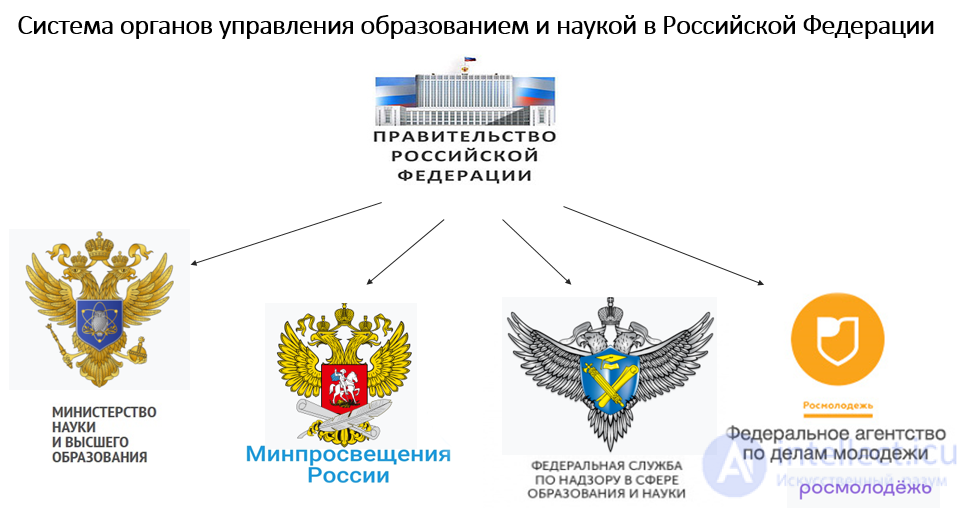
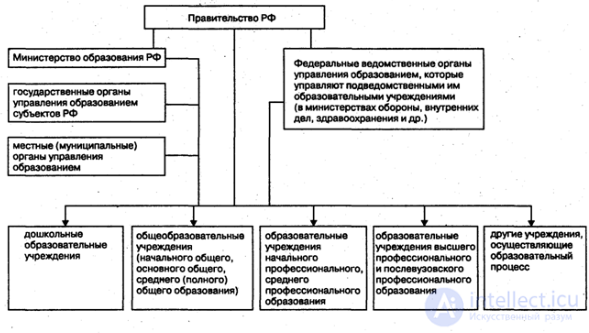
The principal bodies governing education and science in the Russian Federation are:
-
The Ministry of Science and Higher Education of the Russian Federation — develops and implements state policy in the sphere of higher education and science.
-
The Ministry of Education of the Russian Federation — is responsible for general, preschool, and secondary vocational education.
-
Rosobrnadzor (the Federal Service for Supervision in Education and Science) — oversees the quality of education and the accreditation and licensing of educational organisations.
-
The RAS (Russian Academy of Sciences) — coordinates scientific research and acts as a scientific advisor to government bodies.
-
Regional and municipal education authorities — are responsible for delivering educational programmes and monitoring their implementation at the local level.
Scientific and educational institutions and organisations
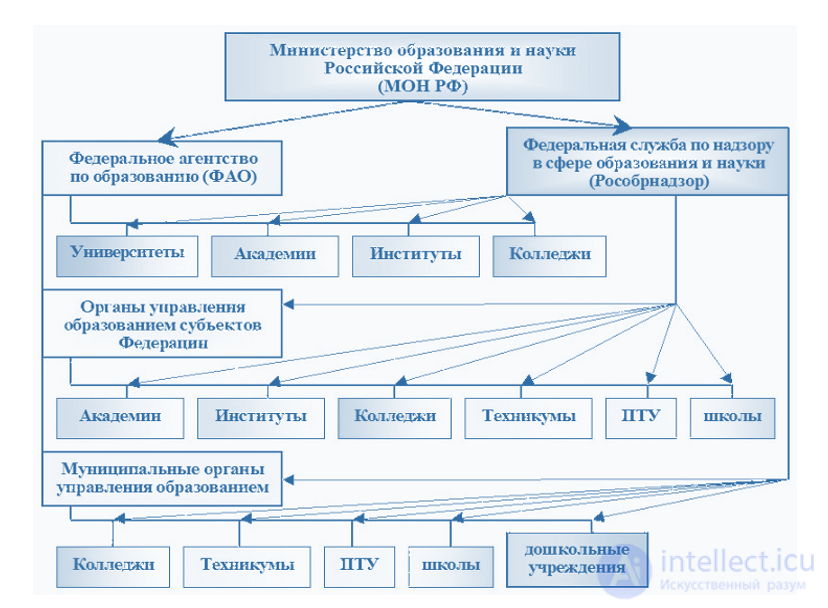
Scientific and educational institutions include:
-
Higher education institutions (universities, academies, institutes), which train highly qualified specialists.
-
Research institutes — engaged in basic and applied research.
-
Schools, colleges, and supplementary education institutions — providing basic and vocational instruction.
-
Innovation development centres — supporting the transfer of scientific developments into industry.
Participants in educational activity
- learners (pupils, students; undergraduate students (cadets);
- postgraduate students; military postgraduate students;
- medical residents;
- trainee assistants;
- course participants; external students)
- and their parents (legal representatives),
- teaching staff,
- academic teaching staff, and other employees
- of educational organisations
The legal basis for the organisation and administration of education and science
The legal basis comprises:
-
The Constitution of the Russian Federation, which guarantees citizens the right to education.
-
Federal laws ("On Education in the Russian Federation", "On Science and State Science and Technology Policy").
-
Presidential decrees and Government resolutions regulating the main directions in the development of science and education.
-
Local acts of educational organisations, which set out internal procedures in detail.
The use of federal state educational standards (FSES) and federal state requirements (FSR) ensures the unity of the educational space of the Russian Federation and a guaranteed level and quality of education. The FSES set out a range of requirements concerning the scope and structure of core educational programmes, the conditions for their delivery, and also the outcomes
of completing core educational programmes, the timeframes for obtaining an education, and so forth.
The structure of bodies governing education and science in the Russian Federation
The system for governing education and science has a hierarchical structure:
-
The federal level — central bodies (the Ministry of Science and Higher Education, the RAS).
-
The regional level — the education ministries and departments of the constituent entities of the Russian Federation.
-
The municipal level — local education authorities.
-
The level of educational organisations — the administrations of schools, universities, and research institutes.
Problems and solutions in the governance of education and science
The main problems:
-
Insufficient funding for educational and scientific institutions.
-
The low competitiveness of Russian universities at the global level.
-
Insufficient integration of science, education, and industry.
-
Bureaucratisation of governance processes.
-
The outflow of young specialists abroad.
Possible solutions:
-
Increasing funding for science and education.
-
Developing international cooperation programmes.
-
Creating conditions for the commercialisation of scientific developments.
-
Streamlining administrative procedures.
-
Attracting talented young people through scholarships and grants.
Distinctive features of the governance of education and science in the Russian Federation
The distinctive features of governance in Russia are:
-
The strong role of the state in regulating and funding the system.
-
Centralised administration combined with elements of decentralisation at the regional level.
-
The active involvement of large state corporations and foundations in scientific research.
-
A programme-based approach to development, including the national projects "Science" and "Education".
These features determine the specific character of how the system functions and call for continuous improvement in the face of contemporary challenges.
State regulation of Russian science.
The structure of the contemporary Russian science system
1) the higher education sector, represented by scientific research conducted within higher professional education institutions;
2) the academic science sector, represented by basic scientific research conducted in the research organisations of the Russian
Academy of Sciences system;
3) the sectoral (applied) science sector, represented by scientific research conducted in other research organisations of sectoral ministries and agencies, oriented towards applied research and development.
List of school subjects studied in the 11-year course of study
Mathematical subjects
- Mathematics: grades 1—6.
- Algebra: grades 7—11.
- Geometry: grades 7—11.
- Probability and Statistics: grades 7—11.
- Computer Science: grades 7—11 (in some schools from grade 5). Grades 1—4 are preparatory, offered as an elective.
Natural science subjects
- Natural History: grade 5 (not everywhere).
- The World Around Us: grades 1—4.
- Biology: grades 5/6—11.
- Physics: grades 5/7—11.
- Chemistry: grades 5/7/8—11.
- Fundamentals of Safety and Defence of the Homeland: grades 5/7/8—11. The subject was introduced into schools in 1991 and was called Fundamentals of Life Safety until 2024.
Social science subjects
Within the history curriculum, world history and the history of Russia (including the history of the USSR) are studied from grade 5 (the history of Russia from grade 6). In 2022 a new class called "Conversations About What Matters" was introduced, in which pupils can discuss recent news and socio-economic and political events in the country and the world together with their teacher.
- History: grades 5—11. In grades 3—4 an introductory course of "stories from the history of Russia" is taught, covering only selected events in national history and (in terms of maps of military operations) omitting significant detail. Grade 5 covers the history of the Ancient World; grade 6 covers the history of the Middle Ages in world history and, in the history of Russia, the period from earliest times to the 16th century. Grades 7—9 cover the early modern and modern period in world history, while in the history of Russia grade 7 covers the 17th century, grade 8 the 18th century, and grade 9 the 19th century. Grade 10 covers contemporary history in world history and the history of the 20th and 21st centuries in the history of Russia. Grade 11 studies the history of Russia and the world in the form of a problem-based analytical course in which pupils are required to work on a problem set by the textbook authors. In some regions and national republics there are separate history courses that supplement the general course on the history of Russia and give attention to their own cultural and historical distinctiveness.
- Social Studies: grades 5/6—11. Grades 6—9 study the fundamentals of social studies. The subject's official title is "Social Studies. Economics. Law"; in grades 10—11 at the basic level these subjects may be studied either separately or as part of the subject "Social Studies". At the advanced level they are studied separately from one another. Since 2023, however, economics and law have been incorporated into the social studies syllabus and have disappeared from the timetables of senior pupils.
- Economics: grades 5/7/10—11.
- Law: grades 8/10—11.
- Geography: grades 5/6—11.
- Fundamentals of Religious Cultures and Secular Ethics: grades 4—5. Introduced as an experiment in selected constituent entities of the Russian Federation from 2010. Compulsory in all schools from 2012. It includes:
- "Fundamentals of Orthodox Culture"
- "Fundamentals of Islamic Culture"
- "Fundamentals of Buddhist Culture"
- "Fundamentals of Jewish Culture"
- "Fundamentals of World Religious Cultures"
- "Fundamentals of Secular Ethics".
- "Fundamentals of the Spiritual and Moral Cultures of the Peoples of Russia" (grades 5—9)
Humanities subjects
- Penmanship: grade 1 (not everywhere) (usually as an elective)
- Literacy Instruction: grade 1
- Native Language: grades 1—11. Taught in republics with their own language, in national districts, or in schools with an ethnocultural component. In such schools, in grades 1—2 it was permitted to "borrow" for this subject the hours allocated to "Labour (Technology)" and "Fine Arts", with these hours subsequently being "returned".
- Native Literature: grades 1—11. Taught alongside the native language in republics with their own language, in national districts, or in schools with an ethnocultural component.
- Russian Language: grades 1—11.
- Literary Reading: grades 1—4.
- Literature: grades 5—11.
- Foreign Language: grades 1/2—11 (English, French, German, Spanish, Chinese; others may also be studied, such as Finnish only in the Republic of Karelia, Italian, Lithuanian, Ukrainian, Polish, Ancient Greek, Hebrew, Estonian, Latin, though the Unified State Exam can be taken only in the first five languages and the Basic State Exam only in the first four)
- Second Foreign Language: grades 5/7—9/11. With the introduction of the new FSES on 1 September 2021, it is no longer a compulsory school subject.
Labour instruction
- Labour (Technology): ("Artistic Craft", "Service Labour", "Industrial Technologies", "Home Management Technologies"): grades 1—8/11.
- Technical Drawing: grades 7—11. Absent from the Russian Federation's Basic Curriculum of 2004 and 2011, although the technical drawing course is in practice included within the technology course.
- Individual Project: grades 10—11. Pupils are introduced to project work and project structure and prepare a project of their own on a topic of their choosing. Projects are defended at the end of the academic year.
Physical education
- Physical Education: grades 1—9/11. As a rule it takes place in various settings (gymnasium, stadium, woodland) where pupils engage in sport.
- Various sports, possibly elective or offered as an option, for example:
- Chess: grades 1/2—5.
- Volleyball: grades 4—6.
- Table tennis.
- Football, basketball, and others.
- Rhythmics: grades 1—4. A subject that develops children's ability to express their emotional perception of music through dance movement, as well as through facial expression and gesture. Rhythmics lessons consist of learning simple, easy dance exercises.
The arts
- Music: grades 1/5—6/7/8.
- Fine Arts: grades 1—5/6/8.
- World Art Culture: grades 8—11.
- Art: grades 7/10—11 (not everywhere), in certain classes; under the 2004 Basic Curriculum in grades 8—9, and under the 2011 Basic Curriculum in grade 8.
See also
- Curriculum
- Specialised-track education
- Subject olympiad
- Instruction
- Learning
- Upbringing


Comments