
Lecture
The Foreign Intelligence Service of the Russian Federation (SVR of Russia) is a component of the national security forces and is tasked with protecting the security of the individual, society, and the state against external threats.
Unlike the Federal Security Service of Russia (FSB), the SVR engages in intelligence and espionage activity outside the Russian Federation. It works jointly with the Main Intelligence Directorate of Russia ( GRU ) , its counterpart in military intelligence matters , which reportedly deployed six times as many agents in foreign states as the SVR did in 1997.
,
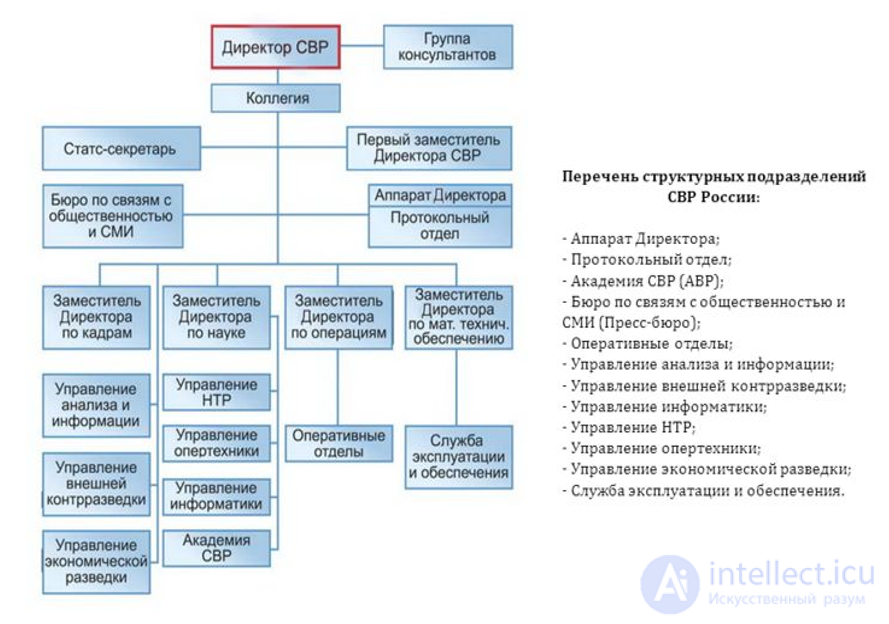
Structural subdivisions of the SVR of Russia.
The Press Bureau is headed by its director, Sergei Nikolaevich Ivanov, who reports directly to the Director of the SVR.
The Press Bureau holds press conferences, briefings, and film and video screenings for media representatives, and works with authors of publications on intelligence-related subjects.
The SVR of the Russian Federation actively recruits Russian citizens residing abroad. "As soon as an officer of the SV
These claims are not confirmed by the official SVR website, which states that only citizens of Russia who do not hold dual citizenship may become SVR agents.
Russian intelligence no longer recruits people on the basis of communist ideals, which was the "first pillar" of KGB recruitment, said analyst Konstantin Preobrazhensky. "The second pillar of recruitment is love for Russia. In the West, only Russian immigrants feel a sense of filial devotion towards Russia. That is precisely why [the SVR] works with them so often. A special unit was created specifically for this purpose.
The Academy of Foreign Intelligence is a specialized institution of higher education that trains and provides continuing professional development for officers of the SVR of Russia and other special services, as well as for academic and teaching personnel, and that carries out research and methodological work on subjects within its field.
Admission to the Academy on the recommendation of SVR subdivisions is open to persons who are citizens of Russia, prepared to serve their Fatherland, holding a higher education degree, under 30 years of age, physically healthy, possessing an aptitude for learning foreign languages and a sufficient level of general educational, political, and scientific-technical preparation and of general culture.
Suitability for study is determined by a number of criteria, the most important of which are considered to be: patriotism; a considered intention to work in intelligence; a high level of general educational and cultural preparation, breadth of outlook, and the ability to set out one's thoughts logically in writing and orally; sound health and good physical fitness.
Intelligence activity is a set of measures carried out by the foreign intelligence bodies for the purpose of obtaining and processing information about events, actions, plans, and intentions of foreign states, organizations, and persons that pose a threat to the state, military, economic, or environmental security of the Russian Federation.
Intelligence activity is conducted in order to identify:
Intelligence activity is conducted for the purposes of (Art. 5 of the Federal Law "On Foreign Intelligence"):
The legal basis of intelligence activity consists of the Constitution of the Russian Federation; international legal instruments regulating the most important relations in the sphere of intelligence activity (the Universal Declaration of Human Rights, adopted by the UN General Assembly on 10 December 1948; the International Covenant on Civil and Political Rights, adopted by the UN General Assembly on 16 December 1966; the European Convention for the Protection of Human Rights and Fundamental Freedoms, adopted by the Council of Europe on 4 November 1950); the Federal Law "On Foreign Intelligence"; other federal laws; decrees of the President of the Russian Federation (for example, Decree of the President of the Russian Federation No. 1349 of 9 October 2007 "On the Director of the Foreign Intelligence Service of the Russian Federation"); and resolutions of the Government of the Russian Federation (for example, Resolution of the Government of the Russian Federation No. 45 of 29 January 2005 "On the Procedure for Granting Lump-Sum Payments Provided for by Article 22 of the Federal Law 'On Foreign Intelligence' to Staff Personnel of the Foreign Intelligence Bodies of the Russian Federation and Members of Their Families") concerning the foreign intelligence of the Russian Federation.
The foreign intelligence bodies of Russia issue, within the limits of their powers and in accordance with the legislation of the Russian Federation, regulatory legal acts governing their activity.
Intelligence activity is conducted on the basis of the following principles:
Counterintelligence activity is activity carried out by the federal security service bodies and (or) their subdivisions (hereinafter in this article, the counterintelligence bodies), as well as by officials of the said bodies and subdivisions, through the conduct of counterintelligence measures for the purpose of detecting, preventing, and suppressing intelligence and other activity by the special services and organizations of foreign states, and by individual persons, aimed at damaging the security of the Russian Federation.
The grounds for the conduct of counterintelligence measures by the counterintelligence bodies are:
a) the existence of data indicating intelligence or other activity by the special services and organizations of foreign states, or by individual persons, aimed at damaging the security of the Russian Federation;
b) the need to obtain information about events or actions that pose a threat to the security of the Russian Federation;
c) the need to ensure the protection of information constituting a state secret;
d) the need to examine (vet) persons who are providing or have provided assistance to the federal security service bodies on a confidential basis;
e) the need to ensure the bodies' own security;
f) requests from the special services, law enforcement agencies, and other organizations of foreign states, and from international organizations, in accordance with the international treaties of the Russian Federation.
The list of grounds for conducting counterintelligence measures is exhaustive and may be amended or supplemented only by federal law.
In the course of counterintelligence activity, overt and covert measures are conducted, the particular character of which is determined by the conditions of such activity. The procedure for conducting counterintelligence measures is established by the regulatory legal acts of the federal executive authority in the field of security.
The conduct of counterintelligence measures restricting citizens' rights to the privacy of correspondence, telephone conversations, and postal, telegraphic, and other communications transmitted over electrical and postal communication networks is permitted only on the basis of a judge's ruling and in the manner prescribed by the legislation of the Russian Federation.
The conduct of counterintelligence measures restricting citizens' right to the inviolability of the home is permitted only in the cases established by federal law or on the basis of a judge's ruling.
Where it is necessary to conduct counterintelligence measures restricting the constitutional rights of citizens specified in this article, the head of a counterintelligence body or his deputy shall file the corresponding application with the court. The decision to file the application shall set out the motives and grounds giving rise to the need to conduct the measures concerned, and shall present data substantiating the application (with the exception of the information specified in part two of Article 24 of this Federal Law). The list of categories of heads of counterintelligence bodies and their deputies empowered to file applications for the conduct of counterintelligence measures restricting the said constitutional rights of citizens is established by the regulatory legal acts of the federal executive authority in the field of security.
An application for the conduct of counterintelligence measures restricting the constitutional rights of citizens specified in this article shall be considered by a judge sitting alone and without delay, at the place where such measures are to be conducted or at the location of the body applying for their conduct.
Having considered the application, the judge shall issue one of the following rulings:
a) permitting the conduct of counterintelligence measures restricting the constitutional rights of citizens;
b) refusing the conduct of counterintelligence measures restricting the constitutional rights of citizens.
The period of validity of a ruling issued by a judge is calculated in days from the day of its issuance and may not exceed 180 days unless the judge decides otherwise. The running of this period is not interrupted. Where it is necessary to extend the period of validity of the ruling, the judge shall issue a decision on the basis of newly submitted materials.
A counterintelligence body applying for the conduct of counterintelligence measures restricting the constitutional rights of citizens specified in this article shall have the right to appeal a judge's refusal to a higher court.
A judge's ruling permitting the conduct of counterintelligence measures restricting the constitutional rights of citizens specified in this article, together with the materials that served as the basis for its adoption, shall be kept by the counterintelligence bodies.
An application by the head of a counterintelligence body or his deputy for the conduct of counterintelligence measures restricting the constitutional rights of citizens specified in this article, the judge's ruling, and the materials that served as the basis for its adoption shall be submitted to the prosecutor's office in the event that supervisory review is conducted on materials, information, or citizens' complaints received by the prosecutor's office indicating a violation by the counterintelligence bodies of the legislation of the Russian Federation.
The results of counterintelligence measures may be used in criminal proceedings in the manner established by criminal procedure legislation for the use of the results of operational investigative activity.

Comments