
Lecture 77 min.
Universal basic income (UBI), unconditional basic income, also: unconditional core income, guaranteed core income, universal core income, freedom dividend, citizen's income, resource income) is a social policy concept involving the regular payment of a fixed sum of money by the state to every member of a given community. Payments are made to all members of the community, regardless of income level, and are not conditional on performing any work. The payments have the following properties:
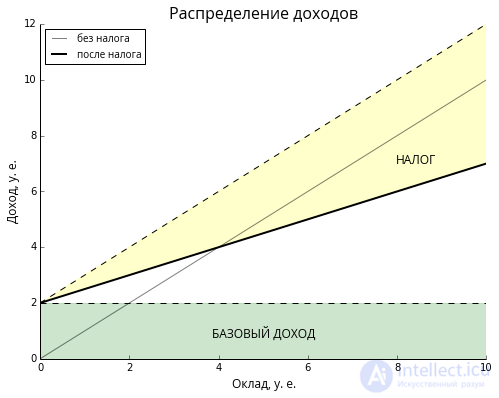

Distribution of the population by income as a function of salary under a basic income and a 50% flat tax.
As of 2025, no country has implemented a full UBI system, but two countries — Mongolia and Iran — have had partial UBI systems in the past. Numerous pilot projects have been carried out, and the idea is under discussion in many countries. Some call unconditional basic income utopian because of its historical origins.
There are several social security systems that can be regarded as similar to a basic income, although they are not unconditional. Many countries have a child benefit system, which is essentially a basic income for the guardians of children. A pension can be a basic income for retirees. There are also quasi-basic income programmes limited to particular population groups or time periods, such as Bolsa Família in Brazil, which targets the poor, or the Thamarat programme in Sudan, introduced by the transitional government to mitigate the consequences of the economic crisis inherited from the Bashir regime. Similarly, the economic consequences of the COVID-19 pandemic prompted some countries to make direct payments to their citizens. The Alaska Permanent Fund is a fund for all residents of the US state of Alaska, averaging about $1,600 a year (in 2019 prices), and is sometimes described as the only example of a real basic income in practice. A negative income tax (NIT) can be viewed as a basic income for certain population groups, under which citizens receive less and less money until the effect reverses as a person's earnings increase.
Critics argue that a basic income at an acceptable level for all citizens is not financially feasible, fear that introducing a basic income would reduce the number of people in work, and consider it socially unfair that everyone should receive the same amount of money regardless of their individual needs. Supporters argue that it is in fact financially feasible, stating that such a system, replacing the many individual means-tested social benefits, would eliminate more costly administrative and bureaucratic effort, and they expect that unattractive jobs would have to be better paid and working conditions improved, since there would have to be an incentive to do them once an income is in place, which would increase willingness to work. Supporters also argue that a basic income is fair, since it guarantees that everyone has a sufficient financial foundation for further development and faces less financial pressure, allowing people to find work that matches their interests and strengths.
Early examples of unconditional payments to citizens date back to antiquity, and the first proposals to introduce a regular unconditional income for all citizens were developed and disseminated between the 16th and 18th centuries. After the Industrial Revolution, public understanding of and support for the concept grew. Since at least the middle of the 20th century, basic income has repeatedly been the subject of political debate. In the 21st century a number of discussions are linked to the basic income debate, including those concerning the automation of a significant part of the workforce by artificial intelligence (AI) and the related questions about the future need for labour. A key question in these debates is whether automation and AI will lead to a significant reduction in the number of available jobs, and whether a basic income could help prevent or mitigate such problems by allowing everyone to benefit from society's wealth, as well as whether a basic income could be a stepping stone to a resource-based or post-scarcity economy.
Ancient Egypt had a strong, unified theocratic state that owned key parts of the Egyptian economy, including the granaries that distributed grain to the population in hard times.
In 46 BC, during a triumph, the Roman general and dictator Julius Caesar distributed 100 denarii to every common Roman citizen. After his assassination in 44 BC, Caesar left 300 sesterces (or 75 denarii) to every citizen. Trajan, emperor of Rome from AD 98 to 117, personally distributed 650 denarii (the equivalent of perhaps US$430 in 2023) to all common Roman citizens who applied for it.
In Utopia (1516), the English statesman and philosopher Thomas More describes a society in which every person receives a guaranteed income. In this book, a basic income is proposed as an answer to the assertion "No punishment on earth will stop people from stealing if it is their only way of getting food", stating:
Instead of inflicting these horrible punishments, it would be far more to the point to provide everyone with some means of livelihood, so that nobody is under the frightful necessity of becoming first a thief and then a corpse.
The Spanish scholar Johannes Ludovicus Vives (1492–1540) proposed that the municipal government should be responsible for securing a subsistence minimum for all its residents, "not on grounds of justice but for the sake of a more effective exercise of morally required charity". Vives also argued that, in order to receive assistance, the poor recipient must "deserve the help he or she receives by proving his or her willingness to work".
The English-born American philosopher Thomas Paine is the author of Common Sense (1776) and The American Crisis (1776–1783), two of the most influential pamphlets of the beginning of the American Revolution. His essay Agrarian Justice was published in 1797. In it he proposed specific reforms to eradicate poverty. In particular, he proposed a universal social insurance system comprising old-age pensions and disability benefits, as well as universal grants for young people, funded by a 10% inheritance tax targeted at land; this is also considered one of the earliest proposals for a social security system. Thomas Paine summarised his view by stating: "Men did not make the earth. It is the value of the improvements only, and not the earth itself, that is individual property. Every proprietor owes to the community a ground rent for the land which he holds." Paine regarded inheritance as partly a common fund and wanted to supplement the citizens' dividend with a tax on inheritance transfers.
In 1797 the English radical Thomas Spence published The Rights of Infants in response to Thomas Paine's Agrarian Justice. In this essay Spence proposes introducing an unconditional basic income for all members of the community. Such a benefit would be funded by socialising land and by the rental income received by each municipality. Part of each person's earnings would be taken by the state and transferred to others.
Henry George proposed creating a pension system and a disability benefit system, as well as a broad system of social support, funded by a single tax on the value of land and natural resources. Social support would be distributed to residents "as a right" rather than as charity. George mentioned, but did not emphasise, the possibility of a direct cash payment of land rent. His ideas gave rise to the economic philosophy known today as Georgism, or the "single tax movement", an economic ideology holding that, while people should own the value they themselves produce, the economic rent derived from land — including all natural resources, common lands and urban areas — should belong equally to all members of society. Some Georgists refer to an unconditional basic income funded by the single tax as a "citizen's dividend", citing Thomas Paine's 19th-century proposal.
Around 1920 support for a basic income began to grow, mainly in England.
Bertrand Russell (1872–1970) advocated a new social model combining the advantages of socialism and anarchism, and held that a basic income should be a vital component of this new society. In his 1918 book Roads to Freedom, Russell wrote: "...the plan we are advocating amounts essentially to this: that a certain small income, sufficient for necessaries, should be secured to all, whether they work or not, and that a larger income – as much larger as might be warranted by the total amount of commodities produced – should be given to those who are willing to engage in some work which the community recognises as useful..."
At the end of the First World War in the United Kingdom, Dennis and Mabel Milner, a Quaker married couple from the Labour Party, published a short pamphlet entitled Scheme for a State Bonus (1918), which advocated "the introduction of an unconditional weekly income for all citizens of the United Kingdom". They held that everyone has a moral right to a means of subsistence, and that this should therefore not depend on work or on the willingness to work.
C. H. Douglas was an engineer who was troubled by the fact that most British citizens could not afford to buy manufactured goods despite the rising productivity of British industry. His solution to this paradox was a new social system he called social credit — a combination of monetary reform and a basic income.
In 1944 and 1945 the Beveridge Committee, chaired by the British economist William Beveridge, developed a proposal for a comprehensive new social security system comprising social insurance, means-tested benefits and unconditional benefits for children. Committee member Lady Rhys-Williams argued that the incomes of adults should be more like a basic income. She was also the first to develop a negative income tax model. Her son, Sir Brandon Rhys-Williams, proposed a basic income to a parliamentary committee in 1982, and shortly afterwards, in 1984, the Basic Income Research Group, now the Citizen's Basic Income Trust, began conducting and disseminating research on basic income.
In his 1962 book Capitalism and Freedom, Milton Friedman proposed a negative income tax (NIT), which in effect sanctioned a basic income for all. In his 1964 State of the Union address, US President Lyndon B. Johnson declared an "unconditional war on poverty", which would be implemented in the following years through extensive legislation. Johnson expanded the agenda into the "Great Society", incorporating education, civil rights, health care and support for the arts. In this political climate the idea of a guaranteed income for every American also took root. Notably, a 1968 document signed by 1,200 economists called for a guaranteed income for every American. Four ambitious basic income experiments began from a similar negative income tax concept. President Richard Nixon explained the aim of the Family Assistance Plan as providing both social protection for the poor and a financial incentive for benefit recipients to take up employment. Ultimately Congress approved a guaranteed minimum income for the elderly and people with disabilities.
In the mid-1970s the main competitor to basic income and the negative income tax, the earned income tax credit (EITC), and its supporters won the backing of enough legislators for the US Congress to enact legislation on this policy. In 1986 the Basic Income European Network (later renamed the Basic Income Earth Network, BIEN) was founded, holding academic conferences every two years. Other supporters included the green political movement, other activists and some groups of the unemployed.
In the late 20th century there were debates about automation and jobless growth, about the possibility of combining economic growth with environmentally sustainable development, and about how to reform the bureaucracy of the welfare state. Basic income was an integral part of these and many other discussions. At BIEN's academic conferences, scholars published papers on basic income from a wide variety of perspectives.
In recent years the idea has come to the fore as never before. The 2016 Swiss referendum on basic income was covered by media around the world despite its rejection. Prominent businesspeople such as Elon Musk, Pierre Omidyar and Andrew Yang have expressed their support, as have prominent politicians such as Jeremy Corbyn and Tulsi Gabbard. The Institute for Public Policy Research predicted that 59% of the tasks currently performed by people could be affected by AI within the next three to five years. A universal basic income could help fill the gap created by this "jobs apocalypse".
In 2019–2021 in Stockton, California, then-mayor Michael Tubbs launched a 24-month guaranteed income pilot programme for 125 residents as part of the privately funded SEED project.
In the 2020 Democratic Party primaries, political newcomer Andrew Yang promoted a basic income as his signature policy. His policy, called the "freedom dividend", provided for payments of $1,000 a month to adult US citizens regardless of employment status.
On 21 January 2021 the two-year, donor-funded Compton Pledge programme began in California, paying a monthly guaranteed income to a "pre-vetted" group of low-income residents. The programme is designed for a maximum of 800 recipients, in which case it would be one of the largest among the 25 US cities exploring this approach to community economics.
Beginning in December 2021, Growing Resilience in Tacoma (GRIT), a guaranteed income initiative providing $500 a month to 110 families, was launched in Tacoma, Washington. GRIT is part of a larger study by the University of Pennsylvania's Center for Guaranteed Income Research. A report on the results of the GRIT experiment was published in 2024.
In response to the COVID-19 pandemic and its economic consequences, proposals such as "helicopter money" and cash transfers were increasingly discussed worldwide. Most countries implemented various forms of partial unemployment schemes, which effectively subsidised workers' incomes without an employment requirement. Around ninety countries and regions, including the United States, Spain, Hong Kong and Japan, introduced temporary direct cash transfer programmes for their citizens.
In Europe, a petition calling for an "emergency basic income" collected more than 200,000 signatures, and polls showed broad support for the idea in public opinion. Unlike the various stimulus packages adopted by the US administration, the EU's economic stimulus plans did not include any form of income support policy.
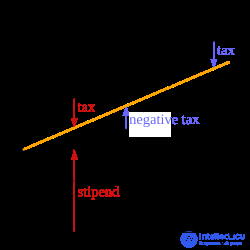
The accompanying diagram shows a basic income/negative income tax system combined with a flat income tax (the same tax percentage for all income levels). On the Y axis here is plotted the pre-tax wage paid by the employer, and on the Y' axis, net income.
Negative income tax
For low-income people under a negative income tax system there is no income tax. They receive money in the form of a negative income tax but pay no taxes. Then, as their earned income increases, this benefit, this money from the state, is gradually reduced. This reduction should be seen as a mechanism for supporting the poor, not as a mechanism that makes the poor pay taxes.
basic income
Under the corresponding basic income system shown in the diagram on the right, however, the situation is different. There, everyone as a rule pays income tax. But, on the other hand, everyone receives the same amount of basic income.
But the net result remains the same.
Yet, as the orange line in the diagram shows, net income is the same in either case. However much a person earns, the amount of money received is the same, no matter which of the two systems is used.
A basic income tax and a negative income tax are generally considered similar in their net economic effect, but there are some differences:
There is a widespread belief that we live in an era of technological unemployment – that technology is increasingly making skilled workers redundant.
One of the main justifications for a basic income is the belief that automation and robotisation may lead to technological unemployment, resulting in a world with fewer paid jobs. A key question in this context is whether a basic income could help prevent or mitigate such problems by allowing everyone to benefit from society's wealth, and whether an unconditional basic income could be a stepping stone to a resource-based or post-scarcity economy.
US presidential candidate and non-profit founder Andrew Yang stated that automation had cost 4 million manufacturing jobs, and advocated an unconditional basic income (which he calls the "freedom dividend") of $1,000 a month in place of worker retraining programmes. Yang said he was influenced by Martin Ford. Ford believes that new technologies will not be able to provide significant employment; on the contrary, because new industries "rarely, if ever, are highly labour-intensive". Similar ideas have been discussed before in history — that "machines will take the jobs". What is new is the existence of several academic studies that forecast a future with significantly less employment in the coming decades. In addition, US President Barack Obama stated that in his view the development of artificial intelligence would intensify the debate around the idea of "unconditional free money for everyone".
Some supporters of an unconditional basic income argue that a basic income could promote economic growth, since it would support people while they invest in education in order to obtain highly skilled, well-paid work. However, basic income is also discussed within the degrowth movement, which opposes economic growth.
Supporters argue that the guaranteed financial security of an unconditional basic income would increase the population's willingness to take risks, which would create a culture of inventiveness and strengthen the entrepreneurial spirit.
The cost of a basic income is one of the most important questions in public debate and academic research, and it depends on many factors. Above all, it depends on the level of the basic income itself, as well as on numerous technical aspects of exactly how it would be constructed.
While opponents argue that a basic income at an adequate level for all citizens cannot be financed, its supporters suggest that it can in fact be financed, with some advocating substantial redistribution and a restructuring of bureaucracy and administration to that end.
According to statements by the libertarian-conservative scholar Charles Murray of the American Enterprise Institute, cited and endorsed in 2016 by Veronique de Rugy, George Gibbs Chair in Political Economy and senior research fellow at the Mercatus Center at George Mason University and the author of articles published in national outlets, as of 2014 the annual cost of an unconditional basic income in the United States would have been roughly $200 billion less than the cost of the US social safety net as it then existed. By 2020 it would have been almost a trillion dollars less.
The American economist Karl Widerquist argues that simply multiplying the size of the grant by the size of the population would be a naive calculation, since this is the gross cost of a UBI and fails to take into account that a UBI is a system in which people regularly pay taxes and receive the grant at the same time.
According to the Swiss economist Thomas Straubhaar, the concept of an unconditional basic income is in principle financeable without any problems. He describes it as "in essence nothing other than a fundamental tax reform" that "consolidates all social policy measures into a single instrument — a basic income paid unconditionally". He also considers a universal basic income socially just, arguing that although all citizens would receive the same amount as a basic income at the start of the month, the rich would lose considerably more money in taxes at the end of the month than they receive as basic income, while for the poor the situation is reversed, similar to the negative income tax concept.
Recent theoretical work has proposed alternative mathematical approaches to distributing a basic income. One such example is the Boltzmann fair division model, which applies the Boltzmann distribution from statistical mechanics to the distribution of resources or income. In this model each individual's share is assigned probabilistically according to an exponential function of a given attribute (for example, need or contribution), providing a flexible mechanism for balancing fairness and efficiency in the distribution of a basic income.
One of the most common arguments against a universal basic income concerns upward pressure on prices, in particular on labour and housing rents, which would probably cause inflation. Public policy choices such as rent control or land value taxation would probably affect the inflationary potential of a universal basic income.
Many critics of basic income argue that people in general would work less, which in turn means lower tax revenues and less money for state and local governments. Studies include:
Although it is difficult to say with certainty what would happen if an entire country introduced a basic income, there are nevertheless studies that have attempted to examine this question:
On the question of basic income versus work, there is also the aspect of so-called welfare traps. Supporters of a basic income often argue that under a basic income, unattractive work would necessarily have to be better paid and working conditions improved so that people continue to do it without being compelled to, thereby reducing these traps.
A 2026 meta-analysis by the American Enterprise Institute based on 122 unconditional basic income programmes found that across thirty randomised pilot projects with published results, the net employment effect was +0.8%. However, in the four programmes with 500 or more participants, the net employment effect was -3.2%. The median number of study participants was 151. Studies that tracked participant attrition from the programme reported an average attrition rate of 37%.
By definition, a universal basic income does not distinguish between the "deserving" and the "undeserving" when making payments. Opponents argue that this absence of discrimination is unjust: "Those who genuinely choose idleness or unproductive activity cannot expect those who have committed themselves to productive work to subsidise their livelihood. Responsibility is central to justice."
Supporters generally regard an unconditional basic income as a fundamental human right that secures an adequate standard of living to which every citizen in a modern society should have access. It would be a kind of foundation, guaranteed to everyone, on which to build and below which one would never fall to a subsistence level.
It is also argued that not discriminating between those supposedly deserving it and those not deserving it is a way of reducing social stigma.
In addition, supporters of an unconditional basic income may argue that the categories "deserving" and "undeserving" are a superficial classification, since people without permanent paid employment also contribute to society, for example by raising children, caring for people or engaging in other value-creating activities that are not institutionalised. An unconditional basic income would provide a balance here and would thus overcome a conception of labour that reduces it to purely paid work and pays too little attention to ancillary activities.
The first comprehensive systematic review of the effects of a basic income (or rather of unconditional cash transfers in general) on health in low- and middle-income countries, a study covering 21 studies, of which 16 were randomised controlled trials, found a clinically significant reduction of about 27% in the likelihood of illness. According to the study, unconditional cash transfers may also improve food security and dietary diversity. Children in recipient families are also more likely to attend school, and cash transfers can increase spending on health care. A 2022 update of this review confirmed these findings on a larger body of evidence (35 studies, most of them large randomised controlled trials) and further showed that unconditional cash transfers also reduce the likelihood of living in extreme poverty.
In 2015 the Canadian Medical Association adopted a resolution in support of a basic income and of conducting basic income trials in Canada.

Since the 1960s, but especially since the late 2000s, several basic income pilot programmes and experiments have been conducted around the world. Here are a few examples:
A number of countries have implemented pilot programmes to introduce an unconditional basic income. In most cases the results were positive. Fears that the poor would spend the money on alcohol or drugs were not borne out.
Russia's first experiment with unconditional basic income payments began in March 2019 in the settlement of Yantarny, Kaliningrad Oblast. The project was initiated by the non-profit foundation Yallend. Each week, 10 people are randomly selected from among the registered participants and receive 1,000 roubles each month for the duration of the project. On 1 July 2019, the project was extended to the whole of Kaliningrad Oblast. On 2 November 2019, during a live broadcast of the programme "Tsentralnoye Televidenie" on NTV, it was announced that the project would operate throughout Russia. In early 2020 the programme's rules changed and all participants who had verified their identity began receiving the unconditional basic income. As of 12 October 2020, more than 20,000 people were taking part in the project, of whom more than 4,600 were receiving an unconditional basic income.
In March 2019, the non-profit organisation "Basic Income Russia Tomorrow" (a member of the BIEN global network) began a start-up pilot project paying a basic income. In April 2019, cashless payments began to be made to participants' bank cards without any conditions, disbursed monthly over 3 months in three Russian regions: Moscow, Moscow Oblast and Buryatia. There were 8 recipients: parents of large families and pensioners. Payments amounted to 5,000–6,500 roubles per person per month. The source of funding was private donations. The experiment's academic partner was the Institute of Socio-Economic Studies of Population of the Russian Academy of Sciences, which developed the questionnaires for basic income recipients.
In 2014, the German entrepreneur Michael Bohmeyer ran an experimental programme called "My Basic Income" (Mein Grundeinkommen), under which several dozen randomly selected people were paid 1,000 euros a month for a year. The project was crowdfunded. According to its organiser, the experiment was intended to convince politicians that state spending would pay for itself through a healthier society, since recipients feel freer and more secure and can significantly increase their creativity.
A project paying unconditional basic income cash transfers was carried out in the Indian state of Madhya Pradesh in 2012–2013. To differentiate the project's outcomes, two experiments were conducted, funded by UNICEF and coordinated by SEWA. Small unconditional monthly basic income cash transfers were made over 12–17 months. There were more than 6,000 recipients.
Main pilot, 20 villages:
Initially, in the main pilot each adult received 200 rupees a month and each child 100 rupees a month (paid to the mother/guardian). After a year the amounts were increased to 300 rupees and 150 rupees respectively.
Tribal pilot, 2 tribal villages under SEWA supervision:
In the tribal pilot, payments amounted to 300 rupees a month for each adult and 150 rupees a month for each child throughout the payment period of 12 months.
The impact on recipients was assessed using several rounds of statistical surveys. In total, more than 15,000 people took part in the surveys.
In brief, the results were as follows: basic income had a strong positive effect on recipients' welfare in terms of living conditions, improved sanitation, nutrition, health care and schooling; it also had a strong economic impact in terms of higher earned incomes, increased productive work and greater assets. The payments had a significant effect in reducing debt and increasing savings, gave more people financial security, and enabled them to make decisions for themselves.
In 2017, the government's economic adviser Arvind Subramanian proposed considering its introduction at the national level. The annual Economic Survey prepared for the government cites a projected basic income of 7,620 rupees (113 US dollars) a year. This sum equals the minimum monthly wage of an urban resident, and although it is not enough for a comfortable life, it would reduce the poverty rate from the current 22% to less than 0.5%. The money is expected to come from funds reallocated from 950 existing welfare programmes.
In March 2019, the leader of the Indian National Congress party, Rahul Gandhi, promised that his party would implement a universal basic income (UBI) programme if elected, but he was not elected. The Indian state of Sikkim committed to implementing a UBI programme for its residents by 2022.
In November 2016, preparations began in Barcelona for the B-MINCOME pilot project. The project combined a guaranteed minimum income with participation in active social policies in disadvantaged urban areas of Barcelona. The pilot project aims to combat poverty and social exclusion. It was led by the Planning and Innovation Department of the Social Rights Area of Barcelona City Council.
The project's total duration was 36 months, including 24 months of payments (from November 2017 to October 2019) and project evaluation. The project targeted 1,000 vulnerable households in ten neighbourhoods making up the Eix Besòs, one of Barcelona's most vulnerable areas. Over two years, and on the basis of a randomised controlled model, 1,000 randomly selected households received a cash transfer of up to a maximum of 1,675 euros a month and were divided into 10 experimental groups. Of these 1,000 households, 550 took part in four active inclusion programmes established by the pilot project for: training and employment; promoting entrepreneurship in the social, solidarity and cooperative economy; grants for renovating flats with a view to renting out rooms; and community participation.
All households in the project were divided into 4 modes of participation:
In July 2019, a report on the preliminary results of the B-MINCOME project was published, examining data collected during the programme's first year. The report showed positive qualitative outcomes for project participants: improved quality of life for beneficiaries, greater freedom and autonomy, reduced dependence on other public subsidies, improved overall welfare and economic well-being, a lower index of severe material deprivation, less anxiety about food shortages, a reduced need to obtain money by means other than work (for example renting out rooms, an issue that particularly affects the city of Barcelona), a lower tendency towards mental illness and better sleep quality, less financial stress, greater happiness and overall life satisfaction, and a significant increase in community engagement and participation. The report found no statistically significant changes in housing insecurity or in households' ability to cope with unexpected expenses (the cash transfer mainly covered basic costs). Nor were any substantial effects observed on employment or other employment-related aspects. This outcome was expected and consistent with other similar experiments, which also confirms the initial hypotheses: people in the conditional modality experienced a "lock-in effect", since their (mandatory) participation in active inclusion programmes could mean they had less time to look for work. Most participants suffered from a high degree of exclusion or job precarity before the project began. It was therefore unrealistic to expect ambitious results in this respect. The project's final results are expected in early 2020.
On 5 April 2020, as part of measures to cushion the socio-economic consequences of the coronavirus pandemic, the Spanish government announced that an unconditional basic income would be introduced shortly. The main emphasis is planned to be on supporting families. The government wishes to retain the unconditional basic income after the epidemic as well. The Minister of Economy expressed the hope that the universal basic income would remain a "permanent structural instrument". The Spanish Council of Ministers approved a programme providing a minimum living income to the neediest citizens. As government spokeswoman María Jesús Montero stated, the move is aimed "at reducing poverty, especially among families with children". Pablo Iglesias, Second Deputy Prime Minister and Minister for Social Rights, justified the decision as follows: "The pandemic has obviously made the situation worse for many of our compatriots. The minimum living income was in the government's programme, but because of the pandemic it became an urgent necessity, because thousands of Spanish families can no longer wait."
The benefit will range from 462 to 1,015 euros a month; 850,000 families will be able to claim it, that is, a total of 2,300,000 people, a third of them minors. The programme will cost the treasury 3 million euros. The minimum living income will be paid from 1 June. For his part, José Luis Escrivá, Minister for Inclusion, Social Security and Migration, stated: "With the approval of this programme, Spain will move closer to the European average for spending on this type of benefit." The number of poor people in the country is growing every year. In its latest report, the Bank of Spain stated that at least 12 million people live below the poverty line.
In 2016, the mayor of Livorno, Filippo Nogarin (Five Star Movement), announced the launch of a basic income programme of 537 dollars. Initially 100 poor families were selected for it; from 2017 their number increased to 200.
On 1 January 2024, the "basic income" welfare programme was discontinued.
In the mid-1970s, funds were allocated from the country's federal budget to run the Mincome project in the town of Dauphin (8,251 residents according to the 2011 census). Town residents were provided with a basic income without any obligations. The experiment ran for 5 years. Most of those receiving the money did not reduce their level of employment. Only young men actually worked some 40–50 percent less, but at the same time they increased the time spent on education. The number of volunteers grew, including in churches, and civic activity increased. Health care costs fell by 10 percent, because people had more opportunity to look after their health.
In February 2016, the government of the province of Ontario announced budget funding for a pilot study of guaranteed basic income payments. In April 2017, the government selected 3 regions to take part in a three-year basic income pilot project. During this time, project participants were to receive a basic income from the government and to serve as key informants in evaluating the programme.
The experimental group comprised 4,000 low-income people aged 18 to 64. Annual basic income cash payments:
Basic income recipients were compared with a control group that received no payments. The aim was to study the effect of the payments on quality-of-life indicators, on work, education and entrepreneurship.
The scheme being tested had several notable differences from "basic income" as defined by BIEN:
Nevertheless, the scheme is very similar to a basic income: receiving payments does not depend on any type of participation or work requirement (for example, recipients do not have to demonstrate that they are working or looking for work); recipients may spend the money they receive as they see fit.
However, in June 2018 a new government came to power in the Ontario general election and cancelled the pilot project just a year after it began. In addition to terminating payments to recipients prematurely in March 2019, the government also announced the discontinuation of the project's evaluation activities from July 2018.
Analysis of the project was made possible by funding from the Hamilton Community Foundation, McMaster University, and the Social Sciences and Humanities Research Council of the Government of Canada.
On 4 March 2020, McMaster University published a study. The report examined how basic income affects recipients in key areas of their lives. The participants' self-reported outcomes help shed light on the potential of basic income as a social policy instrument for reducing poverty and raising people's standard of living in today's precarious labour market. The report's findings:
As of 2020, this is the world's largest and longest-running universal basic income experiment. In 2016 the non-profit organisation GiveDirectly announced its launch, and in 2018 it began making payments in two provinces of Kenya. The cost of the pilot project is 30 million US dollars.
295 villages covering 14,474 households in Kenya's Western and Rift Valley provinces, comprising more than 20,000 people, were randomly assigned to one of four groups:
The full study will continue, but the first results are expected by mid-2020. The effect of basic income on various quality-of-life indicators is being studied.
Recipients say they invest the basic income they receive in a wide range of areas, including seeds for growing tea, livestock, home improvements and investment in education. They also describe how the payments affect their communities and relationships.
The only difference between long-term and short-term payment recipients will be their expectation of receiving payments in the future. Researchers will be able to compare outcomes for both groups in order to understand the relative importance of the transfers themselves and of the expectation of future transfers for behaviour.
Researchers will also compare the effect of lump-sum payments with short-term and long-term payments ("stream" payments). This will provide direct evidence for the ongoing debate about the impact of capital and asset transfers.
Researchers are measuring a wide range of outcomes, including economic status (income, consumption, assets and food security), time use (work, education, leisure, participation in community life), risk-taking decisions (in particular, the choice to migrate or start a business), gender relations (especially women's empowerment), as well as aspirations and outlook on life.
The researchers say that the basic income in this study is universal within villages, but not nationwide. The study will not fully capture the consequences of introducing a universal basic income at the national
продолжение следует...
Часть 1 Unconditional basic income
Часть 2 Comparable payments - Unconditional basic income

Comments