
Lecture
Administration in the field of foreign affairs is a complex, multi-tiered system grounded in both international and national law. The foundation of this system is the Constitution of the Russian Federation, together with the federal laws governing foreign policy activity. The organisational and legal system of administration in this field comprises:
state authorities vested with powers in the field of foreign policy;
the regulatory framework governing foreign policy activity;
diplomatic and consular institutions operating abroad.
The key role in the administration of foreign affairs is played by the Ministry of Foreign Affairs of the Russian Federation (MFA of Russia). Its functions include:
Formulating and implementing the state's foreign policy course.
Coordinating the actions of other state authorities in the international sphere.
Representing the interests of the Russian Federation in international organisations.
Organising the work of diplomatic and consular institutions abroad.
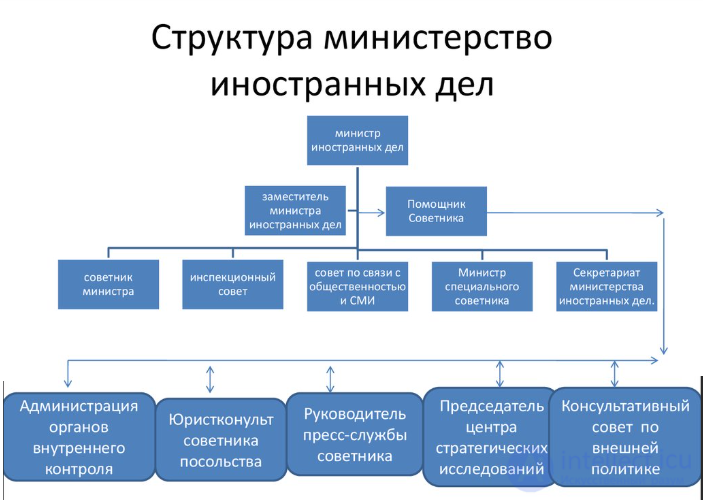
Fig. Structure of the Ministry of Foreign Affairs
Alongside the Ministry of Foreign Affairs, significant roles are played by the Presidential Executive Office of the Russian Federation, the Federal Assembly, and various line ministries that engage with international partners within their respective remits.
Diplomatic missions and consulates abroad
The diplomatic missions and consulates of the Russian Federation provide for engagement with other states and international organisations. The main types of diplomatic institution are:
Embassies — the principal diplomatic missions representing the interests of the Russian Federation in foreign states. Embassies are headed by ambassadors extraordinary and plenipotentiary.
Consulates — institutions concerned with protecting the rights and interests of citizens of the Russian Federation abroad and with providing consular services (issuing visas, processing documents, etc.).
Permanent missions — diplomatic missions to international organisations such as the UN, the OSCE, and UNESCO.
The Ministry of Foreign Affairs of Russia is the central executive authority directing the country's foreign policy activity. Its structure includes:
the central office, responsible for strategic planning and coordination;
territorial directorates responsible for specific regions of the world;
departments specialising in particular areas of international policy (for example, economic cooperation, security, human rights).
Powers of the Ministry of Foreign Affairs
Russian embassies operate in most countries of the world and constitute the principal channel of diplomatic engagement.
Their tasks include:
developing political, economic, and cultural ties;
taking part in negotiations and the conclusion of international agreements;
safeguarding the legal interests of citizens and legal entities of the Russian Federation.
ensures that a unified political line of the Russian Federation is pursued in relations with the host state and, to that end, carries out, in accordance with the established procedure, the coordination and oversight of the work of the missions of federal executive authorities, Russian state institutions, organisations and enterprises, their delegations and groups of specialists located in the host state, as well as of the missions of constituent entities of the Russian Federation opened, in accordance with the established procedure, in the territory of individual constituent entities and administrative-territorial units
Consulates, for their part, focus on providing services to citizens and resolving matters connected with their stay abroad.
Participation in European structures of interstate relations
Russia takes an active part in the work of European organisations aimed at maintaining stability and developing cooperation. Such structures include:
The Council of Europe — an organisation concerned with human rights, democracy, and the rule of law.
The Organization for Security and Co-operation in Europe (OSCE) — a platform for dialogue on security, human rights, and sustainable development.
Eurasian economic and political associations — such as the Eurasian Economic Union (EAEU), aimed at deepening integration within the region.
As one of the founders of the UN and a permanent member of the Security Council, Russia plays a key role in the organisation's work. The main areas of its participation are:
maintaining international peace and security;
taking part in the development and implementation of global initiatives, including sustainable development;
humanitarian assistance and support for countries facing crises.
Russia's Permanent Mission to the UN coordinates engagement with the organisation's structures, including the General Assembly, the Economic and Social Council, and specialised agencies and programmes.
BRICS (Brazil, Russia, India, China, South Africa) is an important international platform focused on cooperation among developing countries. Russia takes an active part in the work of BRICS, pursuing the following objectives:
strengthening economic cooperation and creating conditions for sustainable development;
coordinating positions on key issues of world politics and economics;
developing new financial institutions, such as the New Development Bank (NDB);
implementing joint projects in energy, science, technology, and education.
The Russian Federation actively promotes the BRICS agenda of reforming international institutions, including the UN, the IMF, and the World Bank, in order to enhance the role of developing countries. Cooperation within BRICS strengthens Russia's position on the global stage and contributes to multipolarity in international relations.
Administration in the field of foreign affairs of the Russian Federation is an important element of public administration, aimed at protecting national interests and strengthening the country's position on the international stage. An effective organisational and legal system, an extensive network of diplomatic institutions, and active participation in international structures enable Russia to pursue its foreign policy objectives successfully.

Comments