
Lecture
The introduction of the term "bureaucracy" is usually attributed to Vincent de Gournay, who in 1745 applied it to the executive power, giving the term a pejorative sense: he implied that bureaucrat-officials take real power away from the monarch (under a monarchy) or from the people (under a democracy).
the term "bureaucracy" arose in the 18th century BUT bureaucratic structures themselves existed long before that; already in the ancient states there was
a professionalization of administration. The bureaucratization of administration was one of the distinguishing features of Ancient Egypt and the Roman Empire.
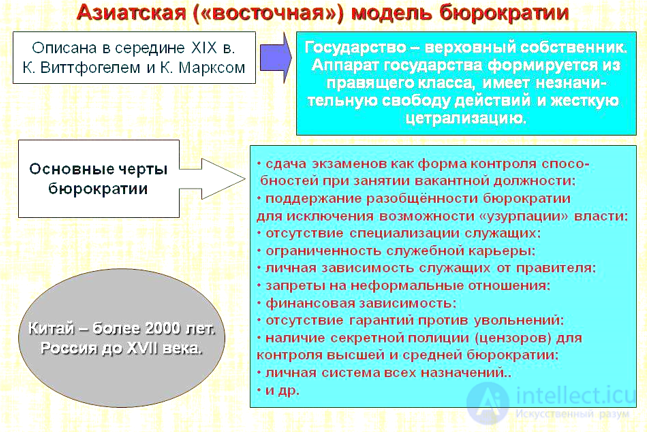
A striking example of bureaucratic power in pre-bourgeois societies is considered to be imperial China, where there existed an examination system for selecting candidates for official posts, a multi-tiered hierarchy
of officials of various ranks, and the enormous power of bureaucrat-officials over their subjects
The term "bureaucracy" has become universal and has firmly entered the languages of many peoples:
In Great Britain, for example, employees of state institutions are called "servants of the Crown,"
in France the term "foctionnaire" is used, which derives from the designation adopted there for
the system of state institutions, "fonction publique."
In Russia a widespread and closely related notion is that of "chinovnichestvo" (the officialdom)
the word "chin" (rank) denoted the established order of some action, and later the corresponding grades in the state hierarchy.
Thus, even according to the etymology of the word, an official is not simply a man of the state, a servant of the sovereign, or a defender
of state interests, but above all a functionary occupying a definite place in the hierarchy of state organizations.
the term "bureaucracy" is used to denote not only a particular social group but also a system of organizations created by public authorities in order to maximize their functions (such as staff services designed to assist public politicians), as well as the institutions and agencies incorporated into the ramified structure of executive power.
In other words, the state bureaucracy is simultaneously an institutionalized community of people functioning within purposefully created
organizations and a corresponding normative order + the very system of such organizations.
For a long time bureaucracy was studied by political scientists, at best, as it was with Karl Marx, who regarded it as an intermediary link between the state and the masses, intended to implement the line of the politically ruling class and accordingly deprived of any autonomy
Modern theories of the state bureaucracy were formulated almost simultaneously by the American school of public administration and by the German sociologist Weber
At the beginning of the 20th century W. Wilson declared the need to distinguish between the political and the administrative in state activity: "Administration lies outside the sphere of politics proper," he wrote. "Administrative questions are not political questions"
The recognition of public administration as an independent type of activity meant that professionals were required to carry it out. The bureaucracy acquired the status of a group significant not only for the state but also for society, since its sphere of competence now included the management of public affairs as well
the approach to the study of bureaucracy became the "administration–politics" dichotomy, which led to the conviction that the problems of public administration were identical to the managerial machinery of private firms, the differences lying only in the nature and scale of the tasks to be solved. Researchers of this period were not interested in the state bureaucracy as a distinct social group.
Weber's conception of bureaucracy did not contradict this theory but complemented it. Weber held that an individual striving to achieve set goals has an interest in certain fixed rules regulating people's behavior in society. Such rules, expressed in impersonal norms and laws, are a necessary condition of goal-rational action, since they sharply reduce the individual's dependence on the will and arbitrariness of other people and also create opportunities to choose adequate means of achieving the goals set, maximizing his conduct.
Bureaucracy becomes a necessary condition for the further growth of rationality in social life; it creates fixed and therefore predictable constraints on individual behavior, which everyone can take into account in their everyday activity
In an article by V. Ivanovsky — a Russian thinker writing twenty years before the publication of Weber's "Economy and Society" — the principles of bureaucratic organization were defined in ways largely consonant with Weber's: the dominance of one and the same juridical and administrative foundations, operating from the center in all directions throughout the bureaucratic organization; "each individual official plays a quite definite role, similar to that played by the numerous cogs, screws, and springs in a clock or other mechanism"
the emergence of modern conceptions of the state bureaucracy took place under the direct influence of organization theory, which arose after the First World War and came to be used mainly to designate economic associations, firms, enterprises, and financial institutions. Weber wrote of two forms of bureaucracy: state and private
. Thus, the appearance of modern scholarly conceptions of the state bureaucracy was preceded by the establishment in people's thinking of the principle of separating political and bureaucratic activity; by the recognition of the need to professionalize managerial labor; and by the identification of the specific features of bureaucracy proper, both as a distinct mode of organizing joint activity and as a distinct social
group
the functionalist approach to the study of the state bureaucracy: the creation within the state of any new body or institution is justified and permissible only if the innovation does not undermine the integrity of the whole and, moreover, contributes to the state's performance of its basic tasks in society. K. Meier distinguishes four types of bureaucratic organization: organizations regulating specific, specialized types of social interaction in society (regulatory policy); organizations exercising control over the external environment (redistributive policy);
organizations of social protection and assistance (distributive policy); organizations empowered to regulate the functioning of particular sectors of society (constituent policy).
R. Merton's methodological approach underlies the study by a number of authors of such a dysfunctional phenomenon in the modern bureaucracy as corruption. N. Singhi, analyzing corruption among Indian
officials, noted that the way bureaucratic organizations operate — generating red tape and dependence — provokes officials into unlawful actions. This capacity of the bureaucratic system
to reproduce dysfunctional phenomena constitutes one of the main problems in combating corruption and other negative processes
the limiting role of the "administration–politics" dichotomy: state institutions, artificially torn out of their political context, lost their specificity and seemed to dissolve among a multitude of other organizations
The value of the systems approach: organizations came to be regarded as open entities, connected by a multitude of threads to the outside world and therefore constantly compelled to respond to changes in the external environment
the following are identified as the main components of the environment of the state bureaucracy: the legislature, which sets the basic parameters of the normative order governing the activity of state institutions and exercises control over the main directions of their actions; the interest groups with which bureaucratic organizations are directly connected; public opinion, which ultimately legitimates the status of the bureaucracy; and the mass media, which shape popular perceptions of these
organizations.
the state bureaucracy has developed internal mechanisms of integration, self-regulation, and adaptation to its environment. High legal security, along with other advantages, makes work in the system of state institutions highly attractive. In France, for example, according to sociological data, 50% of parents would advise their child to enter the civil service and only 28% the private sector
the state bureaucracy has developed internal mechanisms of integration, self-regulation, and adaptation to its environment. In many countries the bureaucracy has managed to secure for itself relative independence from political forces and the right to continue a career regardless of which party wins an election
the state bureaucracy has developed internal mechanisms of integration, self-regulation and adaptation to its environment. The bureaucracy itself, through specialized government bodies, controls the recruitment of new personnel. For this purpose there exist, for example, the Office of Personnel Management in the United States and the Civil Service Commission in the United Kingdom
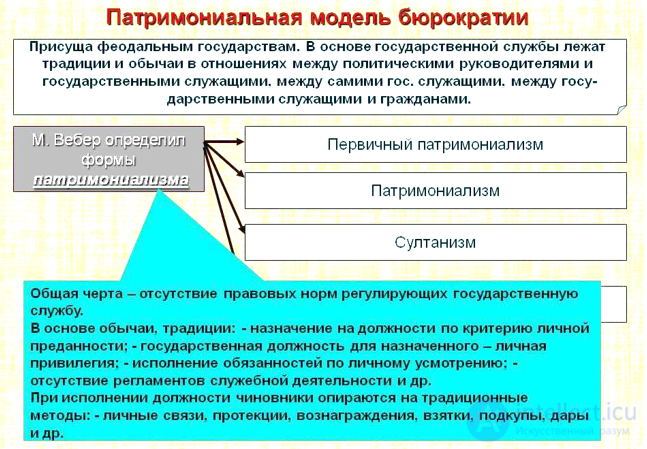
Key features: Personal loyalty and kinship ties play a major role.
Examples: Ancient empires and feudal systems, where power is concentrated in the hands of the ruler and his entourage.
Max Weber proposed a rational model of bureaucracy, which includes:
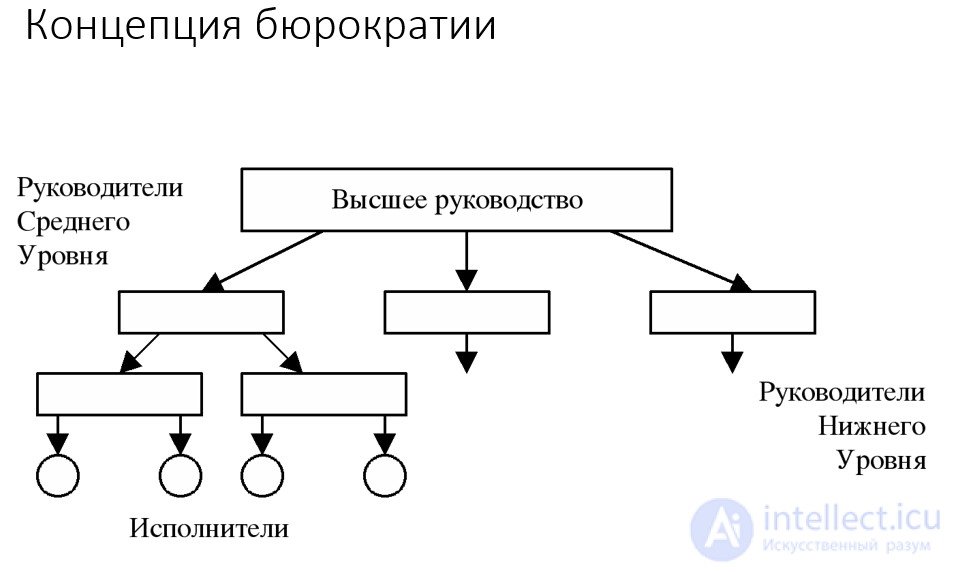
A hierarchy of authority: A clear structure with a division of roles and responsibilities.
Rules and regulations: Formal rules governing conduct.
Professionalism: Recruitment on the basis of qualifications and experience.
Impersonality: Relations are based on official roles rather than on personal ties.
The concept of "rationalization" denotes a set of interrelated processes in the course of which every aspect of human action becomes subject to calculation, measurement and control.
According to Weber, rationalization entails organizing production in the sphere of economic organization on a bureaucratic basis, replacing religious mysteries with personal responsibility in religion, developing law on the basis of universal statutes and legal reasoning in the sphere of law, and, in society as a whole, the spread of bureaucracy, state control and administration.
As a result, there emerged in Europe a new type of society that had never existed before and therefore has no historical analogues — one that contemporary sociologists call industrial.
The idea of the rationality of bureaucracy contains two somewhat divergent aspects: the rationality of bureaucracy maximizes technical efficiency, but on the other hand it constitutes a system of social control and power. Weber drew a distinction between the "official" and the "politician" as two largely opposed types of statesman. The official must act in strict accordance with formal rules within his defined sphere of competence, in no way expressing his personal views and preferences. Whereas the official merely carries out orders and instructions handed down from above, the politician must consistently pursue the realization of his own goals. In doing so he seeks to win supporters for his political course through open struggle.
Roles and tasks: Officials manage day-to-day affairs, whereas politicians make the key decisions.
Conflict of interest: Conflicts sometimes arise between the long-term goals of officials and the short-term goals of politicians.
The party-state model
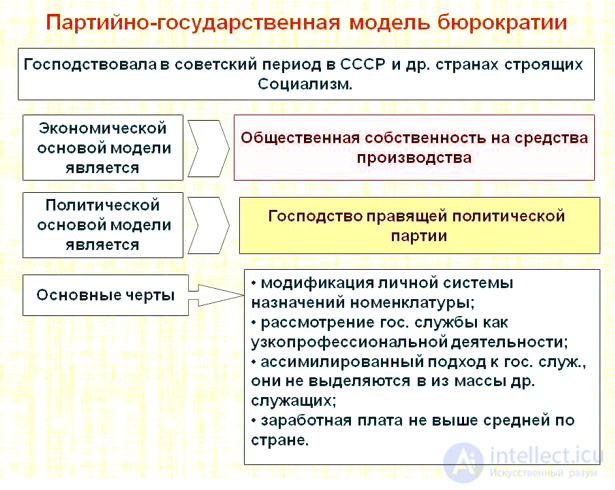
K. Marx: Bureaucracy as an instrument of class struggle.
M. Crozier: Bureaucracy as a closed system prone to internal conflict and stagnation.
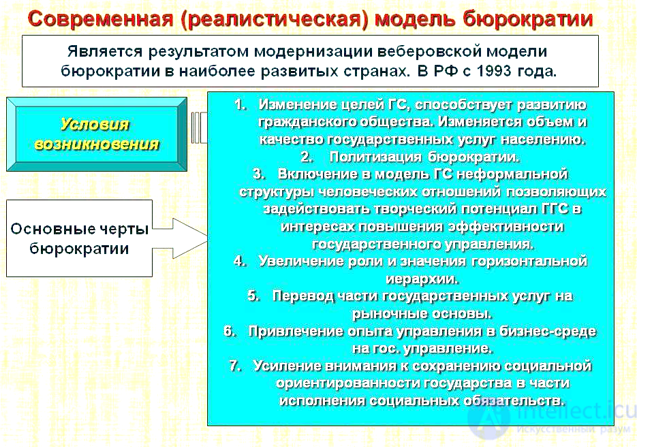
The contemporary (realist) model
CS — civil service
2. Professional bureaucracy presupposes that administrators possess deep theoretical and practical knowledge in narrow fields of activity bounded by role requirements. The principal characteristics of such bureaucrats' work are a high degree of specialization and a high level of competence. As a rule, administrators of this type attend not only to the management process itself but also to the conditions under which that process unfolds. As a result, professional bureaucracy is (compared with apparatus bureaucracy) less formalized, and administrators enjoy greater freedom in making managerial decisions within their role, since senior management is less well informed about the resolution of narrow, specialized matters. As in apparatus bureaucracy, positions are grouped along functional and hierarchical lines, and managerial decision-making is centralized.
HOWEVER!!!
The effectiveness of professional bureaucracy declines sharply in cases where the organization operates under unchanging conditions and its principal components are not subject to constant pressure from the external environment, since their level of professionalism must be sufficiently high. This circumstance entails additional expenditure on training administrative personnel. Moreover, the forms in which power is exercised become more complex: in addition to coercive and reward power, expert and informational power must be actively employed.
3. Adhocracy as a form of bureaucratic management emerged relatively recently. The term "adhocracy" (from the Latin ad hoc — for a specific purpose, and the Greek kratos — power) was introduced into scholarly usage in the 1970s by A. Toffler, who used it to designate an organizational structure based on temporary working groups created to solve a single task or project. According to W. Bennis, a well-known specialist in leadership studies, adhocracy is a rapidly changing, adaptive structure organized around problems that are solved by teams of specialists with diverse professional expertise, selected according to the situation.
Bureaucracy: An organizational structure for effective administration.
Bureaucratism: The negative aspects of bureaucracy, such as excessive formalization and inefficiency.
The iron law of oligarchy: In any organization, power becomes concentrated in the hands of a small group of people.
Formal relations: Official channels and rules.
Informal relations: Personal ties and unofficial interactions.
S. M. Lipset: The influence of democracy on bureaucracy.
F. Riggs: A comparative analysis of bureaucracies across countries.
P. Bourdieu: Social structures and their influence on bureaucracy.
Rules as an end in themselves: When compliance with rules becomes more important than goals.
Organizational goals versus group goals: Conflicts between different levels of the hierarchy.
The problems of petty tutelage and the "vicious circle": Excessive control and bureaucratic inertia.
Dictatorial tendencies among officials: Authoritarian behaviour.
Lack of interest in effective decisions: Fear of innovation and risk.
Institutional growth: The bureaucracy's interest in increasing the number of employees and resources.
Official secrecy: Concealment and a lack of transparency.
Pre-revolutionary bureaucracy: Imperial structures.
Soviet bureaucracy: The party and the state administration.
Post-Soviet bureaucracy: Transformations and new challenges.
State and party bureaucracy: Their interaction and influence on policy.
The struggle with big business: Conflicts and alliances.
The policy of "strengthening the power vertical": Centralization and control.
Key features: Authoritarianism, centralized administration and the role of the bureaucracy.
Impact on society and the economy: Positive and negative aspects.

Comments