
Lecture
Administrative reforms are a process of changing the system of public administration in order to increase its effectiveness and transparency and to adapt it to new challenges. The history of various countries shows that such reforms are necessary in periods of crisis, economic transformation, globalization, or a change of political regime. An analysis of international and historical experience makes it possible to identify key approaches and lessons that may be useful for modern states.

China (6th century BCE – the Qing dynasty period)
In China, administrative reforms were carried out in order to strengthen centralized power and improve the effectiveness of governing an enormous territory. One of the key reforms was the introduction of the examination system for officials (keju) during the Han dynasty and its further development under the Tang dynasty. This system, grounded in Confucian principles, made it possible to select the most capable people for government service regardless of their origins.
The reforms of Peter I in Russia (18th century)
Peter I carried out large-scale reforms to modernize the Russian Empire. As part of these administrative transformations, a collegial system of administration was created, replacing the old prikaz system. The Table of Ranks was also introduced, establishing a strict hierarchy of officials. These measures contributed to the centralization of power and improved governance of the state.
The Napoleonic reforms (France, 19th century)
Napoleon Bonaparte initiated reforms that laid the foundations of France's modern administrative system. The Civil Code he introduced (the Napoleonic Code) became a model for many countries. Napoleon also created the system of prefects — appointed officials who represented the interests of the central government locally, thereby ensuring control and stability.
The Meiji Restoration in Japan (19th century)
The reforms of the Meiji era were aimed at modernizing Japan and transforming it into an industrial state. In the administrative sphere, the feudal system was abandoned and a centralized bureaucracy was introduced. Ministries were created and a system of universal education was established, which raised the level of competence of civil servants.
New Zealand (1980s)
In the 1980s New Zealand carried out one of the most successful administrative reforms, known as the "public sector reform." It included the privatization of state enterprises, the introduction of a contract system for officials, and a shift to results-oriented management. These measures made it possible to cut budget expenditure, improve the effectiveness of public services, and strengthen citizens' trust in government.
Sweden (20th century)
Over the course of the 20th century Sweden became an example of a successful combination of decentralization and social policy. Administrative reforms included the transfer of significant powers to municipalities, which enabled local self-government bodies to take better account of citizens' needs. A system of "open government" was also introduced, which increased transparency and reduced the level of corruption.
Singapore (1960s)
After gaining independence, Singapore under the leadership of Lee Kuan Yew carried out reforms aimed at building a highly effective administrative system. The main emphasis was on attracting the best specialists into the civil service, rigorously combating corruption, and introducing modern management technologies. These reforms enabled Singapore to become one of the most developed countries in the world.
Germany (after the Second World War)
After 1945 the administrative system in Germany was decentralized, which became a key element of the country's democratization. The federal structure and the transfer of significant powers to the Länder made it possible to create an effective system of governance that ensured a balance between the interests of the center and the regions.
Estonia (1990s)
After the collapse of the USSR, Estonia carried out large-scale reforms aimed at creating a modern system of public administration. The country became a leader in digitalization: electronic services were introduced, including e-Residency, which made public services accessible and transparent.

Goals and strategy
Administrative reforms must be clearly directed at achieving specific goals, such as improving effectiveness, reducing corruption, or improving the quality of services.
Transparency and citizen engagement
Reforms succeed when citizens understand why they are needed and have the opportunity to take part in decision-making. The examples of Sweden and Estonia show that public engagement increases trust in government.
Technology as an instrument of modernization
The digitalization of public administration, as in Estonia or Singapore, makes it possible to reduce red tape, speed up processes, and make them more accessible to citizens.
Professionalism and the fight against corruption
The examples of Singapore and Germany demonstrate that the training of civil servants and a rigorous anti-corruption policy are essential elements of successful reform.
Decentralization and the balance of power
The transfer of powers to local authorities, as in Sweden or Germany, makes it possible to take better account of regional specifics and the needs of the population.
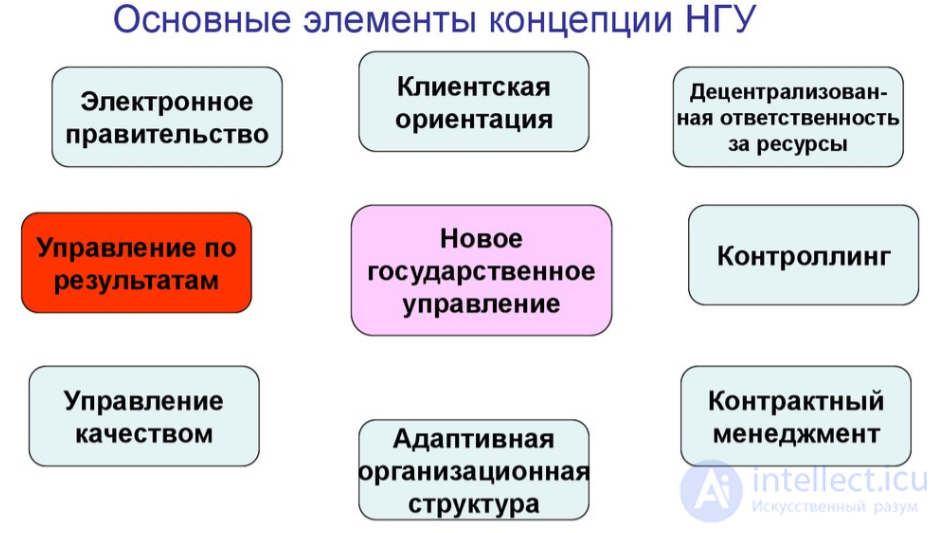
Key characteristics of "governance" — "good governance":
The concept of "Reinventing Government" (RG) was developed by David Osborne and Ted Gaebler, who present the principles of RG not as a set of prescriptive standards but as a generalization of the changes taking place in public administration. (Osborne D. Reinventing Government. How the enterpreneurial spirit is transforming the public sector / D. Osborne, T. Gaebler. Reading. Mass., 1992.)
Reforming the system of managing socio-economic processes in contemporary Russia
The underlying principles are set out as follows:
– the state is regarded not as a necessary evil but as a means of collective action and of solving public problems;
– an effective state must meet the requirements of the information society and the knowledge economy
— a large, centralized, and standardized bureaucracy must be left in the past;
– the problem of public administration lies not with people (bureaucrats) but with the bureaucratic system itself;
– traditional democracy will not be able to solve today's problems of the state by redistributing resources
— the effectiveness of decisions depends on "reinventing" government;
– it is necessary to proceed from the principle of ensuring equality of opportunity for all citizens.
The historical and international experience of administrative reform demonstrates that successful change requires clear planning, political will, and attention to local conditions. The examples of reform in different countries show that the key factors of success are transparency, professionalism, the fight against corruption, and the adoption of modern technologies. Studying these lessons makes it possible to adapt best practices to national conditions in order to ensure effective governance in the interests of citizens.

Comments