
Lecture
PR (public relations) is the management of an organization's communications with its target audience (the public, the external environment); it is an informational influence on public opinion aimed at forming a favourable image of the organization.
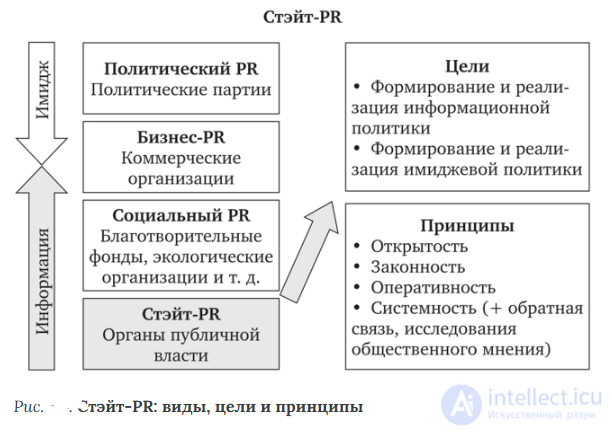
Depending on the actor carrying it out and the substance of the PR activity, one may distinguish political, social and business PR, as well as state PR, conducted within bodies of state power and local self-government. It is state PR, its aims and principles, that will be of primary interest to us (fig. ).
From the early 1990s Russia saw the slow and gradual — and from the mid-1990s the rapid and rather abrupt — development of various "public relations" structures: within state bodies, commercial firms and voluntary associations, and finally in the form of independent professional PR agencies. In parallel, the volume of training for specialists oriented towards work in the PR industry grew steadily.
The first organizations in Russia to place public relations communications on a professional footing were the security and law-enforcement agencies and the special services, which set up dedicated departments of their own.
This is quite understandable, since it is precisely these structures that are characterized by particular attention to crisis situations, the resolution and mitigation of which become central to their work with the public.
In 1996 a public relations directorate was established within the Administration of the President of the Russian Federation. The Ministry of Finance operates a department for public and interregional relations.
Public relations departments also exist in the administrative districts of the capital and in the Moscow Mayor's Office.
The first laureate of the National Award for the development of public relations, in 1998, was the Levoberezhny district of Moscow's Northern District. Among its competitors — 29 projects were submitted in total — the Mayor of Moscow, Yu. M. Luzhkov, was named in the "PR person of the year" category.
Americans regard Mikhail Gorbachev as a highly successful PR specialist: by manipulating the terms "glasnost" and "perestroika", he managed to present to the world an entirely different image of a country that had until then been hidden behind the "iron curtain".
A characteristic example of a "PR man" across the CIS is Vladimir Zhirinovsky. By many criteria — including determination, physical presence and oratorical ability — the politician is considered
a telling example in this field. He was predicted to win, and
that prediction proved correct.
In the constituent entities of the Russian Federation, public relations work is carried out by state information agencies, PR directorates, officers responsible for press relations and other functional units of local authorities.
As for the size of the Russian market for PR services, in 1996, for example, it was estimated at 100 million dollars, while by the end of the 1990s it amounted to some 1 billion dollars. According to the International Committee of PR Agency Associations, a substantial expansion of the PR industry is expected in Russia, with the state and public sector accounting for no less than 13–15%.
Public-sector marketing is the activity of state bodies aimed at studying, forecasting and satisfying the needs of society within the framework of implementing public policy. The principal aim of public-sector marketing is to establish effective communication between state structures and society, as well as to raise the level of trust in the authorities.
The structure of public-sector marketing comprises the following elements:
Studying the needs of the population — analysing citizens' expectations and demands.
Developing strategies and programmes — identifying priority areas of activity.
Informational support — generating and disseminating information about public policy.
Monitoring and evaluating results — measuring the effectiveness of the initiatives implemented.
Marketing in the state-administrative sphere has a number of distinctive features:
The absence of a commercial objective. The principal task is to satisfy social and public needs rather than to generate profit.
A broad audience. Public-sector marketing is directed at all segments of the population.
Direct influence on public opinion. State bodies use marketing instruments to build a positive image and strengthen citizens' trust.
Limited resources. State programmes are often implemented under strict budgetary constraints.
Public-sector marketing focuses on satisfying public needs and addressing social problems.
Economic marketing is directed at achieving commercial objectives and increasing companies' profits.
Political marketing serves as an instrument for promoting political parties, candidates and their platforms.
The main concepts of public-sector marketing include:
A socially oriented approach. Satisfying the needs of society is given pride of place.
An innovation-based approach. The use of modern technologies to increase effectiveness.
Elements of public-sector marketing:
Analysis of the external and internal environment.
Identification of target audiences.
Selection of effective communication channels.
Development and implementation of marketing programmes.
Social policy: improving citizens' quality of life.
Environmental initiatives: promoting sustainable development.
Information policy: fostering transparency and openness.
Cultural development: supporting national traditions and values.
Infrastructure projects: improving transport and social infrastructure.
In a market economy, public-sector marketing is implemented through:
Attracting private investors to carry out social projects.
Partnership with business within public-private cooperation programmes.
The use of digital technologies for interaction with citizens (public services portals, social media).
Public relations ("PR") in public administration is aimed at creating an open dialogue with citizens, informing them about initiatives and strengthening trust in the authorities. The main instruments are:
Press releases and official statements.
Holding public hearings.
Organizing information campaigns.
PR plays a key role at every stage of the formulation and implementation of public policy:
Policy formulation. Gathering data on the opinions and demands of the population.
Policy implementation. Informing citizens about the decisions taken.
Feedback. Evaluating effectiveness and adjusting actions.
Shaping public opinion. Creating a positive image of the authorities.
Influencing the dynamics of social relations. Strengthening social stability.
Publicizing the government's activities. Transparency and openness.
Community life. Supporting local initiatives.
Industrial development. Attracting investment.
Financial relations. Raising the population's financial literacy.
International relations. Promoting the country's image on the international stage.
Consumer relations. Protecting citizens' rights.
Conducting research and collecting statistical data. Providing an evidence base for decision-making.
Mass media. Effective interaction with journalists.
Informing the population about the activities of the authorities.
Building trust in public policy.
Sustaining dialogue between the authorities and society.
Monitoring public opinion.
Information services provide for:
The timely dissemination of reliable information.
The organization of press conferences and briefings.
The maintenance of official websites and social media pages.
The preparation of reports on performance results.
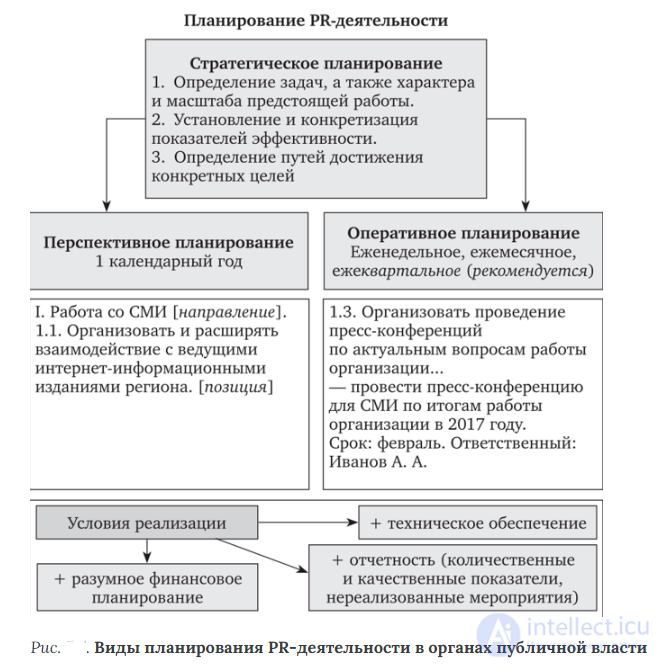
Effective PR activity is inconceivable without competent planning. The types of planning, with examples of specific areas, positions and measures in the field of public relations, together with the additional conditions required for the proper conduct of PR activity in public authorities, are presented in fig.
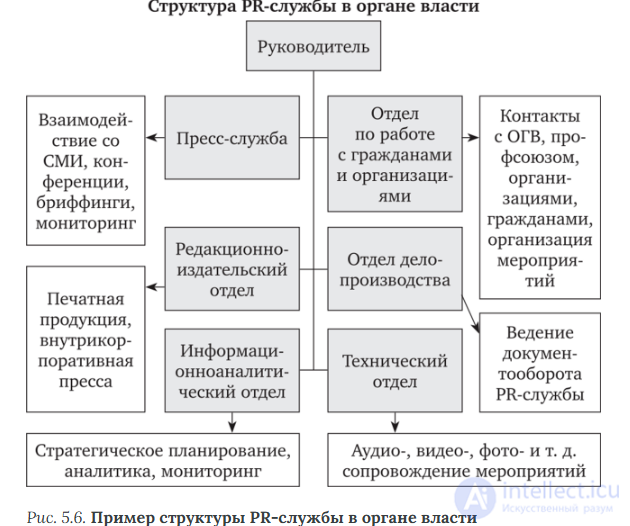
The structure of a PR service is formed in accordance with the tasks of PR activity within public authorities. Below is an example of such a structure, indicating the tasks performed by each unit (fig. ).
An important resource for creating and strengthening a positive image of public authorities is close, productive interaction with the mass media. This interaction is carried out in the following areas:
Effective public-sector marketing and PR are key instruments for raising the level of citizens' trust, achieving transparency in governance and fostering the sustainable development of society. Russia has yet to establish a clear mechanism for the day-to-day conduct of PR within bodies of state power; the work of specialists and of the service as a whole will become effective only when state service bodies, receiving full information about public opinion, use it as an organically embedded component both of the process of taking government decisions and of the operating machinery of state authorities.

Comments