
Lecture
Это продолжение увлекательной статьи про коррупция.
...
carried out, recommendations are drawn up for eliminating corruption risks. These recommendations may include:
After amendments have been made to regulatory acts, their application is monitored in order to verify how effectively the corruption risks have been eliminated. This may also involve follow-up checks and adjustments based on practical experience.
Anti-corruption review employs a variety of methods to identify potential corruption risks:
This method consists of a detailed study of the provisions and adoption procedures of regulatory acts from a legal standpoint in order to identify contradictions and ambiguities that could be exploited for corrupt purposes.
This method assesses how particular provisions may affect social processes, the economy, business, and citizens' behaviour. For example, matters relating to public procurement or licensing, where corruption schemes may arise, can be examined.
A comparison is made with international practice and best anti-corruption standards in order to identify potential improvements to national legislation.
Surveys of citizens, experts, business representatives, and other stakeholder groups may be used to ascertain their views on possible corruption risks in the proposed provisions.
Anti-corruption review plays a key role in preventing corruption at the legislative level. Making review of regulatory acts for corruption risks mandatory helps significantly reduce the likelihood of corruption arising in future legal acts. It also contributes to:
Despite the importance of anti-corruption review, several problems hinder its full implementation:
Anti-corruption review of regulatory legal acts is an important instrument of corruption prevention and helps create a legal framework that minimises the scope for corrupt practices. This process requires a comprehensive approach, the participation of experts, the use of modern analytical methods, and the integration of international standards in order to ensure effective anti-corruption efforts at all levels of law-making.
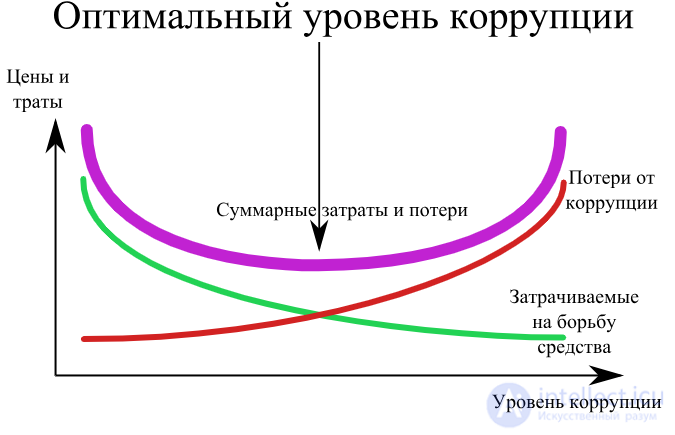
As the state eradicates corruption, the cost of combating it rises to the point where eliminating corruption entirely would require infinite effort. By comparing the losses from corruption with the cost of eradicating it at each level, one can identify an optimal level of corruption that corresponds to the lowest total losses. It turns out that it is more advantageous for society not to eliminate corruption completely, simply because the process is so costly. One should not, however, lose sight of the further effectiveness of the funds spent on combating corruption.
Moreover, excessive zeal in fighting corruption at the expense of addressing its causes can deprive the administrative system of flexibility and the population of civil liberties. The ruling group may use punitive legislation to tighten its control over society and persecute political opponents.
Public education work with people of different ages and social strata is an important part of the overall anti-corruption strategy. It aims to instil in citizens a sense of intolerance towards corruption, raise their awareness of the negative consequences of corrupt acts, and inculcate the values of honesty and law-abiding conduct. Such educational work must be varied and adapted to different categories of the population, taking account of age, social, and cultural characteristics.
The main aims of public education work for corruption prevention include:
Early prevention matters for young people. Adolescents and young adults, as future citizens, must understand that corruption is not merely a legal offence but a threat to justice, equality, and the health of society. It is important to run educational programmes that include:
Such programmes help schoolchildren and students develop critical thinking and the ability to make ethical decisions in life from an early age.
An important aspect is professional training and education for employees of government bodies and private companies so that they know how to avoid corruption schemes and how not to fall victim to corruption.
The main task of public education work among broad sections of the population is to build public understanding that corruption destroys social institutions and threatens the development of society. Various forms of work can be used for this purpose:
Public forums, round tables, and lectures may also be organised, at which the problem of corruption is discussed with the participation of experts, public figures, representatives of government bodies, and engaged citizens.
Preventing corruption among different ethnic and social groups requires an individualised approach. For example:
Despite the importance of public education work, the following challenges and problems exist:
Public education work with people of different age and social groups is an important instrument in combating corruption. Creating a culture of intolerance towards corruption, an informed public, and citizen engagement in efforts to counter corrupt acts is the key to a sustainable reduction in the level of corruption in society.
The main aims of ethical codes for public servants are:
Codes of ethical conduct for public servants are usually based on several key principles:
Public servants are obliged to act in full compliance with the law, openly and honestly before citizens. This includes refraining from any form of deception, manipulation, or bad-faith practice.
Officials must observe impartiality in decision-making, showing no preference for any political or personal group. They are obliged to act in the interests of the state and society, not in the interests of a particular person or group.
Public servants must preserve the confidentiality of information that comes to their knowledge in the course of their official duties and use it solely for the purpose of performing those duties.
Public servants are obliged to account for their actions to management, colleagues, and citizens, and to bear responsibility for their decisions and actions.
Officials must understand that their primary task is service to society, not personal gain. This means taking decisions oriented towards the good of citizens and the effective performance of state functions.
A code of ethical conduct for public servants usually includes several key sections setting out in detail officials' duties, rights, and behavioural requirements:
This section sets out the main aims and objectives of the code, as well as the list of principles and values on which the conduct of public servants is based. It establishes that compliance with the code is mandatory and specifies the consequences of breaching it.
This section describes the main rights and duties of public servants, as well as their responsibility to the state and society. It includes rules governing relations with colleagues, citizens, subordinates, and management.
This section describes the specific standards of conduct that officials must observe in their work, including interaction with citizens, colleagues, and politicians, as well as matters relating to their private lives. For example, not accepting gifts from citizens or organisations, and avoiding conflicts of interest.
This section is important for preventing conflicts of interest and combating corruption. It establishes clear rules to prevent situations in which an employee's personal interests could influence their professional decisions.
The code also sets out procedures for monitoring compliance with its standards, as well as sanctions for breaching them. These may include disciplinary measures up to and including dismissal from the civil service.
The adoption of codes of ethical conduct offers a number of significant advantages:
Despite the significance of ethical codes, several problems may arise in their implementation and application:
Some countries have introduced successful practices in ethical codes for public servants that can serve as models:
New Zealand and Singapore have highly effective ethical codes containing strict requirements for public servants, including requirements on preventing corruption, transparency, and accountability. These countries actively train their officials in compliance with ethical standards and continuously monitor adherence to the codes.
In the United States there is a detailed Code of Ethics for federal public servants, which includes guidance and rules on gifts, conflicts of interest, interaction with lobbyists, and so on. This code is actively used to increase the transparency and accountability of the civil service.
The adoption of codes of ethical conduct for public servants is an important step towards creating an effective and transparent civil service. The codes help reduce corruption risks, increase citizens' trust in state bodies, and establish higher standards of professionalism. However, for ethical codes to be genuinely effective, their actual observance must be ensured through appropriate oversight mechanisms and mandatory training of public servants.
Raising the incomes of public servants is one possible method of preventing corruption, since low salaries can create the preconditions for abuse of power, bribe-taking, and other forms of corrupt behaviour. Higher incomes can reduce the economic pressure on public servants, lessen the temptation to take unlawful decisions in their own interests, and thereby increase the effectiveness of anti-corruption policy.
Low salaries for public servants often lead them to seek additional sources of income, which can create room for corruption schemes such as bribery. Higher incomes reduce dependence on off-budget sources, which helps lessen the motivation to commit corruption offences.
Adequate pay is one of the factors that stimulate professionalism among public servants. Higher incomes can improve the quality of work, reduce staff turnover, and attract qualified specialists to the civil service. The higher the remuneration for the work, the less likely officials are to seek ways of obtaining unlawful income.
When the civil service offers competitive salaries, this can attract more qualified specialists into the system who are able to work effectively and honestly, knowing that their work is valued. This also helps reduce corruption risks, since highly qualified personnel generally have a higher level of moral responsibility and professional standards.
When citizens see that public servants' salaries are sufficient for a decent life, this helps strengthen trust in state institutions. A transparent pay system reduces negative perceptions and suspicions that officials might have an interest in corruption schemes as a source of additional income.
Raising public servants' incomes should be part of a comprehensive anti-corruption strategy. Some possible approaches include:
Reviewing and increasing salaries for key categories of public servants — such as judges, prosecutors, tax inspectors, law enforcement officers, and others — can reduce corruption risks in these areas. It is important to establish clear, transparent, and fair criteria for determining pay levels so as not to create ambiguous situations.
Additional payments, such as awards for achievement, bonuses for completing difficult tasks, or for delivering strong results in combating corruption, can provide good motivation for officials and encourage their commitment to honest and productive work.
Introducing clear and public standards for determining public servants' salaries and compensation is important for increasing public trust in state structures. Transparency makes it possible to rule out unofficial and hidden payments, which can become a source of corruption.
Enhancing social guarantees, such as pension payments, medical insurance, and other benefits, can also be a way of reducing corruption pressure, since officials will feel protected and less inclined to unlawful acts for personal gain.
Although raising public servants' incomes can be an effective means of preventing corruption, there are a number of problems and challenges that must be taken into account:
Raising public servants' incomes requires substantial financial outlays that may be hard to sustain for countries with limited budgets. Especially in conditions of economic crisis or financial difficulty, raising public servants' salaries may require a reallocation of funds, which may meet resistance from other social groups.
Higher incomes must form part of a broader reform of the public administration system. It is important to bear in mind that raising salaries without other structural changes may not lead to a significant reduction in corruption. It is also necessary to improve management processes, increase transparency, and introduce effective oversight mechanisms.
When raising salaries, it is important to maintain a balance so that the increase does not result in excessive privileges for public servants, which could provoke public discontent. If the rise in incomes is perceived as unjustified or excessive, it may provoke protests and even lead to a decline in trust in state structures.
For higher public-servant incomes to work effectively against corruption, it is necessary to strengthen control over the use of public funds, increase the transparency of state structures' work, and introduce anti-corruption mechanisms such as independent audits, monitoring systems, and reporting mechanisms.
Some countries have already taken measures to raise public servants' incomes as a means of combating corruption:
Singapore is known for its highly paid civil service, which attracts qualified specialists and helps prevent corruption. In Singapore, public servants' salaries are competitive with the private sector, which helps reduce the temptation to take bribes or take part in corruption schemes.
Denmark and Sweden likewise use a model of well-paid public servants combined with a highly effective system of oversight and accountability, which reduces corruption risks and increases public trust in government.
In New Zealand and Germany, pay increases for civil servants are likewise accompanied by stronger oversight and by the creation of transparent, publicly accessible accountability mechanisms, which helps minimise corruption.
Raising the incomes of public officials can be an important step in combating corruption, but it must form part of a comprehensive strategy that also includes improved transparency, a stronger oversight system, greater accountability and the introduction of ethical standards. One of the key principles is establishing fairness and transparency in the remuneration system, which helps reduce corruption risks and increase citizens' trust in state institutions.
The struggle of law enforcement agencies against bribery, nepotism, the appropriation of public funds for private use and other forms of corruption is an essential component of state anti-corruption policy. Succeeding against these phenomena requires the integration of various strategies, technologies and institutions aimed at detecting and suppressing corrupt acts, as well as at building a system of legal and public oversight.
Corruption in government bodies significantly undermines trust in the institutions of power and violates the principles of fairness, integrity and transparency, which leads to a decline in the quality of public services and reduced effectiveness of public administration. Bribes, nepotism and the appropriation of public funds become a threat to the functioning of democratic institutions and to justice itself.
Law enforcement agencies play a key role in countering these crimes, since their task is to detect, suppress and punish corruption offences. To do so, law enforcement agencies must have appropriate mechanisms of investigation, punishment and prevention, and must cooperate with other public and private structures.
Bribery: Receiving or offering money, material benefits or other valuables in exchange for actions connected with the performance of official duties. This is one of the most widespread forms of corruption in both public and private structures.
Nepotism: Appointing relatives, friends or acquaintances to senior positions regardless of their professional qualifications. This leads to ineffective management and creates a privileged position for certain groups, which is likewise a form of corruption.
Appropriation of public funds: The unlawful use, for personal purposes, of funds intended for state or municipal needs. This may include embezzlement, budget fraud and various financial manipulation schemes.
Fraud in public tenders: Manipulation of tender procedures, in which participants won competitions by breaking the rules or securing victory through unlawful actions. This is often bound up with bribes and other corrupt schemes.
Effectively combating corruption requires an independent and professional law enforcement system. Its most important elements include:
Creating specialised anti-corruption units: Some countries have established dedicated anti-corruption agencies or units within national law enforcement bodies, such as anti-corruption bureaus, which investigate and suppress corruption offences. Examples include the work of the Federal Bureau of Investigation in the United States (FBI) and the National Anticorruption Directorate in Romania.
Using advanced technologies and investigative methods: Modern corruption investigations often employ techniques such as wiretapping, monitoring of financial transactions, analysis of electronic communications and other means that make it possible to uncover hidden corruption schemes.
Independence of the judiciary: Effective prosecution of corrupt officials depends on the independence of the judicial system, which must ensure impartial adjudication of cases and the imposition of penalties on lawbreakers regardless of their status.
Corruption often extends beyond the borders of a single country, which makes international cooperation in investigations necessary. Law enforcement agencies must work with international partners such as Interpol, Europol and other organisations in order to exchange information and conduct joint operations against transnational corruption.
Extradition of corrupt officials: In cases where corruption suspects are hiding outside their own country, extradition and cooperation agreements with other states are required.
International anti-corruption agreements: International treaties and conventions play an important role in combating corruption, such as the United Nations Convention against Corruption and the Council of Europe's anti-corruption conventions, which encourage countries to comply with international anti-corruption standards.
In order to prevent corruption, law enforcement agencies must actively engage not only in suppressing offences but also in introducing preventive measures. This includes:
Educational programmes and training for public officials: Raising awareness among staff of state and municipal bodies about the consequences of corruption and training them in ethical standards and the law.
Monitoring and auditing of public spending: Regular audits and monitoring of government contracts and expenditure help to identify possible cases of misappropriation of funds or corrupt schemes.
Law enforcement agencies must not only investigate crimes but also ensure that penalties for corruption offences are severe and inevitable. This includes:
Tougher penalties for corruption: In some countries, prison terms and fines for those involved in corruption are being increased, which serves as a deterrent to other potential offenders.
Confiscation of assets: A number of countries have adopted laws on the confiscation of corrupt officials' assets, which provides an additional incentive to refrain from corrupt acts.
Witness and informant protection programmes: Solving these crimes requires protection for those willing to testify against corrupt officials. Witness protection programmes can be an important instrument in combating corruption.
Despite the existence of anti-corruption strategies and methods, law enforcement agencies face a number of problems that can impede their work:
Corruption within law enforcement agencies themselves: In some cases law enforcement bodies may themselves be involved in corrupt schemes, which makes effective investigation difficult. To counter this, it is important to carry out internal oversight and to create independent anti-corruption units.
Lack of political will: In countries where there is a political interest in preserving corrupt schemes, law enforcement agencies may encounter obstruction from the authorities, which reduces the effectiveness of investigations.
Lack of resources: Combating corruption requires considerable financial and human resources, which can be a problem for some countries with limited capacity.
In a number of countries, law enforcement agencies have achieved success in combating corruption:
Singapore: Singapore is one of the world leaders in combating corruption thanks to the creation of an effective anti-corruption commission (the CPIB), which actively investigates and suppresses corruption offences. Strict laws and a high level of trust in law enforcement agencies contribute to the country's low level of corruption.
Romania: Romania's National Anticorruption Directorate (DNA) works successfully, investigating corruption cases involving high-ranking officials, including ministers and judges. Thanks to these efforts, many prominent figures have been convicted, which has sent a powerful signal about the fight against corruption.
South Korea: In South Korea, anti-corruption initiatives include the creation of independent committees and institutions to investigate corruption cases and punish the guilty, as well as reforms aimed at increasing transparency in public administration.
Combating corruption requires a comprehensive approach in which law enforcement agencies play a key role. Effectively fighting corruption calls not only for measures of suppression and punishment, but also for the creation of preventive mechanisms, greater transparency in the work of state structures, and international cooperation. At the same time it is important to bear in mind that success depends on political will, on the existence of independent courts and adequate powers for law enforcement agencies, and on engagement with public opinion.
Strengthening oversight of public officials by civil society and independent journalists is an important element of any system for countering corruption and ensuring transparency in the work of government bodies. Such oversight not only helps to detect corrupt acts but also contributes to building an effective system of checks and balances that protects the interests of society.
Civil society plays a key role in ensuring the transparency and accountability of government bodies. It comprises a variety of non-profit organisations, activists, experts and ordinary citizens who can influence decision-making processes and monitor the activities of public officials.
Civic organisations working on human rights, the environment, anti-corruption and other social issues can conduct independent research and monitoring, uncovering instances of corruption and ineffective use of budget funds. Such organisations can initiate research, work with data and publish reports, which increases the transparency of officials' activities.
Activists and civic groups can run campaigns aimed at changing the laws and policies that facilitate corruption. This may include campaigning for stronger anti-corruption legislation, greater accountability of public officials and better conditions for civic oversight of their activities.
Civil society also plays an important role in educating the public about the importance of monitoring the activities of public officials, and in teaching citizens how they can take part in combating corruption. Such programmes may include training on human rights and the right to information, as well as on how to submit complaints and proposals to the authorities.
In recent years, online platforms and databases that allow citizens and organisations to track the activities of public officials have developed rapidly. In some countries, for example, there are platforms where one can check how budget funds are spent, how public procurement contracts and tenders are awarded, and what assets high-profile officials hold. This provides an independent source of information for assessing the performance of public officials.
Independent journalism plays a critical role in exposing corruption and drawing the attention of the public and the authorities to violations committed by public officials. Journalists examine cases, conduct investigations, uncover facts of corruption, bribery and illicit enrichment, and monitor compliance with the law in the work of state structures.
Journalists who specialise in investigations can expose hidden corruption schemes, manipulation of budget funds, links between politicians and businesspeople, and other forms of wrongdoing. These investigations often generate public outcry, which forces the authorities to respond and take action.
Examples of successful journalistic investigations include material exposing high-level corruption schemes, such as the Panama Papers investigations or investigations carried out by ProPublica and other independent media outlets. These investigations sent a significant signal in favour of stronger oversight of public officials' activities.
Independent media can publish reports, studies and analytical material that help citizens and other stakeholders understand in greater detail how state structures operate and how open and accountable they are. Such material may include data on budget expenditure, personnel decisions, resource allocation and other important aspects of public administration.
Independent journalists can also play a part in generating public pressure on the authorities to adopt anti-corruption measures and raise standards of accountability. Making public the facts of corruption and unlawful actions by public officials often acts as a catalyst for social protest, political change and even criminal investigations.
In order for journalists to do their work effectively, it is important to ensure the protection of their rights and freedoms. An independent press must be able to work freely without fear of persecution, threats or violence. Protecting journalists from political repression and pressure from the authorities is becoming an integral part of combating corruption and ensuring the accountability of public officials.
Effective oversight of public officials requires interaction between the various institutions of civil society, the media and law enforcement agencies. Joint efforts may include:
Civic organisations, journalists and law enforcement agencies can pool their efforts to conduct joint investigations and monitoring. For example, journalists can work with experts from human rights organisations or anti-corruption agencies to investigate crimes involving corruption among public officials.
Interaction between civil society and law enforcement agencies may include support and protection for those who disclose information about corruption. Informants, journalists and activists who take risks in exposing corrupt schemes can be protected through programmes that ensure their safety and confidentiality.
Modern technologies offer new opportunities for monitoring the activities of public officials. The use of open data, digital platforms for complaints and proposals, and the creation of mobile applications for tracking corruption help citizens and journalists monitor officials' actions in real time.
Although strengthening oversight of public officials by civil society and journalists holds great promise, it faces a number of problems and challenges:
In countries with insufficient press freedom, journalists and activists often face political pressure, threats and repression. Under such conditions, combating corruption becomes far more difficult.
Civic organisations and independent journalists often face limited resources, which restricts their capacity to conduct in-depth investigations and monitoring. These resources may be both financial and human.
In countries where law enforcement agencies are involved in corrupt schemes or subject to political influence, civil society and journalists may not trust the official bodies, which makes combating corruption difficult.
Action in India: In India, activists and journalists working together with human rights organisations have achieved significant success in exposing corruption through the use of technology and social media. One example is the active work surrounding the Right to Information Act, which allows citizens to request information about the activities of government bodies.
The case of Iceland: Iceland became an example of effective anti-corruption efforts after the revelations connected with the 2008 financial crisis. Local journalists, supported by civic initiatives, actively investigated unlawful financial schemes, which led to political change in the country.
Strengthening oversight of public officials by civil society and independent journalists is an important instrument in combating corruption. It helps to create a more transparent and accountable system of public administration, increases citizens' trust in the authorities and contributes to a healthy political and social environment.
Here are several original and effective approaches to combating corruption used in various countries:
An independent anti-corruption bureau (the CPIB) has been created, reporting directly to the Prime Minister.
Civil servants' salaries are pegged to income levels in the private sector in order to reduce the incentive to take bribes.
Swift and public punishment of corrupt officials — even high-ranking ones.
After the Rose Revolution of 2003, almost the entire traffic police force was dismissed and new officers were recruited.
Electronic public services were introduced to minimise contact between citizens and officials.
A campaign was conducted to increase public trust in law enforcement agencies.
A system of electronic reporting on officials' income and expenditure has been introduced.
Online platforms for filing complaints and tracking corruption cases are widely used.
Civic organisations take part in monitoring public procurement.
The Brasil Transparente platform allows citizens to track budget expenditure.
The Open Government programme involves the public in decision-making and in overseeing officials.
A high level of trust in state institutions and a low tolerance for corruption.
A transparent system for financing political parties.
Effective protection for whistleblowers.
Mass dismissals and arrests: In 2024 alone, nearly 590,000 people were punished, including high-ranking officials and military officers.
Military purges: In October 2025, Xi Jinping removed nine generals from their posts, including the second most senior figure in the armed forces, for "serious disciplinary violations".
Centralised control: Anti-corruption work is conducted under the auspices of the CPC Central Commission, which makes it an instrument of party discipline.
Show cases: Investigations are often made public in order to demonstrate the authorities' resolve.
In China the death penalty for corruption is applied — particularly in cases involving large sums and high-ranking officials:
In September 2025 he was sentenced to death with a two-year reprieve for taking bribes totalling more than 268 million yuan (≈ $37.6 million).
The court found that he had systematically taken bribes from 2007 to 2024 while holding various posts.
The sentence also includes lifetime deprivation of political rights and confiscation of property.
The two-year reprieve is a chance to have the sentence commuted to life imprisonment if the convicted person does not break the law and cooperates.
This measure is applied frequently, especially if the defendant admits guilt.
China is one of the world leaders in the number of executions, although the official statistics are classified.
According to human rights organisations, those executed in 2015 numbered more than 16,000 people, including in corruption cases.
Operation Clean Hands (Mani Pulite): In the 1990s this was the largest anti-corruption campaign in Europe. It exposed links between politicians and the mafia and led to the collapse of entire parties.
Trials of the elite: For example, former Prime Minister Giulio Andreotti was convicted over links to the mafia — the case lasted 10 years.
Corruption Perceptions Index: Despite the progress made, in 2023 Italy ranked only 42nd in the Transparency International index, which points to a high level of public distrust of state structures.


Italy has an unusual tradition of "dunking" officials in water — and it is not a punishment so much as a satirical ritual:
The Tonca tradition in the city of Trento
The essence of the rite: an official or public figure who has "disgraced" himself over the past year is placed in a metal cage and lowered into the river in front of an audience.
Where it takes place: the city of Trento, northern Italy.
The form of penance: it is a symbolic act lasting only a second — the cage is quickly dipped and lifted again in order to "refresh" the conscience.
The purpose: not to humiliate, but to serve as a reminder of civic responsibility and to raise a smile among the onlookers.
Who gets "dunked": usually local politicians, officials or well-known figures who have made mistakes or become the object of public discontent.
Ukraine has been actively implementing anti-corruption reforms, particularly since 2014:
The ProZorro system: electronic public procurement in which all bids are visible online. This has sharply reduced the scope for kickbacks.
NABU and SAPO: independent anti-corruption bodies that investigate cases against high-ranking officials.
Open registers: officials' asset declarations are available online.
Public oversight: citizens actively take part in investigations and monitoring, especially through the media and social networks.
Trust is growing: in October 2025, 56% of Ukrainians believed that the authorities were genuinely fighting corruption, although 40% still considered the country "hopelessly corrupt".
In Russia the fight against corruption is conducted predominantly through state structures:
The federal law "On Combating Corruption": in force since 2008, it defines the relevant measures and liability.
The Prosecutor's Office and the FSB: the key bodies overseeing compliance with anti-corruption legislation.
Income declaration: officials are required to publish information about their income, but verification is limited.
The Transparency International index: in 2024 Russia ranked 141st out of 180 countries with a score of 28 — indicating a low level of trust and weak effectiveness in the fight against corruption.
Combating corruption in the United States is a multi-tiered system covering the civil service, business and lobbying:
The FCPA (Foreign Corrupt Practices Act): prohibits American companies from paying bribes to foreign officials. It has extraterritorial effect and applies even outside the United States.
Independent bodies: the FBI, the Department of Justice and special prosecutors investigate corruption cases, including cases against senators and governors.
Transparency of lobbying: companies are required to register their lobbying activity and disclose their expenditure.
Codes of ethics: these are in force at all levels of government, including Congress and local authorities.
Civic oversight: the media and civic organisations actively take part in investigations and monitoring.
The EU is working towards harmonising anti-corruption rules among member states:
The new 2023 directive: introduces common definitions of corruption offences — bribery, abuse of office and money laundering.
The European Public Prosecutor's Office (EPPO): investigates financial crimes affecting the EU budget.
Requirements for candidate countries: Ukraine, for example, must carry out a series of anti-corruption reforms in order to join the EU.
Assessment of progress: the European Commission regularly publishes reports on the state of anti-corruption efforts in member and candidate countries.
Funding for civic initiatives: the EU supports NGOs engaged in monitoring and public education.
🇦🇪 In the United Arab Emirates (UAE), the fight against corruption is conducted strictly and systematically, with an emphasis on legal transparency and international standards. Here are the key features:
The revised Criminal Code: since 2018 the UAE has had strict anti-corruption provisions covering both the public and the private sector. The law applies to bribery cases both inside the country and abroad where UAE nationals or companies registered in the country are involved.
Confiscation of assets: courts may seize any valuables connected with corruption offences, including money, property and gifts.
Abu Dhabi Accountability Authority: an independent body that oversees public spending and investigates corruption cases.
Dubai Centre for Economic Security: deals with financial crime, including money laundering and abuses in business.
The UAE cooperates actively with international organisations, including the UN and the FATF, in order to comply with global transparency standards.
In 2022, Law No. 49 "On Human Resources in the Federal Government" was adopted, strengthening oversight of the conduct of public officials.
Despite the progress made, Transparency International does not publish a separate ranking for the UAE, which makes objective assessment difficult.
Press freedom in the country is limited, which reduces the level of public oversight.
Corruption existed in the USSR at every stage of the country's history, despite an official ideology that proclaimed equality and honesty. Here is how it manifested itself and what it was connected with:
The nomenklatura system: key posts were allocated according to party lists, which created a closed elite that was unaccountable to society.
Shortages and distribution: because of shortages of goods and services, corruption often took the form of blat — informal connections used to obtain scarce goods.
The absence of a free press and civic oversight: this made it possible to conceal abuses and to prevent public pressure.
The 1920s–1930s: corruption was linked to the distribution of resources, particularly under the New Economic Policy. Cases of bribery and abuse of office were already being recorded at that time.
The 1950s–1980s: corruption became systemic. Shadow schemes flourished in the Soviet republics, especially in trade, construction and agriculture.
The 1980s: under Gorbachev an anti-corruption campaign was launched, but it was limited in scope. Some high-ranking officials were arrested, but the system itself remained
продолжение следует...
Часть 1 Corruption: its nature, types, causes and the principal strategies for countering it
Часть 2 Business corruption and everyday corruption. - Corruption: its nature, types,
Часть 3 Public education work with people of different ages and social
Часть 4 See also - Corruption: its nature, types, causes and the

Comments