
Lecture
According to an American political conspiracy theory, the deep state is a secret network of members of the federal government (particularly within the FBI and the CIA) working together with high-ranking financial and industrial organizations and leaders to exercise power alongside or within the elected government of the United States.
The term "deep state" arose in the 1990s as a reference to the alleged long-standing deep state in Turkey, but also came to be applied to the American government, including during the Obama administration. The theory, however, gained widespread currency during the presidency of Donald Trump, who invoked an alleged "deep state" working against him and his administration's agenda.
The term had precedents dating back at least to the 1950s, including the concept of the military-industrial complex, which posits the existence of a clique of generals and defense contractors who enrich themselves by drawing the country into endless wars.
Public opinion polls conducted in 2017 and 2018 indicate that roughly half of all Americans believe a deep state exists in the United States
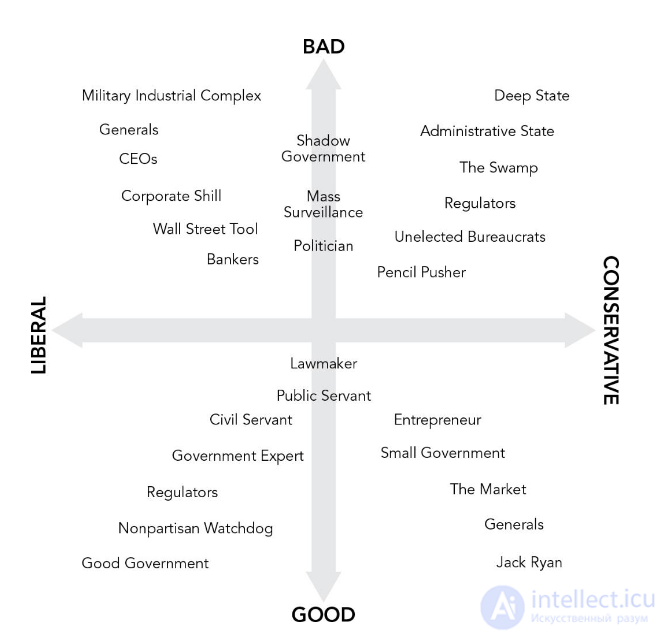
The numerous terms Americans use to describe the Deep State in America, and the frequency with which they are used by different Americans across the political spectrum, as shown by David Rohde
Although the term " deep state" supposedly originated in Turkey in the 1990s, belief in the concept of a deep state has been present in the United States at least since the 1950s. A 1955 article in the Bulletin of the Atomic Scientists quotes Americans expressing their belief in the existence of a "dual state": a hidden national security hierarchy and a shadow government that monitors and controls elected politicians.
Political scientist George Friedman argues that such a deep state has existed since 1871, when the president's power over federal employees was curtailed.
Historian Alfred W. McCoy has argued that the growing influence of the US intelligence community after the September 11 attacks "led to the creation of a fourth branch of the US government," one that is "in many ways independent of the executive branch and increasingly autonomous."
Tufts University professor Michael J. Glennon stated that President Barack Obama failed to confront or change what he calls "double government," and pointed to Obama's inability to close the detention camp at Guantánamo Bay, one of his principal campaign promises, as evidence of the existence of a deep state.
In a 2017 interview several weeks before Trump's inauguration, Senate Democratic leader Chuck Schumer called Trump "really dumb" for repeatedly criticizing the CIA, saying: "Let me tell you, you take on the intelligence community, they have six ways from Sunday at getting back at you." Various commentators, as well as the American Civil Liberties Union (ACLU), have pointed to this statement as evidence of the existence of a deep state.
Rebecca Gordon, a lecturer and author at the University of San Francisco, wrote in a 2020 article for Business Insider that Trump used the term "deep state" to refer to the US government, specifically those governmental institutions that "frustrate" him and that block or fail to carry out his governmental policies, such as the courts, the Department of Justice, and the mass media.
In 2014, former congressional staffer Mike Lofgren argued that there exists a deep state that protects "powerful vested interests," and that "a network of entrenched interests within and beyond the US government... dictates America's defense decisions, trade policy, and priorities, with little regard for the actual interests or wishes of the American people."
In 2017, former US Democratic Representative Dennis Kucinich argued that there are individuals within the intelligence community attempting to undermine relations between the United States and Russia.
Former National Security Agency whistleblower Edward Snowden has argued that there exists a deep state made up of civil servants
US Attorney General Merrick Garland (pictured) became the target of attacks from numerous proponents of the "deep state" conspiracy theory and supporters of Donald Trump in connection with the FBI's 2022 search of Mar-a-Lago.
During his presidency, Donald Trump and his strategists claimed that the deep state was interfering with his plans and that the US Department of Justice was part of the deep state because it did not prosecute Huma Abedin or James Comey. Some Trump allies and right-wing media claimed that Obama was coordinating deep state resistance to Trump. Supporters of President Trump used deep state to refer to claims that intelligence officers and executive branch officials were influencing policy through leaks or other internal means.
In 2018, Newt Gingrich stated that Robert Mueller was part of the deep state in the Special Counsel investigation into Russian interference in the 2016 US elections.
In 2018, The New York Times published an anonymous op-ed by DHS chief of staff Miles Taylor titled "I Am Part of the Resistance Inside the Trump Administration," attributed at the time to "a senior official in the Trump administration." In the piece, Taylor criticized President Trump and asserted that "many of the senior officials in [Trump's] own administration are working diligently from within to frustrate parts of his agenda and his worst inclinations." Former Speaker of the House Kevin McCarthy called this evidence of the deep state at work, while David Bossie wrote an article for Fox News stating that this deep state "is working against the will of the American people."
In 2018, US Republican Senator Rand Paul argued that the fact that the CIA briefed only the "Gang of Eight" on sensitive intelligence matters was an example of the deep state.
In 2020, Trump cabinet member and acting White House chief of staff Mick Mulvaney claimed that assertions that the deep state was working against Trump were "absolutely, 100% true."
The concept of the deep state is a central tenet of the QAnon conspiracist movement, which promotes a pro-Trump conspiracy theory. Trump's talk of the deep state has been described as "a rehash of a long-standing [John Birch Society] theme."
Niall Stanage described how critics of Trump's use of the term "deep state" argue that it is a conspiracy theory with no basis in reality.
UCLA law professor Jon D. Michaels argues that, compared with developing governments such as Egypt, Pakistan, and Turkey, governmental power structures in the United States are "almost entirely transparent." Michaels argues that the American "deep state," which is in fact the "American bureaucracy," comprises the federal agencies responsible for regulation, social welfare, crime prevention, and defense, along with the personnel who run them, and that it differs fundamentally from Trump's use of the term in five important respects:
Critics have warned that the use of this term in the United States may undermine public trust in institutions and be used to justify the suppression of dissent.
Political commentator and former presidential adviser David Gergen stated that the term has been appropriated by Steve Bannon, Breitbart News, and other supporters of the Trump administration with the aim of delegitimizing critics of the Trump presidency.
Stephen Walt, professor of international relations at Harvard University, has argued that no deep state exists and that "to the extent that there is a bipartisan foreign policy elite, it hides in plain sight."
Anthropologist S. August Elliott compared the involvement of the military in the Trump administration to a "shallow state" in which they were forced to steer the administration "away from potential shipwreck."
Linguist Geoffrey Nunberg said that deep state is "an elastic label," since "its history matches the intricate grammar of these conspiracy theories," referring to the shift in conservative rhetoric regarding "big government" from "meddling bunglers" to "insidious ideologues."
Fox News panelist Charles Krauthammer called the idea ridiculous, stating that the US government is controlled by bureaucracy rather than by a government-wide conspiracy.
According to an ABC News / Washington Post poll of Americans conducted in April 2017, about half (48%) believed that a deep state exists, defined as "military, intelligence and government officials who try to secretly manipulate government policy," while about a third (35%) of all participants considered this a false conspiracy theory, and the remainder (17%) had no opinion. Of those who believe a deep state exists, more than half (58%) said it was a serious problem, amounting to 28% of those surveyed
A poll conducted in March 2018 by Monmouth University found that a majority of respondents (63%) were unfamiliar with the term deep state , yet a majority believe that a deep state probably exists in the United States when it is described as "a group of unelected government and military officials who secretly manipulate or direct national policy." Three quarters (74%) of respondents say they believe such a type of group probably (47%) or definitely (27%) exists within the federal government.
An Economist / YouGov poll conducted in October 2019 found that, without giving respondents a definition of the deep state , 70% of Republicans, 38% of independents, and 13% of Democrats agreed that the deep state "is trying to overthrow Trump."
A National Public Radio / Ipsos poll conducted in December 2020 found that 39% of Americans believe there is a deep state trying to undermine President Trump's authority. [ 42 ]
In his 2015 book The State: Past, Present, Future, the academic Bob Jessop comments on the similarities among three constructs:
Author Mike Lofgren links the deep state to the military-industrial complex, defining that complex as the private component of the deep state. University professor and journalist Marc Ambinder has suggested that the myth of the deep state is that it functions as a single entity; in reality, he argues, "the deep state consists of many people, and they are often at war with one another."

Comments