1. Give a single definition whose various aspects are captured by the following characteristics: 1) A condition of genuine human freedom. 2) The nature of the relationships between the individual, the collective, and society from the standpoint of the conscious fulfilment of mutually imposed requirements. 3) A subject of social relations being aware of his or her own conduct, its consequences, and its social significance.
4) A means of preventing violations and of restoring legal norms. 5) A way of positively forming in an official the internal regulators of conduct that induce him or her to act actively within the bounds of official powers and in accordance with objectively conditioned ideals and society's moral values. This is
- Civic passivity.
- civic responsibility *
- The moral burden of society.
- Patriotic identity.
2. As the number of civic alternatives grows, governmental power
- 1) Is strengthened
- 2) Is weakened *
- 3) Nothing changes
3. Explain the professional term used by public administrators: Subjects of jurisdiction are…
- a) Groups of goods in a shop
- b) Specific areas of state activity,
- c) a defined sphere of social relations in which the governing subject may determine all parameters of influence on the participants in those social relations
- d) the objects of the sphere of activity of the Russian Federation as a state — the range of matters, enshrined in the Constitution of the Russian Federation and in the provisions of the Federative Treaty (the Treaty on the Delimitation of Subjects of Jurisdiction and Powers between the Federal Bodies of State Power of the Russian Federation and the Bodies of State Power of the Sovereign Republics within the Russian Federation), the prerogative for resolving which belongs to the federal bodies of state power *
4. Explain the professional term used by public administrators: Discretionary activity is…
- a) Random amusements
- b) Contract work
- c) Activity carried out at one's own discretion and without explicit instructions
- d) freedom of action; the right of the subject of administration (the manager) to make decisions independently, to assess the actual circumstances, or to perform other significant actions. The subject of administration has freedom of action in exercising the powers granted to it) *
- e) Compliance with state standards
5. Explain the professional term used by public administrators: Transfer of powers is…
- a) The gifting of property
- b) The training of new employees
- c) The termination of activity
- d) The process of transferring competence and responsibility from one level of authority or body to another*.
- e) it is the process of transferring all of a manager's functions to other managers or employees in order to achieve specific goals
6. Explain the professional term used by public administrators: Delegation of authority is…
- a) The abolition of a state body
- b) The sale of government assets
- c) The transfer of powers from the local level of government to the federal level
- d) it is the process of transferring part of a manager's functions to other managers or employees in order to achieve specific goals *
7. Explain the professional term used by public administrators: Subsidiarity is…
- a) The settlement of conflicts between countries
- b) The promotion of products on the market
- c) The principle according to which functions should be performed at the lowest possible level of government *
- d) The use of subsidies to support cultural projects
- e) The holding of parliamentary elections
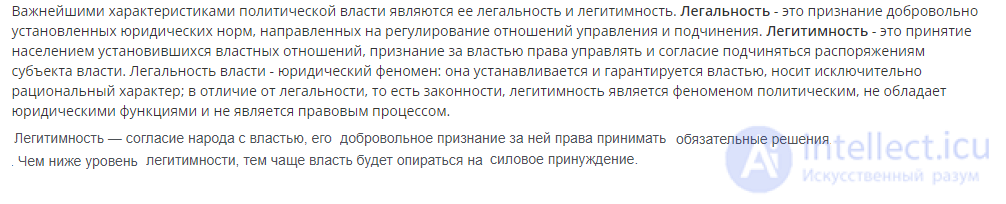
8. The voluntary recognition of the value of power is
- 1) Legality
- 2) Legitimacy*
- 3) Lawfulness
- 4) custom
9. The phases through which information flows pass in the system of public administration (complete the list): 1) Receipt and selection of information, 2) Processing and evaluation of information, 3) Adoption and implementation of a decision
10. Give the definition whose various aspects are set out in the following characteristics: 1) A regime, i.e. an established state order under which all legal relations and actions of state bodies, local self-government bodies, public institutions, and citizens are carried out within the framework of the law; 2) A method, i.e. the totality of ways, techniques, means, legal norms, and guarantees by means of which administrative activity is channelled into the course of the laws and directed towards the execution of the laws in the forms established by the laws and through actions recognized by the laws; 3) A principle of life for all, meaning adherence to the law and to the rule that "it is advantageous to act in accordance with the law and disadvantageous to act contrary to it".
- canon law
- the rule-of-law regime *
- a camp regime
- a totalitarian regime
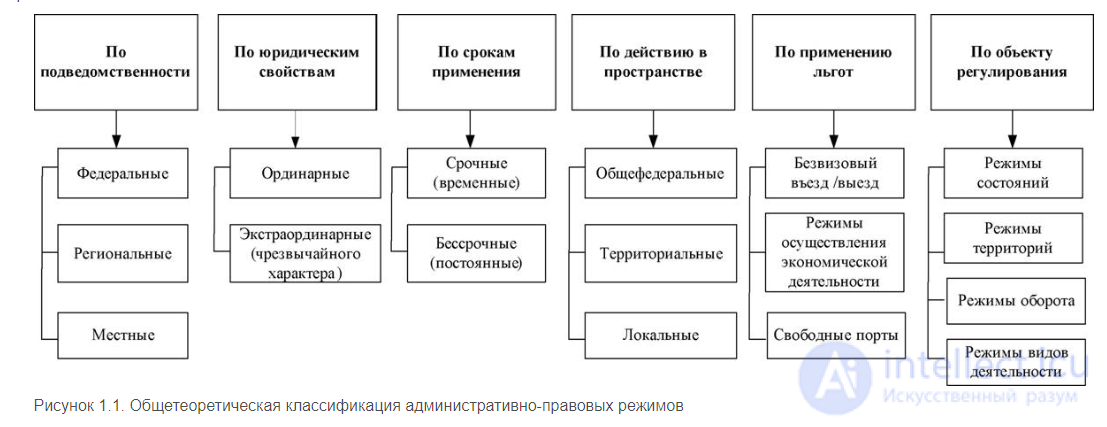
11. Find the correct answer. Administrative regimes include:
- democratic
- registration-based
- authorization-based
- contractual
- liberal
- bureaucratic
- licensing
- totalitarian
- notification-based
- prohibitive
12. Find the correct answer. Arrange in ascending order of numbers (positions): A – levels of public power; B – levels of administrative management
- Municipal administration
- Municipal Assembly
- Head of the municipal formation
- Government of Moscow
- Mayor of Moscow
- Moscow City Duma
- District council (uprava)
- Prefecture
- Federal Assembly of the Russian Federation
- Government of the Russian Federation
- President of the Russian Federation
- Plenipotentiary Representative of the President of the Russian Federation in a federal district
- Federal executive body
- Territorial directorate of a federal ministry
13. Give the definition whose various aspects are revealed by the following characteristics: 1. The approval or endorsement by a higher authority of some act, giving it legal force (the force of law); 2. An element of a legal norm providing for measures of state coercion and means of enforcing norms; the part of an article of a law that specifies the legal consequences of violating that law; 3. A system of measures of influence on the subjects of economic relations aimed at ensuring genuine accountability for the fulfilment of contractual obligations and of the plan, and for the rational use of labour, material, and financial resources. They perform compensatory, stabilizing, and incentivizing functions. 4. In contemporary international law — measures of influence (economic, financial, military) against states that have violated international treaties. 5. Approval, permission, or consent to something
- vetoing
- sanctions *
- disputes
- authorizations
14. Arrange in ascending order of numbers (positions): A – principles for creating administrative-legal acts; B – the stages that the procedure for issuing a normative act necessarily comprises
- timeliness of the act
- discussion of the act
- gathering information about the situation requiring regulation by a normative act
- a reservation in the law
- timeliness of the act
- preparation of the draft act
- publication
- priority of the law
- systemic coherence
- proportionality
15. Explain the universal qualification and management functions performed by every body of public power and administration:
- Planning –
- Organization –
- Regulation –
- Coordination –
- Control –
- Analysis –
16. Give definitions of the proposed formulations:
- A way of implementing legal norms in which citizens and other persons refrain from committing actions prohibited by law. The criminal, administrative-legal, and other prohibitions established by law are not triggered — this is…
- A way of implementing legal norms in which citizens and other persons make use of the subjective rights granted to them in the form of permissions or entitlements. The subject exercises the rights granted at his or her own volition through his or her own actions, or enters into specific legal relations — this is…
- A way of implementing legal norms in which citizens and other persons discharge the obligations imposed upon them. The subject performs the actions directly provided for by the legal norm. An obligation is deemed discharged provided that it has been fulfilled on time, in the proper place, and in the proper manner. Failure to discharge an obligation, as well as its improper discharge, is deemed an offence and entails the application of legal liability — this is…
- The ultimate outcome of the lawful conduct of subjects, which is precisely what should be regarded as socially valuable consequences — this is…
- The specifically legal activity, carried out in the forms established by law, of competent state bodies and officials, as well as of public associations authorized to do so, aimed at creating legal facts and developing new relations and events through the exercise of authoritative powers — this is…
- The embodiment of the prescriptions of state bodies and officials in the actual activity of subjects of law, the conversion of their requirements into lawful conduct — this is…
17. The incorrect statements include:
- The totality of environmental factors in which the work of administrators takes place is the nature of the work.
- The specialization of administrative personnel in the performance of particular functions, the delimitation of competence and responsibility, is the division of labour.
- The assignment of a civil servant to a particular type of administrative work determines the conditions of work of the official.
- The set of actions involved in analysing problems and searching for ways and means of solving them can be defined as heuristic work.
- Actions providing technical support for the work of civil servants can be defined as the administrative type of administrative work.
- Actions performing management functions can be defined as the technical, operator type of administrative work.
18. Find the correct answers:
- Functions performed without justification by executive authorities and officials are defined as…
- Functions that need to be performed but do not correspond to the core profile of activity of a particular state body are, for that body, defined as…
- Functions contained in the Statute of a department (ministry) but repealed by other legal acts are defined as…
- Functions performed without justification by a state body, the abolition of which is bound up with comprehensive organizational and structural changes in the system of public administration, are defined as…
- Functions of executive bodies of state power that may be abolished in the future (but where a decision on the advisability of doing so requires detailed study of the matter) may be defined as…
- Functions of an executive body (official) that it is more expedient, easier, and more effective to perform precisely within that body are defined as…
19. The transfer of functions may be carried out:
- to a higher level of government;
- to a lower level of government;
- to a self-regulatory organization;
- to a municipal (local) administration;
- to an interregional level of government.
20. Give the legal definition of the various ways of determining and changing the competence of state executive bodies:
- the normative fixing of subjects of jurisdiction, rights, and obligations –
- the concentration of the right to take decisions on a defined range of matters solely in central authorities –
- the transfer of certain subjects of jurisdiction and of the right to take decisions on them to subordinate executive bodies and local self-government bodies –
- the dispersal of management functions across the horizontal and vertical dimensions of the state administration system –
- the mutually complementary activity of different tiers of the system of power and administration –
21. The features of a state body include:
- 1. It is established in a legally prescribed manner.
- 2. It is an organizational and legal group of officials empowered by the state to exercise authoritative and managerial functions.
- 3. It is an organization, a body of people united by common tasks.
- 4. It possesses organizational unity and its own competence.
- 5. It functions on the basis of the Statute it has adopted, which establishes the tasks, functions, and powers of officials.
- 6. It is vested with state authority of an external nature only.
- 7. It exercises state authority of both an external and an internal nature.
22. The incorrect statements include:
- The social role of a civil servant is the model of his or her conduct in exercising the rights and obligations prescribed for the status of an official.
- Communication within a state body is the legally regulated movement of individual subjects of administration towards a social community while preserving hierarchical subordination.
- A state institution is a sociotechnical system in which the systematizing element is the human being, the aggregate of interacting people.
- Communication networks are divided into source, outgoing, descriptive, and prescriptive.
- Coordination may be a management function, a power, and a method of organizing relationships.
23. Find the correct statements:
- In terms of the functional structure of a state institution, managerial information is divided into directive, monitoring-and-evaluation, planning, and analytical information.
- Managerial information containing data on the state of the subject of administration (personnel, finances, logistical support, services, etc.) is source information.
- All information about the object of administration is managerial information.
- Documents created within a state institution in the course of preparing and adopting management decisions are outgoing information.
- Information reflecting data on the observed situation and the properties of the managed object is prescriptive information.
- Data on norms of conduct and on the parameters of the required state and activity of the managed object is descriptive information.
- Administrative work is a form of mental labour expended on the performance of management functions


Comments