
Lecture
The fitness test shows the current level of general physical fitness (GPF). That is, whether your body is able to perform some basic strength exercises.
And I will add here a test of overall physical level. That is, how your body responds to strength loading in general.
When you start testing yourself, treat the numbers you get with complete calm. What is, is. It's good that it is so — at least it is clear what you need to work on.
Attention, a nuance! I do not include here tests that require something exotic. For example, everyone likes to refer to the Harvard step test. But personally, one thing about it has always bothered me — the need for a step 30 centimeters high. Do you have one? That's what I mean.
When working with people, I am guided not so much by numbers as by skills. That is, it matters more to me what a person can do, for example, push-ups. The number of these push-ups concerns me personally very little. The main thing is to do at least 10 of them.
You see, it doesn't take much brains to pump up the biceps. No problem, go to the gym and lift dumbbells. But doing a push-up requires quite a lot of energy expenditure. I have many examples of people who work with heavy weights but cannot perform a primitive push-up.
I believe that a strong body is, above all, a coordinated body. It is a body able to run, jump and perform complex coordination tasks. Of course, not everyone needs to get into acrobatics, but it is necessary to master something simpler.
That is why I offer a test of skills and overall strength fitness. I am not saying that these tests will be easy. No, they will not be easy. But, damn it, what do you want: to truly recognize your ceiling, or to disguise yourself in a candy wrapper saying "I am a chocolate bunny".
As for the numbers in the columns below. Someone, somewhere, at some point decided that these numbers work. So be it. I suggest we believe them. It is clear that it is not clear why precisely these numbers ended up inside. Harvard scientists found... well, so be it.
The only thing is, we understand that these numbers were compiled by a certain person. For him, for some reason, this was such an indicator.
What I am getting at... Every cottage has its own rattles. It is quite likely that in a neighboring book the numbers will be completely different. So we look at this calmly and accept it without excessive lengthy analysis.
Now let us move on directly to the tests. I remind you that before any strength exercise you need to warm up for 5–7 minutes. You can take a warm-up routine from YouTube or use something of your own.
What is the first item? Well, naturally, it would be strange if they were not here — push-ups.
We see how many push-ups we can do in one minute.
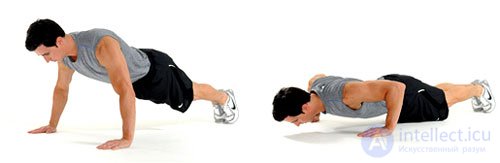
Attention, everyone! Pay attention to the pictures. Only this (full) version is accepted: the starting position is the front plank, hands slightly wider than the shoulders; lower yourself so that only a tennis ball could fit between the chest and the floor (the back and legs perfectly straight throughout the exercise). Everything else (from the knees, from a support) is not accepted. If you are not able to do a push-up in exactly this way, put a dash.
Next, I am interested in the full range of motion. Guys, this applies to you. Half-elbow reps are not it, that is not it at all. Go all the way down, and all the way back up. Absorb the momentum as it happens. Leave the half-range bouncing to your mattress.
Next, regarding the elbows, where they point during the movement. There are options — outward, strictly along the torso, and a middle option of 45 degrees to the torso. Let's not overthink it and test ourselves using the last option. Obviously, you do not need to measure the angles with a protractor; just keep in mind that the elbows go slightly outward.
So, we do push-ups for 1 minute to complete failure of the arms and see what we got in the table below.
If it's lousy, then it's lousy. And we don't need rose-colored cotton wool in the form of 50 push-ups from the knees.
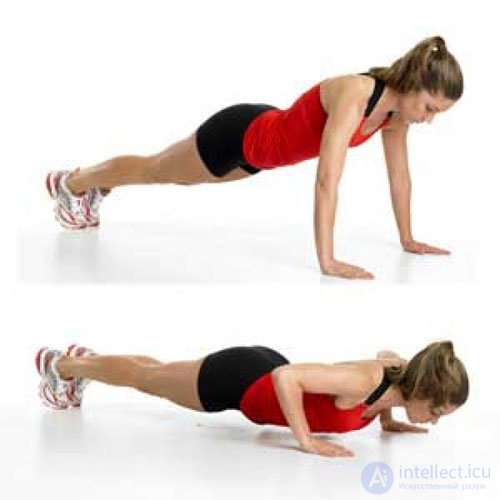
Table for checking the test for men
| Age | 17-19 | 20-29 | 30-39 | 40-49 | 50-59 | 60 and above |
| Excellent | >56 | >47 | >41 | >34 | >31 | >30 |
| Good | 47-56 | 39-47 | 34-41 | 28-34 | 25-31 | 24-30 |
| Above average | 35-46 | 30-39 | 25-33 | 21-28 | 18-24 | 17-23 |
| Average | 19-34 | 17-29 | 13-24 | 11-20 | 9-17 | 6-16 |
| Below average | 11-18 | 10-16 | 8-12 | 6-10 | 5-8 | 3-5 |
| Poor | 4-10 | 4-9 | 2-7 | 1-5 | 1-4 | 1-2 |
| Terrible | 4 | 4 | 2 | 0 | 0 | 0 |
Table for checking the test for women
| Age | 17-19 | 20-29 | 30-39 | 40-49 | 50-59 | 60 and above |
| Excellent | >35 | >36 | >37 | >31 | >25 | >23 |
| Good | 27-35 | 30-36 | 30-37 | 25-31 | 21-25 | 19-23 |
| Above average | 21-27 | 23-29 | 22-30 | 18-24 | 14-20 | 13-18 |
| Average | 11-20 | 12-22 | 10-21 | 8-17 | 15-20 | 13-18 |
| Below average | 6-10 | 7-11 | 5-9 | 4-7 | 3-6 | 2-4 |
| Poor | 2-5 | 2-6 | 1-4 | 1-3 | 1-2 | 1 |
| Terrible | 0-1 | 0-1 | 0 | 0 | 0 | 0 |
I will not go deep into the theory again, I will only say that we do the sit-ups also for exactly 1 minute.
We count the number and look at the table below.
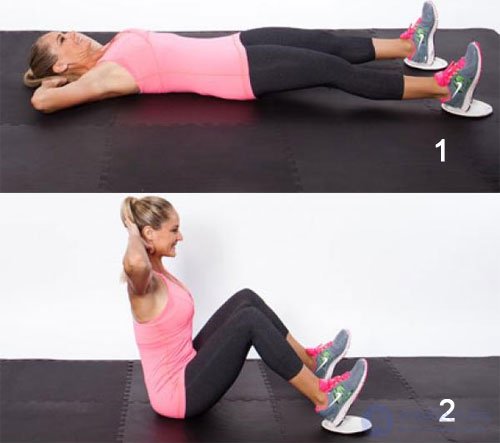
Table for checking the test for men
| Age | 18-25 | 26-35 | 36-45 | 46-55 | 55-65 | 65+ |
| Excellent | >49 | >45 | >41 | >35 | >31 | >28 |
| Good | 44-49 | 40-45 | 35-41 | 29-35 | 25-31 | 22-28 |
| Above average | 39-43 | 35-39 | 30-34 | 25-28 | 21-24 | 19-21 |
| Average | 35-38 | 31-34 | 27-29 | 22-24 | 17-20 | 15-18 |
| Below average | 31-34 | 29-30 | 23-26 | 18-21 | 13-16 | 11-14 |
| Poor | 25-30 | 22-28 | 17-22 | 13-17 | 9-12 | 7-10 |
| Terrible | 25 | 22 | 17 | 9 | 9 | 7 |
Table for checking the test for women
| Age | 18-25 | 26-35 | 36-45 | 46-55 | 55-65 | 65+ |
| Excellent | >43 | >39 | >33 | >27 | >24 | >23 |
| Good | 37-43 | 33-39 | 27-33 | 22-27 | 18-24 | 17-23 |
| Above average | 33-36 | 29-32 | 23-26 | 18-21 | 13-17 | 14-16 |
| Average | 29-32 | 25-28 | 19-22 | 14-17 | 10-12 | 11-13 |
| Below average | 25-28 | 21-24 | 15-18 | 10-13 | 7-9 | 5-10 |
| Poor | 18-24 | 13-20 | 7-14 | 5-9 | 3-6 | 2-4 |
| Terrible | 18 | 13 | 7 | 5 | 3 | 2 |
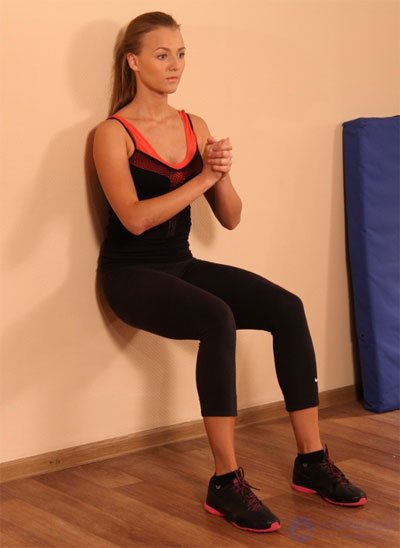
To check the strength of your legs, we will sit against a wall with a stopwatch in the "Chinese chair" position. The picture is given below.
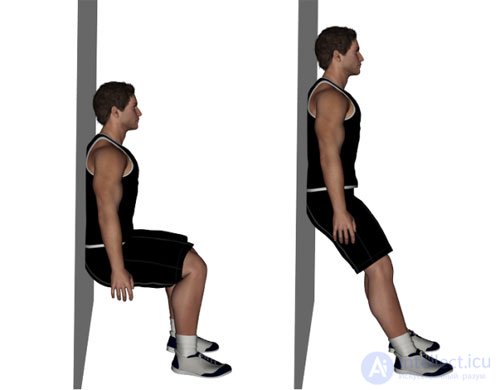
Press your back against the wall and lower yourself into a sitting position so that the angle at your knees is 90 degrees. Start timing as soon as you assume the required position, and hold it for as long as you can.
The key points of the exercise are as follows:
As soon as you begin to rise, sink lower, push against the wall with your hands or against your thighs, the test time ends.
Everything shown in the pictures below is incorrect performance of the exercise.
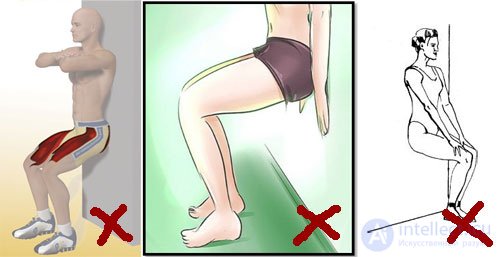
Evaluating the results:
To be sure not to go wrong with your arms, hold them out in front of you, as in the picture below.
To assess and monitor the functional state of the cardiovascular system, simple, valid and relatively informative indicators are widely used that characterize the work of the heart as the sole hemodynamic pump, as well as of the arterial vessels, i.e. the circulatory apparatus as a whole. The heart rate and the values of systolic and diastolic pressure are examined. For this purpose, one-stage, two-stage and three-stage functional tests are used in our country, including those of Martinet–Kushelevsky, Letunov, Karpman and Ruffier [1, 2, 5, 6]. In sports medicine practice, the Robinson index [4, 9], the so-called "double product", has found wide use; it allows (Table 1) an indirect assessment of the functional capacity of the myocardium [3].
1 Test Using the Martinet Method
This test shows how well the body is adapted to exertion in general. The test is performed on a rested body. The test requires the following items:
Resting heart rate is counted immediately after waking up, or if you have not done any strenuous activity for a long time. Count the beats over 10 seconds, then multiply by 6. Alternatively, you can simply sit and count the pulse for exactly 1 minute.
Heart rate after exertion is determined as follows:
Test evaluation using the Martinet method (I remind you that we are testing the body's adaptive capacity to exertion). Here we compare the figures before and immediately after exertion:
Evaluation of measurements using the Ruffier-Dickson method:
(p1+p2+p3) - 200
---------------------------
10
where
p1 – resting pulse,
p2 – pulse after exertion,
p3 – pulse after one minute of rest.
Formula results of 1-3 – excellent,
formula results of 3-6 – good,
formula results of 6-9 – satisfactory.
2. Ruffier Test (Index),
The Ruffier test (index), calculated using the formula

where HR1 – pulse over 15 s at rest;
HR2 – pulse over the first 15 s of the first minute of recovery;
HR3 – pulse over the last 15 s of the first minute of recovery.
There are discrepancies in the interpretation of the test data obtained. For example, on the one hand, levels of the heart's functional reserve were determined using five grades
: less than 3 – high level;
4–6 – above average (good);
7–9 – average;
10–14 – below average (satisfactory);
more than 15 – low.
On the other hand, the numerical values were interpreted as follows: less than
0 – athletic heart;
0.1 to 5 – "excellent", a very good heart;
5.1 to 10 – "good", i.e. a good heart;
10.1 to 15 – "satisfactory", moderate heart failure;
15.1 to 20 – "poor", i.e. severe heart failure.
On the basis of the Ruffier test alone, children are divided into three health groups: basic, preparatory and special.
The basic group includes healthy children in whom no abnormalities were found after a medical examination and on the results of the Ruffier test. They may take physical education under the general program and also take part in various sports competitions.
The preparatory group includes children in whom minor health abnormalities have been found and whose Ruffier index is low. Children in this group follow the basic program but are exempt from physical exertion such as cross-country runs and sports competitions.
The special group includes children whose health condition requires an individual approach to physical exertion. It often happens that, judged by health status, a child belongs to the basic physical education group, whereas the Ruffier index values indicate the presence of heart failure and that the heart may not withstand physical exertion.
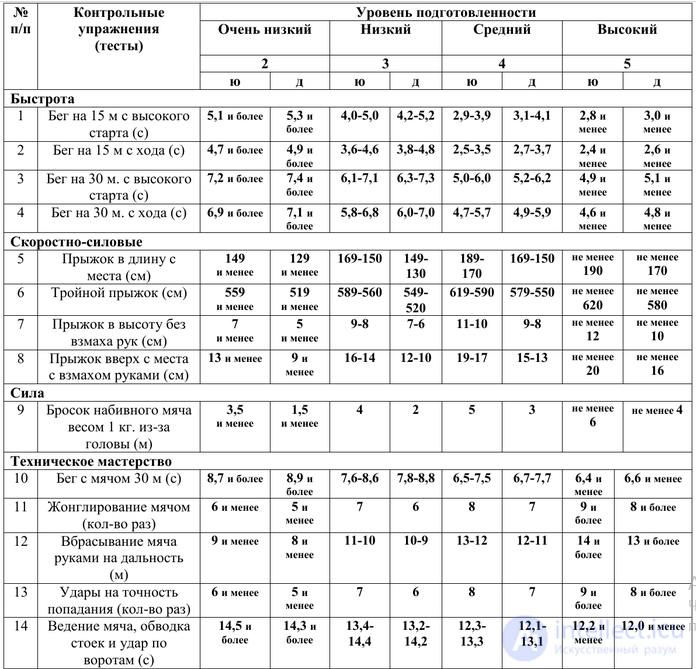
Instructions for performing control standards (tests)
15-meter run.
Speed qualities are assessed. The test is performed from the starting line with a standing start on an audible signal. This test can be conducted in a gymnasium. Two attempts are given and the best result (s) is recorded.
15-meter run with a flying start.
A 10-meter segment for the run-up and a 15-meter segment for the timed run are marked. Students begin running from a standing start. The stopwatch is started at the mark of the beginning of the second segment. The time taken to run the 15-meter segment is recorded.
30-meter run with a standing start.
Conducted to assess the speed abilities of students. Performed from the starting line on a signal. The time taken to run the 30
-meter segment (s) is recorded and assessed.
30 m run with a flying start.
Conducted similarly to the previous test. The run-up segment is 20 m, the timed segment 30 m.
Standing long jump
. From the starting line, pushing off with both feet forward. Landing on both feet. Measurement is taken at the point where the heels land. If one foot lands ahead of the other, the measurement is taken at the rear foot. Two attempts are given and the best result is recorded.
Triple jump
is aimed at assessing speed-strength qualities. The first jump is performed with a two-footed push-off from the starting line, followed by landing on one foot. The second and third jumps are performed with a push-off from one foot, and after the third push-off the student lands on both feet. The result is assessed by the length of the triple jump in meters (two attempts are given).
Standing high jump with an arm swing.
Speed-strength qualities are assessed. A ruler with markings, or with a centimeter tape attached, is positioned vertically.
The student bends the knees and, pushing off the floor by straightening the knees, performs a jump with an arm swing. Two attempts are given. The best result is recorded.
Standing high jump without an arm swing.
Speed-strength qualities are assessed. Conducted similarly to the previous test, except that the arms are pressed against the torso.
30 m run with a ball
is performed from a standing start; the ball may be dribbled in any manner, with at least three touches of the ball over the segment, not counting stopping beyond the finish. The exercise is considered complete when the player crosses the finish line. The judge at the start checks that the start is correct and counts the touches, and the judge at the finish records the running time with a stopwatch.
Kicking the ball for distance and accuracy
Kicks are made at a stationary ball into 5x5 m squares, in any manner, with the ball required to land in the squares. The squares are arranged in a
staggered pattern. The assessment is based on the distance from which the student hits all the squares (each age group has its own distance).
Ball juggling.
The person juggles the ball in any manner, alternating touches with the left and right foot. Two attempts are given. The number of ball touches without the ball dropping is assessed.
Accuracy shots on goal
are performed at a stationary ball with the right and left foot from a distance of 17 m (for ages 11-12, 11 m). The ball is sent through the air into a goal 1.2 m high and 2.5 m wide; kicks may be made in any manner. Ten kicks are taken with each foot. The total number of hits is counted.
Throw-in for distance
is performed in accordance with the rules of football along a corridor 2 m wide. A ball that lands outside the corridor is not counted. Three attempts are given. The best result is counted.
Dribbling, going around 4 cones and shooting on goal
. On a signal, the student dribbles around four cones placed 7 meters apart, starting from the center of the field. After going around them, a shot on goal is taken from outside the penalty
area. The ball must cross the goal line through the air. The standard is timed. The stopwatch is started when the student begins to move and stopped after the ball is kicked, when it has crossed the goal line.
Take the AC test
Take the GPP test
In sports medicine practice, to assess the functional state of the cardiovascular system in fitness enthusiasts and novice athletes, it is advisable to use the simple and sufficiently informative Martinet–Kushelevsky test, as well as the calculated Robinson index. They should be carried out according to the classical methods. The Ruffier index is advisable for qualified athletes and only in its original version.
There is no need to be upset by unsatisfactory results. These are just tests. And in time they will get better.
We are here to change. And if there is nothing to change, there is nothing to do here. I am for change. And you?
1. Gurtovaya M.N. Physical work capacity of boys aged 7–9 with allergic rhinitis at the initial stage of sports training / M.N. Gurtovaya, E.T. Kolunin, N.Ya. Prokopyev. // Medical Science and Education of the Urals. – 2013. – No. 3(75). – P. 80–82.
2. Karpman V.L. Testing in Sports Medicine / V.L. Karpman, Z.B. Belotserkovsky, I.A. Gudkov. – Moscow: FiS, 1988. – 208 p.
3. Kudrya O.N. Indicators of the physiological systems of athletes at different stages of the annual cycle / O.N. Kudrya, V.V. Verner. // Theory and Practice of Physical Culture. – 2008. – No. 7. – P. 67–71.
4. Mikhalyuk E.L. Functional tests in sports medicine: advantages and disadvantages of their use / E.L. Mikhalyuk, V.V. Syvolap, I.V. Tkalich, S.I. Atamanyuk // Current Issues in Pharmaceutical and Medical Science and Practice. – 2010. – Issue XXIII, No. 1. – P. 93–96.
5. Prokopyev N.Ya. Assessment of physical work capacity and functional state of the cardiovascular system of schoolchildren in the city of Tyumen / N.Ya. Prokopyev, S.G. Marinskikh. // Bulletin of Tyumen State University. – 2011. – No. 6. – P. 127–133.
6. Prokopyev N.Ya. Physical work capacity and functional reserves of the cardiovascular system of schoolchildren in Tyumen / N.Ya. Prokopyev, S.G. Marinskikh, V.I. Nazmutdinova. // Bulletin of Shadrinsk State Pedagogical University. – 2011. – No. 1 (10). – P. 142–148.
7. Sidorov S.P. The importance of correctly performing the 20-squat functional test method when assessing the cardiovascular system of young athletes / S.P. Sidorov, A.M. Perkhurov, O.S. Shtefan. // Physical Culture in Prevention, Treatment and Rehabilitation. – 2009. – No. 2 (29). – P. 39–44.
8. Tests in Sports Practice / H. Bubé, G. Fäck, H. Stübler, F. Trogsch. – Moscow: FiS, 1968. – 239 p.
9. Robinson B.F. Relation of heart rate and systolic blood pressure to the on set of pain in angina pectoris // Circulation. – 1967. – Vol. 35, No. 6. – P. 1073–1083.

Comments