
Lecture
Modern people face a large number of tasks every day: work or study, household duties, communication, financial matters, decision-making, and the need to adapt to change. All of these processes require certain resources. If a person expends resources faster than they can replenish them, fatigue gradually develops, and concentration, motivation and the ability to solve problems effectively decline.
A resourceful state can be defined as a state in which a person has sufficient physical, emotional, intellectual, social and material capacities to carry out current tasks and to recover after strain. In the psychological literature, psychological resources are viewed as a combination of a person's internal potentials and external socio-psychological factors that help them cope with stress and achieve life goals.
A resource is not only energy or a good mood. For example, knowledge, money, time, the support of loved ones, health, professional skills and the ability to rest are also resources.
In a world of constant change and growing demands, a person's ability to maintain a resourceful state becomes a key factor in personal resilience and success. Resources are not only physical strength or material means, but also emotional, mental, temporal and social supports that make it possible to cope with challenges and move toward goals without exhaustion. Understanding one's life resources is the first step toward a more conscious and sustainable life, in which energy is distributed wisely and actions are aligned with inner needs.
A person's resourceful state is a concept from psychology and healthcare that describes the physical, emotional and psychological resources available to a person for coping with everyday stressful situations, performing tasks and ensuring overall well-being. It is a concept that emphasizes the importance of having different types of resources to maintain health and effectiveness in life.
Resources can be diverse and include the following features:
Physical resources: These are health, physical endurance, energy and physical activity. A person's physical condition influences their ability to cope with daily tasks and stress.
Emotional resources: These include emotional stability, the ability to manage one's emotions, support from loved ones, and positive emotional states such as joy and satisfaction.
Social resources: These are a social network, support from friends and family, and the opportunity to communicate and interact with other people. Strong social ties and support from others play an important role in a person's resourceful state.
Psychological resources: These include self-confidence, determination, adaptive cognitive strategies, and the ability to solve problems and manage stress.
Internal resources: These are internal motivation, beliefs, values and personal qualities that can support personal growth and development.
Educational resources: These are the level of education and access to information and knowledge that can help in solving tasks and developing skills.
The "give-and-take" balance in relationships: The ability to establish balanced, mutually beneficial relationships with other people is important for maintaining energy balance. This includes the ability to give and receive support, as well as the ability to set boundaries and not deplete oneself in relationships.
Respecting personal boundaries: Understanding and respecting your personal boundaries helps prevent overspending of energy. This includes the ability to say "no" and to set boundaries when necessary.
Awareness of your thoughts: Being aware of and managing your thoughts and inner dialogue can significantly affect your energy level and emotional state.
Dividing events and activities into those that replenish and those that drain energy: The ability to identify which events and activities in your life bring energy and inspiration and which drain it allows you to manage your resources more effectively.
Doing what you love: Engaging in activities that bring joy and satisfaction is an important spiritual resource. This can include hobbies, creative pursuits and other interests.
Understanding the importance of your work to yourself: When a person realizes that their activity has meaning and significance for them personally, this contributes to their spiritual resources and internal motivation.
Awareness of your mission and worth: Understanding your own mission in life and the value you bring to the world can be a source of inner strength and motivation.
Integrating these energy and spiritual resources into daily life can help improve quality of life, enrich personal growth and development, and ensure inner balance and well-being.
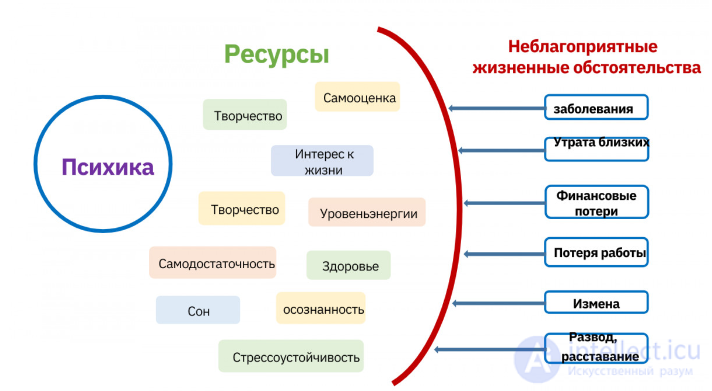
A person's resourceful state may change depending on life circumstances, stressful situations and internal factors. Awareness and development of resources can contribute to improved physical and psychological well-being, and increase the ability to cope with challenges and stress in life.
All these components are interconnected, and a change in one of them can affect the others. Identifying a non-resourceful state is an important aspect of maintaining health and well-being. Psychologists identify several signs that may indicate a non-resourceful state:
Constant fatigue and exhaustion: If a person constantly feels physically and emotionally tired, this may be a sign of a lack of energy and resources.
Decreased motivation and interest: Loss of interest in usual activities and reduced motivation may indicate a deterioration of emotional and spiritual state.
Feelings of helplessness and worthlessness: If a person begins to doubt their abilities and worth strongly, this may be a sign of a non-resourceful state.
Isolation and lack of social activity: If a person avoids contact with others, withdraws into themselves and finds no pleasure in social interactions, this may indicate problems with emotional and social resources.
Reduced sleep quality: Sleep disturbances such as insomnia or excessive sleepiness may result from emotional and energy imbalance.
Reduced productivity and quality of task performance: When a person is short of resources, their ability to cope with duties and tasks may deteriorate.
Increased stress and anxiety levels: Negative emotions, anxiety and worry can aggravate a non-resourceful state.
Physical symptoms: For example, headaches, back pain and digestive problems may be associated with a non-resourceful state.
If you notice signs of a non-resourceful state in yourself or in someone close to you, it is important to pay attention to this condition and take steps to restore resources and maintain psychological and physical well-being. This may include seeking support from a psychologist or doctor, attending to physical health, practicing meditation and relaxation, and paying attention to spiritual and emotional needs.
Resource drains can often have a serious effect on a person's emotional and physical state. Let us look at some of them in more detail:
Constantly ruminating on and analyzing past events: Constantly returning to past failures, mistakes and negative events can lead to an endless cycle of anxious and negative thoughts, which exhausts emotional resources.
Clutter in the environment: Untidiness and disorder at home or in the workplace can create additional stress and drain energy when looking for things and carrying out duties.
Lack of interests and hobbies: A lack of interests and pleasures in life can lead to feelings of despondency and aimlessness, which reduces motivation and emotional resources.
Resentment and anger: Holding on to resentment and anger toward someone can create constant tension and drain emotional energy.
Unfinished business: Unfinished tasks and projects can cause feelings of anxiety and dissatisfaction with oneself, which lowers self-esteem and motivation.
Negative surroundings: Interacting with negative or toxic people can affect our emotional state and energy, leaving little room for positive interactions.
Financial debts: Worrying about financial obligations and debts can cause stress and anxiety, which drains energy.
Regularly sleeping in the same bed as children: A lack of personal space and time for rest can affect emotional and physical well-being.
Constant snacking and unappetizing food: Poor nutrition and a lack of time to prepare healthy food can lower energy levels and affect overall condition.
To manage these "non-obvious" resource drains more effectively, it is important to be aware of their influence on your life and to take steps to eliminate or reduce their negative impact. This may include setting priorities, developing time management strategies, finding ways to relax, and seeking support from a psychologist or counselor.
Restoring a resourceful state is a process that involves managing emotions and physical and psychological resources in order to improve overall well-being and effectiveness. Here are some steps that will help you enter a resourceful state:
Conscious breathing: Deep, conscious breathing can help relieve tension and create a sense of relaxation. Try taking several deep inhalations and exhalations, focusing your attention on your breathing.
Positive thoughts and affirmations: Replace negative thoughts with positive ones. Use affirmations to strengthen your confidence and motivation.
Physical activity: Even a small amount of physical activity, such as a short walk or stretching, can raise energy levels and improve mood.
Relaxation: Use relaxation techniques such as yoga, meditation or deep progressive muscle relaxation to reduce stress and tension.
Planning and organization: Set clear goals and tasks for yourself and develop an action plan. This will help you feel more confident and purposeful.
Social support: Spending time with loved ones and receiving support from friends and family can lift your mood and strengthen emotional resources.
Taking care of physical health: A proper diet, sufficient sleep and regular physical activity will help maintain physical resources.
Spending time on hobbies and interests: Do what brings you pleasure and joy. This will help you feel more balanced and inspired.
Psychological support: If necessary, turn to a psychologist or counselor for professional help in managing emotions and stress.
A positive environment: Try to surround yourself with positive and supportive people, and avoid toxic relationships and settings.
It is important to remember that entering a resourceful state is an individual process, and each person can find their own ways of restoring resources. Experiment and find the methods that work best for you.
Getting rid of stress, procrastination and frustration, limiting the flow of information, and communicating in a calm state are important aspects of maintaining a resourceful state. Here is how you can work with each of them:
Stress:
Procrastination:
Frustration:
Limiting the flow of information:
Communicating in a calm state:
The ability to set priorities and stay in touch with loved ones plays an important role in maintaining a resourceful state and psychological health. Let us look at them in more detail:
Setting priorities:
Support from loved ones:
Avoiding "energy vampires":
By maintaining a balance of priorities and ensuring emotional support for yourself, you can manage your resources more effectively and sustain a resourceful state in everyday life.
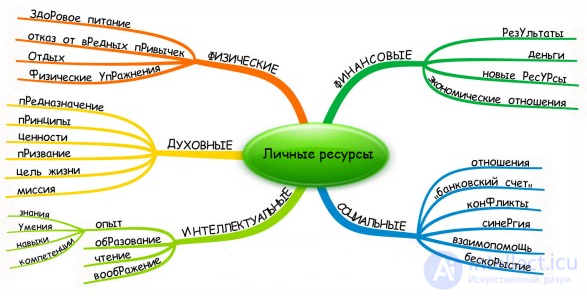
Life resources can be conventionally divided into six main groups.
The physical resource is related to the state of the body and includes:
Sleep is one of the main means of recovery. Sleep deprivation can lead to reduced attention, work capacity, and emotional stability.
For an adult, a practical guideline is 7–9 hours of sleep per day, although individual needs vary.
Physical activity is also a way of maintaining this resource. The World Health Organization recommends that adults perform 150–300 minutes of moderate-intensity aerobic physical activity per week or 75–150 minutes of vigorous-intensity activity. In addition, muscle-strengthening exercises involving the major muscle groups are recommended on at least 2 days per week.
Thus, a minimum guideline may look as follows:
150 minutes of activity ÷ 7 days ≈ 21 minutes per day.
For example, this could be about 30 minutes of brisk walking 5 days a week.
The emotional resource is a person's ability to experience, express, and regulate emotions without damaging their own well-being.
It includes:
For example, a conflict lasting 30 minutes may be over within half an hour, but its emotional consequences may persist for several more hours.
Therefore, it is important to consider not only the duration of an event, but also its psychological "cost."
It is practically useful to set aside at least 20–30 minutes every day for an activity that is not related to obligations and that brings pleasure or a sense of recovery.
The intellectual resource is a person's capacity to concentrate, remember information, analyze situations, make decisions, and learn.
It is especially important for students, managers, and knowledge workers.
The main sources of the intellectual resource:
For example, if a person works at a computer for 8 hours, this does not mean that they are able to maintain the same level of concentration for all 8 hours.
It is useful to divide complex intellectual work into blocks of 45–90 minutes, followed by a short break.
A sample structure of a working day:
60 minutes of work → 5–10 minutes of break → 60 minutes of work → 20–30 minutes of a longer break.
The specific duration should be chosen individually.
Time is a special resource because it cannot be accumulated or brought back.
Every person has approximately:
24 hours × 60 minutes = 1,440 minutes per day.
If a person sleeps 8 hours:
24 − 8 = 16 waking hours.
If work or study takes another 8 hours:
16 − 8 = 8 hours.
After that, it is necessary to account for commuting, meals, household chores, personal care, and social interaction.
For example:
| Type of activity | Time per day |
|---|---|
| Sleep | 8 h |
| Work/study | 8 h |
| Commuting | 1 h |
| Meals | 1.5 h |
| Household chores | 1 h |
| Free time | 4.5 h |
| Total | 24 h |
The table shows that the feeling of "I have no time" is often related not only to the number of tasks, but also to where the 1,440 minutes of each day are actually allocated.
The social resource consists of the relationships and connections that help a person obtain support, information, assistance, and a sense of belonging.
It includes:
A person may have good physical resources but experience severe exhaustion due to social isolation.
The source of this resource is not the number of acquaintances but the quality of relationships. Sometimes one person with whom you can talk honestly and receive support is more valuable than dozens of superficial contacts.
The material resource includes money, housing, property, and other material means.
Money makes it possible to meet basic needs and reduces the number of situations of uncertainty.
To assess the financial resource, a simple formula can be used:
Financial reserve = available savings ÷ average monthly essential expenses.
For example, if a person has savings of 120,000 UAH and essential expenses are 30,000 UAH per month:
120,000 ÷ 30,000 = 4 months.
That is, if expenses remain unchanged, the available funds would theoretically last 4 months.
This is not a universal norm, but a simple indicator for personal financial planning.
It is convenient to represent the resource state as a balance:
Resource state = resource intake − resource expenditure.
If over a week a person receives a notional 100 resource units and spends 120, a deficit arises:
100 − 120 = −20.
If the situation repeats, cumulative depletion develops.
Conversely, if a person spends 100 units and restores 110:
110 − 100 = +10.
This is how a reserve is formed.
It is important to understand that "resource units" here are a notional self-assessment scale, not a medical or scientifically standardized measurement.
For self-assessment, you can use a scale from 0 to 10.
0 points — the resource is practically absent.
5 points — an average state; the person is able to perform basic tasks.
10 points — a feeling of high fullness and sufficiency of strength.
Rate yourself on the following parameters:
| Resource | Score 0–10 |
|---|---|
| Physical energy | ___ |
| Sleep quality | ___ |
| Emotional state | ___ |
| Concentration and thinking | ___ |
| Time | ___ |
| Social support | ___ |
| Financial stability | ___ |
| Rest and recovery | ___ |
| Meaning and motivation | ___ |
| Personal space | ___ |
Maximum score:
10 indicators × 10 = 100 points.
For example, a person obtained:
Sum:
6 + 5 + 4 + 7 + 3 + 8 + 6 + 3 + 7 + 4 = 53 points out of 100.
This is not a diagnosis or a psychological test, but a tool for structured self-reflection.
The main point of such a calculation is not the total itself, but identifying the weakest areas.
After the assessment, you need to answer three questions for each type of resource.
For example:
For example:
Here it is necessary to divide the factors into two groups:
Controllable:
Partially or completely uncontrollable:
Working with resources is more effective when a person focuses first and foremost on the part of the situation that they can actually change.
For a more detailed analysis, you can create your own table.
| Resource | Current level 0–10 | Source | Main drain | What to do |
|---|---|---|---|---|
| Physical | 6 | sleep, walks | sleep deprivation | add 30 min of sleep |
| Emotional | 4 | social interaction | conflicts | reduce conflict-prone contacts |
| Intellectual | 7 | learning | multitasking | work in blocks |
| Time | 3 | planning | social media | limit the time |
| Social | 8 | family, friends | conflicts | maintain meaningful relationships |
| Financial | 6 | work | unnecessary expenses | keep a budget |
| Meaning | 7 | goals | lack of results | define 3 priorities |
Such a table makes it possible to move from an abstract feeling of "I am tired" to a specific question:
"Which resource, exactly, is depleted right now?"
Recovery should be directed specifically at the resource that has been spent.
If the problem is related to physical exhaustion, physical rest is needed.
If a person is overloaded with information, additional information consumption in the form of social media is not always rest. Sleep, a walk, or a calm activity may prove more effective.
If the main deficit is related to social support, solitude may not solve the problem — a conversation with a loved one may be needed.
You can use the rule:
"Identify the deficit → find a source of recovery → set aside time → evaluate the result."
For example:
Deficit: time resource — 3/10.
Cause: too many tasks.
Action: remove 2 non-essential tasks.
Time: 30–60 minutes daily.
Reassessment: after 7 days.
For practical work, the following model can be used:
Resource state = recovery + support + meaning + load management − chronic losses.
Where:
This model shows that improving the resource state does not always require "doing more." Sometimes it is much more effective to reduce the constant drain on resources.
Identifying your life resources is an important stage of self-analysis that helps you understand what you have and which tools are available to cope with life's challenges. Below are the main categories of life resources with examples:
Physical resources:
Emotional resources:
Intellectual resources:
Social resources:
Spiritual and value-based resources:
To identify your life resources, you can conduct a self-analysis by asking yourself the following questions:
Exploring and becoming aware of your life resources will help you manage your life better, make plans, and achieve your goals.
Here are examples of the life resources of a hypothetical person, to help you identify your own life resources:
Physical resources:
Emotional resources:
Intellectual resources:
Social resources:
Spiritual and value-based resources:
Financial resources also play an important role in life. They include your financial security, your ability to manage money, and your financial skills. Here are examples of answers related to financial resources:
Financial security:
Ability to manage money:
Financial skills:
Financial resources can influence your ability to lead a comfortable lifestyle, achieve financial goals, and feel confident in financial decisions. The ability to understand and manage finances can contribute to your overall well-being.
These answers can help you better understand your strengths and the resources that you can use to achieve your goals and solve life's tasks.
It is important to remember that changes in these areas may require time and effort. It may help to develop a personal action plan that includes specific steps and strategies for managing stress, procrastination, and other problematic aspects. Systematic application of these methods can contribute to your overall well-being and resource state.
Maintaining a resourceful state is a key factor in overall well-being and psychological health.
Maintaining a resourceful state requires awareness and effort, but it allows you to cope better with challenges and achieve personal and professional goals. Developing an action plan that includes the strategies described above can help you create a more balanced and satisfying life.
Awareness and management of your life resources is not a luxury but a vital necessity for modern people. The ability to recognize, replenish, and strengthen your resource potential makes it possible not only to prevent burnout but also to build a harmonious, purposeful life. It is important to develop the habit of a regular internal audit by asking yourself: "Where are my supports? What nourishes me? Where do I lose strength?" These simple but powerful guideposts open the way to resilience, in which a person not only survives but also realizes their potential.
A person's resource state is a dynamic balance between what a person receives and what they expend. Resources take different forms: physical, emotional, intellectual, time, social, material, and meaning-related.
Identifying your own life resources begins with a simple procedure: assess each area on a scale from 0 to 10, and identify the main sources of recovery and the main causes of expenditure.
For example, if a person has the following scores:
physical — 6/10; emotional — 4/10; intellectual — 7/10; time — 3/10; social — 8/10; financial — 6/10,
then the main areas of focus become the emotional and time resources. In this case, an attempt to increase productivity by increasing the amount of work may lead to further depletion. It is more rational first to reduce the load and create conditions for recovery.
Thus, taking care of your own resources is not a striving to be in a state of maximum activity all the time. It is the ability to notice the expenditure of resources, restore them in a timely manner, and distribute the available strength in accordance with your real life priorities.
Physical activity, sleep, rest, supportive relationships, and care for mental well-being are among the practices that the World Health Organization also considers in the context of maintaining health and well-being.

Comments