
Lecture
Antivitamins are a group of organic compounds that suppress the biological activity of vitamins. They are compounds that are chemically similar to vitamins but have the opposite biological effect. Once in the body, antivitamins take the place of vitamins in metabolic reactions and inhibit or disrupt their normal course. This leads to vitamin deficiency even when the corresponding vitamin is supplied with food in sufficient amounts or is produced in the body itself.
For example, the antivitamins of vitamin B1 (thiamine) are pyrithiamine and the enzyme thiaminase, which cause polyneuritis.
Antivitamins are substances that can interfere with the normal functioning of vitamins in the body. They act by blocking, destroying, or reducing the activity of vitamins. Antivitamins may arise as a result of consuming certain foods, interactions between drugs and vitamins, or external factors. They can lead to vitamin deficiency and cause various diseases and symptoms.
Examples of antivitamins:
Antivitamin A (retinoids): Some compounds, such as isotretinoin, can reduce the activity of vitamin A, which may impair immune function and lead to dry skin and other problems.
Antivitamin K (coumarins): Coumarins, such as warfarin, are used as anticoagulants, but they can also interfere with the normal formation of vitamin K in the body, which may affect blood clotting.
Antivitamin B6 (isoniazid): Isoniazid, used to treat tuberculosis, can cause vitamin B6 deficiency, which may lead to neurological symptoms.
Antivitamin D (phenytoin): Phenytoin, used in some neurological diseases, can lower vitamin D levels in the body.
Antivitamin C (aspirin): Long-term use of aspirin in large doses can reduce the absorption of vitamin C.
It is important to know that antivitamins can be harmful to health, and their intake or their effect on vitamins should be monitored and taken into account when choosing food or taking medications. People taking medications that may affect vitamin levels in the body should consult a doctor to determine whether additional measures are needed to maintain vitamin balance.
Advances in research in chemotherapy, the nutrition of microorganisms, animals and humans, and the determination of the chemical structure of vitamins have created real opportunities to refine our understanding of the antagonism of substances in the field of vitaminology as well. At the same time, the discovery of antivitamins has contributed to a fuller and deeper study of the physiological action of the vitamins themselves, since the use of an antivitamin in an experiment abolishes the action of the vitamin and causes corresponding changes in the body; this to some extent broadens our knowledge of the functions that a given vitamin performs in the body.
Antivitamins are known for almost all vitamins. They can be divided into two main groups:
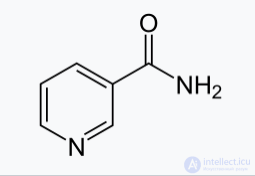
Nicotinamide, the amide of nicotinic acid, is one of the active forms of vitamin PP. It is a component of the coenzymes NAD+ and NADP+, which participate in the transfer of protons in many biochemical redox reactions, for example, in the oxidation of ethanol to acetaldehyde in the liver.
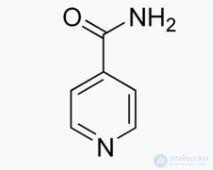
Isonicotinamide, the amide of isonicotinic acid, despite its structural similarity to nicotinamide (vitamin B3 or PP), exhibits a pronounced antivitamin effect (it suppresses the physiological effects of vitamin B3) and is therefore considered its antivitamin. Consequently, it is widely used in the synthesis of isonicotinic acid hydrazide (isoniazid), which is an antituberculosis drug.
Under the influence of environmental factors — temperature, oxygen and other oxidizing agents, light (especially ultraviolet, including that in sunlight), acids, alkalis and bases — vitamins are destroyed and lose their biological activity. Different vitamins vary in their sensitivity: some are highly stable, while others break down quickly. This is primarily because vitamins, by virtue of their chemical structure, are highly reactive compounds that readily enter into chemical reactions. From the moment a vitamin molecule comes into being, whether naturally or by chemical synthesis, until it enters the body, its fate depends largely on the conditions of storage and processing.
The main factors of vitamin instability are:
| Vitamin | To light | To oxidation | To reduction | To heating | To metal ions | To moisture | Optimal pH |
| A | H | H | M | M | L | Neutral, slightly alkaline | |
| K3 | M | L | M | M | H | M | Neutral, slightly alkaline |
| B1 | L | M | H | H | M | M | Slightly acidic |
| B2 | H | L | M | M | L | Neutral | |
| B3 | L | L | Neutral | ||||
| B5 | M | L | Neutral | ||||
| B6 | L | L | M | L | Acidic | ||
| B9 | M | M | M | L | L | L | Neutral |
| B12 | M | M | L | L | Neutral | ||
| C | L | H | L | H | H | M | Neutral, acidic |
| D3 | H | H | M | M | M | Neutral, slightly alkaline | |
| E | L | L | M | L | L | Neutral |
H — highly sensitive
M — moderately sensitive
L — slightly sensitive
Because solutions of vitamin C have low stability, to retain it in a finished dish (soup), it is recommended to add the foods containing it to boiling water rather than cold water .
Although heat treatment destroys some vitamins, it increases the availability of others, particularly those found in vegetables; the method of cooking matters here[54].

Comments