
Lecture
The concept of communal hygiene is "hygiene of populated areas" (from French communis — dwelling, settlement, populated place — and Greek hygieinos — bringing health).
Communal hygiene is an independent branch of hygiene science that studies the patterns of positive and negative influence of all factors of the external, ambient, and internal environment and of socioeconomic conditions on the health of the population living in settlements or in autonomous enclosed spaces (spacecraft, submarines), as well as the patterns of influence of human and societal physiological, domestic, and occupational activity on the environment, with the aim of preserving and promoting the health of the population and creating the most favorable sanitary living conditions.
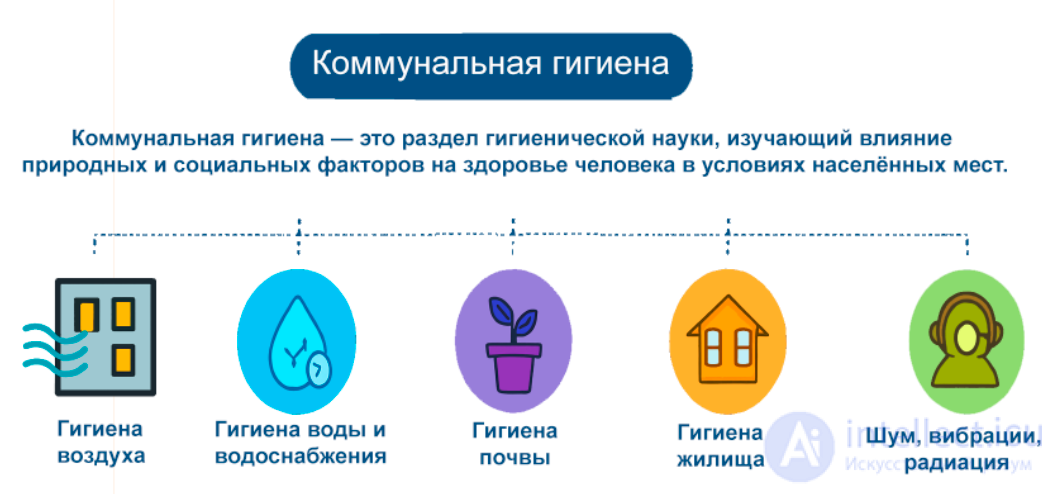
The main sections of communal hygiene are:
1. Hygiene of water and water supply of populated areas.
This section provides the scientific basis for hygienic standards of water quality for domestic and drinking water supply, ensuring that the population receives water that is epidemiologically safe, chemically harmless, and favorable in organoleptic properties, and it also establishes the norm of domestic and drinking water supply in a settlement to meet the basic hygienic functions of water. It addresses the selection of the best water supply sources that satisfy the population's need for good-quality drinking water. Methods of water treatment are presented, and the choice of optimal, principal schemes of water supply for settlements and individual facilities is substantiated, so as to provide the population with a sufficient quantity of good-quality drinking water. It defines the hygienic requirements that must be met in the siting of equipment and in the operation of waterworks and networks in order to ensure high-quality drinking water.
2. Sanitary protection of water bodies.
It scientifically substantiates the quality of water in water bodies with a view to their use as sources of centralized domestic and drinking water supply or for recreational purposes. It studies the sources of pollution of water bodies and their hazard to human health. It substantiates the maximum permissible concentrations (MPCs) of chemical and biological pollutants in water bodies and determines the conditions for discharging wastewater into water bodies in each specific case to ensure proper water quality. It scientifically substantiates the principal sewerage schemes for settlements and separately located facilities. It determines the main operating parameters of sewage treatment plants that ensure highly effective removal of organic, biological, and chemical pollutants from wastewater. It takes part in the design of new treatment facilities. It substantiates the hygienic requirements for the siting of equipment and the operation of sewage treatment plants and networks in order to ensure proper efficiency of wastewater treatment.
3. Sanitary protection of soil and sanitation of populated areas.
This section studies the sources and conditions of soil contamination by chemical and biological substances. It scientifically substantiates the maximum permissible concentrations of exogenous chemical substances (MPC of ECS) in soil, and investigates the migration of pollutants into the surface layer of the atmosphere and the accumulation of harmful substances in plant-derived products. It substantiates the sanitary requirements for the cleaning of settlements in order to create healthy living conditions in them.
4. Sanitary protection of atmospheric air.
It studies the sources of atmospheric pollution and the conditions affecting the intensity and range of dispersion of atmospheric pollutants. It scientifically substantiates the concentrations of atmospheric pollutants that are harmless to the health of the population and do not impair sanitary and living conditions (maximum permissible maximum single concentrations, MPC-MS, and average daily concentrations, MPC-AD). It substantiates the hygienic requirements for the siting and operation of industrial facilities that are sources of atmospheric pollution, in order to prevent concentrations of atmospheric pollutants exceeding hygienic standards from appearing in the air of residential areas.
5. Hygienic significance of physical factors in populated areas.
It studies the influence on the health and living conditions of the population of such physical factors as noise, vibration, electromagnetic fields, etc. It scientifically substantiates the maximum permissible levels (MPLs) and other measures for preventing the adverse effects of physical factors on the health and residence of the population in settlements.
6. Hygiene of residential and public buildings and structures.
It studies which conditions of the indoor environment of residential and civic buildings and structures are optimal for humans, and what significance architectural and planning solutions, engineering equipment, interior design, and the organization of the operating regime have in ensuring hygienic conditions of the indoor environment.
7. Hygiene of the planning of populated areas.
It examines the health-promoting significance of natural and climatic conditions and their role in creating favorable living conditions for the population. It determines how they should be taken into account in the planning of settlements, the selection of sites for settlements, functional zoning, etc. It scientifically substantiates urban planning measures for using favorable natural factors and reducing to a safe level the possible adverse influence of some of them. It establishes hygienic requirements for urban development in view of the possible adverse influence on living conditions and population health of a complex of anthropogenic environmental factors.
8. Population health as an integral criterion for assessing the state of the environment.
It defines methodological approaches to studying the influence of external and environmental factors on the health of the population in populated areas using mathematical methods and computer technology. It scientifically substantiates and plans health-promoting measures for preserving and improving population health in settlements at the individual, group, and population levels.
Air hygiene — control of pollution, ventilation, and microclimate.
Water and water supply hygiene — assessment of drinking water quality, protection of sources, sanitary standards for water supply systems.
Soil hygiene — prevention of soil contamination by household and industrial waste.
Housing hygiene — sanitary requirements for layout, lighting, humidity, and occupancy density.
Noise, vibration, radiation — assessment and minimization of harmful physical factors.
Organization of sanitary supervision — monitoring compliance with standards, prevention of epidemics.

Comments