
Lecture
Oxidative stress (from English oxidative stress) is the process of cell damage resulting from oxidation.
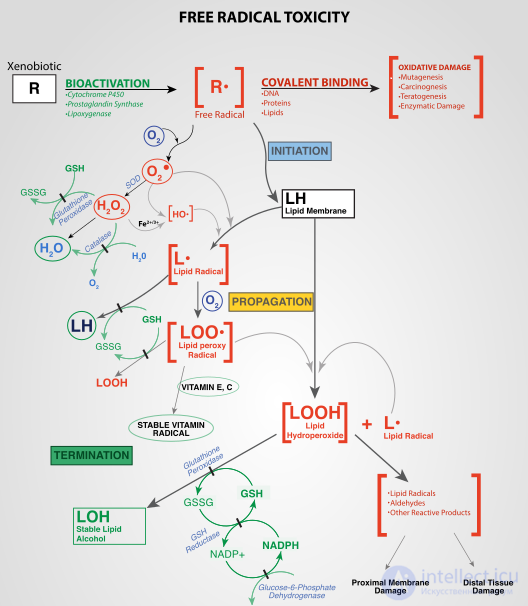
All forms of life maintain a reducing environment within their cells. The cellular "redox status" is maintained by specialized enzymes through a constant input of energy. Disruption of this status causes elevated levels of toxic reactive oxygen species, such as peroxides and free radicals. As a result of the action of reactive oxygen species, important cell components such as lipids and DNA are oxidized.
In humans, oxidative stress is a cause or an important component of many serious diseases, such as atherosclerosis hypertension Alzheimer's disease , diabetes, infertility , and it is also one of the components of chronic fatigue syndrome and of the aging process . In some cases, however, oxidative stress is used by the body as a protective mechanism. The human immune system uses oxidative stress to fight pathogens, and some reactive oxygen species can serve as mediators in signal transduction
From a chemical point of view, oxidative stress is a significant increase in the cellular redox potential or a substantial decrease in the reducing capacity of cellular redox couples, such as oxidized/reduced glutathione. The effect of oxidative stress depends on its severity. Cells can return to their initial state after minor disturbances. However, more pronounced oxidative stress causes cell death.
In the human body, the most common reactions are the Fenton and Haber-Weiss reactions, which generate hydroxyl radicals.
The most dangerous part of oxidative stress is the formation of reactive oxygen species (ROS), which include free radicals and peroxides. One of the least reactive ROS, superoxide, is converted spontaneously or in the presence of transition metals into more aggressive species (the hydroxyl radical and others), which can damage many cellular components — lipids, DNA and proteins (as a result of their oxidation). Most ROS are formed continuously in the cell, but their level under normal conditions is so low that the cell either inactivates them with the antioxidant system or replaces the damaged molecules. Thus, ROS formed as by-products of normal cellular metabolism (mainly due to a small leakage of electrons in the mitochondrial respiratory chain, as well as other reactions in the cytoplasm) do not damage the cell. However, ROS levels exceeding the cell's defensive capacity cause serious cellular disturbances (for example, ATP depletion) and, as a result, destruction of the cell. Depending on the severity of the stress, cells may die by apoptosis, in which the internal contents of the cell have time to degrade into non-toxic breakdown products, or by necrosis, when the oxidative stress is too intense. In necrosis, the cell membrane is disrupted and the cell contents are released into the surrounding environment, which can in turn damage neighboring cells and tissues.
Two types of electromagnetic radiation are distinguished: ionizing and non-ionizing. Non-ionizing radiation includes three frequency ranges: static (0 Hz), extremely low frequency (<300 Hz), intermediate frequency (300 Hz – 10 MHz), and the radiofrequency range, including radiofrequency and microwave (from 10 MHz to 300 GHz). Sufficiently strong low-frequency electromagnetic fields can cause greater damage to body systems, since these frequencies are close to the physiological range and, consequently, their overlap can distort ongoing biological processes.
An electromagnetic field enhances the generation of reactive oxygen species and, therefore, at sufficient strength has a destructive effect on various cellular organelles, such as the mitochondrial DNA of spermatozoa
Exposure of the blood-testis barrier to a strong electromagnetic field may affect its permeability, leading to the generation of antisperm antibodies (ASA), which are a key element of male fertility, ASA are associated with oxidative stress in spermatozoa, which impairs capacitation and the acrosome reaction and causes DNA fragmentation.
In animal experiments, 50 and 60 Hz electromagnetic fields were studied. Exposure to a strong electromagnetic field, like light, directly affects the pineal gland, impairing the biological effect of melatonin. Melatonin regulates the rhythms of gonadotropin-releasing hormones in the hypothalamus, affecting follicle-stimulating hormone (FSH) and luteinizing hormone (LH), and also effectively reduces oxidative stress. This can alter the production of sex hormones, leading to changes in spermatogenesis and masculinization.
Radiation injury to living cells is largely due to the formation of free radicals. The biomolecule most frequently damaged by ionizing radiation is DNA. Exposure to ionizing radiation is considered carcinogenic.
Antioxidant stress is an excess of bioavailable antioxidant compounds that affects the ability of the immune system to neutralize pathogenic threats. Its principal opposite is oxidative stress, which can lead to pathological conditions such as coronary heart disease or cancer.
Antioxidant compounds reduce the amount of reactive oxygen species (ROS), which decreases the release of free radicals. When ROS function is impaired, there is greater susceptibility to atopic disorders or diseases because of disruption of the behavior of the Th1-type immune response chain of "attack–kill–presence–response". Thus, excessive intake of antioxidants can lead to antioxidant stress, in which antioxidants may weaken or block adaptive responses to stress and cause dangerous health conditions and harm.
The concept of antioxidant stress can best be described as excessive or harmful consumption of antioxidant-rich food, an imbalance of pathogenic immune system responses. If these processes are chronically unbalanced, from acute to chronic, this can lead to serious health disorders. Immunological stress due to excessive antioxidant intake contributes to adverse health effects, in particular allergies, asthma and physiological changes (especially of the skin).
Many foods contain antioxidants, and numerous dietary supplements are exceptionally rich in antioxidants. Products marketed as healthy usually advertise their antioxidant content as a beneficial aspect of the product without regard to the overall oxidative balance in the diet. As a rule, this happens because the biological action of antioxidants is misunderstood in popular culture, since the main focus is only on their beneficial properties for reducing ROS in order to prevent an excessive amount of free radicals, which could otherwise lead to well-known pathological conditions.
Many antioxidant compounds are also antinutrients, such as the phenolic compounds found in plant foods, which belong, among others, to the families of phenolic acids, flavonoids, isoflavonoids and tocopherols. Phenolic compounds in foods usually contribute to their astringency and may also reduce the availability of some minerals, such as zinc. Zinc deficiency is characterized by growth retardation, loss of appetite and impaired immune function. In more severe cases, zinc deficiency causes hair loss, diarrhea, delayed sexual maturation, impotence, hypogonadism in men, and eye and skin lesions.
High doses of antioxidants may in some cases be associated with health risks, including higher mortality. For example, high doses of beta-carotene and vitamin E have been found to increase the risk of lung cancer and all-cause mortality in smokers. High doses of vitamin E may increase the risk of prostate cancer and one type of stroke. Antioxidant supplements may also interact with certain medications.
The main factor by which antioxidants cause or contribute to the health problems mentioned above is the weakening or inactivation of reactive oxygen species (ROS), which the immune system uses to destroy pathogens, mainly simple organisms such as bacteria and fungi. ROS produce free radicals as a by-product of the oxygen burst used to destroy pathogens. An excess of free radicals that are not effectively removed or scavenged leads to oxidative stress, which can also be harmful.
Free radicals are not the enemies that popular culture has made them out to be, since they assist in proper biochemical signaling, which makes them essential for a healthy immune system. Several complex biological systems for scavenging and trapping free radicals already exist, and these generally do not require an increased amount of antioxidants for nominal functioning. Disrupting these natural processes with antioxidants can have additional undesirable results beyond promoting disease states, such as interference with anticancer drugs, so enhancing antioxidant defenses is not always beneficial to the host. [ citation needed ]
Antioxidants weaken the Th1 immune response, which is responsible for eliminating bacterial and fungal threats, while the Th2 immune response compensates for the weak Th1 response by increasing its own responders, which may not only be ineffective but also generally destructive to the surrounding tissues, and thus harmful. The end result: excessive antioxidant intake is a direct root cause of allergic diseases and skin changes, with stimulating signs (objective findings) and symptoms (subjective states) of localized and widespread diseases.
Because of the low-level biochemical nature of these immunological systems and their processes, the consequences of antioxidant stress can lead to the appearance of overlying symptoms, leading or contributing to the onset of chronic, concomitant, localized and/or disseminated disease states that are clinically difficult to treat successfully.
A diet rich in antioxidants may permit skin changes such as acute acne or chronic non-infectious lesions, especially when the Th1 immune process is continually disrupted by an overload of dietary sources of antioxidants, such as daily vitamin C supplements, for example. Allergic reactions caused by the invasion of atopic pathogens, extending far beyond the microbiota, may become the initiating factors that cause chronic atopic disease.
In atopic skin conditions caused by chronic antioxidant stress, symptoms resembling chronic granulomatous disease (CGD) may appear. CGD is a disease in which phagocytes have an impaired ability to destroy pathogens because of a genetic inability to kill pathogens effectively with ROS, compared with the supplement-induced inability caused by antioxidant stress. [10]
Practically all living organisms consume antioxidants in some amount. Inadequate dietary intake of antioxidants can have detrimental consequences. For example, vitamin C deficiency is the main cause of scurvy. Vitamin C can be ingested by eating certain fruits. The dietary balance of oxidants and antioxidants is crucial for maintaining optimal health.
Studies have been conducted on the antioxidant capacity of various supplements and compounds. [11] However, no dietary system has been developed to quantify which levels of oxidants or antioxidants are "healthy." Unfortunately, in laboratory testing there is no single gold-standard assay for determining a clinically accepted antioxidant potential because of the numerous available assay methods, although there are several accepted popular assays that can be combined into a final result to obtain a representative antioxidant value. [12] The resulting values are subjective, since the assay methods contributing to the final value can differ greatly between individual assay results. [13]
Furthermore, such a value does not emphasize the predominance of some types of antioxidant compounds over others (for example, lycopene compared with ascorbic acid), which means that although the final content value of two substances may be the same, the potential overlapping resulting effect may differ, making clinical evaluation of the resulting symptoms highly unreliable with respect to the underlying condition. Nevertheless, a Norwegian scientific study produced a table of 3139 foods [14] over an eight-year period, with normalized values based on a modified assay, which gives a more complete picture when comparing the antioxidant capacities of different foods.
Although it is not known what constitutes a healthy oxidative level, it is known that regular exercise substantially narrows this balance, releasing more ROS and reducing the ability of leukocytes to release oxidant. [15] The available antioxidant studies have revealed a significant problem in defining what can be called oxidative and antioxidant stress, pointing to a wide range of variables to be taken into account, such as human physiology, status, environment and other factors. [16]
Numerous dietary substances, compounds and foods have some antioxidant capacity. Strong antioxidants include, among others, vitamins C and E, resveratrol and flavonoids (for example, in wine), Sangre de grado ( Croton lechleri ), also known as Dragon's Blood, green and black tea, cloves, cinnamon, the most commonly used spices and herbs, mint, several types of berries and nuts, coffee and chocolate.
Normal intake of antioxidants, traditionally considered staples of a healthy diet, may have beneficial effects with regard to certain disease states, such as neurological disorders, inflammatory conditions and depression. However, a chronically unbalanced diet or the intake of large amounts of supplements can lead to serious diseases because of the suppression of ROS. Allergies, asthma, and bacterial and fungal skin infections (changes) are known conditions that result from antioxidant stress.
There are many types of antioxidant compounds. Examples include, but are not limited to, carotenoids (beta-carotene, lycopene), lutein, manganese, magnesium, selenium, vitamin A (retinol), vitamin C (ascorbic acid, ascorbates) and vitamin E (α-tocopherol, tocotrienols), and many more. These compounds can be found as ingredients in various foods, as components of ingredients, or as broader categorical classifications of components. Determining the complex composition of a food or ingredient makes it possible to identify antioxidant compounds in general and, thus, the potential antioxidant content of the food.
Because studies and reports on antioxidant stress are generally few, there is a fundamental gap in knowledge in this medically important area. The long-term effects of chronic antioxidant stress are insufficiently studied. Safe levels of antioxidant intake in the human diet have not yet been established. The lack of general awareness of the subject has resulted in comparatively few clinical or field studies and scanty data and statistics, and may indicate that a valuable area of nutrition research has been categorically dismissed or overlooked.
Tests for oxidative stress and antioxidant reserves are offered by at least one diagnostic company. Diagnosis of antioxidant stress is currently extremely rare owing to factors such as widespread ignorance, insufficient understanding in the clinical setting, and trivial contemporary medical training on the subject. Presumably, considering the total number of conditions associated with oxidative stress (for example, cancer), a comparable statistical population of conditions associated with antioxidant stress (for example, allergies) is hypothetically viable, based on the available documented research concerning the known pathology of antioxidant stress.

Comments