
Lecture
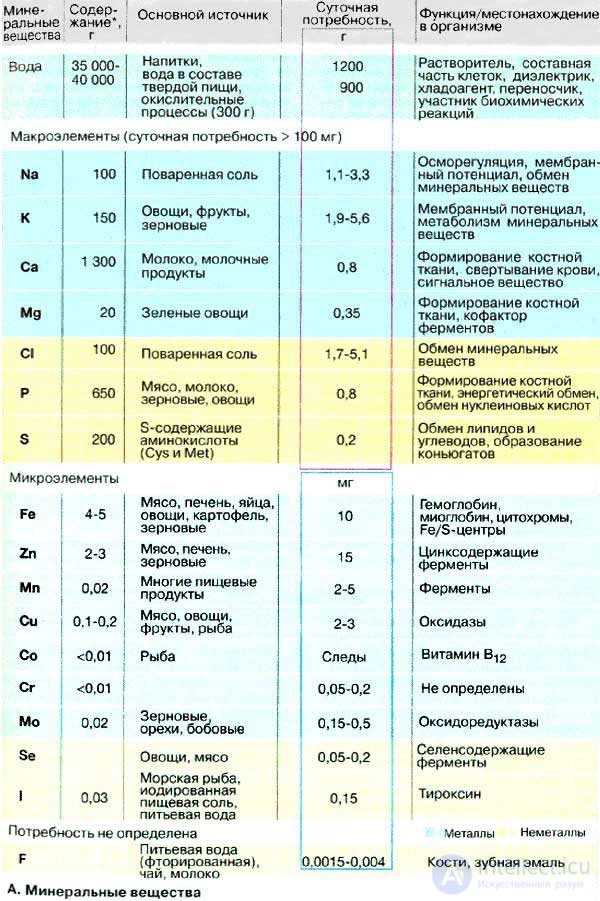 A. Minerals
In quantitative terms, the most important inorganic component of food is water. In an adult, the daily water requirement is approximately 2.4 L. This figure includes water entering the body with solid and liquid food, in the form of beverages, and also water formed in the respiratory chain (see p. 142). The special role of water in supporting vital processes was discussed in detail on p. 32.
Essential elements are divided into macroelements (daily requirement >100 mg) and microelements (daily requirement <100 mg). The macroelements include sodium (Na), potassium (K), calcium (Ca), magnesium (Mg), chlorine (Cl), phosphorus (P), sulfur (S) and iodine (I). The essential trace elements, needed only in trace amounts, include iron (Fe), zinc (Zn), manganese (Mn), copper (Cu), cobalt (Co), chromium (Cr), selenium (Se) and molybdenum (Mo). Fluorine (F) does not belong to this group, but it is necessary for maintaining bone and dental tissue in a healthy state (see p. 332). Whether vanadium, nickel, tin, boron and silicon are essential trace elements remains an open question. Such elements are conventionally called conditionally essential.
The table (column 2) gives the average content of minerals in the body of an adult (based on a body weight of 65 kg). The average daily requirement of an adult for these elements is given in column 4. In children, in women during pregnancy and breastfeeding, and in patients, the requirement for trace elements is usually higher.
Since many elements and water can be stored in the body, deviations from the daily norm are compensated over time. Water is stored in all tissues of the body, calcium in the form of apatite of bone tissue (see p. 332), iodine as part of thyroglobulin in the thyroid gland, and iron as part of ferritin and hemosiderin in the bone marrow, spleen and liver. The liver serves as a storage site for many trace elements.
Mineral metabolism is controlled by hormones. This applies, for example, to the intake of H2O, Ca2+, PO43-, the binding of Fe2+, I-, and the excretion of H2O, Na+, Ca2+, PO43-.
The amount of minerals absorbed from food generally depends on the metabolic needs of the body and, in some cases, on the composition of foods. Calcium can serve as an example of the influence of food composition. Absorption of Ca2+ ions is promoted by lactic and citric acids, whereas phosphate ion, oxalate ion and phytic acid inhibit calcium absorption because of complex formation and the formation of poorly soluble salts (phytin).
Mineral deficiency is not such a rare phenomenon: it arises from various causes, for example a monotonous diet, impaired absorption, or various diseases. Calcium deficiency may occur during pregnancy, as well as in rickets or osteoporosis. Chloride deficiency occurs because of a large loss of Cl- ions during severe vomiting. Because of insufficient iodine content in foods, iodine deficiency disorders and goiter have become common in many regions of Central Europe. Magnesium deficiency may arise from diarrhea or from a monotonous diet in alcoholism. A deficiency of trace elements in the body often manifests as impaired hematopoiesis, i.e., anemia.
The last column lists the functions performed in the body by the given minerals. The table shows that almost all macroelements function in the body as structural components and electrolytes. Signaling functions are performed by iodine (as part of iodothyronine) and calcium. Most trace elements are cofactors of proteins, mainly enzymes. Quantitatively, iron-containing proteins — hemoglobin, myoglobin and cytochrome — predominate in the body, as well as more than 300 zinc-containing proteins.

Comments