
Lecture
Theory of impetus (from Latin impetus ‘push, impulse’) — a natural-philosophical theory according to which the cause of the motion of thrown bodies is a certain force (impetus) impressed into them by an external source. The theory of impetus arose out of criticism of certain tenets of Aristotle’s physics, but on the whole conforms to it.
The theory of impetus was an attempt to answer the question: what moves a body thrown near the surface of the Earth? The presence of a moving force was considered necessary in view of the general tenets of Aristotle’s mechanics, according to which motion is possible only in the presence of a moving force. The theory of impetus assumed that, during the joint motion with the thrown body (a stone, an arrow, a cannonball), the mover (a person’s hand, a bowstring, a sling, a firearm, etc.) impresses into the thrown body a certain force (among Eastern thinkers — a violent inclination), which then makes the body continue to move . This impressed force was named, in the 14th century, impetus. Impetus was considered a new quality of the moving body, absent in a body at rest, analogous to how heat is a quality of a hot body absent in a cold body. The process of the transfer of impetus was conceived by analogy with heat transfer. In the course of the body’s motion, the impetus was gradually exhausted, owing to which the thrown body eventually fell to the surface of the Earth.
Initially the theory of impetus developed in the context of commentaries on Aristotle’s works or even theological treatises, and only at the end of the 16th — beginning of the 17th century were works written that attempted to build on its basis a consistent physical theory (by Giambattista Benedetti, Galileo Galilei). However, such a theory was never created .
Great disagreement was always caused by the question of whether impetus is exhausted in the course of the body’s motion spontaneously, or only owing to the resistance of external factors (friction against the air, the action of gravity). In favour of the spontaneous self-exhaustion of impetus spoke Philoponus, al-Baghdadi, Francis of Marchia (Eng.)Rus., Nicole Oresme; in favour of the disappearance of impetus due to the resistance of external factors — Avicenna, Jean Buridan, Albert of Saxony.
Further, some thinkers held that a body moving under the action of impetus does not experience weight (Avicenna); others held that weight and impetus act simultaneously (al-Baghdadi), at least over some portion of the trajectory (Albert of Saxony).
Later (from the 14th century on) disputes began over the question of how the initial motion (i.e. the joint motion of the thrown body and the mover) gives rise to impetus: through the presence of velocity or of acceleration? In the first case impetus also generates the velocity of the thrown body; in the second, also its acceleration. Buridan spoke in favour of the first variant, Nicole Oresme of the second. Connected with Buridan is also another disputed concept — the notion that impetus can cause a rigid body to rotate about its own axis; this was rejected by Giambattista Benedetti in favour of the assumption that impetus can cause only rectilinear motion of a body.
The lack of clarity in the general tenets of the theory of impetus affected its application to the solution of concrete physical problems. For example, some scholars and philosophers applied the theory of impetus to justify the hypothesis of the Earth’s rotation about its axis (Giordano Bruno), while others — on the contrary — used it to refute that hypothesis (Jean Buridan, Giovanni Battista Riccioli). Great disagreement was also caused by another question: is it necessary, in order to explain the motions of the heavenly bodies (as it was assumed in the Middle Ages, attached to celestial spheres), to invoke the existence of special spiritual entities, the so-called “intelligences” (a kind of angel), or is it sufficient to assume that the motion of the heavenly bodies occurs owing to the impetus impressed into them at the creation of the world by God. In favour of the second possibility spoke Philoponus, Jean Buridan, Albert of Saxony, while Avicenna and Nicole Oresme held that one cannot do without invoking intelligences. There were also compromise solutions to this problem (al-Bitruji, Francis of Marchia (Eng.)Rus., Riccioli).
At the beginning of the 20th century the opinion was expressed (mainly by Pierre Duhem) that the theory of impetus is a direct predecessor, a kind of medieval shell for the modern concept of inertia, and that impetus itself is an analogue of momentum. Indeed, in some versions of this theory the impetus imparted to a body was considered to change only owing to influences from the external environment, and was calculated by the same formula as momentum in classical mechanics (such were the versions of Avicenna and Buridan).
However, at present this point of view is considered outdated . Significant differences are connected with the fact that in medieval theory the state of rest was considered something primary, and it was the cessation of rest, i.e. the setting of a body into motion, the appearance of velocity in a body, that required explanation. In some cases the cause of motion was, for example, weight; in others, impetus. On the whole the theory of impetus was fully consistent with Aristotle’s physics, since force was considered the cause of a body’s motion, and velocity was considered proportional to force. In modern science, rest is merely a special case of motion, and it is the change of the state of motion, i.e. acceleration, that is subject to explanation; according to Newton’s second law, acceleration is proportional to force.
Further, impetus was considered a certain special quality with which a moving body is endowed, analogous, for example, to heat. In modern physics, in accordance with the principle of relativity, a moving body is not considered to possess any special qualities as compared with a body at rest.
At the same time, in some respects the theory of impetus contributed to the emergence of classical mechanics, since it subjected some tenets of Aristotle’s mechanics to criticism. Starting with Galileo, the term “impetus” was increasingly used in the same sense as “impulse”.
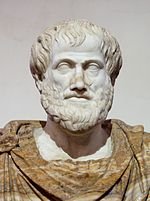
The origins of the theory of impetus lie in antiquity — in the physics of Aristotle.
Aristotle. According to Aristotle, each kind of matter has its own natural place within the universe: the natural place of the element of earth is at the very centre of the world, followed by the natural places of the elements of water, air, fire, and ether. The sublunar world was characterized by motion along vertical straight lines; such motion had to have a beginning and an end, which corresponds to the perishability of all earthly things. If an element of the sublunar world is displaced from its natural place, it will strive to reach its natural place. Thus, if a handful of earth is lifted up, its natural motion will be vertically downward. Since the elements of earth and water strove downward, toward the centre of the world, in their natural motion, they were considered absolutely heavy; the elements of air and fire strove upward, toward the boundary of the sublunar region, and were therefore considered absolutely light. Aristotle explained the increase in the speed of a falling body by the body’s approach to its final point — the Earth. Upon reaching its natural place, the motion of an element of the sublunar world ceases.
Motion of a body toward its natural place was called natural motion. Otherwise the motion was called violent. Aristotle held that violent motion is possible only if a force is applied to the body from another body: “everything that is in motion must be moved by something else”; the thing moved and the mover must be in direct contact . Aristotle considered the speed of a body to be proportional to the applied force.
This theory had difficulty explaining an elementary fact: when a person throws a stone, the stone continues to move after contact with the hand ceases. Indeed, a stone belongs to the category of heavy bodies; its natural place is below, on the Earth. While it is in the hand, it undergoes violent motion, but after the thrower releases it, the stone, it would seem, ought to undergo natural motion toward the centre of the world, i.e. fall to the surface of the Earth. But the stone moves quite differently: it first rises upward or moves at an angle to the horizon, and only afterward falls to the ground. In Aristotle’s opinion, the motion of the stone is sustained by the air, which, in turn, had been given motion by the human hand .
Hipparchus. Another solution to the problem of projectile motion was given by Hipparchus of Nicaea in the book On Bodies Carried Down by Their Weight. This book itself has not survived to us, but we are acquainted with its main ideas through Simplicius’s retelling:
Hipparchus writes that if a piece of earth is thrown straight upward, the cause of the upward motion will be the throwing force, as long as it exceeds the weight of the thrown object; moreover, the greater the throwing force, the faster the object moves upward. Then, as the force decreases, the upward motion will proceed at an ever-decreasing speed, until, finally, the body begins to move downward under the action of its own inclination — although the throwing force will still be present in it to some extent; as it is exhausted, the body will move downward ever faster and faster, reaching its maximum speed when this force finally disappears .
According to the most widespread interpretation of this passage, Hipparchus’s “throwing force” is the same thing as impetus. In that case, Hipparchus contains the first statement of the concept of impetus .
The notion of the existence of certain internal movers in moving bodies was expressed by the Athenian philosopher of the late 2nd — early 3rd century Alexander of Aphrodisias . Similar ideas (in a theological context) are found in the 5th-century Christian thinker Synesius, a pupil of the legendary Hypatia[10][11].
However, the true author of the concept of impetus is usually considered to be the 6th-century Alexandrian thinker John Philoponus.
Philoponus. In his commentaries on Aristotle’s Physics, Philoponus criticized Aristotle’s solution to the problem of projectile motion and proposed another solution to this problem. In his opinion, the “throwing agent” (for example, a hand or a bowstring) imparts to the thrown body a moving force (later named impetus), which then moves the body after contact ceases; here again the influence of Aristotle’s physics manifested itself, in which the speed of a body was considered proportional to force. The surrounding air does not aid the motion, as Aristotle believed, but hinders it[12]. However, even in a vacuum the impetus of a body would have to decrease (be exhausted) spontaneously.
Philoponus also applied the theory of impetus to the motion of the heavenly bodies. He rejected the notions prevalent at the time (expressed, for example, by Theodore of Mopsuestia and Cosmas Indicopleustes) that the heavenly bodies are carried through space by angels. In his opinion, the motion of the heavenly bodies occurs owing to the moving force impressed into them at the creation of the world by God[13].
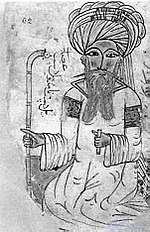
Avicenna. Philoponus’s theory of the moving force became known among Muslim scholars. Thus it was mentioned by one of the founders of Arabic philosophy, al-Farabi (9th—10th centuries). A significant contribution to its development was made by the outstanding 11th-century philosopher and scholar Avicenna (Ibn Sina) (The Book of Healing, c. 1020). In his opinion, the “mover” imparts to the moving body a certain “inclination”, analogous to the way fire transfers heat to water. The role of mover may be played not only by a hand or a bowstring, but also by weight.
The “inclination” is of three kinds: psychic (in living beings), natural, and violent. “Natural inclination” is the result of the action of weight and manifests itself in the falling of a body, i.e. in the natural motion of a body, in agreement with Aristotle. In this case “inclination” can exist even in a body at rest, manifesting itself in resistance to being at rest. “Violent inclination” is the analogue of Philoponus’s moving force — it is imparted to the thrown body by its “mover”. As the body moves, its “violent inclination” decreases owing to the resistance of the medium; as a consequence, the body’s speed also tends to zero. In a vacuum, “violent inclination” would not change, and the body could undergo perpetual motion. In this one could see an anticipation of the concept of inertia, but Avicenna did not believe in the existence of a vacuum.
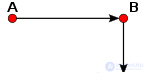
In Avicenna’s opinion, “natural” and “violent inclination” cannot coexist in one body. A thrown body will move under the action of “violent inclination” until it is exhausted under the action of the external medium (the portion of the trajectory AB in the figure on the left). Immediately after this the body will momentarily stop and begin to move under the action of “natural inclination”, i.e. fall vertically downward (the portion of the trajectory BC in the figure on the left). Thus, in Avicenna’s theory, over a certain portion of the trajectory of a thrown body, weight does not act upon it.
Avicenna attempted to give a quantitative estimate of “violent inclination”: in his opinion, it is proportional to the weight and the speed of motion of the body[14].
Al-Baghdadi. Further development of the theory of impetus is connected with the Baghdad philosopher Abu’l-Barakat al-Baghdadi (12th century). Unlike Avicenna, al-Baghdadi held that a “violent inclination” in a body is exhausted even in the absence of resistance of the medium, in empty space, the existence of which he did not deny. Moreover, al-Baghdadi considered it possible for both “natural” and “violent inclination” to coexist in one body. As the thrown body moves, its “violent inclination” gradually decreases, while its “natural inclination” remains constant, and eventually the body begins to move downward.
A significant achievement of al-Baghdadi was the inclusion of acceleration in the picture of the motion of a falling body. In his opinion, as the body moves, its weight imparts to it ever new portions of “violent inclination”, owing to which the body’s motion accelerates.
A follower of al-Baghdadi on this question was the philosopher of the next generation, Fakhr al-Din al-Razi[15]. Conversely, the outstanding 13th-century Persian scholar Nasir al-Din al-Tusi, while sharing the notion of the existence of “violent inclination” in thrown bodies, leaned toward Avicenna’s version[16].
Al-Bitruji. Another 12th-century scholar, Nur al-Din al-Bitruji, used the theory of impetus to explain the cause of the motion of the planets. Whereas most scholars of that time were convinced that the planets move under the action of incorporeal spiritual movers (“intelligences”, or angels), al-Bitruji gave a mechanical explanation: the highest celestial sphere receives a moving force from the Prime Mover and transmits it to the lower spheres, to which the planets are attached; as it advances toward the Earth, this force weakens[16][17]. As an analogy, al-Bitruji cited the fall of a thrown stone: the moving force imparted to the stone by the hand weakens over time, as a result of which weight begins to dominate in the stone and the stone falls to the ground.
However, al-Bitruji was nevertheless forced to resort to the notion of the animateness of the spheres to explain the non-uniformity of the observed motion of the planets (in particular, retrograde motions): each of the spheres experiences a certain desire to “imitate” the motion of the sphere of the fixed stars, moved directly by the Prime Mover. This “imitation” is what gives rise to the non-uniformity[17].
In Catholic Europe the notion of an impressed force became known as early as the 12th century. It appears likely that European authors borrowed elements of the theory of the moving force from Eastern scholars[18].
The “force of the throw” is mentioned by the 12th-century French natural philosopher Thierry of Chartres[19]. The theory of impetus was briefly mentioned by the great 13th-century scholastics Roger Bacon, Albertus Magnus and Thomas Aquinas, but they rejected it in favour of Aristotle's theory. A fairly detailed account of the theory of impetus is found in the work of the philosopher Peter John Olivi, who worked in the second half of the 13th century and who, however, also rejected it[20]. William of Ockham was likewise critical of the theory of impetus, arguing that it explained the unknown through something even more unknown; impetus was treated as an additional quality of moving bodies, analogous to heat, whereas Ockham held that a moving body is in principle no different from a body at rest (an example of the use of Ockham's razor). He, however, also rejected Aristotle's treatment of the problem of projectile motion.
Francis of Marchia. The first European philosopher to agree with the theory of impetus was the Italian theologian Francis of Marchia (English)Russian (Commentary on the Sentences of Peter Lombard, c. 1320). His motives lay in the field of theology: in Francis's view, receiving the sacrament of communion is able to draw the believer toward God, instilling divine grace in him. Francis regarded the imparting by the hand of a certain force to a thrown stone, thanks to which it continues moving after contact with the hand ceases, as an analogy of the sacrament of communion in the material world[21].
According to Francis, the motive force must be exhausted as the body moves, even if the motion takes place in a vacuum, as with Philoponus and al-Baghdadi[22][23][24]. A little later he was also supported by the Parisian philosopher Nicholas Bonetus, who paid great attention to the problem of motion in a vacuum[25].
Francis of Marchia (English)Russian also applied the theory of impetus to the motion of celestial bodies. In the Middle Ages the prevailing view was that the heavenly bodies were fixed to celestial spheres, which moved under the influence of “intelligences” — special spiritual beings usually identified with angels[26]. According to Francis, the angels rotate the celestial spheres by imparting impetus to them[27]. Since impetus is not conserved but spontaneously decreases, the angels are forced to do this continuously[28].
Buridan. The theory of impetus owes its greatest development to the outstanding mid-14th-century scholastic Jean Buridan, professor at the University of Paris, to whom the term “impetus” itself belongs:
A man throwing a stone moves his hand together with the stone, and when shooting from a bow the bowstring moves together with the arrow for some time, pushing the arrow; and the same holds for a sling that hurls a stone, or for machines that throw enormous stones. And as long as the thrower pushes the thrown body while remaining in contact with it, the motion is slower at first, for then only the external mover moves the stone or the arrow; but during the motion impetus is continuously acquired, which together with the above-mentioned external mover moves the stone or the arrow, so that their motion becomes ever faster. But after separating from the thrower, the thrower no longer moves the thrown body, but only the acquired impetus moves it, and this impetus, owing to the resistance of the medium, is continuously weakened, and so the motion becomes ever slower[29].
Buridan believed that impetus decreases not spontaneously, but because of the resistance of the external medium, as well as because of gravity, which (in accordance with Aristotle) acts on all earthly bodies and is a fundamentally ineliminable factor[30]. He regarded the product of the body's velocity and the quantity of matter as the measure of impetus. It cannot be ruled out that these ideas were borrowed from Avicenna[31].
Buridan regarded heaviness as an analogue of the hand in the motion of thrown bodies: heaviness imparts impetus to falling bodies. However, unlike the hand, heaviness acts continuously. From this followed his explanation of the acceleration of bodies in falling (quite similar to al-Baghdadi's theory): the motion of a falling body accelerates because, as the body moves, its heaviness imparts to it ever new portions of impetus. Thus the cause of the acceleration of falling bodies is not heaviness (which merely indicates the direction of motion), but the impetus acquired by the body as a result of heaviness and the motion already begun[32]. Buridan possibly meant that velocity is acquired by the body not continuously, but in discrete portions[33][34].
An important innovation of Buridan's was the extension of the concept of impetus to the case of rotating rigid bodies (the notion of rotational impetus). In his view, if a body mounted on an axle is spun, it will be given a circular impetus, which will make it rotate until the body stops owing to the resistance of the external medium. Buridan applied the notion of circular impetus also to explaining the motion of the celestial spheres. Buridan believed that the existence of intelligences (special spiritual beings that carry out the motion of the celestial spheres) does not follow from the Bible and that another explanation of the motion of the heavens is also possible:
At the moment of creation God imparted to the heavens as much and the same kind of motion as exists now, and, setting them in motion, impressed in them impetuses, thanks to which they then move uniformly, since these impetuses, meeting no resistance, are never destroyed or diminished[35]
(a similar opinion was expressed earlier by John Philoponus). It should be noted that, like other medieval scholastics, when explaining specific astronomical phenomena Buridan continued to resort to notions of intelligences. Thus he believed that the cause of the equality of the periods of motion of the Sun, Mercury and Venus along the zodiac (manifested in the fact that Mercury and Venus are always found in the sky not far from the Sun) was “an identical ratio of the moving intelligences to the moving spheres”, although he knew of the hypothesis according to which these planets revolve around the Sun[36]. Thus Buridan did not completely abandon the notion of celestial intelligences, merely noting that it does not necessarily follow from the Bible, with which the notion of “initial impetus” is also entirely compatible[37].
Buridan also used the theory of impetus to refute the hypothesis of the Earth's rotation about its axis. The traditional argument against this hypothesis was that on a rotating Earth, bodies thrown vertically upward could not fall back to the point from which their motion began: the surface of the Earth would shift beneath the thrown body. Supporters of the hypothesis of the Earth's rotation answered this argument by saying that the air and all earthly objects (including those thrown upward) move together with the Earth. Buridan objected to this: the impetus acquired when thrown will resist horizontal motion. He gives the following example: “If a strong wind were blowing, an arrow shot vertically upward would not be able to travel as far horizontally as the air, but only partly”[38] [39].
Other representatives of the Parisian school. Other scholars of the University of Paris — younger contemporaries of Buridan — also made a significant contribution to the development of the theory of impetus.
Albert of Saxony shared Buridan's opinion that impetus decreases not spontaneously, but because of the resistance of the external medium and gravity, and also that the motion of a falling body accelerates because, as the body moves, its heaviness imparts to it ever new portions of impetus. He even attempted to give a mathematical expression for the change in the velocity of a falling body (the velocity is proportional to the distance travelled from the state of rest). Albert agreed with Buridan's theory of “initial impetus” regarding the causes of the motion of the celestial spheres.
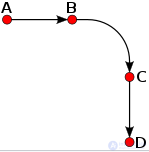
Considering the trajectory of a body launched in a horizontal direction, Albert concluded that it must consist of three segments. For some time the body must move under the action of impetus along a horizontal straight line, then along a curved trajectory, when gravity gradually begins to act on it and the impetus decreases, and finally vertically downward, when it will move only under the action of gravity. From the standpoint of the theory of impetus he considered a thought experiment: how a stone would move through the Earth if the Earth were drilled all the way through:
When the centre of gravity of this falling body coincided with the centre of the world, this body would continue to move further toward the other part of the sky owing to the impetus not yet destroyed in it; and when in the course of the ascent this impetus is fully spent, this body would again begin to descend, and in the course of the descent would again acquire for itself a certain small impetus, thanks to which it would again pass through the centre of the Earth; and when this impetus too is destroyed, it would again begin to descend, and so it would move back and forth around the centre of the Earth, oscillating for as long as impetus remained in it, and, finally, it would come to rest[40].

This example was given earlier by the ancient Greek writer Plutarch in the dialogue On the Face Which Appears in the Orb of the Moon, and after Albert of Saxony it was used by other European scholars, including Tartaglia and Galileo.
Another Parisian philosopher, Nicole Oresme, returned to the notion that impetus decreases even in a vacuum. Unlike Buridan, Oresme believed that the hand imparts impetus to a thrown stone not simply by virtue of its own motion (together with the stone), but by virtue of the acceleration of that motion: first the hand with the stone is at rest, then it accelerates to a certain speed, at which point the palm opens and the stone separates from the hand. Accordingly, impetus produces not only velocity but also the acceleration of bodies .
Among the supporters of the theory of impetus was also another well-known Parisian philosopher — Marsilius of Inghen.
Although the number of supporters of the theory of impetus was initially small, the authority and arguments of the Parisian philosophers led to its wide diffusion in the late Middle Ages.
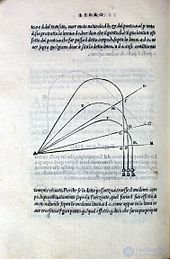
The popularity of the theory of impetus continued to grow during the Renaissance. In the 15th century it was used to explain various phenomena by Nicholas of Cusa[35][41] and Leonardo da Vinci[42], and in the 16th century by the Spanish scholastic Domingo de Soto[43][44]. The famous mathematician and engineer Niccolò Tartaglia applied the theory of impetus to explain the motion of a cannonball (Nova Scientia, 1537). In his view, the trajectory of the ball consisted of the same three segments as in Albert of Saxony's theory, except that the initial segment of the trajectory was not assumed to be horizontal[45].
Giordano Bruno, in the dialogue The Ash Wednesday Supper (1584), uses the theory of impetus to defend the Copernican heliocentric system — to explain why the Earth's rotation is not observed by observers located on its surface. In doing so he gives the example of a moving ship, as Nicole Oresme had done earlier, but develops the theme more deeply:
One of two men is on a sailing ship, and the other is outside it; each of them has his hand at almost the same point in the air, and from that point, at the same moment, the first throws a stone and the second throws another stone, without any push; the stone of the first, without losing a single instant and without deviating from its line, will fall to the appointed place on the ship, while the stone of the second will be left behind. And this happens for the reason that the stone which falls from the outstretched hand on the ship, and consequently moves following its motion, has imparted to it a force which the other stone, falling from a hand outside the ship, does not have; and all this happens even though the stones have the same weight and traverse the same intervening space, moving (supposing this possible) from the same point and experiencing the same push.
Here “the force imparted to the stone” and “the push” are, of course, nothing other than impetus, although the term itself is not used[46][47].
An attempt at a systematic elaboration of mechanics on the basis of the theory of impetus was made by the outstanding mathematician and physicist of the late Renaissance Giovanni Battista Benedetti (Book of Diverse Mathematical and Physical Reflections, 1585).
In one of his works the theory of impetus was used by Johannes Kepler[48].
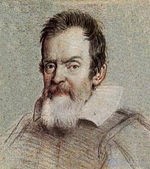
In his treatise On Motion (1590) Galileo Galilei made an attempt to use the theory of impetus in constructing a mechanics of falling bodies. In doing so he considered impetus to be self-exhausting. The treatise, however, was never published.
In the work Letters on Sunspots (1613) Galileo concluded that a body remains in a state of rest until some external cause is found that removes it from this state. Likewise, a body remains in a state of inertial motion until an external cause is found that removes it from this state. Thus, no force, external or internal, is required to sustain the motion of a body. Whereas in both Aristotle's physics and the theory of impetus motion was regarded as a process, while rest was regarded as a state[49], it was Galileo who for the first time called both of them a state[50]. This was a crucial step on the path to the concept of inertia.
But even in his Dialogue Concerning the Two Chief World Systems (1632), when describing a thrown body, Galileo repeatedly used the terms “impressed force” and “impetus”. As Alexandre Koyré showed, by this he meant simply velocity or momentum, yet he never clearly declared the non-existence of impetus as a special quality of a thrown body[51].
Throughout the whole of the 17th century the terms “impressed force” and “impetus” continued to be used by physicists, mostly in the sense of momentum[52], but sometimes in the same sense of an additional quality of a moving body as these terms were used in the Middle Ages. The French Jesuit scholar Honoré Fabri tried to give the theory of impetus a mathematical form and to build on its basis a theory of free fall[53]. The Italian Jesuit scholar Giovanni Battista Riccioli (New Almagest, 1651) tried to use the theory of impetus to refute the Earth's rotation about its axis[54], and also to explain the motion of the planets, joining the opinion of Francis of Marchia (English)Russian that angels move the planets by imparting impetus to them (but without the mediation of celestial spheres)[55].
The first to explicitly abandon the theory of impetus and to state that motion requires no force, including an internal one, to sustain it, was the Dutch physicist Isaac Beeckman[56]. However, he did not publish this conclusion, formulating it only in his private diary. The law of inertia in its correct form was first formulated by René Descartes in the work The World, or Treatise on Light (1630) and published in the treatise Principles of Philosophy (1644). The law of inertia was called the first law of motion by Newton in the Mathematical Principles of Natural Philosophy (1687)

Comments