
Lecture
Kinetic energy paradox — a thought experiment within classical mechanics that allegedly demonstrates a violation of the Galilean principle of relativity. When the speed of a body changes, the increment of its kinetic energy in one frame of reference is not equal to the increment in another frame of reference. From this it allegedly follows that there exist frames of reference in which the law of conservation of energy is violated, and, as a consequence, the Galilean principle of relativity is allegedly violated.
Consider a toy car with a wind-up spring capable of storing potential energy  . We will neglect energy losses to friction. Suppose this store of energy is able to accelerate the toy to a speed
  . Let us move to another inertial frame of reference, which moves relative to the Earth toward the car with speed . From the point of view of this frame of reference, the speed of the toy before acceleration is equal to and the kinetic energy is equal to . The speed of the toy after acceleration is equal to
  and the kinetic energy is
  . Thus, the kinetic energy of the car has increased by
  , which exceeds the store of energy in the spring .
The paradox is explained by the fact that the reasoning given above does not take into account the change in the momentum and kinetic energy of the Earth in the process of accelerating the toy. If the change in the momentum and kinetic energy of the Earth is taken into account, the paradox is resolved. We will neglect the rotational motion of the Earth for now.
Let us move to a frame of reference in which the Earth and the toy are initially at rest. After the toy accelerates, in accordance with the law of conservation of momentum, one can write the equation  , where
  — is the mass of the toy, — is the speed of the toy,
  — is the mass of the Earth,
  — is the speed of the Earth. In accordance with the law of conservation of energy, one can write the equation
 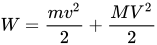 . Expressing the speed of the Earth from equation and substituting it into equation , we obtain
 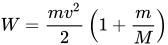 .
.
Let us then move to a frame of reference in which the Earth and the toy are initially both moving with speed . After the toy accelerates, in accordance with the law of conservation of momentum, one can write the equation  , where
  — is the speed of the Earth after the toy accelerates. In accordance with the law of conservation of energy, for the change in kinetic energy one can write the equation
  . Let us express the speed of the Earth from equation and substitute it into the previous equation. We obtain
  . After simple transformations we obtain
 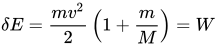 . That is, in this case too the change in the kinetic energy of the whole system is equal to the potential energy of the spring .
The change in the kinetic energy of the toy in the new frame of reference is three times greater than in the frame of reference associated with the Earth, because it occurs not only due to the potential energy of the spring, but also due to the fact that the wheels of the toy, in the new frame of reference, brake the Earth .
Let us now take into account the rotation of the Earth caused by the toy. On the right-hand side of the formula the rotational kinetic energy of the Earth will also appear. It will be of the same order as the kinetic energy of the Earth's translational motion, so in the frame of reference in which the Earth was initially at rest, it, like the energy of the Earth's translational motion, can be neglected, and it can be considered that the entire potential energy of the spring is converted into the kinetic energy of the toy. In the frame of reference in which the initial speeds of the toy and the Earth are equal to , the rotational kinetic energy of the Earth will be the same as in the first frame of reference, since the change in the Earth's angular velocity is the same in all inertial frames of reference. Therefore the rotational energy can be neglected in the second frame of reference as well .
Consider a body of mass moving with speed  . Suppose that for some time
  a constant force
  , directed along the same line as the speed , acts on this body. It changes the speed of the body from the value to the value
  . As a result of the action of this force, the change in the kinetic energy of the body will be equal to
  .
.
Now let us move to another frame of reference, moving relative to the previous frame of reference uniformly and rectilinearly with speed , directed along the same line as the speed . In this frame of reference the change in kinetic energy will be equal to  , that is, it will be smaller than in the first frame of reference, which is inconsistent with the Galilean principle of relativity .
The principle of relativity requires that the same physical laws hold in the two frames of reference under consideration. Thus the law of conservation of energy must be satisfied, according to which the change in the energy of a body must be equal to the work done by external forces. Therefore in the first frame of reference the relation 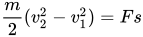 must hold. Here
  — is the length of the path travelled by the body in the first frame of reference during the time in which the speed increased from to . Since the body moves with acceleration
  , then
 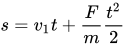 .
.
In the second frame of reference  . Here
  — is the length of the path travelled by the body in the second frame of reference
 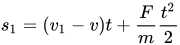 . So,
. So,  . Since
 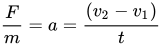 , then
  . Thus
  .
.
The work of the external force in the first frame of reference exceeds that in the second by exactly as much as the change in kinetic energy in the first frame exceeds that in the second. Since in the first frame the change in energy is equal to the work of external forces, this holds true for the second frame as well. Consequently, the Galilean principle of relativity is not violated .
Explosion of metal on impact – the phenomenon of a metal exploding upon its impact deceleration, whereby the energy released in the explosion is significantly greater than the kinetic energy of the piece of metal before its deceleration. For example, when falling at a speed of more than 2000 m/s, iron meteorites are almost completely vaporized after colliding with the Earth's surface. Thus, in this phenomenon the law of conservation of energy is allegedly violated.
There is a view that in reality no explosion of the metal occurs at all upon its deceleration
During abrupt deceleration of the metal, the free electrons continue their motion by inertia and, as a result, are not able to hold the positive ions of the metal's crystal lattice in the same places. When the kinetic energy of each metal atom becomes comparable to the energy of the crystal lattice, the ions of the crystal lattice fly apart under the action of electrostatic repulsion. The energy of each atom in the crystal lattice is converted into the energy of the explosion.

Comments