
Lecture
Separate points of a rotating body have different linear velocities.  . The speed of each point, being tangential to the corresponding circle, continuously changes its direction. Speed magnitude
  determined by the speed of body rotation
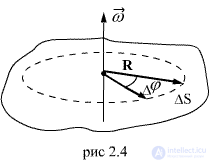
  and the distance R of the considered point from the axis of rotation. Let for a small period of time
  the body turned to the corner
  (figure 2.4). A point located at a distance R from the axis passes the path equal to

Linear velocity of a point by definition.
 |
(2.6) |
Find the linear acceleration points of the rotating body. Normal acceleration:

substituting the value of speed from (2.6), we find:
 |
(2.7) |
Tangential acceleration

Using the same relation (2.6) we get
 |
(2.8) |
Thus, both normal and tangential accelerations grow linearly with the distance of the point from the axis of rotation.

Comments