
Lecture
The “big push” theory is a synthesis of the concepts of the “vicious circle of poverty” and “self-sustaining growth”, whereby a large injection of capital into a country makes it possible to create self-sustaining growth, which in turn makes it possible to modernise the economy. The first to formulate this theory was Paul Rosenstein-Rodan in his 1943 article.
Professor Paul Rosenstein-Rodan first formulated the “big push” theory in the article “Problems of Industrialisation of Eastern and South-Eastern Europe” in 1943, making the case for the modernisation of countries through primary industrialisation: autonomous investment is directed towards the growth of national income .
The Harrod–Domar model, formulated by R. Harrod in 1939 and supplemented by E. Domar in 1946, lies at the foundation of the “big push” theory, making it possible to consider a depressed economy not only in the short run, as Keynesianism does, but also in the long run. When the warranted rate of growth is lower than the natural rate, the actual rate will exceed the warranted one: a surplus of labour resources will create the preconditions for growth in investment, and from this an economic boom will arise. The model demonstrates the link between the rate of growth of investment and the rate of growth of GDP .
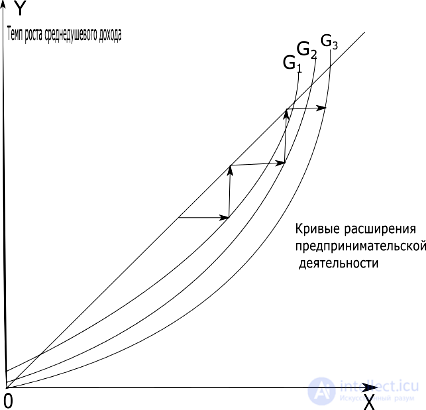
To modernise an economy, a large injection of capital is required, as a result of which self-sustaining growth arises. A high level of saving is possible only through a coercive monetary and fiscal policy on the part of the state. The volume of investment must be sufficient for irreversible economic development, so that it is not eaten up by current needs. Professor H. Leibenstein of the University of California puts the size of the “minimum critical effort” (investment) at 12–15% of national income in his book “Economic Backwardness and Economic Growth” of 1957. Such a push will raise the growth rate of per capita income, lift the economy out of stagnation, increase purchasing power and raise demand, which will stimulate an increase in the number of entrepreneurs, who will in turn ensure the subsequent growth of per capita income .
In the figure “Leibenstein's concept” a multiplier effect can be observed: a shift takes place from curve G1 to G2 and then to G3, and the number of economic agents influencing the growth of per capita income expands .
Professor R. Nurkse of Columbia University set out, at the conference of the International Economic Association[en] in August 1957, and subsequently in his book “Equilibrium and Growth in the World Economy” , published in 1961, the theory of balanced growth[en]: to modernise an economy by carrying out a balanced set of investments in several industries. Investment in various sectors of the economy contributes to the development of the entire economic infrastructure. Synchronising the injection of capital into the productive sectors makes it possible to achieve self-sustaining growth, to overcome the narrowness of the domestic market, and stimulates the expansion of entrepreneurship .
In 1958 Professor A. Hirschman of Columbia University, in his book “The Strategy of Economic Development” , proposed an alternative concept of unbalanced growth[en]: since in developing countries such a factor of production as capital is not available in sufficient volume for the various industries, it is proposed to invest selectively. The first injection of capital will cause a disturbance of equilibrium in the market and will stimulate additional investment in a neighbouring industry, which in turn will lead to a new disequilibrium state in other industries and to the stimulation of investment in the economy as a whole, which will lead to general economic development .
Professor H. Singer of the University of Sussex, developing the ideas of A. Hirschman and R. Nurkse, proposed a concept in his work “International Development: Growth and Change” in 1964, in which balanced growth is achieved by means of unbalanced investment. It is necessary to increase labour productivity in agriculture and in the traditional export industries through import substitution and the development of the country's own productive and social infrastructure. This concept implies an injection of capital financed by external borrowing .
In Rosenstein-Rodan's view, there are three indivisibilities in underdeveloped countries. This indivisibility is responsible for external economies and thus justifies the need for a big push. The indivisibilities are as follows:
Indivisibility of the production function may relate to any of the following:
This leads to increasing returns (i.e. to economies of scale) and may require a large optimal firm size. This can be achieved even in developing countries, since in many industries at least one firm of optimal scale can be created. But investment in social overhead capital involves investment in all the basic industries (for example, energy, transport or communications), which must necessarily precede directly productive investment activity. Investment in social overhead capital is “lumpy” in nature. Such capital requirements cannot be imported from other countries. Consequently, it is imperative to make substantial initial investment in social overhead capital (this is roughly 30 to 40 per cent of the total volume of investment undertaken by underdeveloped countries). Social overhead capital is further characterised by four indivisibilities:
Developing countries are characterised by low per capita income and low purchasing power. Markets in these countries are therefore small. In a closed economy, modernisation and increased efficiency in a single industry does not affect the economy as a whole, since the output of that industry will not be able to find a market. It is necessary to create a large number of industries simultaneously, so that the people employed in one industry consume the output of other industries and thereby create additional demand.
To illustrate this, Rosenstein-Rodan gives the example of the footwear industry. If a country invests heavily in the footwear industry, all the disguised labour from other industries finds employment and a source of income, which leads to growth in the production of shoes and in their own incomes. This increased income will not be spent solely on buying shoes. It is quite possible that the growth of income will lead to increased spending on other products as well. However, there is no corresponding supply of these products to meet the increased demand for other goods. In accordance with the basic market forces of supply and demand, the prices of these goods will rise. To avoid such a situation, it is necessary to distribute investment across different industries.
The situation may be different in an open economy, since the output of a new industry can replace former imports or possibly find its market through exports. But even if the world market substitutes for domestic demand, a big push will still be required (although its required size may now be reduced by the presence of international trade).
A high level of investment requires a correspondingly high level of saving. We cannot always rely on foreign aid, since huge volumes of investment in various sectors must be made not just once but repeatedly. Consequently, domestic saving is necessary. But in an underdeveloped economy this is a problem because of the low level of incomes. The marginal rate of saving must be increased following the growth of incomes brought about by increased investment.
Consider a country whose economy is characterised by a large number of sectors that are so small that any increase in the productivity of one sector does not affect the economy as a whole. Each sector can either rely on traditional methods or switch to modern methods of production, which will raise its efficiency. Suppose there are workers in the economy and
  sectors. Thus, each sector has
 workers.
Using traditional technology , a sector will produce an amount of output, with each worker producing one unit of the good.
Using modern technology, a sector will produce more, since productivity will be higher than one unit per worker. However, the modern sector will require some workers (say, ) to perform administrative tasks.
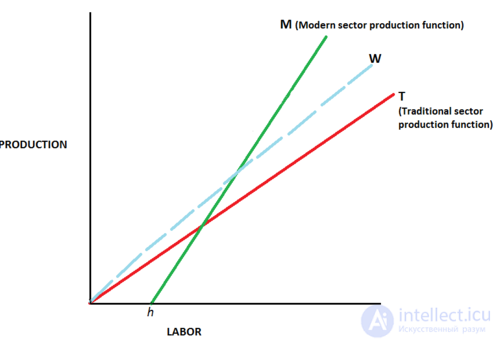
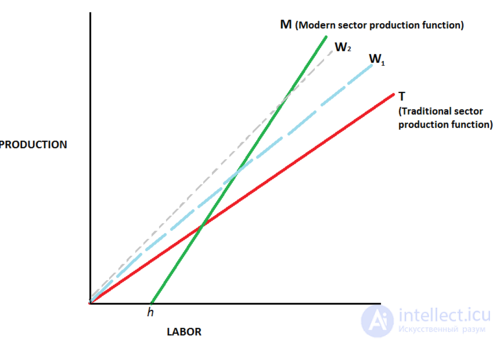
In Figure 1 the x-axis represents employed labour, and the y-axis the level of output. Output in the traditional sector is represented by curve T, and output in the modern sector by curve M. Curve M has a positive intercept on the x-axis, which means that even at zero output there is a minimum number ofworkers who still remain employed to carry out administrative activity. With our assumption of workers in the economy, the modern sector will have a higher level of productivity than the traditional sector. The production function of the modern sector is steeper than that of the traditional one, because of the higher productivity of workers in the former. The slope of both production functions equals
 , where
  the marginal labour required to produce an additional unit of output. This level of is lower for the modern sector than for the traditional one.
Suppose that in the traditional sector workers are paid one unit of output, which they subsequently spend equally across all sectors. In the modern sector workers are paid a higher wage. If all workers are employed in the traditional sector, then the demand generated for the output of each sector equals . State intervention is such that investment is made in those industries that have stronger forward and backward linkages. We have two possible cases:
 , a firm that faces demand
  will need to hire
  workers if it wishes to modernise. This will cost the firm
 .
.Now wages are low. Consequently
 .
.
This means that the costs (determined by ) are lower than the earnings (calculated as ). Thus, the firm makes a profit and chooses to modernise (even if other firms do not).
 , a firm that faces demand will incur losses if no other firms decide to modernise.
This is because
 .
.
This means that the costs (determined by  ) are higher than the earnings (calculated as ).
However, if all other firms modernise, the demand facing them will be higher.  , brought about by the higher level of income of the workers of these modernised firms. Thus, the firm too will decide to modernise in order to make a profit:
 .
.
The large-scale industrialisation programme advocated by this model requires enormous investment that goes beyond the capabilities of the private sector. Investment in infrastructure and basic industries (such as electric power, transport and communications) is “lumpy” and has a long gestation period. Consequently, the role of the state in this theory is of decisive importance for investment in social overhead capital. Even if the private sector had the resources necessary to invest in such a programme, it would not do so, since it is driven by considerations of profit. Many investments are profitable from the point of view of the social marginal net product, but not from the point of view of the private marginal net product. In this connection, individual entrepreneurs have no incentive to invest and to reap the benefits of external economies
The “big push” theory received a wide response in developing countries, since it named the shortage of capital as the main cause of backwardness, while the programme for escaping it proposed extensive use of the administrative apparatus; left out of consideration were the problems of inefficient industries and underdeveloped infrastructure .
The concept of a balanced set of investments, meanwhile, presupposed an artificial superstructure over the entire economic system, while the concept of unbalanced growth, on the contrary, assigns too great a role to the market mechanism, which is supposed to smooth out shortages and changes in industries quickly and promptly .
Professor G. Myrdal of Stockholm University noted that in developing countries prices and factors of production respond very weakly to supply and demand and to economic incentives in general, that a high level of monopolisation is present in the market, and that the bureaucratic system pursues its own interests, which means that the positive effect of large injections of capital within the framework of the “big push” theory is limited .
This theory has been criticised by Hla Myint and Celso Furtado, in particular on the grounds of the enormous efforts that underdeveloped countries must make in order to advance along the path of industrialisation. Some of the main criticisms are as follows.

Comments