
Lecture
Dynamics investigates the laws and causes that give rise to the motion of bodies, that is, it studies the motion of material bodies under the action of forces applied to them. Mechanics — one of the most ancient sciences, whose development was driven by practice and the needs of society. The first theoretical treatises on mechanics include Aristotle’s “Physics” and “Mechanics” (4th century BC). Archimedes (3rd century BC) developed the scientific foundations of statics (the theory of the lever, the doctrine of the centre of gravity, the beginnings of hydrostatics). The further development of mechanics (the addition of forces by the parallelogram rule, the doctrine of the moment of a force) is associated with the names of the Italian Leonardo da Vinci (15th century), the Fleming Simon Stevin (16th century), and other scientists. The foundation of modern classical mechanics consists of Newton’s three laws. Newton’s mechanics is based on Galileo’s fundamental principles.
G. Galileo (1564–1642) is rightly considered the founder of physics as a science. We owe to him the development of the modern method of research, briefly expressed in the chain: experiment => model (isolating the main features of a phenomenon, that is, applying abstraction) => mathematical description => consequences of the model => new experiment to test them.
Among his other scientific achievements, in mechanics he introduced two fundamental principles: the principle of inertia and the principle of relativity. Galileo’s principle of inertia was restated by I. Newton (1643–1727) as the first law of mechanics.
Newton’s first law states:
There exist frames of reference in which every point particle is in a state of rest or uniform rectilinear motion until this state is changed by the action of other bodies. Such frames of reference are customarily called inertial.
The answer to the question: “Do inertial frames of reference exist or not?” is, as always, given by experiment. According to the results of modern measurements, the heliocentric frame of reference, in which the centre of the Sun is at rest and whose axes point toward the fixed stars, is inertial. This means the following simple thing: existing accelerometers (devices measuring acceleration) do not detect any deviations from Newton’s first law in the heliocentric frame of reference. Rest or uniform rectilinear motion is a state with zero acceleration; consequently, if a body not subject to external influences acquires an acceleration, this means that the motion of that body is being considered in a non-inertial frame of reference. The Solar System undergoes finite (bounded) motion within our galaxy (the Milky Way); any finite motion is motion with acceleration, but the Solar System is far from the centre of the galaxy — we are peripheral inhabitants — the curvature of its trajectory is negligible, our instruments do not detect any accelerations, and we assert that the heliocentric frame of reference is inertial. An inertial frame of reference is yet another idealization: in the strict sense, inertial frames of reference do not exist. It is natural to suppose that this circumstance was among those that prompted Einstein to create the general theory of relativity, which asserts the physical equivalence of all frames of reference in general, not only inertial ones, and that fields of inertial forces are equivalent to gravitational fields (the so-called “equivalence principle”, to be discussed in more detail later).
It will be seen further on that any frame of reference moving translationally with a velocity constant in magnitude and direction relative to some inertial frame of reference is also inertial. In other words, the existence of one inertial frame of reference implies the existence of an infinitely large number of such frames.
The property of a body to preserve a state of rest or uniform rectilinear motion is called inertia. This principle itself — Galileo’s principle of inertia (or Newton’s first law) — is far from as obvious as it may seem.
Before Galileo, it was thought that motion required some cause, a moving force. Even the great Leonardo da Vinci wrote: “Every motion tends toward its own preservation, or rather every moving body moves continually so long as the action of its mover is retained within it”. Remarkably, the dim-witted Colonel von Zillergut from Jaroslav Hašek’s book “The Good Soldier Švejk” thought much the same way: no petrol, the engine doesn’t work, the car stops. After Galileo, R. Descartes’s (1596–1650) crisp Latin formulation became possible: “Quod in vacuo movetur, semper moveri” (what moves in a vacuum will move forever).
The fact is that in nature, bodies eternally preserving a state of rest or uniform rectilinear motion are indeed never observed. It was necessary to exercise that very capacity to build models, discard the inessential, and abstract, in order to discover the principle of inertia. In studying the fundamental laws of mechanics, we idealize the system: we neglect friction forces, assume there are no other bodies nearby, and so on. And then the principle of inertia reveals itself in all its beauty and power:
Uniform rectilinear motion requires no engine; a moving force is needed only to change this type of motion of a body.
To describe an action, the concept of force is introduced. Under the action of forces, bodies either change their velocity of motion  , that is, acquire accelerations (the dynamic manifestation of forces), or deform, that is, change their shape and size (the static manifestation of forces). At each instant of time, a force is characterized by a numerical value, a direction in space, and a point of application.
Force — is the result and manifestation of interaction. It is a vector quantity that, in classical (non-quantum) physics, is a quantitative characteristic of interaction.
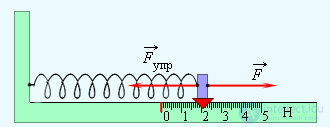
Fig. 3.1. Force acting on a spring
In order to establish which forces act on a body, it is necessary to determine which other bodies the given body interacts with. Force is always the result of an interaction of physical bodies. It is probably for this reason that R. Feynman, in his “Feynman Lectures on Physics”, called the inertial forces — which are not the result of an interaction of the body under consideration with other bodies and which appear only in non-inertial frames of reference — pseudo-forces.
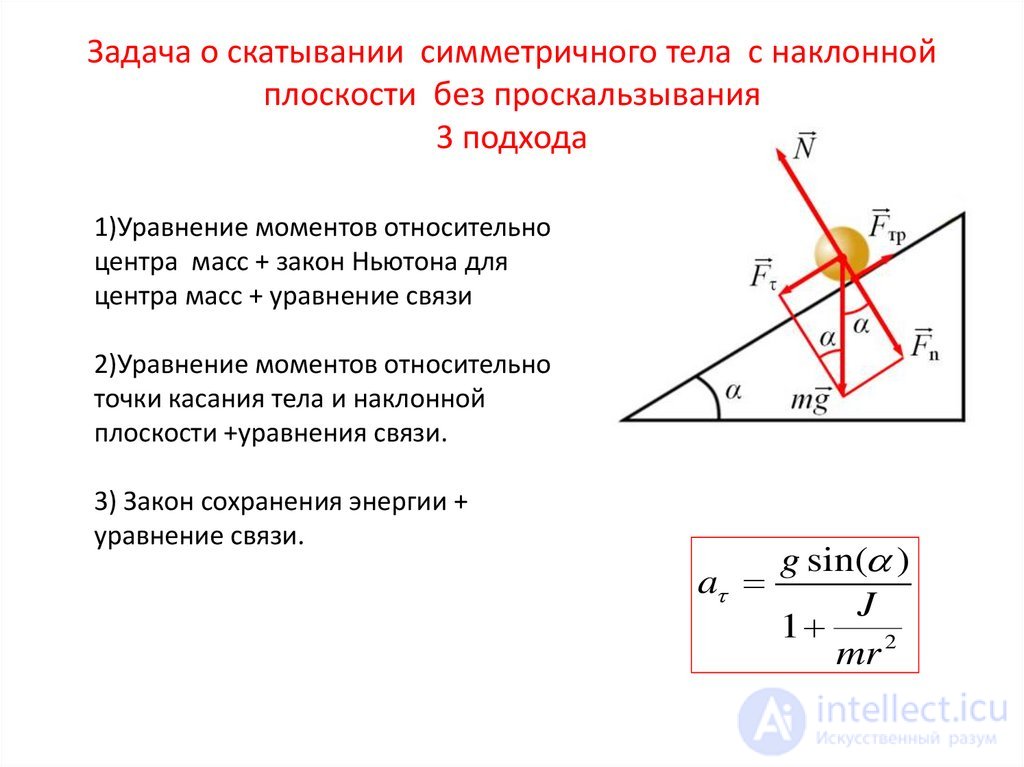
the problem of a body sliding off an inclined plane.
From experience, it is known that under identical actions various bodies change their velocity of motion differently, that is, in other words, they acquire different accelerations, therefore the equation relating the force acting on a body and its acceleration must include some characteristic of the body itself. Such a characteristic is the mass of the body m.
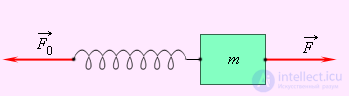
Fig. 3.2. Two different forces acting on a body cause its acceleration.
The experimentally established second law of Newton states:
The product of the mass of a point particle and its acceleration equals the vector sum of the forces applied to that point:

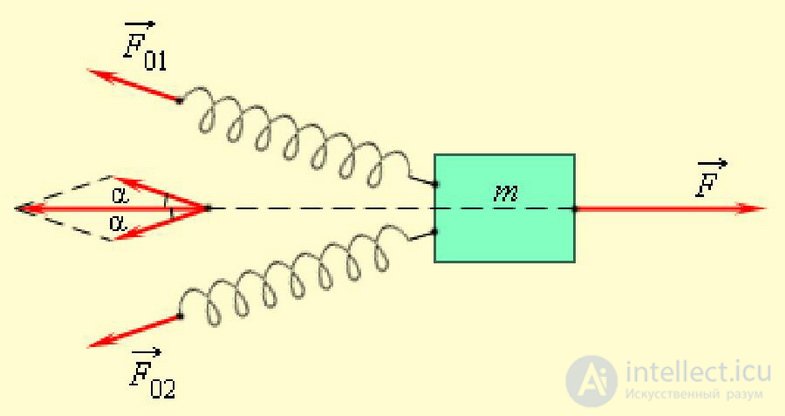
Fig. 3.3. Several forces acting on a body can neutralize one another.
Let us immediately emphasize that this holds only for non-relativistic velocities of motion, that is, velocities small compared to the speed of light in vacuum:  .
.
Newton’s second law is often formulated as follows. The product of the mass of a body and its acceleration equals the vector sum of the forces applied to the body.
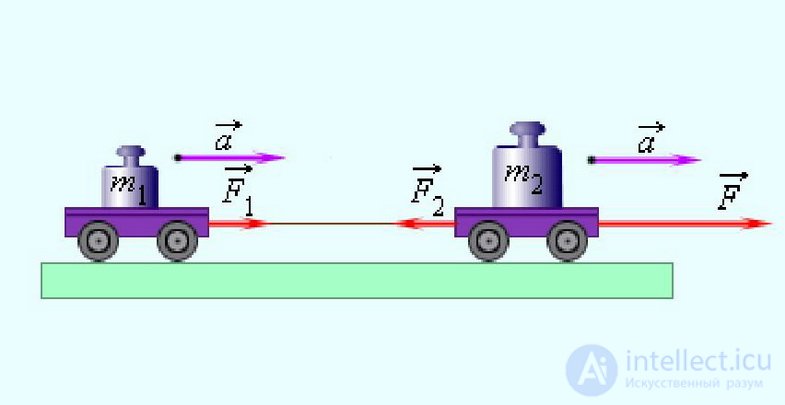
Fig. 3.4. Only external forces cause acceleration of a system (in this case — two carts with loads.)
It must be pointed out that, in this formulation, if we are dealing with an extended body that cannot be regarded as a point particle, Newton’s second law describes only the translational motion of the extended body, in which all points of the body have identical accelerations, velocities and displacements. Newton’s second law, in this form, is not capable of describing the rotational motion of a body. The rotation of an extended body depends critically on the points at which forces are applied to the body. Obviously, in the case of a point particle this question is meaningless: all forces are applied to that single point. In the equation written above, namely:
there is no indication whatsoever of the points of application of the forces to the extended body.
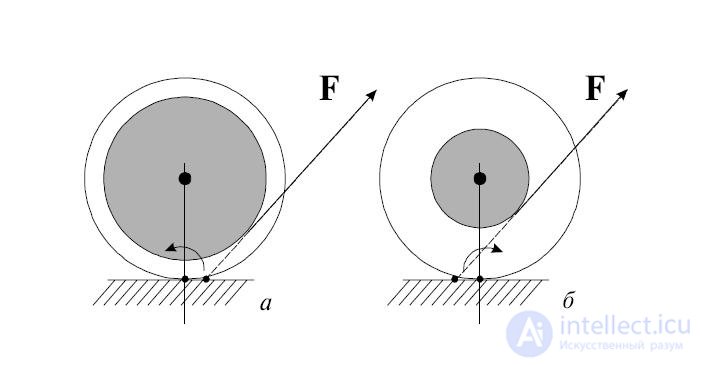
Fig. 3.5. The motion of a spool depends not only on the applied forces, but also on their points of application.
To describe the rotational motion of an extended body, the equation of Newton’s second law written above is modified so that the position vectors of the points of application of the forces appear explicitly in it. As a result of this modification, moments of force appear on the right-hand side of the equation instead of forces.
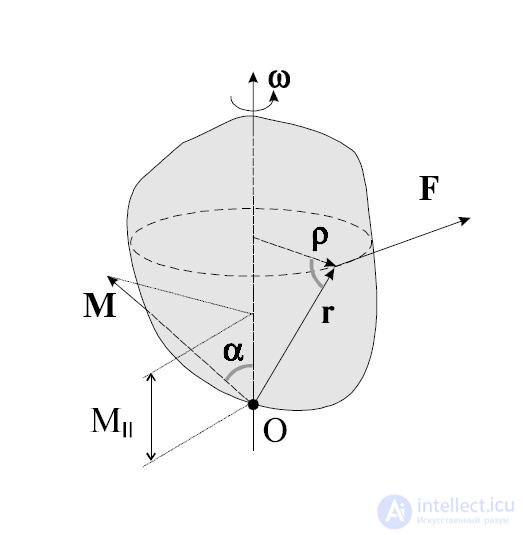
Fig. 3.6. Rotation of a body about a fixed axis.
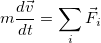
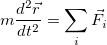
Taking into account that the acceleration 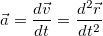 , Newton’s second law can be written in the form of three fully
equivalent relations:

(3.2.1)
(3.2.2)
(3.2.3)
each of which allows one to emphasize a particular aspect of this law.
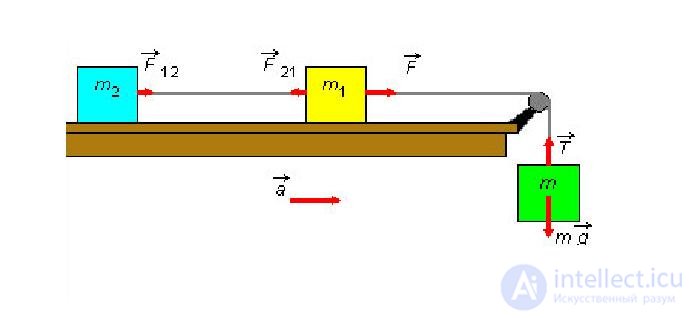
Fig. 3.7. Forces arising during the accelerated motion of a system.
Let us begin with some fairly trivial observations.
If, for brevity, we denote the vector sum of forces standing on the right-hand side  by
by 
and recall that a force may be non-stationary, that is, it may depend on time, that in most cases force fields are inhomogeneous, that is, the force depends on the coordinates of the point, and that there are forces, such as, for example, the force of fluid friction, which depends on the velocity of the body’s motion in the fluid, then it turns out that, in the general case, 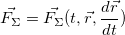 .
.
Then, from (3.2.3) it follows that
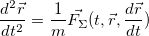
(3.2.4)
the equation of Newton’s second law is a second-order differential equation, solved with respect to the highest (second) derivative.
It is precisely for this reason that the equation of the second law of Newton is most often called the equation of motion.
Mathematicians have proved that, first, given certain requirements on the properties of the function standing on the right-hand side of the equation — the force — a solution of the equation (3.2.4) exists. Note that in physical applications these requirements are practically always satisfied, and if not, it is worth checking whether the formulation of the physical problem is correct, or too idealized. Second, there are infinitely many solutions of equation (3.2.4), and these solutions differ in the values of two (the equation is of second order) vector constants, to find which initial conditions are needed: it is necessary to specify the initial position of the point and its initial velocity at some initial instant of time t0
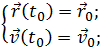
(3.2.5)
It has been proved in mathematics that the solution of the differential problem (3.2.4) — (3.2.5) is unique. The proven uniqueness of the solution is very useful from a purely practical point of view: however the function that turns equation (3.2.4) into an identity and satisfies the initial conditions (3.2.5) is found, it is the one and only solution that this problem has.
Writing Newton’s second law in the form (3.2.2) suggests the introduction of a new kinematic characteristic of the moving point particle, taking into account not only its velocity , but also its mass m. If the mass is constant — and this is indeed so, read on — then it can be brought under the derivative sign and the equation of motion rewritten in the form
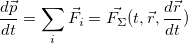
(3.2.6)
Here

(3.2.7)
by definition, by definition, is the momentum of a point particle of mass m, moving with a non-relativistic velocity , the latter meaning (as a reminder) that  .
.
The relativistic limitations on the applicability of Newtonian mechanics in general, and of the expression for momentum (3.2.7) in particular, were understood, of course, not in Newton’s time, but only after Einstein created the special theory of relativity, which, in this context, of course, can be treated as the mechanics of near-light speeds, when  .
.
To this day (early 2010), there is no exhaustive answer to the question of what mass is. To help resolve this question, among others, the LHC — the Large Hadron Collider — was built and is now being tested in operation.
Today, for our limited purposes, the following can be asserted.
Mass is a phenomenological characteristic of elementary particles that does not depend on whether the particle is moving or at rest in a given frame of reference. In other words, mass, like, for example, electric charge, is a number characterizing an elementary particle that does not depend on anything else. Mass, if it is nonzero, quantitatively characterizes the inertial and gravitational properties of a body. But not everything is so simple: for example, the mass of a photon is equal to zero, yet the photon participates in gravitational interaction: its “trajectory” is curved in the Sun’s gravitational field, which has been observed, measured, and the result agrees with the predictions of the general theory of relativity.
The general theory of relativity is based on the so-called “equivalence principle”, which asserts that inertial mass is equal to gravitational mass. In other words, there is no separate inertial mass and separate gravitational mass; there is simply mass "responsible" for everything. The fact that inertial and gravitational mass are strictly proportional to one another was established experimentally by the Hungarian physicist Eötvös (a series of experiments from 1889–1908) with a relative error no greater than  . After this, the equality of inertial and gravitational mass is no longer a problem and is ensured by a corresponding choice of units of measurement. The results of Eötvös’s experiments were used by Einstein in formulating the equivalence principle.
It must be acknowledged and accepted that, within the framework of non-relativistic Newtonian mechanics, it is impossible to give a coherent answer to the question of what mass is. This requires the concepts and tools of both the special and the general theory of relativity, but even these are not entirely sufficient, given the absence, to this day, of a complete theory of elementary particles. This, however, introduces no difficulties into the practical use of Newtonian mechanics.
In the SI system, the unit of mass is the kilogram (kg). This unit of measurement is a base unit.
Fig. 3.8 shows the values of the masses of some physical objects.
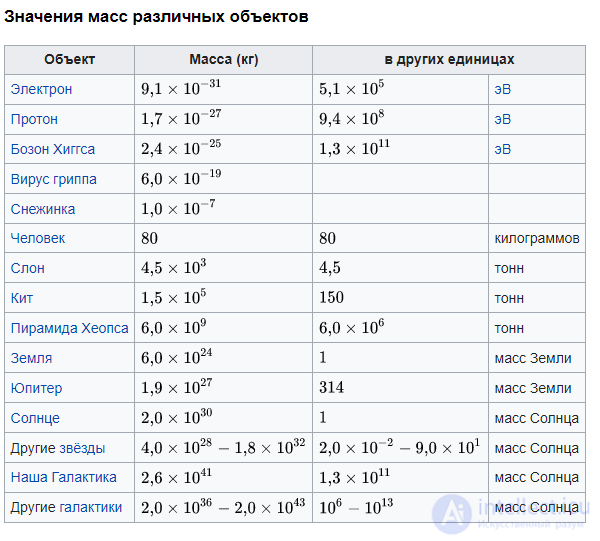
Fig. 3.8. Masses of some physical objects
Note that if we define energy E as an integral of motion whose conservation, for a closed system, is due to the homogeneity of time, and momentum  as an integral of motion whose conservation, for a closed system, is due to the homogeneity of space, then mass is an invariant quantity, equal to
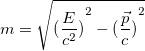
(3.2.8)
Here c — is the speed of light in vacuum, whose invariance has been experimentally established in the experiments of Michelson, Michelson and Morley and numerous followers: the experiments were repeated over almost 50 years (from 1881 to 1930) and, with precision that grew many times over (up to 200-fold), gave one and the same result. The invariance of c is a fundamental postulate of the special theory of relativity.
As already stated, the structure of the left-hand side of Newton’s second law, written in the form (3.2.2), only suggests the expression for momentum. In fact, it can be shown that, both in the non-relativistic and in the relativistic case, the expressions for momentum (3.2.7) and (3.2.9) are a direct consequence of the following definition of momentum:
Momentum  is the term for the conserved characteristic of a closed system, whose conservation is due to the homogeneity of space. From this it follows that for a single non-relativistic
  particle, its momentum is:

Note also that the equation of motion, written in the form (3.2.6) with the momentum from (3.2.9), unlike (3.2.2), holds at any velocity.
The equation of motion in the form (3.2.6)

(3.2.10)
with momentum  can be read as follows:
The rate of change of the momentum of a body equals the vector sum of the forces applied to the body.
Often a very useful formulation, following from (3.2.10), is the following:
The increment in the momentum of a body over some time  equals the product of the average total force acting on the body and the time of its action:
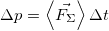
Newton’s second law establishes the unit of measurement of force  .
.
In the SI system, the unit of force is the newton (N):
1 SI unit of force = 1 SI unit of mass • 1 SI unit of acceleration = 1 kg • 1 m/s2 = 1 N.>>
Additional information
http://www.plib.ru/library/book/17005.html – Strelkov S.P. Mechanics, Nauka Publishing House, 1971 – pp. 73–75: an experiment with the severing of threads tied to a heavy ball from above and below;
http://vivovoco.rsl.ru/VV/JOURNAL/NATURE/10_99/HOOK.PDF — Priroda (Nature) journal, 1999, No. 10 — regularities of impact in mechanical systems (A.P. Ivanov)
As already noted, a force need not be constant: it may depend on time, on the position of the body in space, on its velocity. Therefore, solving the equation of motion in the general case is a rather nontrivial problem. Let us give an example of solving such a problem.
Example. A body of mass m, at rest at the origin of coordinates, at time t = 0 begins to be acted upon by a periodic force

where  — is the unit vector of the 0x axis, and T — is the period of variation of the force. For half the period the force is directed along the positive direction of the 0x axis; for the next half period — in the opposite direction. Find the dependence on time of the velocity of the particle and of its position (coordinate) on the 0x axis.
Since the maximum value of the force is equal to  , let us introduce a notation for the maximum acceleration
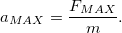
Then the equation of motion takes the form:
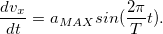
Hence the velocity at time t, taking into account that at the initial instant of time the particle is at rest  , is equal to

The position of the body on the 0x axis is also determined by integration. Taking into account that at the initial instant of time the particle is at the origin of coordinates (x(0) = 0), we obtain

Graphs of the time dependences of the acceleration (in units of  ), the velocity (in units of
  ) and the coordinate (in units of
  ) are shown in Fig. 4.
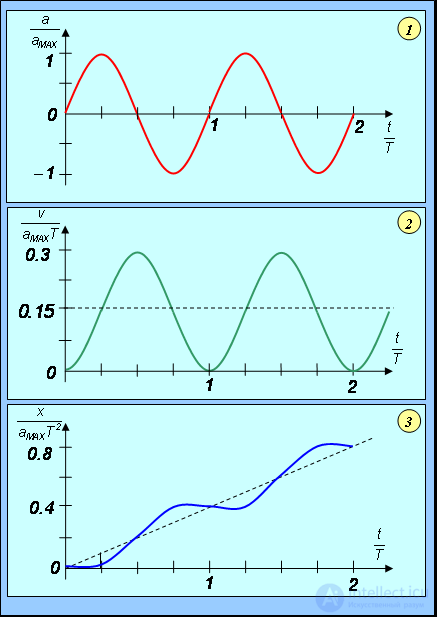
Fig. 3.9. Dependence of the acceleration (1), velocity (2) and position (3) of the particle on time
The acceleration graph, naturally, repeats the force graph. The velocity changes with the same period as the force and acceleration, but, unlike the force and acceleration, it never changes sign: the velocity gained during the half-period of the positive force  decreases to zero during the action of the negative
  force. The average value of the coordinate over the period
  grows in proportion to time. The coordinate itself oscillates about this linear dependence. The average value of the velocity over the period is constant and equal to

it is shown as a dashed line in Fig. 3.9. (2). The time dependence of the average coordinate is shown as a dashed line in Fig. 3.9. (3).
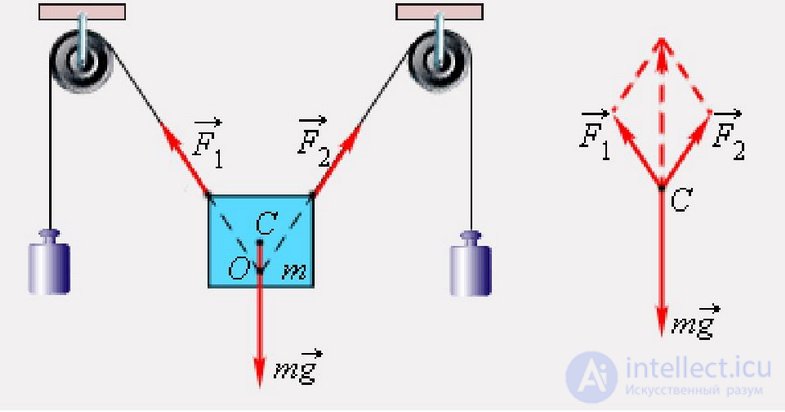
Fig. 3.10. Several forces acting on a body.
What if it is not one force but several that act on our point? In mechanics, the principle of independence of the action of forces is of great importance:
The total acceleration of the body is equal to the sum of these “partial” accelerations. According to this principle, forces and accelerations can be resolved into components, the use of which leads to a substantial simplification in the solution of problems:

where


and

The sum of the forces F is called the resultant (or net) force applied to the body.
Newton’s third law states that
The action of bodies on one another always has the character of an interaction. The forces with which bodies interact are equal in magnitude, opposite in direction, and directed along one common straight line.
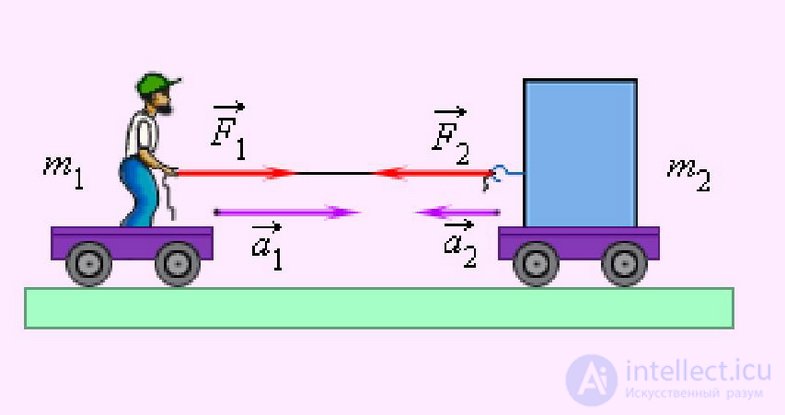
Fig. 3.11. Illustration of the equality of forces 
If we denote the force acting on the first body as a result of its interaction with the second body as  (the first index is the number of the body on which the force acts), and the force acting on the second body as a result of its interaction with the first body, correspondingly, as
  , then the equality of the forces in magnitude and their opposite direction can be written as

(3.2.11)
Or, equivalently:

(3.2.12)
Two forces equal in magnitude and oppositely directed form what is called a “couple”. The fact that the interaction forces, according to Newton’s third law, are directed along one common straight line can be stated as follows: the arm a of the couple of interaction forces is equal to zero. This is illustrated by the figure below. According to Newton’s third law, the left-hand situation a) in the figure holds; the right-hand one — c) — is impossible.
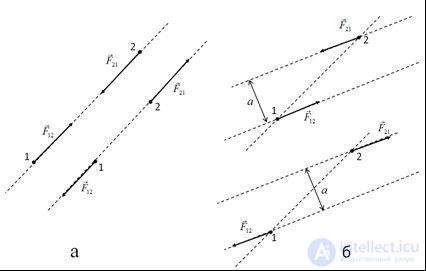
Fig. 3.12. Various examples of the application of forces.
If two bodies forming together a closed system could interact as shown in the right-hand — c) — part of the figure, then such a closed system would spin itself up, which contradicts the law of conservation of angular momentum and which has never been observed in any experiment. And if relation (3.2.12) did not hold, then such a closed system would accelerate itself, which contradicts the law of conservation of momentum and which has likewise never been observed in any experiment.
Note that in the simplest case of two bodies at rest possessing only scalar characteristics, such as mass, electric charge and the like, Newton’s third law is a quite obvious consequence of the homogeneity and isotropy of space for a closed system. In this case the only physically distinguished direction in space is the direction of the unit vector  parallel to the straight line passing through the points in space at which the particles are at rest. Accordingly, the interaction forces can only be directed along or against .
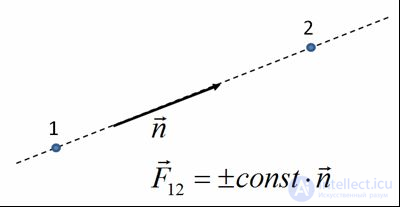
Fig.3.13. Direction of the interaction force between two material points.
However, the law of equality of action and reaction holds only under the assumption of an infinite speed of signal propagation. Even in the simplest case of electromagnetic interaction, Newton's third law holds only in the limit  As an example, consider the interaction of two positive charges Q1 and Q2 (Q1 > 0; Q2 > 0), moving respectively with velocities v1 and v2 , on each of which forces F1 and F2 act from the other charge (Fig. 3.14)
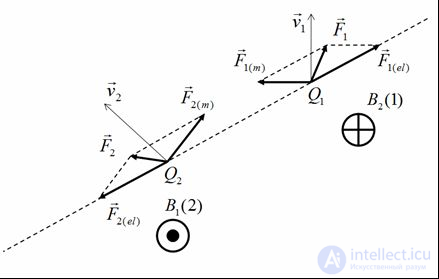
Fig.3.14. Electromagnetic interaction of moving charges (In this case Newton's third law does not hold, because the charges are not an isolated system. Fields E and H also take part in this interaction).
Each of these forces F1 and F2 can be represented as the sum of two components. The first component is the electric interaction force according to Coulomb's law. It acts along the line joining the charges, F1(el) = –F2(el) and satisfies the requirements of Newton's third law. But besides the electric interaction of the charges there is also their magnetic interaction: each of the moving charges creates a magnetic field with induction B at the location of the other charge. The magnetic field acts on a charge moving with velocity v with the Lorentz force, directed perpendicular to the velocity.
In the situation shown in Fig. 3.14, the field B1 created by charge Q1 at the location of charge Q2 is directed perpendicular to the plane of the figure, toward us, while the field B2 created by charge Q2 at the location of charge Q1 is directed perpendicular to the plane of the drawing, away from us. The magnetic Lorentz force is perpendicular to the velocity v and the magnetic induction B. The Lorentz forces F1(m) and F2(m), acting on each of the charges Q1 and Q2, do not coincide in direction and, consequently, cannot satisfy the law of action and reaction. It is clear from the figure that the resultant force of the first charge acting on the second (“action”) is NOT equal to the resultant force of the second charge acting on the first (“reaction”), i.e. Newton's third law does not hold.
Note that at  the forces of magnetic origin are much smaller than the electric ones. Since the deviation from the law of equality of action and reaction is caused by magnetic forces, this ratio is insignificant at not very high speeds and can usually be neglected.
In this section we give examples of forces acting in mechanical systems. These are the force of gravity and the weight of a body, elastic forces and friction forces. The origin of the force of gravity is related to one of the fundamental interactions — the gravitational one. (We will become more familiar with this interaction when studying the law of universal gravitation.) The other fundamental interaction — the electromagnetic one, that is, the interaction between electric charges and currents, underlies the forces associated with the deformation of bodies. These are, above all, elastic forces, as well as friction forces arising from deformation upon contact of rough surfaces. During deformation, the equilibrium distribution of charges inside the atoms, molecules or ions that make up bodies is disturbed, which leads to a change in the forces acting between them.
Force of gravity and weight. Galileo already understood that if the resistance of the air acting on a body moving through it is neglected, then all bodies fall to Earth with one and the same acceleration  . The force “providing” this acceleration is called the force of gravity.
In a frame of reference attached to the Earth, on any body of mass m there acts a force of gravity
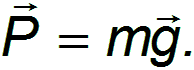
Unless otherwise stated, we will consider the force of gravity to coincide with the force of gravitational attraction (of a body's gravitational attraction to the Earth). Strictly speaking, the force of gravity is the resultant of the force of gravitational interaction of the body with the Earth and the centrifugal force of inertia acting on a body in any rotating frame of reference, in particular one attached to the Earth. But since centrifugal forces are considerably smaller than gravitational ones, in many problems (not all) they can be neglected.
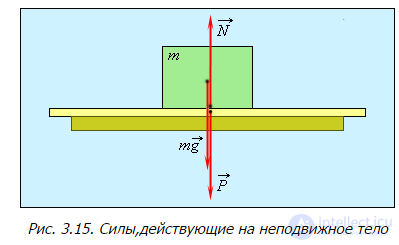
Fig. 3.15. Forces acting on a body at rest
The force with which a body acts on its suspension or support is called the weight of the body.
When a body is at rest, the force of gravity is balanced by the reaction of the support or suspension  , that is

By Newton's third law, the weight of the body  is equal to

If, however, the body together with its support or suspension moves with acceleration, then the weight of the body is not equal to the force of gravity.
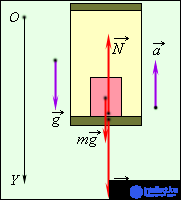
Fig. 3.16. Forces acting on a body moving with acceleration
Let us recall in passing that, by definition, the vertical (downward) direction is called the direction of the free-fall vector . Accordingly, any direction perpendicular to is horizontal.
Let a suspension in the form of a spring mounted on a frame move together with an elevator with acceleration a (fig. 3.17).
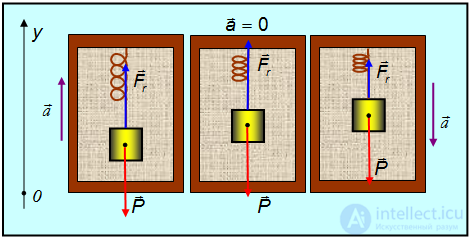
Fig. 3.17. Dependence of the weight of a moving body on the acceleration of the support
Then the equation of motion of the body will have the form
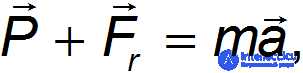
where — is the reaction of the suspension, that is, the force with which the spring acts on the body. By Newton's third law, the body acts on the spring with a force equal to —  , which by definition is the weight of the body . Replacing in the equation of motion the reaction of the support with the force — , and the force of gravity
  — with the product mg, we get:
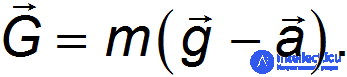
Let us project the obtained relation onto the vertical axis y, directed vertically downward:

From this it follows that in magnitude the weight  can be either greater or smaller than the force of gravity
  (see fig. 6). During free fall of the frame with the suspension
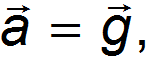
and the force , with which the body acts on the suspension, is equal to zero: a state of weightlessness sets in. The “disappearance” of the weight of the body, that is, of the force of pressure on the support, does not mean the disappearance of the inertial properties of the body (its mass).
In A.R. Belyaev's science-fiction novella “The Star KEC”, the hero's first experience of weightlessness is described. He pushes off and flies along the corridor of the space station:
“ — Grab the strap! — shouted Kramer. These straps, like the handles of a suitcase, were everywhere: on the walls, on the floor, on the ceiling. I grabbed the handle, expecting to be jerked when I stopped, but at that same moment I was surprised to feel that no strain was felt in my hand”.
This description, of course, contains a crude physical error: the disappearance of the hero's weight does not at all mean the disappearance of his momentum mv. Changing the momentum (stopping) requires a force, so the cosmonaut should have been “jerked” exactly as on Earth.
Elastic force. When a body is deformed, elastic forces arise that oppose this deformation. For small deformations, the arising forces are proportional to the magnitude of the deformation. If a spring in its normal (unloaded) state has a length  and we deform it (stretch or compress it) to a length
  , then an elastic force acts on our hand

The coefficient  is called the spring stiffness coefficient, and the “minus” sign indicates that the elastic force opposes the deformation of the spring. The equation given describes the simplest case of Hooke's law.
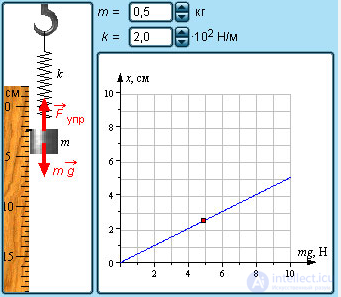
Linear elastic deformations and Hooke's law.
The emergence of the elastic force in the process of oscillation of a body on a spring is shown in fig. 3.18.
Example. What is the effective stiffness coefficient for a spring composed of two other springs with stiffness coefficients  and
and  , if the springs are connected: a) in series (fig. 3.19), b) in parallel (fig. 3.20).
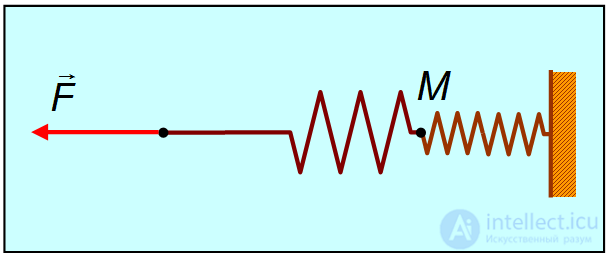
Fig. 3.19. Series connection of springs
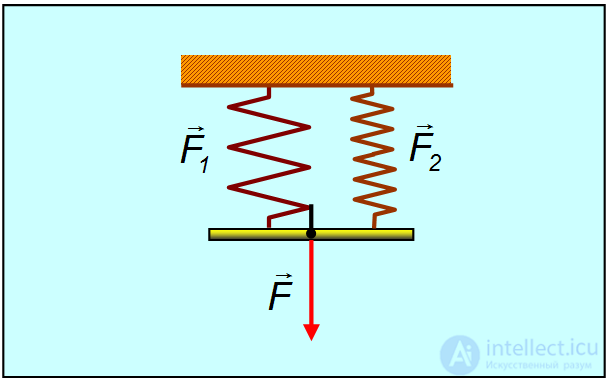
Fig. 3.20. Parallel connection of springs
Solution. If we stretch springs connected in series, the elastic forces arising in each of them are equal and equal to the stretching force  (see fig. 7): the connection point
  is in equilibrium. Consequently, the elongations of the springs are equal, respectively, to
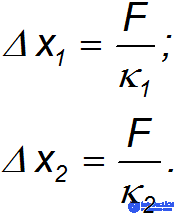
The total elongation of the composite spring is equal to
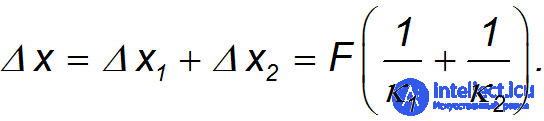
The effective stiffness of springs connected in series is determined from the relation:
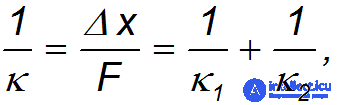
from which
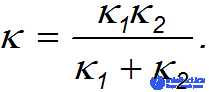
When stretching springs connected in parallel, their elongations  are equal, so that in each of them its own elastic force arises:
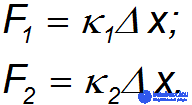
In the state of rest, the sum of these forces is equal to the stretching force (see fig. 3.20):

so that the stiffness coefficient of springs connected in parallel is equal to

In a number of problems, when the stiffness coefficient is large, the magnitude of the deformation is neglected, but not its consequences — the arising elastic forces. This is also an example of a physical abstraction, a model.
Force of friction. When clean surfaces of solid bodies — free of liquid lubricant — come into contact, forces called dry friction forces arise between them. Their characteristic feature: these forces do not vanish even in the absence of relative motion of the bodies in contact.
Friction that can exist between bodies not moving relative to one another is called static friction.
The following statement holds regarding the force of static friction:
The force of static friction is always equal in magnitude and opposite in direction to the external force which, in the absence of friction, would cause relative sliding of the bodies.
However, the force of static friction cannot exceed a certain maximum value  . As long as the external force is less than , relative sliding of the bodies does not occur, since the force of static friction “automatically” assumes a value that compensates for the action of the external force.
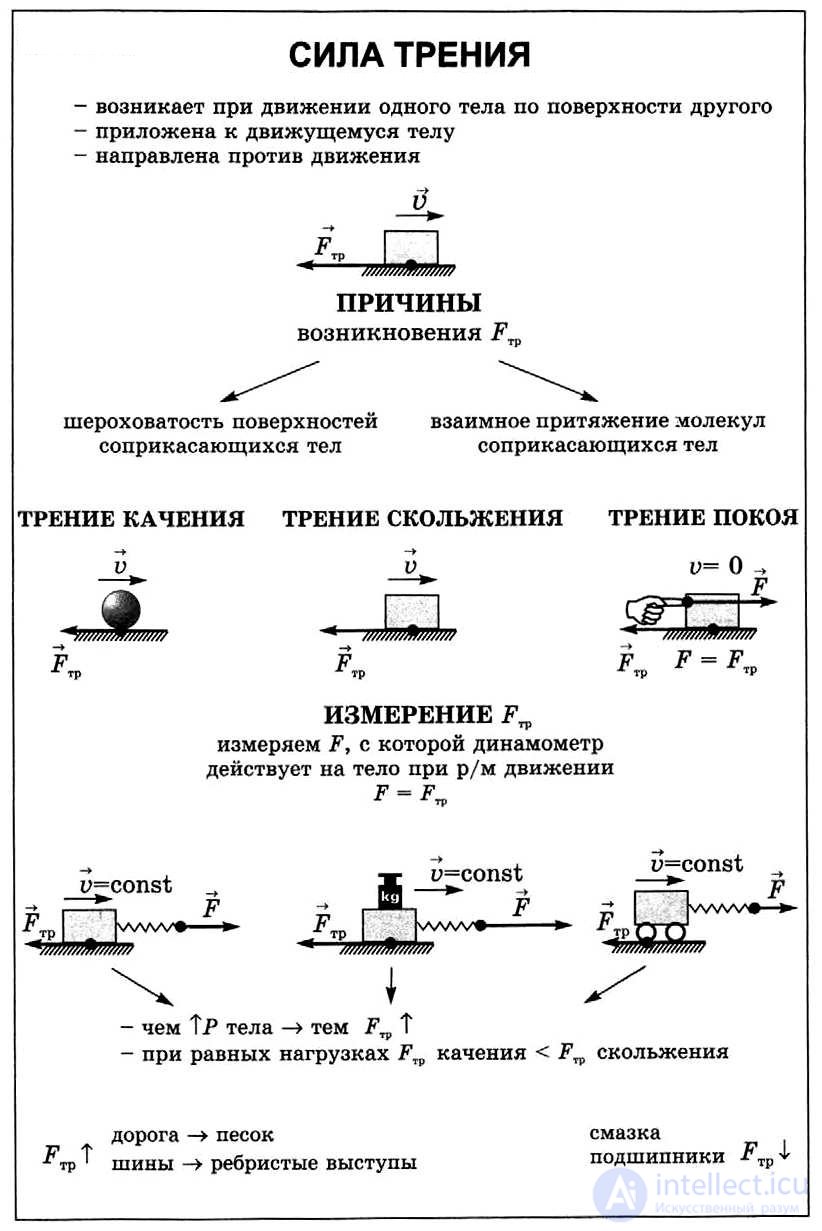
Force of static friction and force of sliding friction
Dry friction forces between objects moving relative to one another are called forces of sliding friction.
They depend in a rather complicated way on the relative velocity of motion, but for a wide class of phenomena and pairs of materials in contact they can be considered constant and equal to the maximum value of the force of static friction. They are directed so as to oppose the relative slipping of the bodies in contact.
For the maximum value of the force of static friction, the following relation has been established experimentally — Amontons-Coulomb's law:
The maximum force of static friction is proportional to the normal force pressing the bodies in contact together
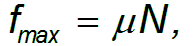
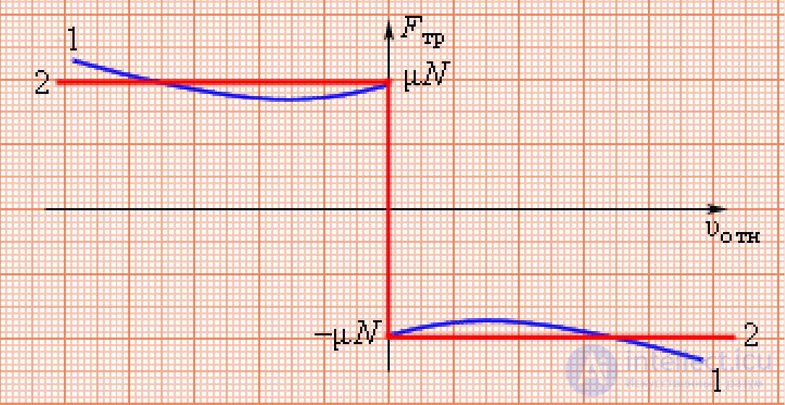
Fig. 3.21. Dependence of the friction force on the relative velocity of the bodies
where  — is the coefficient of static friction, depending on the properties of the surfaces in contact. Characteristic values of are given in the table.
Table
Coefficient of static friction for some pairs of materials in contact

It should be kept in mind that the coefficient of static friction depends strongly not only on the materials of the bodies in contact, but also on the condition (finish) of their surfaces, as well as on the presence of foreign substances, for example, rust on the surface of steel parts.
When solid bodies are in contact, not only dry friction forces (static or sliding) act between them. Owing to the deformation of bodies, rolling friction forces can also arise. They are much smaller than static friction forces, and are usually neglected.
The following example demonstrates a case in which the support reaction force is not parallel to the force of gravity. Let a body of mass  slide along an inclined plane which makes an angle
  with the horizontal (fig. 3.22).
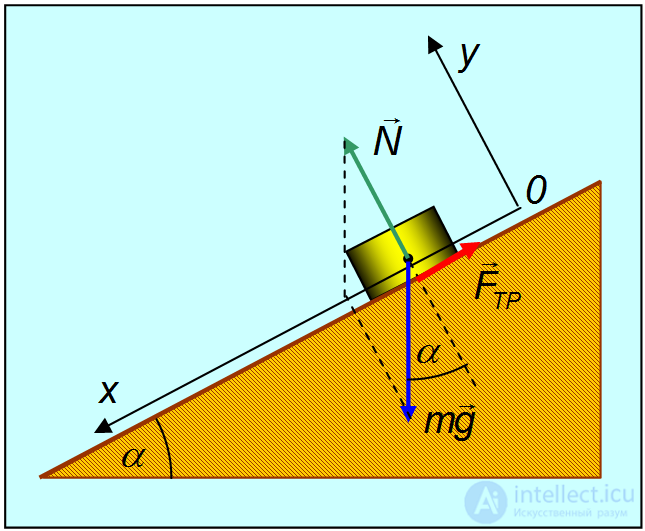
Fig. 3.22. Motion of a body along an inclined plane
In order to set up the equation of motion, it is necessary to establish which forces act on the body under consideration. In doing so, one must first determine the action of which other bodies on the given body should be taken into account. For a body sliding along an inclined plane, the action from the Earth is significant (it is characterized by the force of gravity  ) and the action from the plane (it is characterized by the support reaction force
  , where
  — is the normal component of the reaction force (the normal pressure force), and
  — is the tangential component of the reaction force, that is, the friction force). Accordingly, the equation of Newton's second law, or the equation of motion, has the form:

To find the acceleration of the body, one must go from vectors to their projections onto suitably chosen directions. (It is usually expedient to choose the axis along the direction of motion as one of the coordinate axes). Let us project the vectors entering the equation onto the directions  and
and  (see fig. 3.22):

(3.2.13)

(3.2.14)
Assuming that the body slides down, instead of  we substitute into the first equation the force of sliding friction

with the value of N following from the second equation, that is:

(3.2.15)
Then from the first equation, after dividing it by the mass, for the acceleration with which the body slides down, we obtain:

Let us solve the problem in the following formulation: the body was placed on the inclined plane and released without a push, that is, the initial velocity of the body is equal to zero. If it becomes necessary to determine the dependence of the coordinate x of the body on time t, we can take its initial value to be equal to zero as well.
Strictly speaking, it is not known in advance whether the body will start to slide down or not. Let us assume that the body remains at rest, find from the equations of motion the value of the force of static friction, and obtain the condition for the state of rest to be preserved from the requirement that the force of static friction cannot exceed its maximum value, equal to the force of sliding friction. This is a general technique that leads to a result — an inequality, when satisfied, the state of rest is preserved — not only in this simplest case, but also in considerably more complex situations.
If the body is at rest, then

(3.2.16)
and the friction force appearing in (3.2.13) is the force of static friction

(3.2.17)
Substituting (3.2.16) and (3.2.17) into (3.2.13), for the force of static friction we obtain

(3.2.18)
But the force of static friction cannot exceed its maximum value, equal to the force of sliding friction. Requiring that (3.2.18) not exceed (3.2.15), after cancellation we obtain the condition for the state of rest to be preserved

(3.2.19)
When this inequality is satisfied (the angle is small, the friction coefficient is large), if the body is not simply placed on the inclined plane but is also pushed upward, then the body will start to slide, decelerating, upward, stop, and remain at rest.
When the opposite inequality is satisfied (large angle, small friction coefficient)

the body will, decelerating, slide upward, stop, and, “failing to hold”, will slide back down.
Dry friction arises when bodies pressed against each other come into contact as a result of their relative displacement. The surfaces of real bodies are not smooth; they have roughness (fig. 3.23). Therefore contact between the bodies occurs not over the entire visible area of contact, but in separate regions located on the protrusions of the surfaces. During sliding, the regions of contact are destroyed and arise anew. Important practical consequences of sliding friction are the heating and wear of the rubbing surfaces.
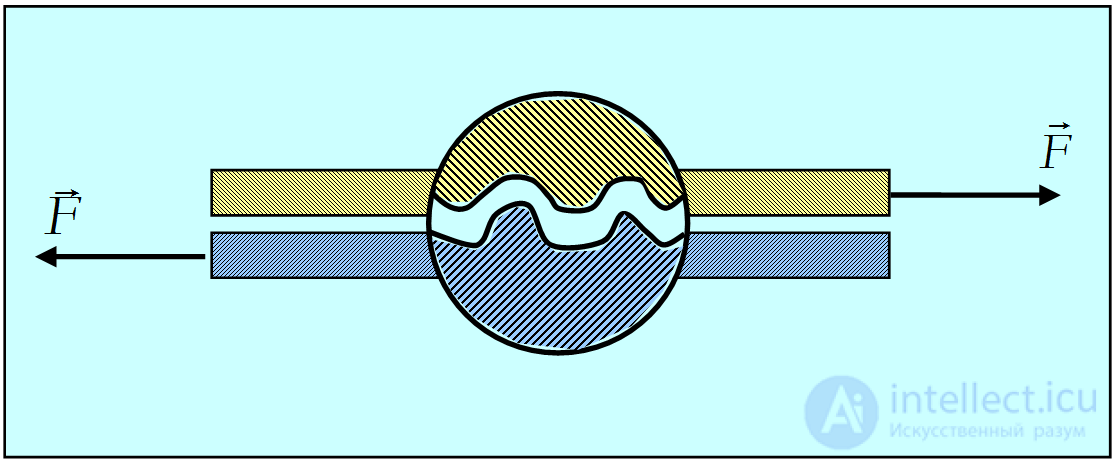
Fig. 3.23. Mechanism of the origin of dry friction
Force of medium resistance. When a body moves in a liquid or gaseous medium, a force of medium resistance, depending on the velocity of the body, acts on it. At low speeds of motion, the resistance force is proportional to the velocity
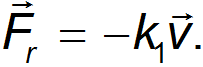
As the speed of the body increases, the resistance force depends on the velocity according to a quadratic law
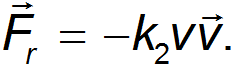
In both cases the resistance force is directed against the velocity vector of the body.
The dependence of the force on the velocity of the body leads to the existence of a steady-state velocity of motion, when the resistance force reaches the magnitude of the driving force.
Example. Let us consider the slow motion of a body under the action of a constant force  = const in a liquid medium. In projections onto the direction of the force, Newton's second law for the body has the form
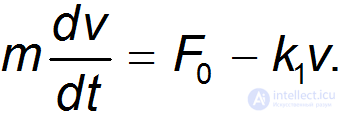
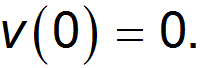
Let the body start moving with zero initial velocity
Integrating the equation of Newton's second law, we obtain
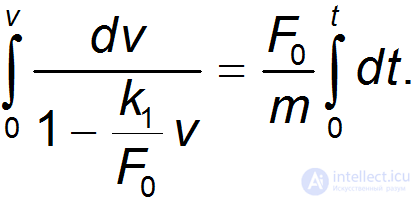
or
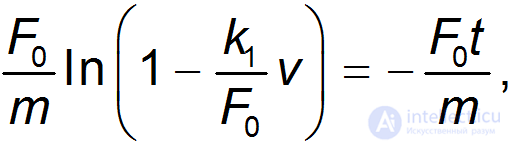
from which the dependence of the velocity of the body on time takes the form:
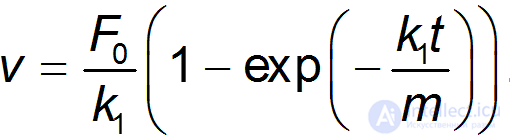
Fig. 3.24 shows graphically the dependence of the velocity of the body on time.
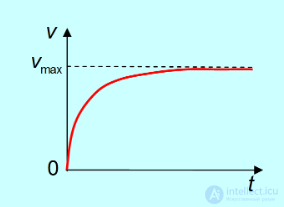
Fig. 3.24. Velocity of motion of a body in a viscous medium
It can be seen that the velocity of the body, with the passage of time, tends to a limiting value
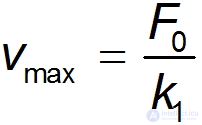
— the velocity of steady-state motion.
Let us consider a system of  material points
  ,
,  , …,
, …,  , whose positions are given by the position vectors
  ,
,  , …,
, …,  , and whose momenta are equal to
  ,
,  ,...,
,...,  , respectively (fig. 3.25).
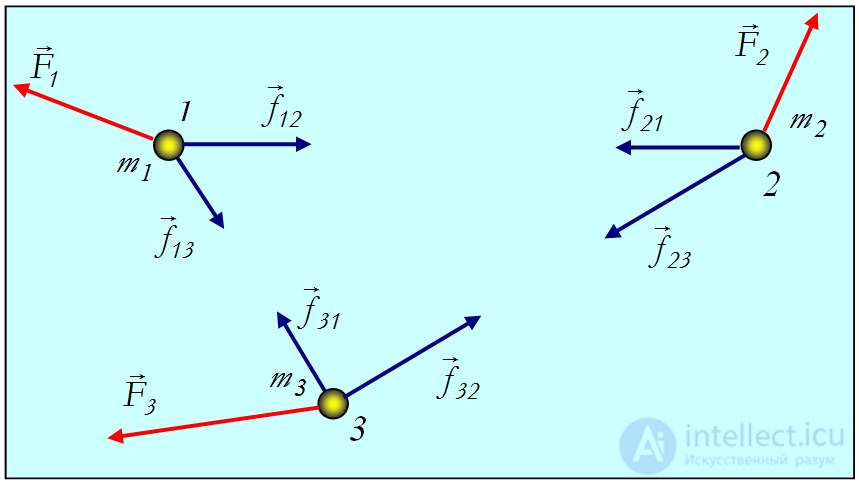
Fig. 3.25. A system of interacting particles
Among the forces acting on these material points, we will distinguish internal forces between the bodies included in the system, and external forces acting on the system from bodies not included in it. We will denote internal forces as  , where the indices show that this force acts on the body with number
  from the body with number
  . In addition, some external force
  acts on the body with that number.
Let us write the equation of Newton's second law (the rate of change of the momentum of a body equals the sum of all forces acting on the body) for all material points of the system
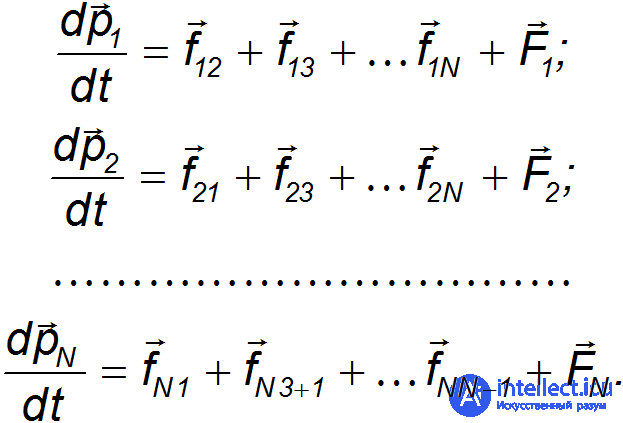
Let us add together these equations. The sum of all internal forces on the right-hand side turns out to be equal to zero. Indeed, it consists of paired terms of the type
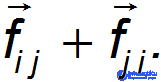
By Newton's third law, the interaction forces of two material points and are equal in magnitude and opposite in direction (acting along the line joining these material points):
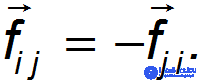
Therefore, on the right-hand side we are left only with the sum of all external forces:

The sum

of the momenta of the particles forming a mechanical system is called the momentum of the system.
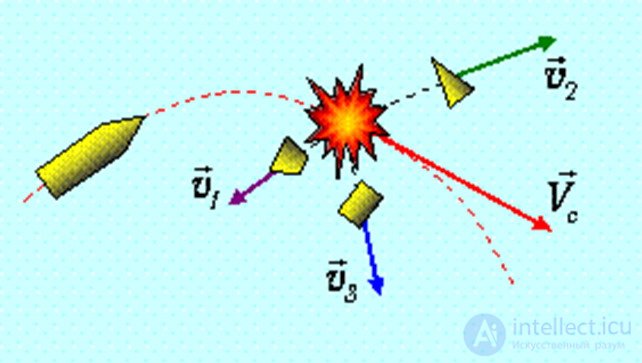
Fig. 3.26. The total momentum of the fragments of a shell equals the momentum of the shell itself before the explosion.
The momentum of the system satisfies the equation
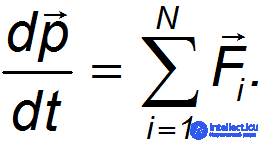
A system of bodies interacting only with each other and not interacting with other bodies is called closed.
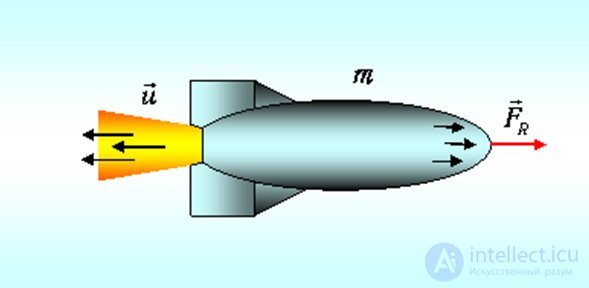
Fig. 3.27. The total momentum of the shell and the particles flying out of it does not change with time
In other words, no external forces act on a closed system. In the absence of external forces
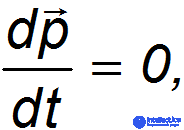
from which
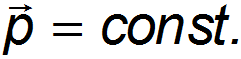
The total momentum
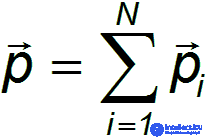
of a closed system is conserved, that is, it is constant in time.
This statement, known as the law of conservation of momentum, is related to fundamental properties of nature (the homogeneity of space), and is therefore valid not only in classical mechanics, but in physics in general.
Situations are possible in which the external forces are not equal to zero, but the projection of their resultant onto some direction  is equal to zero. Then, as follows from (3.4.1), rewritten in the form
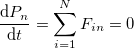
the projection of the momentum of the system  onto this same direction will be conserved. An example may be provided by the already considered motion of a body thrown at an angle to the horizontal. The force of gravity, directed vertically downward, acts on the body. Its projection onto the horizontal axis is equal to zero, and therefore the horizontal projection of the momentum is conserved, and correspondingly, the horizontal projection of the velocity is constant.
Applying the law of conservation of momentum makes it possible to solve many problems, for example, when the exact forces acting in the system are unknown.
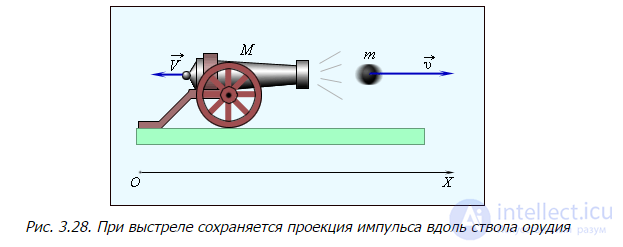
Fig. 3.28. When a shot is fired, the projection of the momentum along the barrel of the gun is conserved
Example. Firing from an AK-47 assault rifle, a soldier experiences recoil: a mean force Fcp acts on him, equivalent to the weight of a mass M = 6.5 kg. Given that the mass of the bullet is m = 7 g and it leaves with an initial velocity of 850 m/s, determine the rate of fire n of the rifle (that is, the number of bullets fired by the rifle per unit time).
In time  ,
, 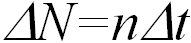 bullets are fired. They carry away momentum
  By the law of conservation, the same momentum is transferred to the rifle. Therefore, by Newton's second law, the mean recoil force is equal to
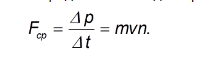
By the condition of the problem 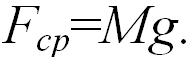 From this we find the rate of fire of the weapon:

Naturally, when firing in bursts, and even more so with single shots, the number of rounds per minute will be lower.
Let us again consider the same system of point particles. Let us construct the position vector  according to the following rule:
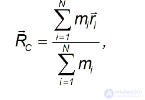
where  — the position vector
  — of the point particle of the system, and
  — its mass.
The position vector determines the location in space of the centre of inertia (centre of mass) of the system.
It is by no means necessary that some point particle actually be located at the centre of mass of the system.
Example. Let us find the centre of mass of a system consisting of two small balls — point particles — connected by a weightless rod (Fig. 3.29). Such a system of bodies is called a dumbbell.
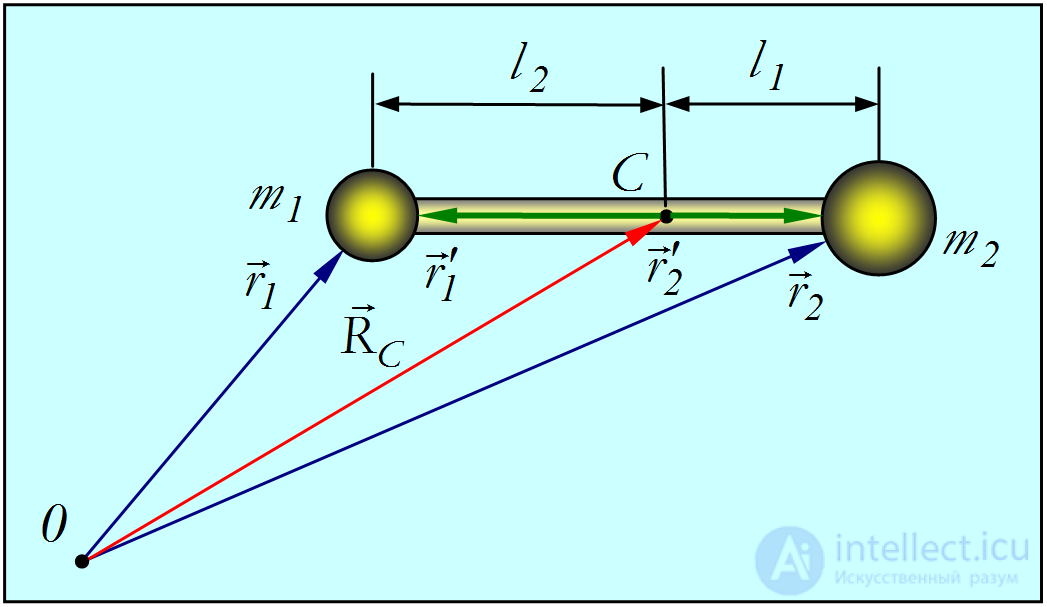
Fig. 3.29. Centre of mass of a dumbbell
It is evident from the figure that
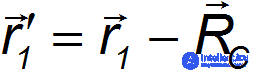
and
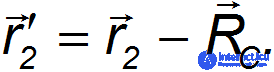
Substituting into these equalities the expression for the position vector of the centre of mass
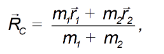
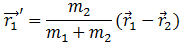
we obtain
and
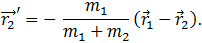
It follows from this that the centre of mass lies on the straight line passing through the centres of the balls. The distances l1 and l2 between the balls and the centre of mass are respectively equal to
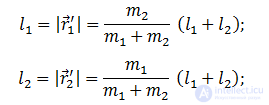
The centre of mass is closer to the ball whose mass is greater, as is evident from the ratio:

Let us determine the velocity with which the centre of inertia of the system moves. We differentiate both sides with respect to time:
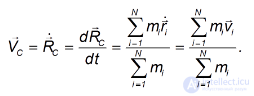
In the numerator of the resulting expression on the right-hand side stands the sum of the momenta of all points, that is, the momentum  of the system. In the denominator stands the total mass of the system
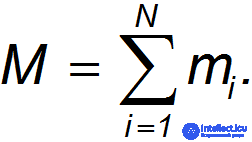
We have obtained that the velocity of the centre of inertia is related to the momentum of the system and its total mass by the same relation that holds for a point particle:
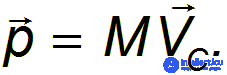
Thus, we may consider the velocity VC to be the velocity of the system as a whole. It may, of course, differ from the velocities of each of the bodies making up the system.
The centre of mass of a closed system always moves with constant velocity, since the momentum of such a system is conserved.
If we now differentiate the expression for the momentum of the system with respect to time and take into account that the derivative of the system's momentum is the resultant of the external forces, we obtain the equation of motion of the centre of mass of the system in the general case:
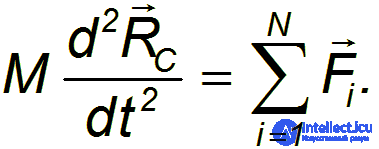
It is evident that
The centre of mass of a system moves in exactly the same way as a point particle would move, with mass equal to the mass of all the particles of the system, under the action of the vector sum of all the external forces applied to the system.
If we have a system of point particles whose internal arrangement and motion do not interest us, we are entitled to regard it as a point particle with the coordinates of the position vector of the centre of inertia and a mass equal to the sum of the masses of the point particles of the system.
If we attach a frame of reference to the centre of mass of a closed system of point particles (particles) — it is called the centre-of-mass frame — then the total momentum of all the particles in such a frame turns out to be zero. Thus, in the centre-of-mass frame, the closed system of particles as a whole is at rest, and only the motion of the particles relative to the centre of mass exists. This is why the properties of the internal processes occurring in a closed system are clearly revealed.
In the case where the system is a body with a continuous distribution of mass, the definition of the centre of mass essentially remains the same. Let us surround an arbitrary point  in our body with a small volume
  . The mass contained in this volume equals
  , where
  — the density of the material of the body, which may not be constant throughout its volume. The sum over all such elementary masses is now replaced by an integral over the entire volume
  of the body, so that for the position of the centre of mass of the body we obtain the expression
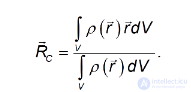
If the material of the body is homogeneous, its density is constant, and it can be taken outside the integral sign, so that it cancels in the numerator and denominator. Then the expression for the position vector of the centre of mass of the body takes the form
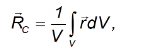
where — the volume of the body.
In the case of a continuous distribution of mass as well, the following statement holds:
The centre of mass of a rigid body moves in the same way as a point particle would move, with mass equal to the mass of the body, under the action of the vector sum of all the external forces applied to the body.
Example. If a shell explodes at some point along its parabolic trajectory, the fragments fly off along a great variety of trajectories, but its centre of mass continues to move along the parabola.
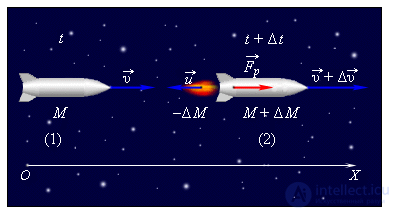
Let us consider the motion of a body whose mass changes in the course of the motion, using the motion of a rocket as an example.
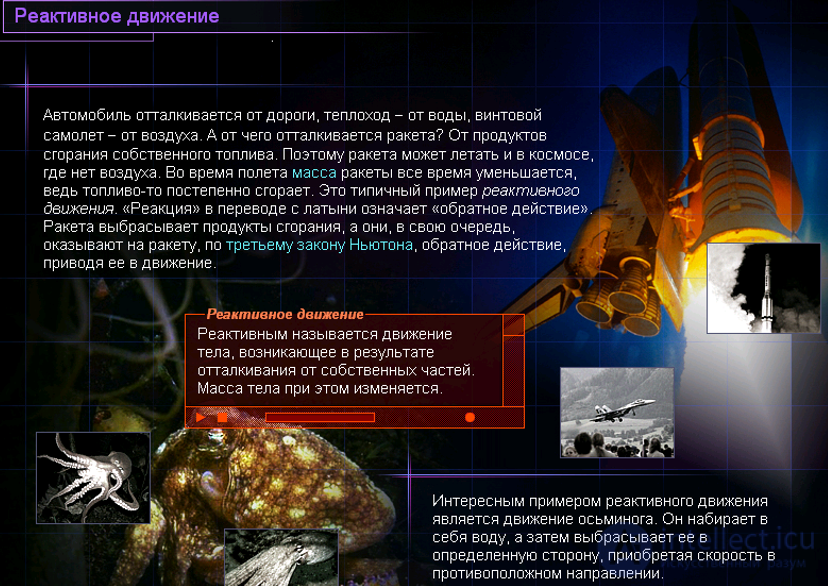
The principle of rocket motion consists in the fact that the combustion products of the fuel are ejected from the rocket at high speed, thereby pushing it in the opposite direction.
Note that, as the rocket moves, its mass continuously changes, and therefore Newton's second law in the form considered earlier is inapplicable for describing the motion of a rocket.
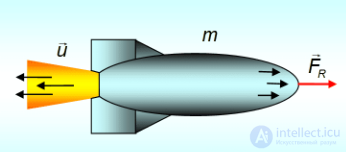
Fig. 3.30. Principle of rocket motion
Let  — be the mass of the rocket at time
  , and
, and  — its velocity. The momentum of the rocket will be
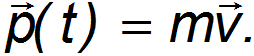
Over a time  the mass of the rocket and its velocity receive increments
  (moreover < 0), since the mass of the rocket decreases) and
  respectively, so that by the time
  they will be equal to


The momentum of the rocket will become

In addition to this, we must take into account the momentum of the gases ejected over the time  :
:

where 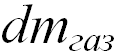 — the mass of the gases ejected over the time
  ,
,  — their velocity relative to the Earth.
Let us make use of Newton's second law in impulse-momentum form. Then

Let us expand the brackets, taking into account that  (the mass of the rocket has decreased by the mass of the gases ejected from the engine nozzle):

Let us introduce u — the velocity of the gas jet outflow relative to the rocket. Then
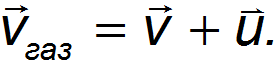
After transformations and retaining terms of the first order of smallness (the second-order term 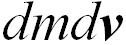 is discarded), we obtain

or
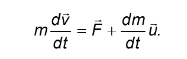
This equation resembles Newton's second law in form, but here an additional term appears
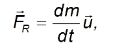
called the reactive (thrust) force. Taking this into account, the equation of motion takes the form
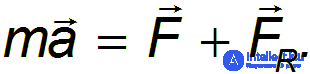
This equation of motion of a body of variable mass is called the Meshchersky equation.
The quantity
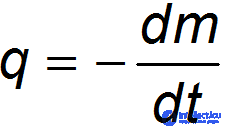
is called the fuel consumption rate.
Let us consider the motion of a rocket in the absence of external forces (F = 0) (Fig. 3.31). Let us project the Meshchersky equation onto the direction of motion of the rocket  :
:
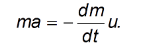
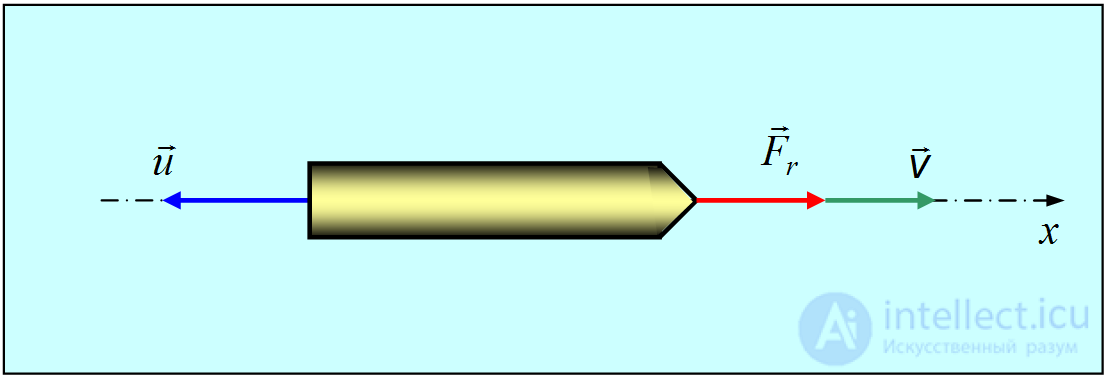
Fig. 3.31. Motion of a rocket in the absence of external forces
Taking into account that
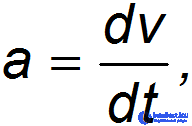
we obtain
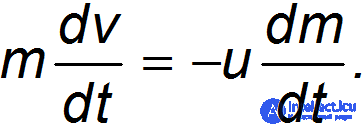
Let us separate the variables:
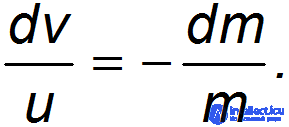
Usually it can be assumed that the velocity of gas outflow relative to the rocket is constant. Integrating the resulting equation, we find
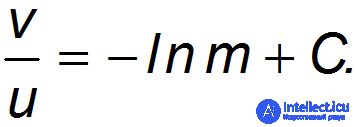
Let at the initial time  = 0 we have
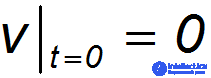
and
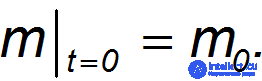
Then

from which we find the constant of integration
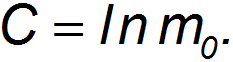
Then the formula for the velocity of the rocket, called the Tsiolkovsky rocket equation, takes the form
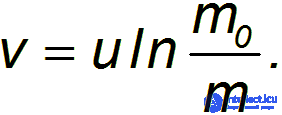
It is clear that the final velocity of the rocket is determined by the velocity of the gas jet outflow, which — in the case of a chemical engine with an oxidation reaction and ejection of reaction products — depends on the combustion temperature T and the molar mass M of the gases
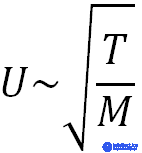 .
.
Consequently, the most effective fuel will be hydrogen, with a very high combustion temperature and low molar mass. Hydrogen as a fuel has found wide application in astronautics, despite its increased fire hazard and the requirement (when stored in the rocket's tanks) for very low (cryogenic) temperatures.
Example. Suppose a rocket must be given the first cosmic velocity  = 8 km/s. If a propellant with an exhaust velocity of
  = 1 km/s (gunpowder) is used, then the ratio of the payload mass to the rocket's launch mass will be
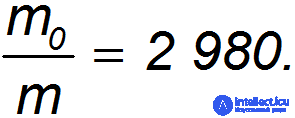
If, however, a propellant with = 2 km/s (hydrogen) is used, then
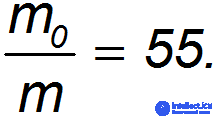
It is evident that, for the same payload, the launch mass of the rocket in the second case will be almost 50 times smaller than in the first.
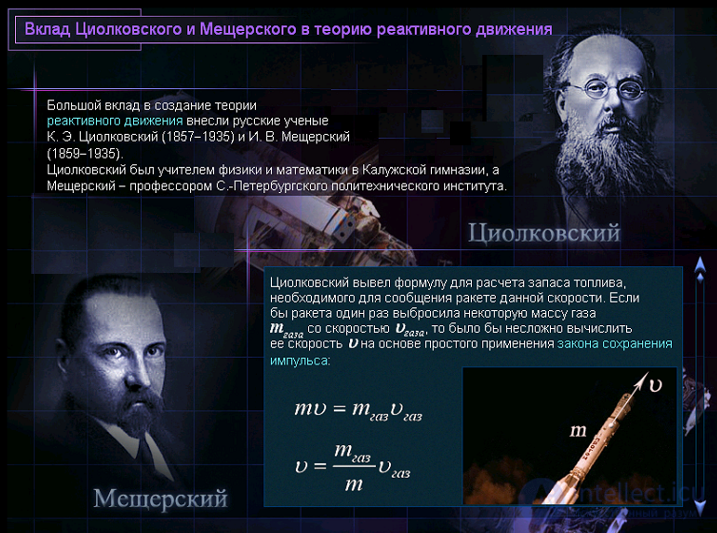
the scientists I.V. Meshchersky and K.E. Tsiolkovsky. The contribution of these scientists to the development of jet propulsion
During the Great Patriotic War, rocket-artillery systems (“Katyushas”) – multiple rocket launchers mounted on trucks – played an important role in the combat operations of our army.
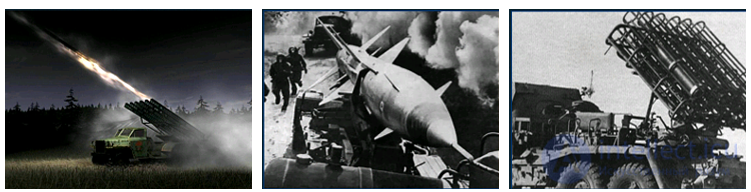
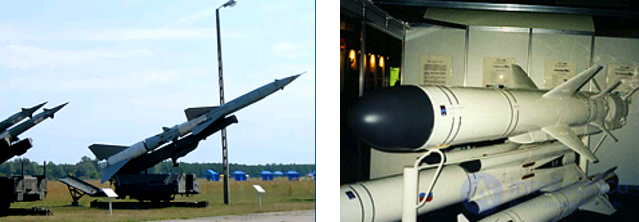
Modern combat missiles carry both conventional and nuclear warheads. They are capable of covering several thousand kilometres within a few dozen minutes. Depending on the launch site and the location of the target, they are divided into classes: “surface-to-surface”, “surface-to-air”, “air-to-surface”.
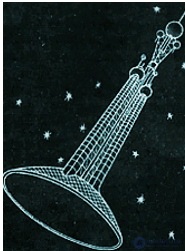
The creation of a photon rocket will make it possible to travel to stars and galaxies.
Let us ask ourselves the question: why, following Newton, did we formulate Galileo's principle of inertia as a separate (first) law of motion? After all, it follows from the second law when the sum of all forces acting on the body is zero. Indeed, this is so. But with respect to which frame of reference do we formulate the laws of dynamics?
Among all conceivable frames of reference, these laws appear simplest in so-called inertial frames of reference. Let us consider a body located so far from other bodies that it experiences no influence from them whatsoever. Let us call such a body freely moving. If we now attach a frame of reference to such a body, then in it the free motion of another body appears simplest of all: it will be uniform and rectilinear. This is precisely the law of inertia, discovered by Galileo. The meaning of the law lies precisely in the fact that
There exists such a frame of reference in which a free point particle is at rest or moves uniformly and in a straight line.
A frame of reference in which Newton's first law holds is called inertial.
It is precisely for an inertial frame of reference that we formulated Newton's second law.
An inertial frame of reference is likewise a certain abstraction used in science. In practice, a freely moving body, as well as an inertial frame of reference, can exist only with greater or lesser accuracy. In the vast majority of cases, our planet can be chosen as an inertial frame of reference (a geocentric frame). In other cases, for example to describe the motion of the planets, a frame attached to the Sun is chosen as such (a heliocentric frame). Sometimes even this is not enough, and then a frame attached to the stars is used.
Thus, Newton's first law postulates that there exists a frame of reference in which a free point particle is at rest, or moves uniformly and in a straight line. But if at least one inertial frame exists, then any other frame of reference moving relative to it uniformly and in a straight line will also be inertial.
Indeed, let us establish the relationship in the description of motion of the same point particle, considered relative to two different frames of reference.
Let a frame of reference be given with the origin of coordinates at point 0, and let another frame of reference be given with the origin of coordinates at point 0' (Fig. 3.31).
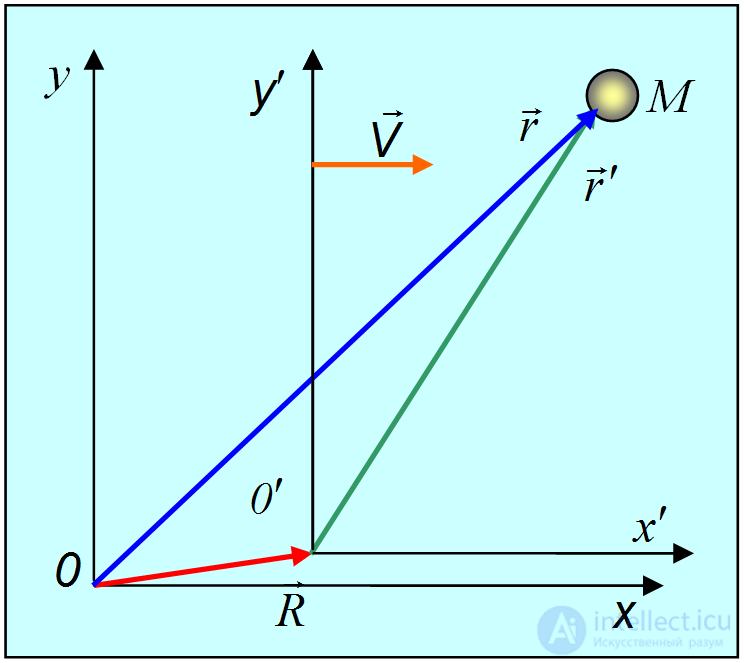
Fig. 3.31. Motion of bodies in two different frames of reference
All quantities relating to this frame of reference we shall mark with a prime (x', y', z' etc.). The position of the origin 0' relative to the frame 0 is characterized by the position vector  . Let us consider the motion of the point particle M. Its position relative to the frame 0 is given by the position vector
  , and relative to 0' — by the position vector . Based on the rules of vector addition, we can write

Let us differentiate this relation with respect to time and obtain:
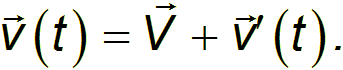
Here  ,
,  — the velocity of the point particle M relative to frames 0 and 0', respectively. The vector V — is the velocity of the “primed” frame of reference relative to the “unprimed” one. We have obtained the velocity-addition law of classical mechanics:
The velocity v of a point relative to frame 0 can be represented as the vector sum of its velocity relative to frame 0' and the velocity V of frame 0' relative to frame 0.
If frame 0' moves relative to 0 rectilinearly and uniformly, then V does not depend on time. Differentiating the resulting velocity-addition law with respect to time, we find that the accelerations of point M relative to both frames of reference are identical:
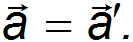
If  , then also , that is, Galileo's law of inertia holds in both frames of reference. Hence, if frame 0 is inertial, then frame 0' will be inertial as well.
The laws of mechanics have the same form in all inertial frames of reference, which are physically equivalent (indistinguishable from one another). This is precisely what constitutes Galileo's principle of relativity:
The equations expressing the laws of nature are invariant with respect to transformations of coordinates and time from one inertial frame of reference to another.
The sameness of the form of the equations of motion in all inertial frames of reference does not, of course, mean that one and the same motion looks the same in any inertial frame, since besides the equations of motion (Newton's laws) the law of motion of a body is also determined by initial conditions, which, in inertial frames of reference moving relative to one another, are naturally different: the initial velocities are different
If the initial conditions are different, then one and the same motion of a body looks different in different inertial frames of reference. As an example, let us consider the fall of a ball from the top of a ship's mast (Fig. 3.32). From the point of view of an observer on the ship, the ball moves rectilinearly: it falls with zero initial velocity vertically downward. Whereas for an observer standing on the shore, the trajectory of the ball is a parabola: the ball has a horizontal initial velocity different from zero.
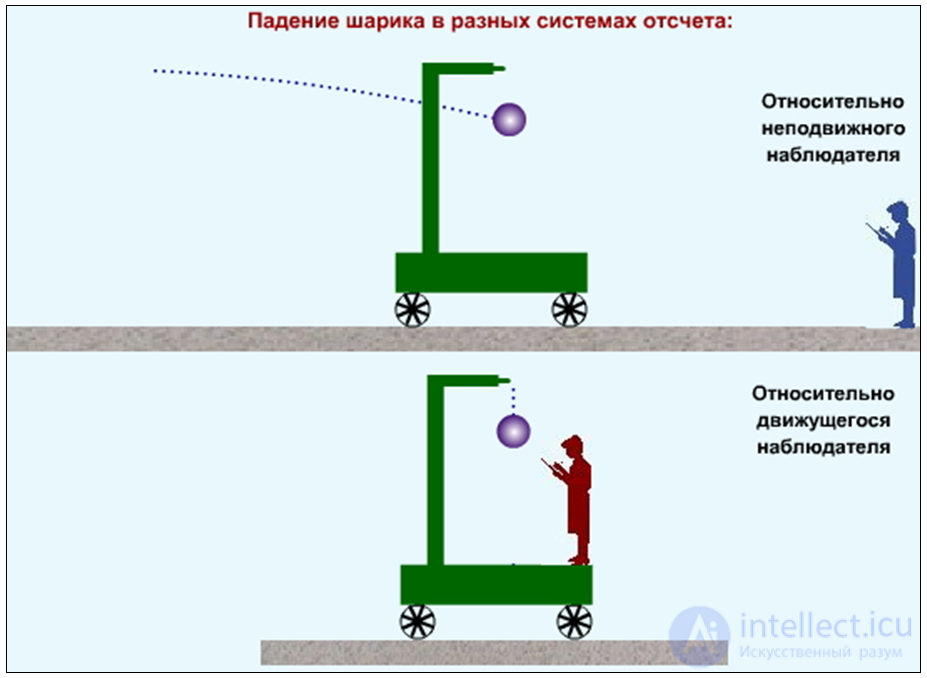
Fig. 3.32. Motion of a body in different inertial frames of reference
The relation between the coordinates of a point in different frames of reference is given by the equation obtained above

It can be written in the form of equations for the components along the coordinate axes. To simplify the formulas, one often proceeds as follows. First, the axes of the frames are chosen to be parallel, with the axis x pointing in the direction of motion of frame 0' relative to frame 0. Second, the origin of the time reckoning is chosen to be the moment when the origins of both frames coincided. Then

and we obtain the Galilean transformations
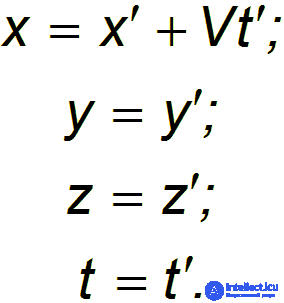
We have supplemented the transformations of the spatial coordinates with the equality of times  in both frames of reference, in order to emphasize that in classical mechanics time is assumed to be absolute, being one and the same in both frames of reference.
Changing to another frame of reference is one of the methods for solving a number of physical problems. Let us give an example.
Example. A motorboat, travelling downstream, overtook a raft at point A. After a time  it turned back and then met the raft at a distance
  below point A. Find the speed of the current, given that the speed of the boat relative to the water is constant.
In this problem we are dealing with one-dimensional motion of particles (the raft and the boat can be treated as particles, since they move translationally). It is expedient to solve the problem in two ways, differing in the choice of the frame of reference.
Method 1. In the frame of reference attached to the bank of the river (Fig. 3.33), it is necessary to express the distances covered by the raft and the boat in terms of the speed of the river current  and of the boat relative to the water
  , and the times of travel of the boat downstream and upstream
  respectively. After the necessary transformations it becomes clear that
  and , consequently, the total time of motion of the boat (and hence of the raft as well) equals
  . It is obvious that in this time the raft covered a distance
  , from which the speed of the current is found.
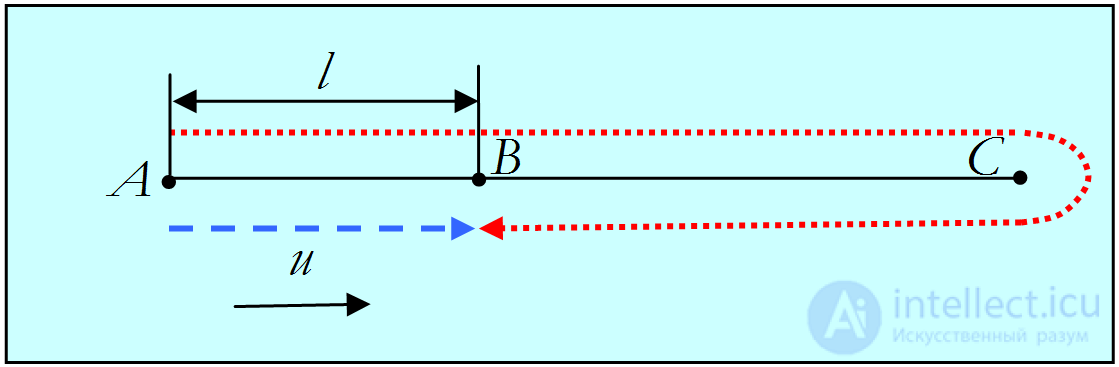
Fig. 3.33. Motion of a boat downstream and upstream along a river
In the frame of reference attached to the bank, the distance  , covered by the raft, equals

and the distance  , covered by the boat, equals

Taking into account that

after transformations we obtain

Consequently, the time of motion of the raft equals , from which the speed of the current

Method 2. In the frame of reference attached to the raft, which moves relative to the banks with the speed of the current, it is obvious that the times of motion of the boat downstream and upstream are equal, and each equals . Therefore the total time of motion equals , and we again obtain the same result but by a much simpler route.
A comparison of the two methods of solution shows the importance of a well-founded choice of frame of reference.

Comments