
Lecture
According to legend, one summer day in 1665 I. Newton, contemplating the surrounding nature, noticed an apple falling down. If there is an attraction between the Earth and the apple, then the same force should exist between any two bodies with masses  and
and  . All bodies in nature attract one another. This interaction is called gravitational and is, as already noted in topic 3.3, one of the fundamental interactions in nature.
We know very little about it, far less than, for example, about the electromagnetic interaction. Nevertheless, at the level of mechanics we can describe gravity, and this is yet another manifestation of the difference between the questions “why” and “how”. The same idea is expressed in the old physics textbook from which the epigraph to this course is taken: “Without going into an investigation of the causes of gravity, we shall note only that it is commonly called the attractive force of the Earth. Since the matter itself cannot be fully explained, one may to some extent justify this position by the fact that various observations have confirmed the existence of such an attractive force in nature”.
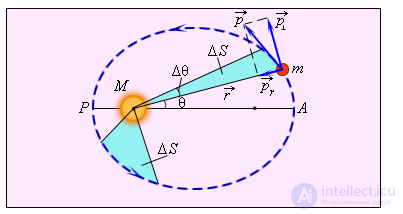
Perhaps the falling apple does suggest certain thoughts, but 50 years before Newton, quantitative relations were already known that paved a more direct path to establishing the law of universal gravitation. Among the greatest discoveries in astronomy were the laws of planetary motion established by J. Kepler (1571–1630):
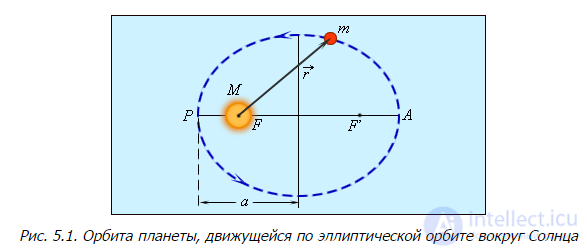
Fig. 5.1. The orbit of a planet moving along an elliptical orbit around the Sun
Since the planets revolve around the Sun owing to the force with which the luminary acts on them, Kepler's laws allow us to determine the form of this force. Let us place the origin of coordinates at the centre of the Sun. Let  be the position vector of the planet, and
  its velocity at a given moment of time. During a time
  the displacement of the planet equals
  and is directed at an angle a to the position vector. The area
  of the triangle formed by the vectors ,
  and +, equals
  — (Fig. 5.2).
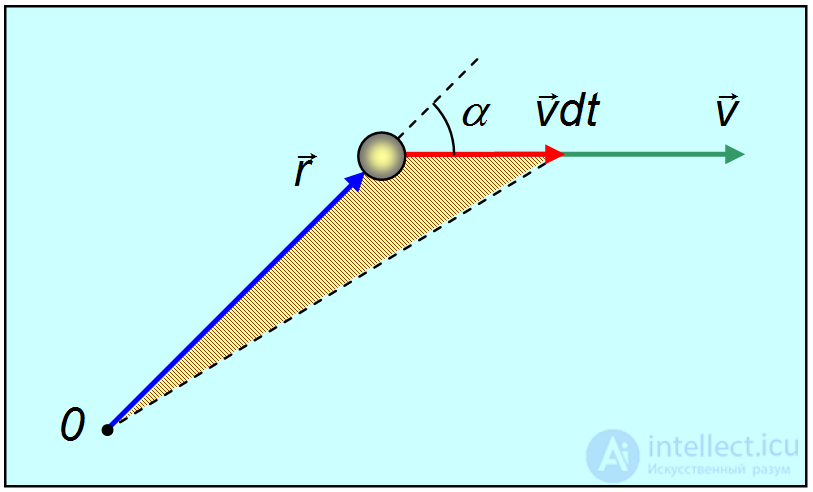
Fig. 5.2. Areal velocity
According to Kepler's second law, the quantity
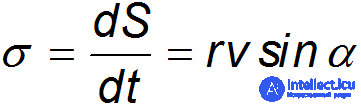
remains constant. Kepler's first law states, in particular, that the orbit of a planet lies in a single plane. This means that the vector
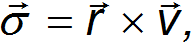
whose magnitude is equal to /, and whose direction is orthogonal to the plane of the orbit, does not depend on time. This vector, called the areal velocity, is proportional to the angular momentum of the planet
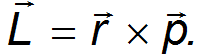
It follows from this that the forces acting on the planet are central: they are directed along the line connecting the Sun with the planet, and depend only on the distance to the Sun.
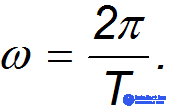
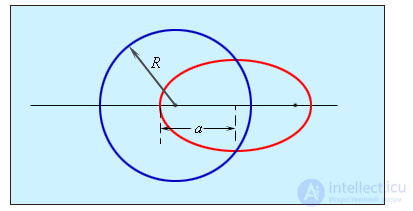
Kepler's third law allows us to establish the dependence of the forces on distance. A special case of an elliptical orbit is a circular orbit, at the centre of which is the Sun. Then Kepler's second law reduces to the statement that the angular velocity  of the planet's revolution is constant. Recall that the angular velocity is inversely proportional to the orbital period T:
For this case, Kepler's third law states that the ratio of the squares of the orbital periods of the planets equals the ratio of the cubes of the radii of their orbits, that is, the squares of the periods are proportional to the cubes of the orbital radii:
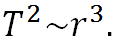
It follows from this that the squares of the angular velocities are inversely proportional to the cubes of the radii:
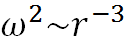
The combination  is nothing other than the normal acceleration, which for uniform circular motion coincides with the total acceleration
  , where
  is the mass of the planet. Thus, we obtain that
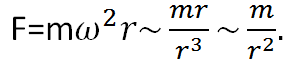
Thus, the Sun attracts the planet with a force proportional to the mass of the planet and inversely proportional to the square of the distance to it:

Here  is a coefficient of proportionality. Correspondingly, the planet attracts the Sun with the same force, which can be expressed as

where  is the mass of the Sun, and
  is some other coefficient of proportionality. From the equality of the magnitudes (Newton's third law) follows the relation
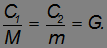
Denoted by the symbol  , the ratio of the coefficients of proportionality to the mass is called the gravitational constant. Substituting the values

into the expressions for the force of gravity between the Sun and the planet, we find

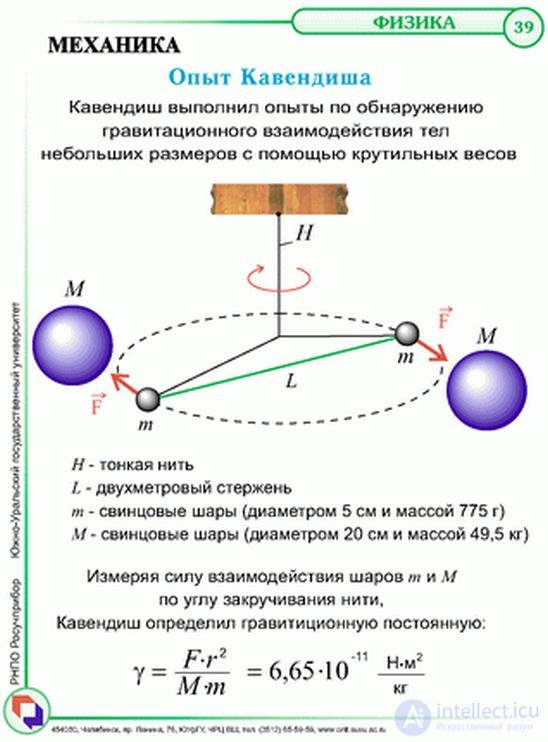
Fig. 5.3. Cavendish's experiment for measuring the force of gravitational attraction
Generalizing the relation obtained, we can state that the forces of gravity between any two bodies are determined by the masses of the interacting bodies and the distances between them. According to the established law of universal gravitation,
any two point particles interact with a force proportional to the product of their masses and inversely proportional to the square of the distance between them
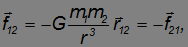
where the gravitational constant  m3/(kg·s2), and
  is the position vector of the second body relative to the first (Fig. 5.4). The minus signs indicate that the interaction forces
  are attractive and oppositely directed.
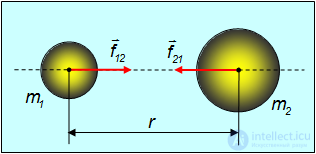
Fig. 5.4. Gravitational forces between two bodies
The gravitational constant is most accurately determined from the change in the oscillation period of a torsion balance caused by the approach of the attracting masses. The first measurements date to the end of the 18th century, the classic among them being H. Cavendish's experiment (1798).
The scheme of the Cavendish experiment consists in the use of a torsion balance (Fig. 5.5).
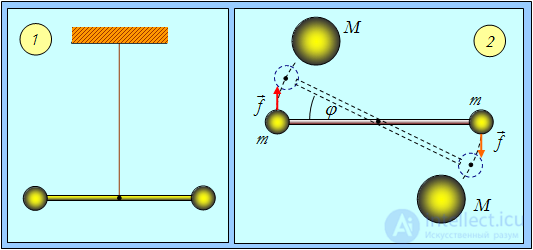
Fig.5.5. Cavendish's experiment: 1 — torsion balance; 2 — top view
A beam carrying two small lead balls is suspended on a thin quartz fibre. When massive lead spheres are brought close to them, the fibre twists. By measuring the angle of rotation of the beam  and knowing the torsion modulus of the fibre, one can directly measure the force of interaction. Knowing the masses of the spheres and the distance between them, the gravitational constant can be determined from the law of universal gravitation:

The operation of the apparatus used by Cavendish is shown in Fig. 5.3.
If bodies cannot be regarded as point particles, they are represented as a collection of point particles (particles), and by geometrically summing the interaction forces of the individual particles, the resultant force of gravitational attraction between them is found. It can be shown that for bodies of ideally spherical shape the law of gravitational interaction is the same as for point particles, provided the position vector is taken to connect the centres of the spheres (see Fig. 5.4).
The law of universal gravitation allows us to establish the scales of distances and masses in the Solar System.
The radius of the Earth can be found using geometric measurements on its surface. The first to do this was Eratosthenes (276–194 BC), who found a value for the radius of the Earth of R3
= 6,311 km. Eratosthenes was wrong by only 1%: modern measurements give the following result for the mean radius of the Earth: R3 = 6,371.03 km. In reality the Earth is not a sphere; a more accurate model of the “figure of the Earth” is as follows: an oblate ellipsoid of revolution with mean equatorial radius (semi-major axis of the ellipsoid)  km and polar radius (semi-minor axis of the ellipsoid)
  km. The eccentricity of this ellipsoid of revolution is quite small
  , so in most problems the Earth can, with sufficient accuracy, be treated as a sphere.
The scheme of Eratosthenes' experiment is shown in Fig. 5.6. At noon on the day of the summer solstice in the city of Syene (now Aswan), the Sun was at the zenith, and objects cast no shadow. On the same day and at the same time in the city of Alexandria, located 5,000 stadia from Syene, the Sun deviated from the zenith by about 7°. This amounts to approximately 1/50 of a full circle (360°), from which it follows that the circumference of the Earth is 250,000 stadia.
Knowing the length of the meridian, one can determine which “stadium” Eratosthenes used, since in antiquity the following stadia were in use:
• Babylonian = 194 m
• Greek = 178 m
o Attic = 177.6 m
o Olympic = 192.27 m
• Egyptian = 172.5 m
o stadium of the pharaonic system = 209.4 m
• Ptolemaic and Roman = 185 m
• stadium (ghalwe) of the Assyro-Chaldeo-Persian system = 230.4 m
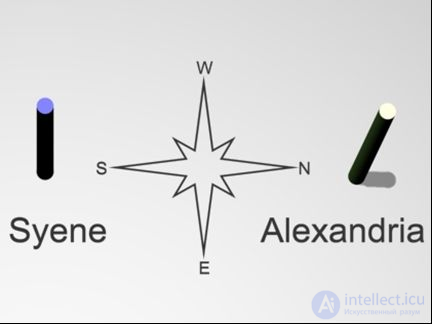
Fig. 5.6. Eratosthenes' experiment for determining the radius of the Earth
How can the mass of the Earth be found? Every body of mass  is attracted to it with a force
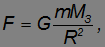
where  is the mass of the Earth, and
  is the distance from the body to the centre of the Earth. On the other hand, the ratio of the force to the mass is the acceleration of free fall
  (neglecting the rotation of the Earth):

It follows from this that does not depend on the mass and size of the body and is determined solely by the parameters of the Earth and the distance to it. Near the surface of the Earth

and = 9.81 m/s2. From this we find the mass of the Earth:

The closest celestial body to the Earth is the Moon. Let us determine the distance  to the Moon. We know that the period of revolution of the Moon around the Earth is
  = 27.32 days = 27.32·86,400 = 2.36·106 s. The centripetal acceleration of the Moon
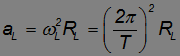
must be equal to the acceleration of free fall at the orbit of the Moon for = . Equating and  , we find:
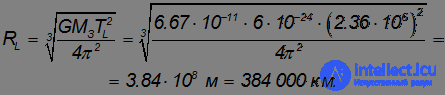
The orbital speed of the Moon is equal to

It is easy to determine the angular diameter  of the Moon: a thumb, whose thickness is approximately 1 cm, covers, at arm's length (that is, at a distance of about 1 m), its disc. From this

More precise measurements give for the angular diameter

From this the radius of the Moon is
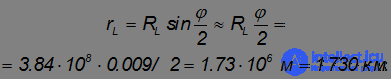
Knowing the distance from the Earth to the Moon, one can use geometry to determine the distance from the Earth to the Sun. When the Moon is at first quarter, the directions from it toward the Earth and toward the Sun form a right angle (Fig. 5.7).
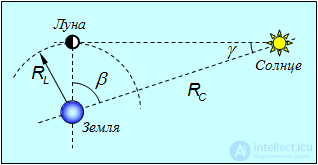
Fig. 5.7. Geometric method for determining the distance from the Earth to the Sun
If at this moment one measures on Earth the angle  between the directions to the Moon and to the Sun, then the distance to the Sun is determined as

The angle turns out to be close to a right angle: = 89°51'. It is therefore more convenient to use the supplementary angle  =
=  /2 – β = 9' = 0.15° = 0.0026 rad. Then the distance to the Sun will be equal to
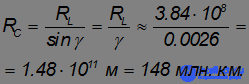
This distance is called the astronomical unit (A or a.u., denoted above as  ). More precisely, A = 1.496·1011 m.
Knowing the period of revolution of the Earth around the Sun  = 1 year = 365.25 days = 3.156·107 s, we find the orbital speed of the Earth:

Finally, we shall determine the parameters of the Sun. The angular diameter of the Sun as seen from the Earth is approximately the same as that of the Moon: φ = 32' = 0.533° = 9.31·10–3 rad. From this we find the radius of the Sun:
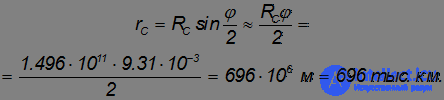
We obtain the mass of the Sun  from the law of universal gravitation: the centripetal acceleration of the Earth in its orbit
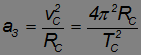
must be equal to the acceleration of free fall of the Earth toward the Sun

Equating  and
and  , we obtain:

In this expression we see the combination familiar from Kepler's third law: the ratio of the cube of the distance from the planet to the Sun to the square of the orbital period. This ratio is the same for all planets, since they revolve around one and the same star.
The orbital speed of the Earth can also be written in the form
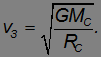
This expression holds for any planet with the corresponding change of orbital radius .
The estimates given show how much can be learned about the world by observing it from a comfortable armchair and ... understanding the laws of nature.
In the previous section we implicitly assumed that the inertial mass  in Newton's second law

and the gravitational mass  in the law of universal gravitation
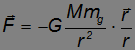
are one and the same thing. Strictly speaking, we have so far had no grounds for this, other than a purely philological one — the word “mass” is used in both laws. But suppose we call the quantity in the law of universal gravitation not mass, but, say, gravitational charge (by analogy with electric charge). It then immediately becomes clear that the question of the relationship between and is not so simply resolved. The answer must be obtained experimentally.
The inertial mass enters into Newton's second law and characterizes the inertial properties of a body. The gravitational mass appeared in the law of universal gravitation and reflects the ability of bodies to attract one another. The acceleration of a body under the action of gravitational forces at the Earth's surface can be written as
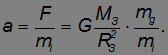
The body of experimental facts indicates that the acceleration a is the same for all bodies:

This means that the inertial mass and the gravitational mass of all bodies are strictly proportional to each other, that is, their ratio / is the same for all bodies. The unit of measurement of gravitational mass and the gravitational constant  can then be chosen so that = . Thus, and are identical for a suitable choice of units.
The constancy of the ratio / for all bodies is a characteristic feature of the gravitational field. For example, in an electric field we encounter nothing of the kind: there the ratio of a body's charge to its mass  /
/ can take any value and varies from body to body. Accordingly, there is no question of identifying electric charge with mass.
Something changes in the space surrounding bodies: we say that they create a gravitational field. The energetic characteristic of this field — the potential energy of interaction of two gravitational masses — is determined according to the general rules. Namely, the gradient of the potential energy must give the force:
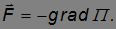
For central forces
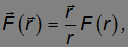
to which the force of universal gravitation also belongs, this equation, as we saw in the previous section, reduces to the equation
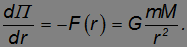
Hence
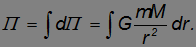
Integrating, we obtain
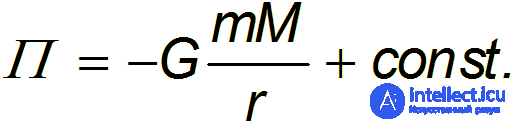
The integration constant const is taken equal to zero so that as  tends to infinity, the potential energy of gravitational interaction tends to zero. This does not diminish generality, since it is the difference of potential energies that is physically observable, not its value.
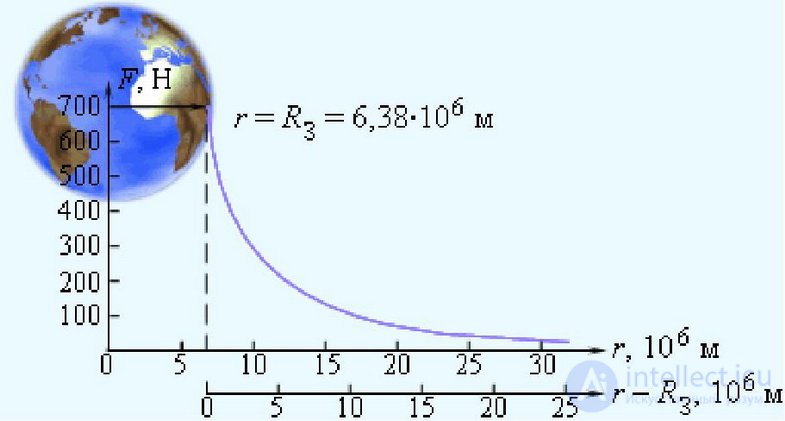
Let us consider the change in the potential energy of a body  , moved from the surface of the Earth to a height
  :
:
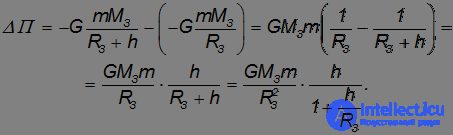
Taking into account that

we obtain
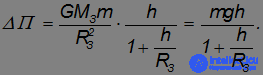
If we choose the potential energy of the body on the surface of the Earth to be zero, then  . At small heights
  we can neglect the ratio
  in the denominator of the right-hand side of the obtained formula for the potential energy, which gives the familiar expression

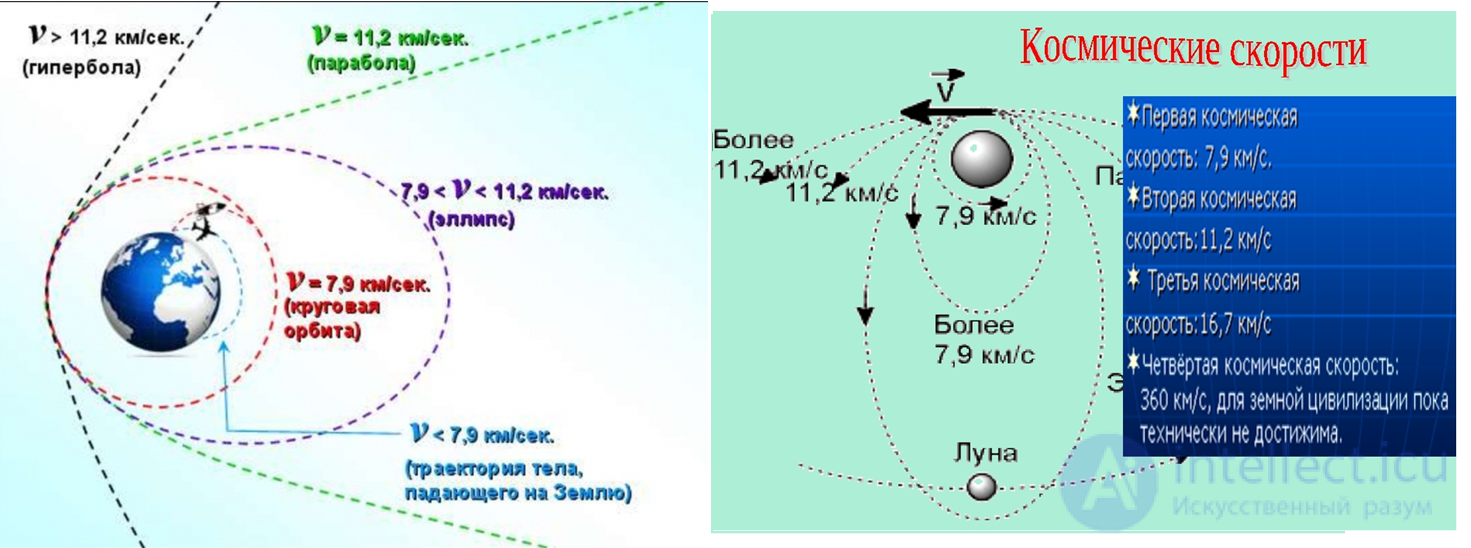
Cosmic velocities (the first v1, the second v2, the third v3 and the fourth v4 ) — are the characteristic critical velocities of motion of cosmic objects in the gravitational fields of celestial bodies and their systems. Cosmic velocities are used to characterize the type of motion of a spacecraft within the sphere of influence of celestial bodies: the Sun, the Earth and the Moon, other planets and their natural satellites, as well as asteroids and comets.
By definition, a cosmic velocity is the minimum initial velocity that must be imparted to an object (for example, a spacecraft) on the surface of a celestial body in the absence of an atmosphere so that:
Cosmic velocities can be calculated for any distance from the centre of the Earth. However, in astronautics the values calculated specifically for the surface of a spherical homogeneous model of the Earth with a radius of 6371 km are often used.
Let us apply the law of universal gravitation to determine two characteristic “cosmic” velocities, related to the size and gravitational field of some planet. We shall consider the planet to be a single sphere.
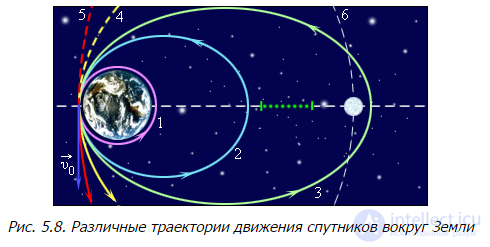
Fig. 5.8. Various trajectories of satellite motion around the Earth
Let G be the gravitational constant, and let M be the mass of the Earth (or another gravitating body) and m be the mass of the body or projectile escaping it. At a distance r from the centre of gravity, the body experiences an attractive force
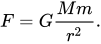
Therefore, the work required to move the body a small distance dr against this force is given by the expression
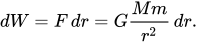
Then the total work required to move the body from the surface r 0 of the gravitating body to infinity is equal to [15]

To perform this work to reach infinity, the minimum kinetic energy of the body at launch must correspond to this work, so the escape velocity v 0 satisfies
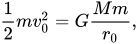
which leads to
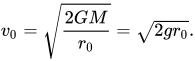
The first cosmic velocity  is the name given to the minimum horizontally directed velocity at which a body could move around the Earth in a circular orbit, that is, become an artificial satellite of the Earth.
This is, of course, an idealization: first, a planet is not a sphere; second, if a planet has a sufficiently dense atmosphere, then such a satellite — even if it could be launched — would burn up very quickly. It is a different matter that, say, an Earth satellite flying in the ionosphere at an average altitude of 200 km above the surface has an orbital radius differing from the average radius of the Earth by only about 3%.
A satellite moving in a circular orbit of radius  (Fig. 5.9) is acted upon by the Earth's force of attraction, which imparts to it a normal acceleration

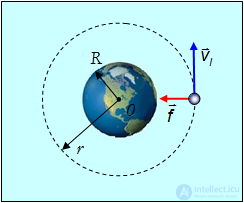
Fig. 5.9. Motion of an artificial Earth satellite in a circular orbit
By Newton's second law we have
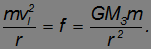
If the satellite moves close to the surface of the Earth, then

and

Therefore for at the Earth we obtain

We see that is indeed determined by the parameters of the planet: its radius and mass.
The period of revolution of the satellite around the Earth is equal to

where  — is the radius of the satellite's orbit, and
  — is its orbital velocity.
The minimum value of the period of revolution is achieved when moving in an orbit whose radius is equal to the radius of the planet:
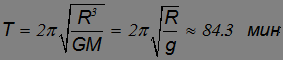
so the first cosmic velocity can also be defined as follows: the velocity of a satellite in a circular orbit with the minimum period of revolution around the planet.
The period of revolution grows with increasing orbital radius.
If the period of revolution of a satellite is equal to the period of the Earth's rotation about its axis and their directions of rotation coincide, and the orbit lies in the equatorial plane, then such a satellite is called geostationary.
A geostationary satellite constantly hangs over the same point on the Earth's surface (Fig. 5.10).
Fig. 5.10. Motion of a geostationary satellite
In order for a body to be able to leave the sphere of the Earth's attraction, that is, to be able to move away to such a distance where attraction to the Earth ceases to play a significant role, the second cosmic velocity is required (Fig. 5.11).
The second cosmic velocity  is the name given to the smallest velocity that must be imparted to a body so that its orbit in the Earth's gravitational field becomes parabolic, that is, so that the body could become a satellite of the Sun.
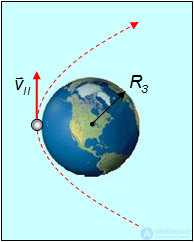
Fig. 5.11. The second cosmic velocity
In order for a body (in the absence of medium resistance) to be able to overcome the Earth's attraction and leave for outer space, it is necessary that the kinetic energy of the body at the surface of the planet be equal to (or exceed) the work done against the forces of the Earth's attraction. Let us write the law of conservation of mechanical energy E of such a body. At the surface of the planet, specifically — the Earth
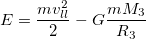
The velocity  will be minimal if, at an infinite distance from the planet, the body is at rest
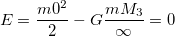
Equating these two expressions, we obtain
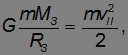
whence for the second cosmic velocity we have

To impart the necessary velocity (first or second cosmic) to a launched object, it is advantageous to use the linear velocity of the Earth's rotation, that is, to launch it as close as possible to the equator, where this velocity is, as we have seen, 463 m/s (more precisely 465.10 m/s). In this case the direction of launch should coincide with the direction of the Earth's rotation — from west to east. It is easy to calculate that in this way one can gain several percent in energy costs.
Depending on the initial velocity imparted to the body at the point of launch A on the Earth's surface, the following types of motion are possible (Fig. 5.8 and 5.12):
 , the body will fall to the Earth.
 , the body will move along an elliptical trajectory.
 , the body will “go off to infinity” along a parabolic trajectory
 , the body will “go off to infinity” along a hyperbolic trajectory.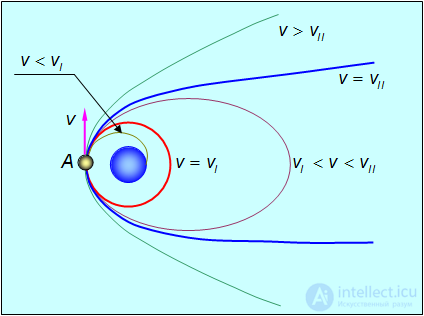
Fig. 5.12. Forms of the trajectory of a particle depending on the launch velocity
The motion in the gravitational field of any other cosmic body, for example, the Sun, is calculated in exactly the same way. To overcome the attractive force of the luminary and leave the Solar System, an object at rest relative to the Sun and located from it at a distance equal to the radius of the Earth's orbit  (see above) must be given a minimum velocity
  , determined from the equality
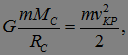
where , we recall, is the radius of the Earth's orbit, and  — is the mass of the Sun.
From this follows a formula analogous to the expression for the second cosmic velocity, where one must replace the mass of the Earth with the mass of the Sun and the radius of the Earth with the radius of the Earth's orbit:

Let us emphasize that  — is the minimum velocity that must be imparted to a body at rest, located in the Earth's orbit, so that it overcomes the Sun's attraction.
Let us also note the connection

with the orbital velocity of the Earth  . This connection, as it should be — the Earth is a satellite of the Sun — is the same as that between the first and second cosmic velocities and .
In practice we launch a rocket from the Earth, so it is certainly involved in orbital motion around the Sun. As was shown above, the Earth moves around the Sun with a linear velocity
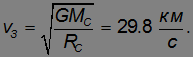
It is advisable to launch a rocket in the direction of the Earth's motion around the Sun.
The velocity that must be imparted to a body on the Earth so that it leaves the confines of the Solar System forever is called the third cosmic velocity  .
.
The velocity depends on the direction in which the spacecraft leaves the zone of the Earth's attraction. Under optimal launch conditions this velocity is approximately = 6.6 km/s.
The origin of this number can also be understood from energy considerations. It would seem sufficient to impart to the rocket, relative to the Earth, a velocity

in the direction of the Earth's motion around the Sun, and it would leave the confines of the Solar System. But this would be correct only if the Earth had no gravitational field of its own. The body must have such a velocity once it has already moved away from the sphere of the Earth's attraction. Therefore the calculation of the third cosmic velocity is very similar to the calculation of the second cosmic velocity, but with the additional condition — that at a great distance from the Earth the body must still have the velocity  :
:
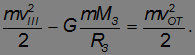
In this equation we can express the potential energy of the body on the Earth's surface (the second term on the left-hand side of the equation) through the second cosmic velocity in accordance with the formula obtained earlier for the second cosmic velocity
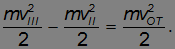
From this we find

Newton proved that the more precise formula of Kepler's third law is as follows:
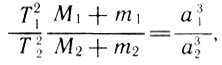
where M1 and M2 - are the masses of some celestial bodies, and m1 and m2 - are respectively the masses of their satellites. Thus, the planets are considered satellites of the Sun. We see that the refined formula of this law differs from the approximate one by the presence of a factor containing the masses. If by M1=M2=M we understand the mass of the Sun, and by m1 and m2 - the masses of two different planets, then the ratio
 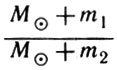 will differ little from unity, since m1 and m2 are very small compared to the mass of the Sun. In this case the exact formula will not differ noticeably from the approximate one.
The refined third law of Kepler allows us to determine the masses of planets that have satellites, and the mass of the Sun. To determine the mass of the Sun, we shall compare the motion of the Moon around the Earth with the motion of the Earth around the Sun:
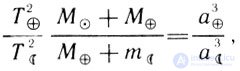
where T and a
and a - are the period of revolution of the Earth (year) and the semi-major axis of its orbit, T
 and a - are the period of revolution of the Moon around the Earth and the semi-major axis of its orbit, M
 - is the mass of the Sun, M
 - is the mass of the Earth, m - is the mass of the Moon. The mass of the Earth is negligible compared to the mass of the Sun, and the mass of the Moon is small (1:81) compared to the mass of the Earth. Therefore the second terms in the sums can be discarded without introducing a large error. Solving the equation for
  we have:
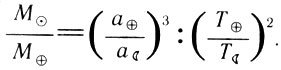
This formula allows us to determine the mass of the Sun, expressed in Earth masses. It amounts to about 333,000 Earth masses.
To compare the masses of the Earth and another planet, for example Jupiter, one must in the original formula assign index 1 to the motion of the Moon around the Earth of mass M1, and 2 - to the motion of any satellite around Jupiter of mass M2.
The masses of planets that have no satellites are determined from the perturbations that they, through their attraction, produce in the motion of neighbouring planets, as well as in the motion of comets, asteroids or spacecraft.
1. Determine the mass of Jupiter by comparing the system of Jupiter with a satellite with the Earth–Moon system, if the first satellite of Jupiter is 422,000 km from it and has a period of revolution of 1.77 days. The data for the Moon should already be known to you.
2. Calculate the distance from the Earth, on the Earth–Moon line, at which points the attractions of the Earth and the Moon are equal, knowing that the distance between the Moon and the Earth is 60 Earth radii, and the mass of the Earth is 81 times greater than the mass of the Moon.

Comments