
Lecture
Action in physics is a scalar physical quantity that serves as a measure of the motion of a physical system. Action is a mathematical functional that takes as its argument the trajectory of motion of a physical system and returns a real number as its result.
Action is one of the fundamental physical quantities, entering into the modern formulation of most basic physical theories in every fundamental branch of physics, while also having enormous significance in theoretical physics. It may play a lesser role in comparatively more applied areas, although even there it is often used. It is used equally in quantum, classical, and relativistic physics.
In classical mechanics, the principle of least action postulates that a physical system always follows the trajectory with the least action.
In quantum mechanics, in the path-integral formulation of the theory, a physical system simultaneously follows all possible trajectories, with the probability amplitude of following a particular trajectory determined by the action of that trajectory. If the characteristic action is much greater than Planck's constant, the amplitude of the classical trajectory with the least action dominates — and in this way quantum mechanics passes over into classical mechanics.
Action has the physical dimension energy · time = momentum · distance, which coincides with the dimension of angular momentum. In physical meaning, action is the phase of the quantum “probability wave”, or more precisely — it is proportional to this phase (because of the different dimensionality used in traditional systems of physical units, including SI):  — with a constant dimensional coefficient — Planck's constant.
If the action is written down for some system, this in principle determines both its classical behaviour (that is, the behaviour of the system in the classical approximation) and its quantum behaviour. The first — through the principle of stationary (least) action, the second — through the Feynman path integral. At the same time the action itself is written identically, in one and the same form, for both the classical and the quantum case, which makes it a very convenient tool (for quantization via the Feynman path integral one in principle only needs to know the action defined for ordinary classical trajectories, that is, written the same way as for classical applications).
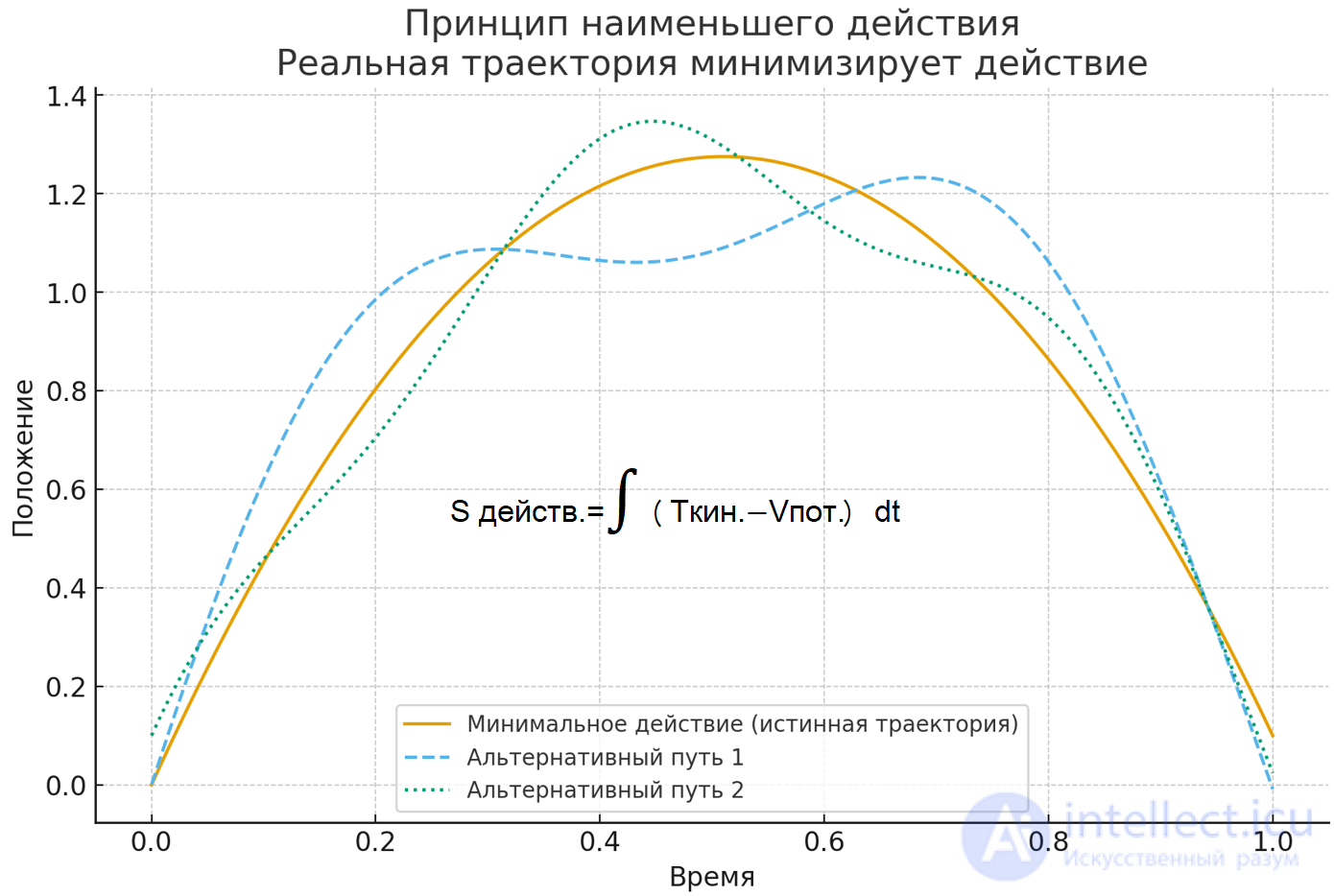
Here is a visualization of the principle of least action: the real trajectory (the parabola) is smooth; alternative trajectories are "wiggly" and have a greater action.
Interpretation:
The line — the real path of a body flying under the action of gravity.
The dashed lines — possible but unrealized paths (they give a greater action).
Nature “chooses” the path where the action is minimal.
Action and force are not the same thing.
They are related, but they are different physical concepts.
Force — is what directly changes the motion of a body.
F=maRoughly speaking: force “pushes” or “pulls”.
Example: you push a box — there is a force.
Action (action) — is an abstract quantity that describes the entire path of the system over time:
S=∫(T−V) dt
where:
T — kinetic energy,
V — potential energy,
S — action.
This is a fundamental principle, from which Newton's law of force is derived.
Force — is a local quantity (at each point in time: it pulls, it pushes).
Action — is a global quantity, for the entire motion as a whole.
Nature chooses the trajectory where the action is minimal → and from this, Newton's second law F=ma follows as a consequence.
That is:
Force — is a consequence of the principle of action, and not the other way around.
You threw a ball.
Under the action of gravity it flies along an arc.
Why along an arc? Because that way the action is minimal.
From this alone we already get the force of gravity F=mg .
Modern physics (quantum physics, field theory) is built not on force, but on action.
Force — is a more “old-fashioned” concept.
Action — is more fundamental and universal.
In classical mechanics, quantum mechanics and field theory, the principle of least action operates:
The real trajectory of motion of a system — is the one for which the action is minimal (or extremal).
This is not “force” and not “energy”, but a deeper principle, from which the laws of motion are derived.
If you throw a stone, it flies along a parabola. Why exactly like that?
Because such a trajectory minimizes the action for the given situation.
classical mechanics (Lagrange, Hamilton)
quantum mechanics (Feynman: summation over trajectories)
general relativity
modern field theory and the Standard Model
One can imagine that the system “chooses” the path that requires the smallest “amount of action” to carry out its evolution.
This is one of the most general and profound principles of physics — almost all laws are derived from it.
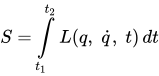
Historically the terminology fluctuated quite a bit, but at present it is customary to call the quantity
or
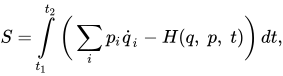
the action, where:
 — the full set of coordinates characterizing the dynamical system (its configuration space),
 — the set of velocities (derivatives of q
 with respect to time),
Both quantities S in principle coincide, but are expressed differently — the first in accordance with the Lagrangian formalism, the second in accordance with the Hamiltonian formalism.
It is customary to call abbreviated action
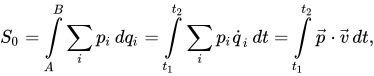
where the notation coincides with that used above, and the expression under the last integral — is the scalar product of the momentum and velocity vectors, which in the case of a single particle can be understood in the ordinary Newtonian sense.
In general, in this section qi, q˙i and pi
 mean generalized coordinates (not necessarily coinciding with Cartesian ones), the generalized velocities corresponding to these coordinates, and the momenta canonically conjugate to these coordinates. In the particular case they may be chosen as Cartesian coordinates, in which case (in mechanics) the corresponding momenta represent the ordinary components of the vector momenta of the material points of the system.
For distributed systems (for example, for fields or elastic continuous media) the action can usually be written as follows:
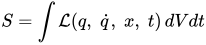
or

where
 — the densities of the Lagrangian and Hamiltonian functions respectively,
 — a point of the space occupied by the medium or field (often — ordinary three-dimensional space),
 — the volume element of this space,
 — the values of the generalized coordinates (for example, the displacements of an elastic medium, or — for a field — the field variable, such as, for example, the electromagnetic potential) and the generalized momenta for a given point x of the distributed system (medium or field).
Integration is carried out both over space and over time. The total number of coordinates and momenta qi, pi describing the system is, as we see, infinite in this case, since their number is finite only for a single x, while the set of the x themselves is infinite.
From the modern point of view, action has the meaning of the phase of the wave function (though expressed traditionally — for a more direct connection with classical mechanics — in different units, specifically S=ℏφ, where S — is the action, φ — is the phase in radians, and  — is the universal Planck constant).
Classical physics (mechanics and field theory) is the high-frequency, short-wavelength approximation to quantum physics, valid when the phases of the waves are very large (S/ℏ≫1 ), which means that under the given (“classical”) experimental conditions (the characteristic sizes, characteristic momenta and characteristic energies of the problem under consideration) the quantum corrections to the classical theory will be sufficiently small (in practice most often so small that they are experimentally undetectable). In this case the quantum problem as a whole simplifies considerably, passing over into the classical one, and one can make use of the principle of least action and/or the Hamilton–Jacobi equation, in which action continues to play a key role.
In quantum physics itself — when solving the same problem without the condition — action plays an especially large role in the formalism of the Feynman path integral. Moreover, part of the results of classical field theory carry over, in a certain sense, fairly directly to the quantum case, and since action is one of the simplest objects, working with it (and above all, the very writing down of the action for a given dynamical system — a field, a particle, interacting fields or particles, or other objects) is often one of the most effective tools in formulating the quantum theory of various fields, even when this is not connected with writing the path integral and working with it explicitly.
Maupertuis, in works of 1740(?), 1741—1746, first formulated the principle of least action for mechanics and expressed the idea that this was a universal law of nature, interpreting optics as well (Fermat's principle) in terms of action (he used what is now customarily called the abbreviated action). Maupertuis was inclined toward a theological interpretation of this principle, which, in his view, testified to a certain perfection of the world created by God.
Already during Maupertuis's lifetime, these works of his were supported and further developed by Euler, who moreover developed the calculus of variations, which made it possible to realize the advantages of the principle most effectively.
Then Lagrange, in his “Analytical Mechanics” (“Mécanique analytique”), published in 1788, developed the application of the principle of least action in mechanics, using the calculus of variations and introducing generalized coordinates. He also set out, in 1795, the method of undetermined multipliers (Lagrange multipliers), which made it possible to significantly improve the use of the principle of least action in problems with constraints.
The action for a fast-moving (“relativistic”) particle was corrected (compared with the old Newton–Lagrange variant, whose range of applicability is motions slow compared to the speed of light) at the beginning of the 20th century; this was apparently first done explicitly by Planck in 1907 , and in this connection the works of Minkowski (1907) and Born (1909) can also be mentioned . It took, for a free point particle, the form of the interval (the length — the proper time — in Minkowski spacetime) along the world line (the spacetime trajectory) of the particle, with the opposite sign, replacing the ordinary Newtonian expression in the mechanics of fast particles. Therefore the principle of least action for relativistic particles leads to the greatest possible proper time along the trajectory.
In 1915 Hilbert, using the variational method with respect to the Einstein–Hilbert action[eng.], obtained the correct equations of the gravitational field in general relativity. Here, perhaps for the first time, the advantage of the simplicity of the approach was used to such a full extent — the approach starting from writing down, from general considerations, a scalar (invariant) action (whose explicit form is not known in advance), and then — obtaining the equations of motion for the field (the field equations) by varying this functional.
At the beginning of the 20th century, Planck, Bohr, Sommerfeld, Schwarzschild and others used action (usually the abbreviated action) for the early formulation of quantum theory, which from the modern point of view is a certain variant of the quasi-classical approximation, and which turned out to be quite well suited for describing such key problems as the harmonic oscillator and the atom with circular and elliptical orbits of the electron (at least, this applies to the simplest case — the hydrogen atom). The quantization rule, widely used at this stage in the development of quantum theory, amounted to quantizing the abbreviated action on closed orbits in accordance with the condition
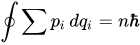 or (in Cartesian coordinates for a single particle):
 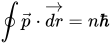 .
.
Louis de Broglie (1923—1924) used this formalism to formulate his statements about the wave nature of the electron and of material particles in general.
A notable role in substantiating the modern form of quantum mechanics (in the sense of clarifying its relation to classical mechanics) was played by the Hamilton–Jacobi equation, which deals with action as a function of coordinates and time, and which already has a form close to that of the basic equation of quantum mechanics — the Schrödinger equation — and is in essence its classical limit.
Feynman developed the path-integral method in quantum mechanics (1938), reformulating quantum mechanics so that it organically made use of the classical action functional, with the difference between the complete quantum description and the classical one reduced to the need to sum the quantity eiS over all conceivable trajectories (and not just over the single classical trajectory or over those close to it). This formalism is one of the most popular in modern theoretical high-energy physics, finding applications (together with the technique of Feynman diagrams) in other areas of physics as well, and also in pure mathematics. Subsequently (1949) Feynman developed, closely related to the path integral though also admitting a reformulation not explicitly using this approach, the method of Feynman diagrams, which became one of the main tools in quantum field theory and provided one of the ways of overcoming the difficulties of quantum electrodynamics, which as a result became one of the most precise physical theories and the standard model for constructing other quantum field theories.
Starting from the second half of the 20th century, a number of generalizations of the action for a point particle were invented, for example, in the field of string theory — the Nambu–Goto action[eng.] (the area action) and the Polyakov action[eng.].
In conclusion it should be said that in the modern abstract areas of theoretical physics, action is one of the main tools for formulating a specific theory from the very initial stage. For example, one very widespread way of formulating a new theory amounts to first of all trying to write down the action for the system under study, restricting the possible variants by imposing symmetry conditions, and often — also by considerations of simplicity.
Action in classical mechanics is written in two forms, which are ultimately equivalent:
the Lagrangian form:
or the Hamiltonian form:
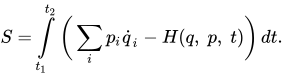
(on the abbreviated action — see the section “Terminology” above).
Despite being ultimately equivalent, the Lagrangian and Hamiltonian forms of writing the action have non-coinciding technical and conceptual advantages. Each of them can be regarded as the basis for constructing (on the basis of the principle of least, or stationary, action) the Lagrangian and Hamiltonian forms of mechanics respectively. Namely, by carrying out direct variation of the first action with respect to each  independently of the others, or, equivalently, by writing the Euler–Lagrange equations for this functional, and for the second form — by varying independently with respect to each δqi and δpi
 (writing Hamilton's equations), it is easy to obtain the equations of motion in the Lagrangian and Hamiltonian forms respectively. In the particular case of using Cartesian coordinates, these will be the Newtonian equations of motion.
By carrying out the derivation of the equations of motion with a suitable choice of coordinates (generally, not Cartesian) and using the method of Lagrange's undetermined multipliers, one can readily obtain, in a convenient form, the equations of motion for systems with constraints as well, sometimes eliminating the constraint reaction forces from them (which can noticeably simplify the equations).
It should be noted that, for all its fundamental significance, the concept of action does not cover some cases of macroscopic mechanics; for example, it does not allow one to write down the action in the presence of arbitrary dissipative forces, and accordingly does not allow one to use the principle of least action to describe them.
Classical action, from the modern point of view, is a quantity proportional to the phase of the quantum wave function of the corresponding particle or system (in essence this is the phase itself, only measured in different units; however the coefficient of proportionality is unknown within classical mechanics — it is an essentially quantum quantity; from the point of view of classical mechanics it only matters that it is very small). Classical mechanics itself is the short-wavelength limit of quantum mechanics and can be obtained from it by the transition ℏ/S→0 .
.
For mechanical distributed systems (for example, for elastic continuous media), the action can usually be written as follows:
or
where dV — is the volume element, three-dimensional in the case of describing fields in three-dimensional space, — are the densities of the Lagrangian and Hamiltonian functions, q, q˙ and p
and p — are the field variables (for example, potentials) corresponding to the velocity
  and the canonically conjugate momenta. Each such field variable, velocity and momentum is a function q=q(x,y,z,t), q˙=q˙(x,y,z,t), p=p(x,y,z,t)
 of the “spatial” variables and time, representing, in this way, an infinite-dimensional (taking into account the physical notion of a possible atomic discretization of the distributed system — simply a very high-dimensional) vector. Singling out an individual coordinate qi∈R
 amounts to expanding q in some basis (this may be, for example, a basis of delta functions, which reduces everything essentially to the limit of the discrete problem, but perhaps even more often the Fourier transform is used because of its convenience).
For non-mechanical distributed systems, a similar form of writing is possible on the basis of an analogy with mechanical ones. In particular, a similar approach works for fundamental fields, which formally also fit the definition of distributed systems (although this too can be considered merely an analogy — the choice one way or the other here is essentially terminological). Fundamental physical fields are examined in detail in a separate section, although ordinary distributed systems, mechanical ones especially, provide, in general, quite good models that help in understanding the construction of the dynamics of these fields and, in particular, questions related to action.
Examples:

where ρ=const — is the density of the medium, E=const
 — is the modulus of elasticity,
  — is the deviation of the elastic medium at a given point at a given moment of time from the reference equilibrium position — this is a distributed generalized coordinate (in this problem it is a three-dimensional vector, but precisely under the stated conditions each of its components can be considered separately), u˙
 — is the rate of change of u
 with time — the distributed velocity, also, of course, a function of
  . ∇
. ∇ here — is the gradient operator, which here can be considered as applied separately to each component of u, with the squares of the three components then being summed.
Varying this functional with respect to u gives the equation of motion in the form of the ordinary wave equation independently for each component of u, that is, for  .
.
The action written out can readily be used for an inhomogeneous medium as well, that is, for non-constant ρ and E
and E ; it also generalizes directly to anisotropic media with a tensorial E. In all these cases the equation of motion of the medium will already differ noticeably from the ordinary wave equation, but it can be obtained practically just as easily by varying this action.
Action in classical field theory is used to obtain the field equations (both free ones and those with sources) from the principle of stationary (least) action (by varying with respect to the field variables). It is also used to obtain the equations of motion of particles interacting with a given field, likewise through the principle of stationary (least) action, but by varying with respect to the coordinates (and, in the Hamiltonian version, also the momenta) of the particles.
The very form of the action for a field (used both in the classical and in the quantum sense) is in general very similar to the form of the action for distributed systems (in particular, for mechanical distributed systems, such as a string, a membrane, and so on). This makes it possible to establish, sometimes a direct, sometimes a conditional, analogy between the one case and the other, although in detail the two may differ noticeably (so a direct mechanical analogy is not always possible, and sometimes it simply turns out not to be too easy to construct and use).
Most often (in the case of linear fields, or when studying them in the linear approximation) the action has a fairly simple form and splits into three terms:
 ,
,
where Sf — is the “action of the free field” — which is essential for studying the behaviour of the field without its interaction with “matter” (other fields), t — is the interaction term, from which the action of “matter” (other fields) on the given field is derived,
  — is the action for the free “matter” (other fields), determining its behaviour in the absence of the given field, in particular, such properties of “matter” as its inertia. The form of the second term determines, in the field equations, the terms representing its source(s), and determines the action of the given field on “matter” (other fields); for example, the equations of motion of a charged particle in the given field (more specifically, the forces acting on it) are derived from and .
However, for essentially nonlinear fields, such a splitting into three separate terms, generally speaking, does not work (and even after singling out the linear approximation, certain problems often remain, although in itself it is often meaningful and possible). For example, in general relativity (and other metric theories of gravity), the gravitational field falls into the term relating to “matter” (and non-gravitational fields) in the form of the metric, which enters into the volume element and into the covariant derivatives. This fact provides for the interaction of gravity with “matter” without requiring a separate term (the so-called case of minimal coupling), and it is also what makes the equation of the gravitational field essentially nonlinear. Another example (though relating to quantum field theory, but having analogies in the classical case as well): quantum electrodynamics — its linear approximation, when calculated by perturbation theory in loop diagrams, leads to infinite, meaningless results, connected with the actual impossibility of singling out the bare (unrenormalized, non-interacting) fields of the charged particle and the electromagnetic field. The way this problem was solved was the renormalization program, which restores the Lagrangian of the actual (interacting) fields.
Among the fundamental physical fields, scalar fields, although present in theory, still have a largely hypothetical existence, and their properties, accordingly, are rather poorly known. However, this is the simplest case; moreover, besides fundamental fields, macroscopic fields are also of interest — for example, the gas pressure field in acoustics, which, in the case of small (and smooth) deviations from equilibrium, can in a certain sense be directly likened to an abstract scalar field.
The simplest kind of action for a scalar field φ , leading to a linear field equation, has the form:

(written in a form corresponding to a field in three-dimensional space; here α — the “force constant”, c — the propagation speed of waves of the field φ, which for fundamental fields is usually — so as not to violate the principle of relativity — taken equal to the speed of light, ∇ — the three-dimensional gradient, m
 — the mass of the field φ (m=0
 for massless fields), dV — the element of three-dimensional volume). As we can see, Sf is Lorentz-invariant, and it is very easy to rewrite it in four-dimensional notation, where this is even more obvious.
When varied with respect to φ (for a free field, that is, for  ), this action gives the Klein–Gordon equation, and at m=0 — the wave equation. The case
  gives a variant of the Klein–Gordon equation for a tachyonic scalar field, which may also find application in theory (this is a field with an unstable equilibrium at φ=0
 in infinite space, or without imposing boundary conditions that lead to stability).
we will not specify here in detail, since we are not considering here any particular scalar field and its interaction with anything specific yet. However, note that if we do not want to violate the principle of relativity, this term must also be Lorentz-invariant (like  ). For example, for interaction with another scalar field u this term could be
 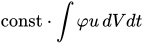 or
or 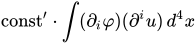 or their sum, etc.).
The standard action for the electromagnetic field is written as

where
 — the action for the free field (Fij
 here — the electromagnetic field tensor, α
 — a constant depending on the system of units used, summation over i, j
 is implied by the Einstein summation convention),
the interaction term can be written in different ways:
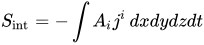
or

(the first form is convenient for deriving the field equation(s) (with sources), and the second — for deriving the equation of motion of a charged particle; here Ai — the electromagnetic potential, q — the charge of the particle, ui
 — the 4-velocity, dτ
 — the differential of proper time (the interval divided by c), φ and A→
 — the electric and three-dimensional vector potential, v→
 — the three-dimensional velocity, c — the speed of light, and
  — the four-dimensional spacetime coordinates; for several particles one should take several terms of this kind — one for each),
Ss — the action for “matter” (free particles), which together with Sint is used to derive the equations of motion of charged particles. For fast (“relativistic”) particles (see below) one should take (neglecting spin) the action

where m — the mass (rest mass) of the particle, c — the speed of light, dτ — the differential of proper time (for several particles one should take the sum of several terms of this kind).
If, however, the motion of the particles is slow compared to the speed of light and the Newtonian approximation is sufficient, then one can take the corresponding approximate action, the usual one for classical mechanics:
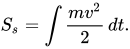
The simplest way to obtain Maxwell's equations in the form
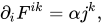
is by varying the action written above with respect to and using the definition  .
.
Varying with respect to  , one obtains the equations of motion, which look simplest in four-dimensional form:

where the right-hand side coincides with the ordinary Lorentz force, which can also be written (and, if desired, derived explicitly) in three-dimensional form as well; that is, in three-dimensional form the equation of motion will be:
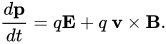
The action for the electromagnetic field (both its free-field term and the term describing interaction with currents) is Lorentz-invariant from the outset (more precisely, it is a 4-scalar). The same can be said of the action for all the fundamental fields known in modern theories (speaking somewhat more precisely — in the generally accepted theories that have passed experimental verification).
However, the action of classical (Newtonian) mechanics, regardless of the form in which it is written, Hamiltonian or Lagrangian, does not possess the property of Lorentz invariance. Historically, at a certain moment (at the turn of the 19th and 20th centuries) the need arose to bring mechanics into agreement with the principle of relativity, that is, to make it Lorentz-covariant. The simplest way to do this is to write, for a particle (a “point particle”), an action that would be Lorentz-invariant, and then, by the usual procedure of variation, obtain from it an equation of motion that will already be Lorentz-covariant (approximately, for slow motions, such mechanics should coincide with Newtonian mechanics, since the latter is well verified for small velocities).
The simplest action for a free particle that can be proposed, proceeding from Minkowski geometry, is a quantity that, up to a constant factor, coincides with the length of the world line of the given particle (and considerations of dimension will determine the coefficient):

where m — the mass (rest mass), τ — the proper time measured along the world line of the particle, ds — the element of the interval along it, — the 4-velocity, v — the three-dimensional velocity, t — time (“coordinate time”, the time of the laboratory frame of reference).
Expanding  in orders of smallness of the quantity v2/c2
 (in the case when it is sufficiently small, much less than unity), we easily obtain the non-relativistic action of classical mechanics:

where the first term can be discarded, since it makes no contribution to the equations of motion (with the exception of a contribution to the equations of the gravitational field, in which its influence does not vanish even in this approximation; here, however, we are talking about the equations of motion of the particle itself for which the action is written, and gravity in the Einsteinian sense is not being considered). If desired, one can, in the expansion performed, keep also the terms of the following orders in v2/c2, giving relativistic corrections for the case of small velocities (instead of using the exact relativistic action and the exact equations of motion, if this is for some reason expedient).
For the Newtonian theory of gravitation the action could be written as  where Sm
 — the action of “matter”, as it is customary to say in theories of gravitation — that is, everything except gravity, and ∇φ — the three-dimensional gradient of the gravitational potential (which implies an infinite propagation speed of the gravitational interaction). This quantity is clearly not Lorentz-invariant, and therefore, like all of classical mechanics, it can be extended — approximately — to the case of slow motion (compared to the speed of light) and not very strong gravitational fields (if only because strong fields will, generally speaking, accelerate bodies to high velocities). There are many theories that, in one way or another, introduced corrections to this action in order to make it Lorentz-invariant (see Alternative theories of gravitation); however, most of them now have only historical significance, or conversely have not yet proven their advantages to the scientific community. Also, some promising (though also rather far from a final resolution) theories for describing gravity, such as, for example, string theory and its generalizations, are moreover rather complex and cover not only gravity, and therefore deserve separate consideration.
Therefore we will limit ourselves here to giving the action corresponding to the main (non-quantum) theory of gravitation of modern physics — general relativity. This is the Einstein–Hilbert action:

where G — Newton's gravitational constant,  — the scalar curvature (Ricci scalar) of spacetime,
  — the determinant of the matrix of components of the metric tensor, and Sm — the action for the non-gravitational fields (massive particles, the electromagnetic field, and so on).
By varying this action with respect to the metric gij of spacetime (which plays the role of the gravitational potential, that is, the field variables in this theory), one obtains the Einstein equations (sometimes also called the Einstein–Hilbert equations) in the form:
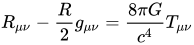
(this is precisely how they were first obtained in 1915 by Hilbert; Einstein took a different path).
The term of the equation describing the source of the gravitational field (the right-hand side) arises here because the metric gμν , with respect to which the variation is carried out, enters into
 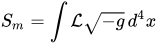 at least through the factor
  , which enters into the expression for the element of (four-dimensional) volume (here L
 — the Lagrangian density for “matter” — that is, of all non-gravitational fields, and Tμν
 — their energy–momentum tensor).
The action for the gravitational field of general relativity can also be rewritten in another form, equivalent to this one except for boundary terms (and if the boundary terms happen to vanish, then fully equivalent), containing under the integral, instead of the curvature tensor, a construction made of  , which can be interpreted as the square of the strength of the gravitational field — that is, in a form analogous to how the action is usually written for simpler — scalar and vector — fields, for example the electromagnetic one.
Supplementing the action written above with the term 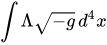 , we obtain the Einstein equations with a Λ
 -term:

A fully satisfactory quantum theory of gravity, as far as is known, does not currently exist (2024). However, many of the theories that, with greater or lesser justification, can claim this role usually give the effective Einstein–Hilbert action in the low-energy limit.
For fermionic (in particular, spinor) fields one can not only write an action, but also obtain formally classical equations for these fields by varying such an action. However, unlike bosonic fields, fermionic fields are observed less well in their classical form, since the Pauli exclusion principle forbids more than one fermion from occupying the same state, which is permitted for bosons and allows them, when present in large numbers in the same quantum state, to be observed as an ordinary classical field, for example, the electromagnetic one. But there is also a theorem asserting (at least within the applicability of perturbation theory) that the result of second quantization for such fermionic fields coincides with the interpretation of such “classical” fields as wave functions of fermions in the sense of first quantization.
Thus, for example, the Dirac equation, obtained by means of the principle of stationary action from one or another form of writing the action for a particle with spin 1/2, has a direct relation to the quantum description of such a fermion (for example, an electron).
The Dirac equation has a property that presents a certain difficulty for deriving it from an action with a quadratic Lagrangian (and, indeed, from any other, if one uses the usual rules of variation and treats the components of the spinors as ordinary numbers). This property is the first order of the derivatives in the Dirac equation.
One sometimes gets around this by simply introducing artificial formal modifications to the restrictions on the rules of variation or on the action of derivative operators.
A more systematic approach, apparently, consists in treating fermionic fields (spinors and their components) as Grassmann[Eng.] numbers, that is, as anticommuting numbers, which changes the sign of the first- and second-order derivative terms compared to the ordinary case, so that the second-order terms cancel out upon variation, while the first-order ones remain.
The Feynman path integral is applicable to the quantum description of both point particles in ordinary space and fields (as distributed systems) in configuration space (and this applicability to both cases is in principle unsurprising, since the formal difference between a point particle and a multidimensional, even infinite-dimensional, dynamical system lies only in the dimensionality of the configuration space, which is well understood already within the framework of classical mechanics).
If the action  (essentially coinciding with the ordinary classical action, at least for systems whose description is not so exotic as to hinder such a use of terms) is known, that is, if it can be written for an ordinary classical trajectory x(τ)
 in “ordinary” or configuration space (τ may be time or simply a parameter in a parametric four-dimensional description), then the quantum wave function of such a system with a point source at the spacetime point
  can be written in the form of a functional integral
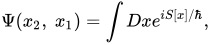
where x — the trajectory beginning at x1 and ending at x2 , the integral denotes summation over all conceivable such trajectories, for each of which the action S[x] has its own value. Moreover, in the relativistic case, among the trajectories there are also trajectories with segments of backward motion in time, which can be interpreted as trajectories of a virtual antiparticle moving forward in time, with the turning points interpreted as the virtual creation and annihilation of particle–antiparticle pairs.
In quantum field theory, integration is applied both over the trajectories of particles in ordinary space (more precisely, in spacetime), which in this case is usually called first quantization, and over trajectories in the space of field variables, which is called second quantization. Both methods, as far as is known, give equivalent results within the framework of perturbation theory.
The Feynman path integral is one of the most popular methods among modern theoretical physicists for quantization (constructing a quantum theory). At the same time, it is one of the most direct ways of comparing the quantum picture with the classical one, which is one of its serious psychological advantages, since each trajectory in it is in principle perceived as classical, and the action is calculated exactly according to the classical recipe, which in a number of cases and aspects makes the theory noticeably more visualizable and easily understood than other approaches. Among other things, this property is convenient for carrying out the transition to the classical limit (see below), and the transition to it starting from the path integral is in this sense one of the most standard paths in modern physics. The same applies to the sufficient convenience of obtaining, by this route, the quasiclassical approximation (also see below).
In a number of cases (a quite limited range — when the action is quadratic in the coordinates or field variables and their derivatives, and the integral reduces to a multidimensional Gaussian one with a limiting transition to the infinite-dimensional case) the Feynman path integral can be computed explicitly and exactly. Its calculation by numerical methods is also practiced. In many cases this integral is useful in various transformations and other theoretical calculations.
It is not difficult to establish the equivalence of the path-integral approach to the Schrödinger equation, at least in the trivial topological situation.
For free (non-interacting) fields in empty flat space, integration over trajectories often makes it possible to obtain explicitly the propagator, which turns out to coincide with the propagator obtained from the differential equation for the corresponding field (for example, from the wave equation for a massless scalar field). It turns out, moreover, that for interacting fields the path integral is perhaps the most natural (and popular among modern theorists) way of justifying the technique of Feynman diagrams. The point is that the path integral for a system of interacting particles (fields) is easily split into parts where there is no interaction (and the result, as we said just above, is known for this case — it is the propagator corresponding to the behavior of the free field, which can be quite easily calculated by any method), supplemented by a point interaction, which then reduces to ordinary finite-dimensional integration — in accordance with the Feynman rules.
However, quantization by means of the path integral is not limited to perturbation theory (Feynman diagrams). This method also finds more nontrivial applications, both in theoretical physics and in certain areas of pure mathematics.
In quantum mechanics, the fact that the behavior of a quantum-mechanical system tends toward classical physics in the limit of large actions (large quantum numbers) is called the correspondence principle. This principle was introduced by Niels Bohr in 1923.
The rules of quantum mechanics are very successfully applied in describing microscopic objects, such as atoms and elementary particles. On the other hand, experiments show that various macroscopic systems (a spring, a capacitor, etc.) can be described fairly accurately in accordance with classical theories, using classical mechanics and classical electrodynamics (although there exist macroscopic systems exhibiting quantum behavior, for example, superfluid liquid helium or superconductors). However, it is quite reasonable to assume that the ultimate laws of physics should be independent of the size of the physical objects being described. This is the premise for Bohr's correspondence principle, which asserts that classical physics should emerge as an approximation to quantum physics as systems become large.
The conditions under which quantum and classical mechanics coincide are called the classical limit. Bohr proposed a rough criterion for the classical limit: the transition occurs when the quantum numbers describing the system are large, meaning either the excitation of the system to large quantum numbers, or that the system is described by a large set of quantum numbers, or both cases. A more modern formulation states that the classical approximation is valid at large values of the action  . In terms of “school” physics this means that the following inequalities must hold:


(the product of the characteristic momentum of the process and its characteristic size, and the product of the characteristic energy of the process and its characteristic time, are significantly greater than )
The correspondence principle is one of the tools available to physicists for choosing the quantum theory corresponding to reality. The principles of quantum mechanics are quite broad — for example, they state that the states of a physical system occupy a Hilbert space, but do not say which one exactly. The correspondence principle restricts the choice to those spaces that reproduce classical mechanics in the classical limit.
Dirac's formulation, also called “Dirac's correspondence principle”: “The correspondence between the quantum and classical theories consists not so much in a limiting agreement as  , but rather in the fact that the mathematical operations of the two theories obey, in many cases, the same laws.”
In the path-integral formulation of quantum mechanics, trajectories that give a value of the action noticeably different from the stationary one (determined from the principle of least action) make a small contribution to the resulting transition amplitude (infinitesimally small at  ). Thus, in the quasiclassical approximation the transition amplitude is determined solely by the classical trajectories of the particles (in the simplest case of motion in space such a trajectory is unique), determined from the principle of least action, and the Schrödinger equation passes into the Hamilton–Jacobi equation.

Comments