
Lecture
If frames of reference move uniformly and rectilinearly relative to one another, and Newton's laws of dynamics hold in one of them, then these frames are inertial. G. Galileo established that in all inertial frames of reference the laws of classical dynamics have the same form: this is the essence of the mechanical principle of relativity (the Galilean principle of relativity). The creation in the 19th century of Faraday — Maxwell electrodynamics and numerous experiments with electric and magnetic fields led scientists (to quote Einstein) “to the conjecture that no properties of phenomena correspond to the concept of absolute rest, not only in mechanics but also in electrodynamics, and even more — to the conjecture that for all coordinate systems for which the equations of mechanics hold, the same electrodynamic and optical laws hold as well...” However, Einstein noted, “Maxwell's electrodynamics — as usually understood at the present time — when applied to moving bodies, leads to asymmetries which do not appear to be inherent in the phenomena.” The resolution of this contradiction between the generalized principle of relativity and the equations of electrodynamics led to the rejection of Galilean transformations and to the creation of the special theory of relativity (STR), which is the subject of this chapter.
Consider two frames of reference — the inertial frame K (with coordinates x, y, z ), which we conventionally take to be at rest, and the frame K' (with coordinates x', y', z' ), moving relative to K uniformly and rectilinearly with velocity v (for definiteness along the x axis ). We will begin counting time from the moment when the origins of both systems coincide (Fig. 6.1).
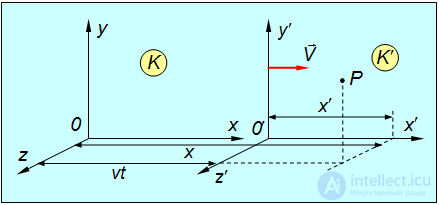
Fig. 6.1. Galilean transformations when passing from one inertial frame of reference to another
Earlier we already found the relation between the coordinates of an arbitrary point P in both frames of reference:
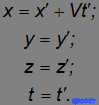
These equations are called the Galilean transformations. In classical mechanics it is assumed that the flow of time does not depend on the relative motion of the frames of reference, that is, to the coordinate transformations we have added an equation for the coincidence of times.
Differentiating the Galilean transformations with respect to time, taking into account

we obtain the Galilean rule for the addition of velocities in vector form:

Differentiating once more, we find the relation for accelerations — the acceleration a in the frame K turns out to be equal to the acceleration a' in the frame K' :
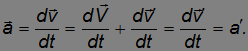
Once again: the acceleration of any body is the same in all frames of reference moving relative to one another rectilinearly and uniformly (that is, V = const). As is said, accelerations are invariant with respect to such frames of reference. Therefore, if one of them is inertial, then the remaining frames of reference will also be inertial.
As a consequence, no mechanical experiment can determine whether a given frame of reference is at rest or moving rectilinearly and uniformly. In other words, there is no preferred frame of reference in nature.
Quantities whose numerical values do not change under coordinate transformations are called invariants of the transformations.
Invariance of length and time interval. The distance between two points P1 and P2 can be expressed through the coordinates of these points in the frame K :

and it is precisely this distance that the observer in the frame of reference K measures. For the observer in the frame of reference K', the coordinates of the same points will be different, and he will determine the distance between them as

From the Galilean transformations it follows that

and similarly for the other coordinates, so that

In other words, both observers find the same value for the distance between two points — length is invariant with respect to Galilean transformations.
Similarly, it is obvious that time intervals are invariant for both observers:

If two events are simultaneous (t1 = t2), then the time interval between them is equal to zero. As a consequence of invariance, this is also true in the frame of reference K', that is, these events are simultaneous in any inertial frame of reference.
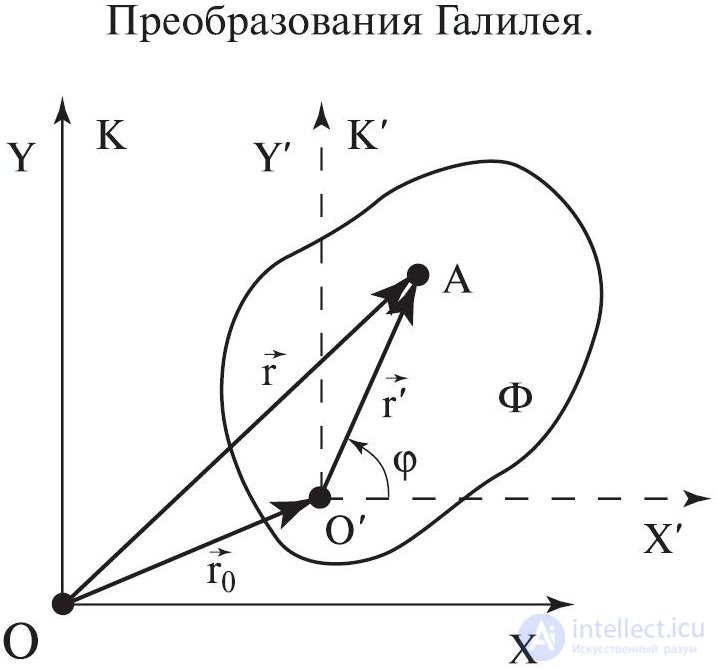
Fig. 6.2. Galilean transformations in the general case
Let us think about where these seemingly so natural statements came from. The Galilean transformations for coordinates follow from the simple geometric rule for the addition of vectors. But let us look more closely at this figure. The vector r' is essentially defined with respect to the frame K', and the observer in this frame uses it to describe the position of some point in space. The observer in the frame of reference K assumes that he can use this same position vector, adding it to the position vector of the origin 0', to obtain the position of the same point relative to the frame K. But on what is this assumption based? On the fact that the vector r' is the same in both frames of reference, that it has the same projections onto the coordinate axes and the same length in both. This means that in deriving the Galilean transformation we implicitly assumed from the outset the invariance of distances. The invariance of time intervals, on the other hand, we postulated quite openly. The basis for this is our everyday experience. But any experience is limited by the scales within which it was acquired. When scientists encountered the physics of high speeds while studying the propagation of electromagnetic waves (light), it turned out that our everyday experience was no longer applicable.
Let us first consider another wave process — sound. Sound propagates in an elastic medium: air, water, solids. The speed of sound is determined by the properties of the medium and is constant relative to the medium. If an observer moves within the medium, then relative to him the speed of sound will be different, determined by the Galilean law of velocity addition. In the presence of a medium there can be no talk of a principle of relativity: the frame of reference in which the medium is at rest is singled out. The motion of all other frames of reference is easy to establish (for example, when a car moves, the presence of the air medium is revealed by air resistance — the apparent headwind).
It used to be thought that light, too, was a mechanical wave process in a special elastic medium called the ether. Relative to the ether, light propagates at a speed conventionally denoted by the letter c.
It has been established experimentally that the speed of light is c = 2.998·108 m/s = 299.8 thousand km/s. The Galilean mechanical principle of relativity means that no ether wind is observed in mechanical motion. This was explained by the “subtlety”, the “rarefaction” of the ether, which offers no resistance to the motion of the “coarse” objects that mechanics deals with. Electromagnetic phenomena, the propagation of light, were another matter entirely. There the ether wind should have been observed, and the purpose of the experiments (Michelson, 1881; Michelson and Morley, 1887) was precisely to search for this wind.
The idea was to use the orbital motion of the Earth with a speed of V = 30 km/s. Moving at this speed relative to the ether, an observer could detect an apparent change in the speed of light: it should equal c + V when moving toward a light beam and c – V when moving away from the light source. The ratio of the speed of the Earth to the speed of light

so that it was necessary to achieve such or an even higher relative measurement accuracy. This turned out to be possible thanks to the use of an interferometer. We will not go into the technical details of the Michelson — Morley experiment, but will describe only its main physical idea.
In this experiment, the times of travel of light from a source S to a mirror M and back to the source were compared for two cases: when the path of light was parallel and orthogonal to the orbital velocity of the Earth.
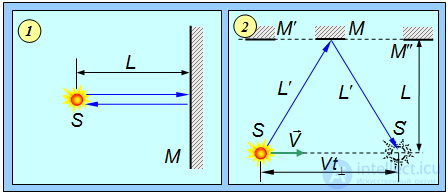
Fig. 6.3. The idea of the Michelson — Morley experiment: 1 — the path of light is parallel to the orbital velocity of the Earth; 2 — the path of light is orthogonal to the orbital velocity of the Earth
In the first case (see Fig. 6.3–1) light travels the path L to the mirror in a time

and the return path — in a time

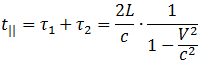
Adding these times, we obtain the total time spent by light traveling to the mirror and back:
In the second case (see Fig. 6.3–2), because of the motion of the mirror and the source, light will spend a time on its path

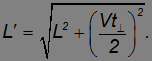
The distance L' is easily found by the Pythagorean theorem:
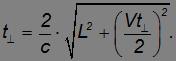
from which we obtain the equation for the time it takes light to travel its path in the second case
Solving this equation gives
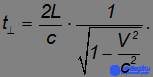
Comparing the times of propagation of light in the first and second cases, we see that they differ

Structurally, the Michelson interferometer was built so that the beam from the source split in two: part of it went parallel to the velocity of the Earth, and part — orthogonally. After reflecting from the mirrors, the beams met at one point and created an interference pattern (Fig. 6.4).
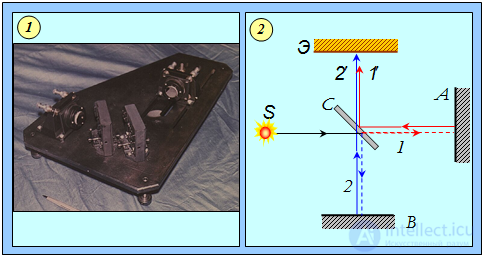
Fig. 6.4. The Michelson interferometer: 1 — general view; 2 — diagram of the setup
No difference in the travel times of the two paths was found. But perhaps the velocities of the Earth and the ether had accidentally coincided, and that was why no ether wind was observed? The experiment was repeated six months later, when the Earth, in its orbital motion, had turned in the opposite direction. The result was the same.
To explain the negative result of the Michelson — Morley experiment, an interesting hypothesis was put forward. First J. FitzGerald, and then (independently of him) H.A. Lorentz tried to explain the result of the experiment by supposing that the ether wind “presses” on bodies and shortens their dimensions along the direction of motion. If this is so, then in the formulas for the longitudinal propagation of light in the interferometer the “true” path length L must be replaced by some other quantity L||. Then the formula for determining the time spent by light propagating in a direction parallel to the orbital velocity of the Earth takes the form
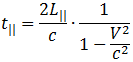
For the times to coincide

it is then sufficient to set
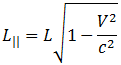
The Lorentz — FitzGerald hypothesis seemed artificial, invented only to explain the results of one experiment.
Meanwhile physicists faced another difficulty, unrelated to the Michelson — Morley experiment. By this time the theory of electromagnetism had taken shape, embodied in Maxwell's equations. And it turned out that Maxwell's equations are not invariant with respect to Galilean transformations. This meant that, it would seem, using an electromagnetic field one could do what had not succeeded in Michelson's experiments — detect the motion of an inertial frame. But then one would have to abandon the Galilean principle of relativity, which looked quite convincing. Moreover, the light used in the Michelson — Morley experiments is a particular case of an electromagnetic field.
Therefore the question was posed: what should the coordinate transformations from one frame of reference to another look like in order for Maxwell's equations to be invariant? The answer was given in 1904 by Lorentz, and since then these transformations have been named after him (although they had appeared earlier in the works of other scientists — in W. Voigt's work in 1887 and in J. Larmor's work in 1900).
From Maxwell's equations it follows, in particular, that light propagates at a speed c. Let us return again to two inertial frames of reference (see Fig. 6.1). We will take one to be at rest (the K-frame). Let the other (the K'-frame) move relative to the K-frame with a constant velocity V. For simplicity we will assume that the coordinate axes of both frames are parallel, that at the initial moment of time the origins 0 and 0' coincide, and that afterward the point 0' moves with velocity V along the x axis. Let, at the initial moment of time t = 0, a light pulse be emitted from the point 0 (coinciding with the point 0' ) along the x axis. Its equation of motion has the form

Its equation of motion relative to the frame of reference K' must be the same:

This is a particular case of the invariance of Maxwell's equations, but considering it is enough to derive the Lorentz transformations.
We will reason in the same way as when deriving the Galilean transformations, taking into account everything we have since learned. In the Galilean transformations, the coordinate x relative to the frame of reference K was made up of the position of the origin of the frame K' (the quantity Vt) and the coordinate x'. But now we will no longer assume the invariance of lengths, and so we multiply x' by some coefficient γ. In other words, we assume proportionality of lengths in different frames of reference, but not their equality. Then the coordinate x of some material point is related to the coordinate x' of the same point by the relation
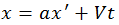
The coefficient γ is as yet unknown, and the quantity Vt — the distance between the points 0 and 0' at time t, measured by the clocks of the frame K.
If the frame K' moves relative to K with velocity V, then the frame K moves relative to K' with velocity –V. Given the equal standing of both frames of reference, we can write an analogous relation between the coordinates:
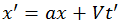
Now the quantity Vt' — is the distance between the points 0 and 0' at time t', measured by the clocks of the frame K'. As we can see, we do not assume the invariance of time intervals, but neither do we reject such a possibility: if our equations admit the solution
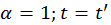
then we will return to the fold of classical mechanics. As we shall see, this variant is not realized.
Let us write the direct and inverse coordinate transformations so that the coordinates and times relating to one frame of reference stand on the left and right sides of the equations, respectively. To do this, let us express x through x', t' using the second equation, substitute this expression into the first equation, and find t from it. We obtain as a result:
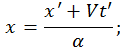
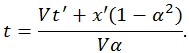
Let us now apply the coordinate and time transformations obtained to the laws of motion of the light pulse in the frame of reference K. Let us substitute the expressions found for x, t into the equation of motion of the light pulse
We obtain
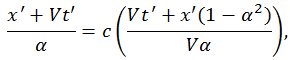
from which
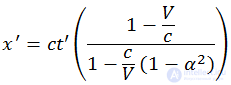
For this equation to have the form
the expression in parentheses must equal one, that is
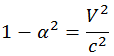
or
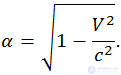
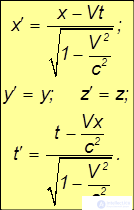
Substituting the expression for γ into the coordinate and time transformations found above, we obtain the Lorentz transformations. They must be supplemented with the relations

which coincide exactly with what was found in the Galilean transformations. To obtain the inverse transformations, it is enough to change the sign of the velocity V.
The quantity
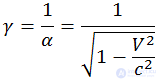
is generally called the relativistic factor (multiplier). With this notation, the Lorentz transformations, which leave the equations of the theory of electromagnetism invariant, take the form:
The inverse Lorentz transformations have the form:
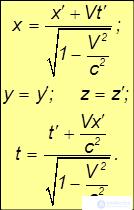
It can be seen that, unlike the Galilean transformations, here not only the spatial coordinates but also time transform.
The achievements of his predecessors were understood and brought into a coherent system thanks to the works of H. Poincaré and A. Einstein.
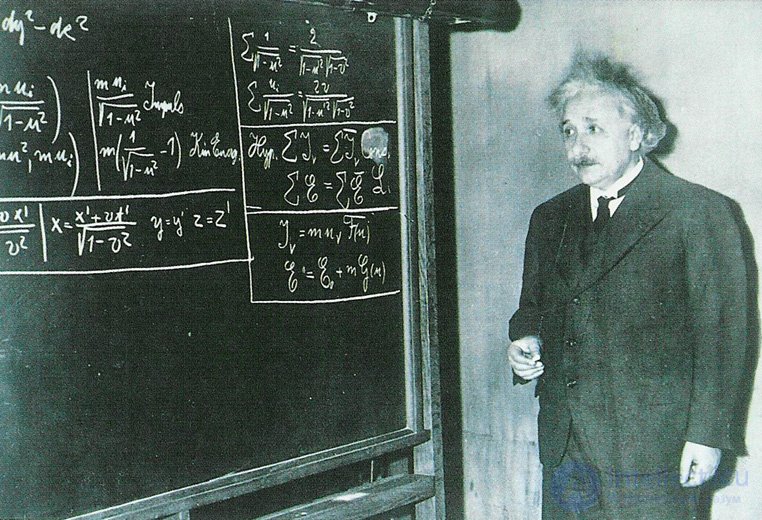
Fig. 6.5. A. Einstein
By 1905 the special theory of relativity had been created. The special theory of relativity (STR) is a modern physical theory of space and time in which, as in classical Newtonian mechanics, it is assumed that time is homogeneous, and space is homogeneous and isotropic. STR is based on two postulates.
The principle of relativity:
No experiments (mechanical, electrical, optical) carried out within a given inertial frame make it possible to detect whether this frame is at rest or moving uniformly and rectilinearly: all laws of nature are invariant with respect to the transition from one inertial frame of reference to another.
The principle of invariance of the speed of light:
The speed of light in a vacuum does not depend on the velocity of the light source or the observer and is the same in all inertial frames of reference.
The first postulate is a generalization of the Galilean mechanical principle of relativity to all phenomena of nature. According to the second postulate, the constancy of the speed of light is a fundamental property of nature, stated as an experimental fact. Above we used this postulate in the form of the equations of motion of the light pulse


From these postulates follows the necessity of replacing the Galilean transformations with the Lorentz transformations.
A direct consequence of the Lorentz transformations: there can be no objects moving faster than light. One could associate a frame of reference with such objects, but for V > c the coordinates and times would take imaginary values. It turns out that the speed of light plays the role of the maximum possible speed of propagation of a signal.
Invariance of the interval. Suppose two events are given: one occurred at time t1 at the point with coordinates x1, y1, z1, and the second — at time t2 at the point with coordinates x2, y2, z2.
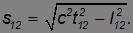
The interval between events is the quantity

Placing primes over the coordinates and times, we obtain the value of the interval s'12 between these same events in another frame of reference. From the Lorentz transformations we find:




from which it follows:

Thus,
The value of the interval is an invariant with respect to Lorentz transformations.
In classical mechanics, this property was possessed separately by the time interval

and the spatial distance

In relativistic physics (from the English relativity — relativity), only the interval between events possesses this property
Time dilation. Suppose a clock is fixed at the origin of the frame K' : its coordinates are then x' = y' = z' = 0, and t' — is the time it shows (that is, the time in the frame of reference K'). Substituting these values into the equations of the Lorentz transformations, we find the usual expressions for the coordinates of this clock in the frame K: x = Vt, y = z = 0 (that is, in the frame K the clock moves with velocity V along the x axis). What is surprising is the last equation — the transformation of time:
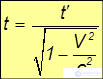
or
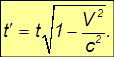
The time t', measured by the clock in the frame K', is less than the time t, measured by the clock of the frame K.
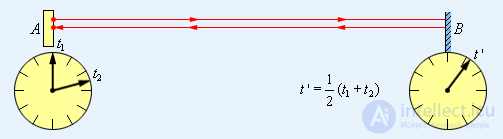
Fig. 6.6. Reconciling the clock readings of observers A and B
The time t', shown by the clock in the frame of reference in which it is at rest, is called proper time.
The specific construction of the clock plays no role here: the point is that the time interval is no longer an invariant and differs for different frames of reference. This is demonstrated by the following example.
Example 1. The lifetime τ0 of a muon at rest (one of the elementary particles) is equal to 2.2 μs. From the point of creation to the detector that registered its decay, the muon traveled a distance l = 6 km. Let us determine the speed v (as a fraction of the speed of light) at which the muon flew.
In the frame of reference K', associated with the muon, its lifetime is equal to τ0. In the laboratory frame K, according to the relation obtained, the time from the creation of the muon to its decay is
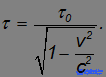
In this time the muon will cover a distance
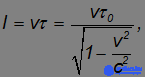
from which we find
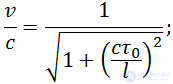
The quantity

substituting cτ0 and l into (6.4.1), we obtain

If the lifetime of the muon relative to the laboratory frame K were the same as in the frame of reference in which it is at rest, then in the laboratory frame of reference it would have traveled a distance L

which is more than nine times less than the actual distance. Even if it had flown not at its actual speed (6.4.2), but at the limiting speed c, which is impossible for a particle with nonzero mass, it would have flown only ct0 = 660 m, but by no means 6 km.
Numerous observations of elementary particles covering distances far greater than classical mechanics would allow them — direct proof of the reality of the time dilation effect.
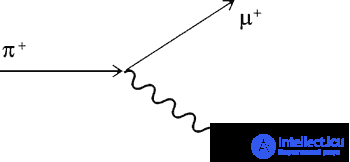
Fig. 6.7. Decay of a pi meson into a muon and a neutrino
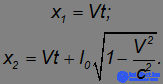
Length contraction. Suppose a ruler is fixed along the 0x axis in a moving frame of reference, with length (proper length) equal to l0. If one end of the ruler is at the origin of coordinates (x'1 = 0), and its other end is at the point with coordinate x'2=l0, then the Lorentz transformations directly give the coordinates of the ends of the ruler in frame of reference K :
The difference between these coordinates gives the length of the ruler in frame of reference K :
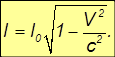
A moving ruler becomes shorter than a ruler at rest. This fact is also consistent with the statement that in relativistic mechanics the invariant is the interval s12, not spatial distances. The resulting contraction of the length of a moving object resembles the Fitzgerald–Lorentz contraction. But with the difference that no ether acts on the object and no mechanical stresses arise in the ruler. Simply the length in the moving and stationary frame of reference differs, just as the time intervals between two events differ. Both of these effects — length contraction and time dilation — are related to each other.
Example 2. Let us consider the events described in the previous example from the point of view of an observer “sitting” on the muon.
At the moment of the muon's birth, the detector registering its decay was, from the point of view of the observer in the laboratory, at a distance l. From the point of view of the observer on the muon, the detector approaches the muon with speed v, and the initial distance L to it will be smaller:

The detector will approach the muon in time

This time coincides with the lifetime of the muon, which will decay in the detector, as was also seen by the stationary observer. The descriptions of the events are different, but both observers will register one and the same physical fact — the decay of the muon in the detector.
Simultaneity of events. Let there be two events 1 and 2. We choose the place and time of the first of them as the origin of the corresponding coordinates: x1 = 0, t1 = 0. Let event 2 occur simultaneously with or after the first

at a point on the 0x axis at a distance L. Let us see what the coordinates and moments of time of these events are from the point of view of an observer moving in the positive direction of the 0x axis with speed V. From the Lorentz transformations it follows that x'1 = 0, t'1 = 0, that is, the coordinates and time of the first event do not change. The second event, however, will occur at the point x'2 at the moment of time t'2, where
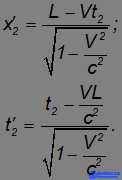
The sign of the coordinate x'2 will be the same as in classical mechanics. If the observer does not manage to reach the place where the event occurs by the moment it happens (Vt2 < L), then the event will occur ahead of him along his course (x'2 > 0); if he does manage to (Vt2 > L), — then event 2 will occur behind him (x'2 < 0). But what happens to the moment of occurrence of event 2 has no analogue in classical physics. Indeed, relative to a stationary observer event 2 occurred after event 1. But at a sufficiently high speed

the sign of t'2 becomes negative, that is, the order of the events changes!
But is this always possible? After all, events 1 and 2 may be causally connected with each other. For example, event 1 — the birth of a father, and event 2 — the birth of his child. Would it not be absurd if there were found an observer for whom the child was born before the father (the cause-and-effect relation would be violated, as they say)? Of course, this is impossible. Let us formulate the condition under which events 1 and 2 can be connected with each other. Since the maximum possible speed of propagation of any signal does not exceed c, events can be in a cause-and-effect relation only if they are not too far apart from each other:

Only then will a “message” about the first event reach the second before it occurs. But if

then, for the order of events to change, the observer would have to move with a speed
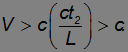
And this, as we have seen, is impossible.
Thus, events that can in principle depend on each other have the same temporal order for all observers.
If, however, events occur so far apart from each other that they cannot be connected by any signal
then the order in which these events occur depends on the speed of motion of the observer, and at
the order of the events will be different than in the stationary frame of reference. In particular, simultaneous events (t1 = t2) occurring in the stationary frame of reference at any distance from each other cannot be causally connected (this would require signals with infinitely large speed). From the formula for the transformation of time we obtain, for t2 = 0:
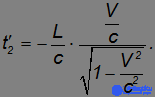
Hence, at any speed of an observer moving in the positive direction of the 0x axis, event 2 occurs earlier than event 1. When moving in the opposite direction (V < 0), event 2 occurs later.
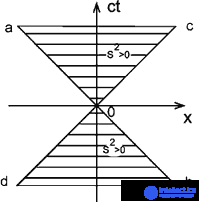
Fig. 6.8. Events may be simultaneous, from the point of view of some observer, if ds2 > 0
Let us illustrate what has been said with the following example. Let a train A’B’ be moving, at the ends of which two lightning bolts strike, leaving marks A and B on the rails (fig. 6.9).
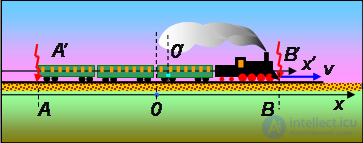
Fig. 6.9. On the concept of the relativity of simultaneity
Let us mark the midpoint 0’ in the train, and correspondingly 0 on the track. Let us associate the frame of reference 0x with the railway track, and the frame of reference 0x’ with the train. Let the flashes of light occur simultaneously at point 0. Then in the stationary frame of reference x both events (lightning strikes) occur simultaneously.
Since the train is moving to the right, and consequently, at the moment the flashes reach the middle of the train, point 0’ is to the right of 0, the flash from point A’ will reach point 0’ later than the one from point B'. This means that in the frame x’ the lightning strike at point B’ occurs earlier than at point A’.
We have seen that, along with the relativity of time intervals and spatial distances, even the simultaneity of events has no absolute meaning. All of them are relative, that is, they depend on the motion of the observer. In classical physics, quantities such as the velocities of bodies and their kinetic energies were relative. Now this list of similar quantities has simply grown longer.
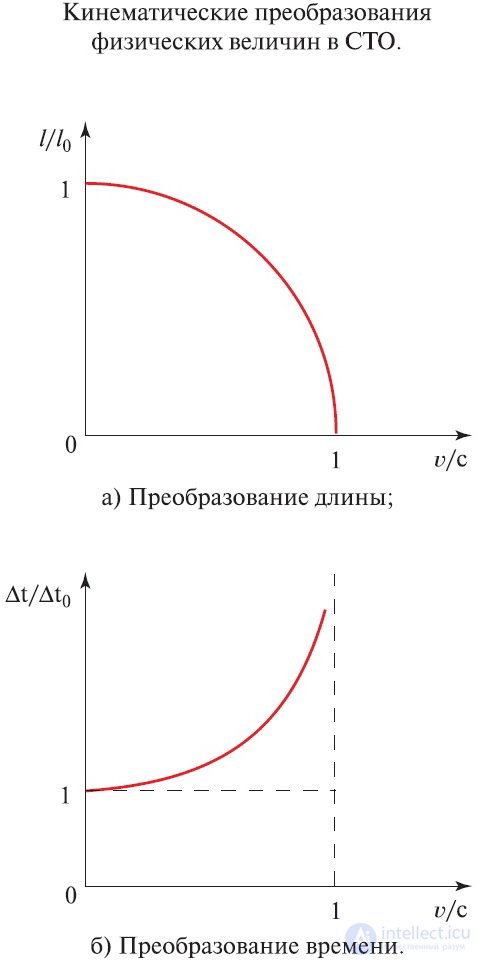
Fig. 6.10. Kinematic transformations of physical quantities in special relativity
We have said that the speed of light is the maximum possible speed of propagation of a signal. But what will happen if light is emitted by a moving source in the direction of its velocity V ? According to the law of addition of velocities that follows from the Galilean transformations, the speed of light should be equal to c + V. But in the theory of relativity this is impossible. Let us see what law of addition of velocities follows from the Lorentz transformations. To do this, let us write them for infinitesimal quantities:
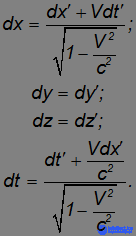
By definition, the components of velocity in frame of reference K are found as the ratios of the corresponding displacements to the time intervals:

The velocity of the object in the moving frame of reference K' is defined analogously, except that the spatial distances and time intervals must be taken relative to that frame:

Consequently, dividing the expression dx by the expression dt, we obtain:
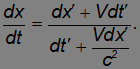
Dividing the numerator and denominator by dt', we find the relation between the x-components of the velocities in different frames of reference, which differs from the Galilean rule for the addition of velocities:
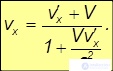
Moreover, unlike in classical physics, the components of velocity orthogonal to the direction of motion also change. Analogous calculations for the other components of velocity give:
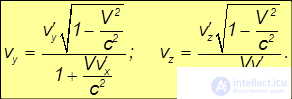
Thus, formulas have been obtained for the transformation of velocities in relativistic mechanics. The formulas for the inverse transformation are obtained by replacing the primed quantities with unprimed ones and vice versa, and replacing V with –V.
Now we can answer the question posed at the beginning of this section. Suppose that at point 0' of the moving frame of reference K' a laser is installed, sending a light pulse in the positive direction of the axis 0'x'. What will be the speed of the pulse for a stationary observer in the frame of reference K? In this case, the velocity of the light pulse in the frame of reference K' has the components

Applying the law of relativistic addition of velocities, we find for the components of the velocity of the pulse relative to the stationary frame K :

We obtain that the speed of the light pulse, also in the stationary frame of reference relative to which the source of light is moving, equals
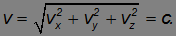
The same result is obtained for any direction of propagation of the pulse. This is natural, since the independence of the speed of light from the motion of the source and the observer is built into one of the postulates of the theory of relativity. The relativistic law of addition of velocities is a consequence of this postulate.
Indeed, when the speed of motion of the moving frame of reference V << c, the Lorentz transformations pass over into the Galilean transformations, and we obtain the ordinary law of addition of velocities

In this case the rate of the passage of time and the length of the ruler will be the same in both frames of reference. Thus, the laws of classical mechanics are applicable if the speeds of objects are much less than the speed of light. The theory of relativity did not cross out the achievements of classical physics, it established the limits of their validity.
Example. A body with speed v0 strikes a wall perpendicularly, the wall moving toward it with speed v. Using the formulas for the relativistic addition of velocities, let us find the speed v1 of the body after the rebound. The collision is perfectly elastic, and the mass of the wall is much greater than the mass of the body.
Let us use the formulas expressing the relativistic law of addition of velocities.
Let us direct the x axis along the initial velocity of the body v0 and associate the frame of reference K' with the wall. Then vx = v0 and V = –v. In the frame of reference associated with the wall, the initial speed v'0 of the body is equal to
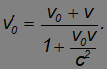
Since the wall can be considered infinitely massive, by the law of conservation of energy, after the elastic collision the body will bounce back in the opposite direction with the same absolute value of speed (relative to the wall):
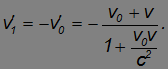
Let us now return to the laboratory frame of reference K. Substituting v'1 in place of v'x into the relativistic law of addition of velocities, and again taking into account V = –v, we find after transformations:
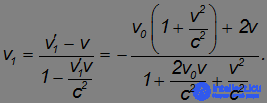
Let us now analyze the limiting cases.
If the speeds of the body and the wall are small (v0 << c, v << c), then we can neglect all the terms in which these speeds and their product are divided by the speed of light. We then obtain from the formula found the result of classical mechanics
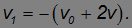
The speed of the ball after the rebound increases by twice the speed of the wall; it is directed, naturally, opposite to the initial one. It is clear that in the relativistic case this result no longer holds. In particular, for v0 = v = c/3 it follows from it that the speed of the body after the rebound would be v1 = –c, which cannot be.
Now let a body moving at the speed of light strike the wall (for example, a laser beam reflected from a moving mirror). Substituting v0 = c into the relation found, we obtain
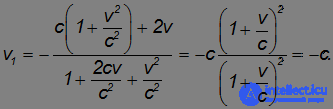
In other words, the speed of the laser beam changed direction, but not its absolute magnitude, as it should be.
Let us now consider the case when the wall is moving with a relativistic speed. In this case the relation found gives us
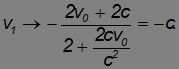
After the rebound, the body will also move with a speed close to the speed of light.
Finally, let us substitute into the relation found the values v0 = v = c/3 :
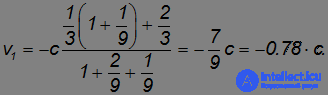
Unlike in classical mechanics, the theory of relativity gives, for the speed after the rebound, a value smaller than the speed of light.
Finally, let us see what happens if the wall is receding from the body with the same speed (v = –v0). We have in this case:
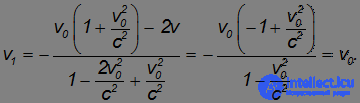
As in classical mechanics, the body will not catch up with the wall, and its speed will not change.
The phenomenon of aberration was discovered by J. Bradley in 1725: observations showed that over the course of a year the stars trace small ellipses in the sky. The period of revolution of the stars suggested that this phenomenon was connected with the annual motion of the Earth around the Sun. The theoretical explanation was based on the idea of adding the velocity of the ray of light from the star to the orbital velocity of the Earth. It is said that the impetus for understanding the effect came from a boat trip Bradley took. He noticed that the pennant on the mast did not indicate the direction of the wind at all, but changed its direction each time the boat turned.
Suppose, for example, that in the heliocentric frame of reference light from a star M stationary in this frame of reference arrives at the Earth at an angle ψ to the direction of motion of the Earth at the moment this light is received by terrestrial detectors (left part of fig. 6.11). The axis OX of the chosen frame of reference is directed along the velocity vector of the Earth (red arrow in the right part of the figure).
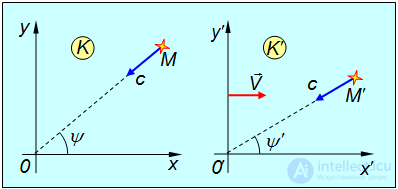
Fig.6.11. Angles of observation of the star in different frames of reference
In the frame of reference K', associated with the Earth, the angle of inclination ψ' of the light ray will be different. Indeed, the x-components of the velocity of the light ray in the frames K and K' are respectively equal to
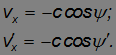
Here we took into account that the modulus of the speed of light in both frames is equal to c. On the other hand, the component of the velocity of light in the frame K' can be obtained from the relativistic law of addition of velocities
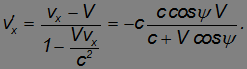
Equating the right-hand sides of the expressions for v'x we find
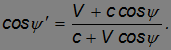
Over the course of a year, the Earth, in the stationary frame of reference, traces a closed trajectory, its speed changing in magnitude and direction, so that the angle of observation of the star ψ' also changes periodically, while the angle ψ remains unchanged. This is precisely the phenomenon of aberration.
Let us now apply the formulas obtained to the case of observing the starry sky from a hypothetical spacecraft moving at high speed. Let us imagine that the stars in the stationary frame are distributed uniformly across the sky. From the point of view of astronomers on the ship, this is no longer so. Indeed, a star located behind the ship along its course will not shift: from our formulas, for ψ = 180°, cos ψ = –1, it follows that cos ψ' = –1, ψ' = 180°. A star located, however, at an angle ψ = 90° (cos ψ = 0) to the course of the ship will be observed by the cosmonauts in the direction cos ψ' = V/c. For V close to c this angle is very small. All the stars of the forward hemisphere (in the stationary frame of reference) will be concentrated in this narrow cone. Conversely, it can be shown that the stars from a narrow cone with the same opening angle, but behind the ship, will occupy the entire rear hemisphere in the frame of reference K'. Thus, as the speed of the ship increases, the sky behind it remains almost empty, while almost the entire visible Universe merges into a bright spot ahead along the course.
The mass of an elementary particle is its invariant characteristic and does not depend on whether the particle is moving or at rest. However, the expression for momentum introduced earlier
|
|
(6.7.1) |
is only approximately valid at non-relativistic (v << c) speeds of the particle. One should not attach excessive dramatic significance to the words “approximately valid” for the simple reason that, when we are talking about the motion of macroscopic bodies, these corrections are vanishingly small. For example, the orbital speed of the Earth is 30 km/s, to which correspond relativistic corrections of order of magnitude (v/c)2 ~ 10–8. However, when considering the motion of elementary particles (electrons, protons, etc.), the relativistic corrections are most often no longer small: the correct relativistic values of physical characteristics can exceed their values calculated by non-relativistic formulas by thousands of times.
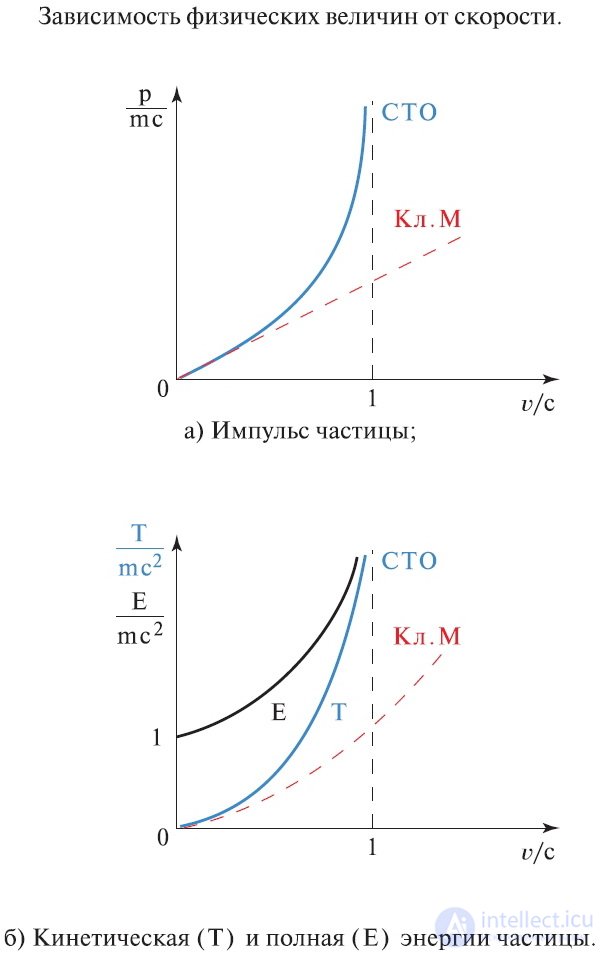
Fig. 6.12. Dependence of physical quantities on speed
Let us assume that the expression, valid also in the relativistic (v ~ c) case, for the momentum of a free particle of mass m, moving in our frame of reference with velocity  can be written in the form
|
|
(6.7.2) |
where  — is some function of only the modulus of the speed. A free particle is a closed system consisting of a single particle; for a closed system space is isotropic (one of the time-tested universal postulates of modern physics), so the momentum vector must be directed along the only vector present in the problem, namely: the velocity vector of the particle
  , and for the same reason its modulus cannot depend on the direction in which the particle is moving, hence
  . Expression (6.7.2) is a momentum, that is, dimensionally it is a product of mass and velocity, hence the function is dimensionless. Accordingly, it cannot depend simply on the modulus of the particle's speed v, since that is a dimensional quantity. Only a dependence on the dimensionless ratio of the particle's speed to some other speed is possible. It is not hard to see that this must be an invariant speed, otherwise, for one and the same speed of the particle, this ratio, and with it the function
  and the momentum itself, would take different values, which contradicts common sense. We have at our disposal only one invariant speed: the speed of light in vacuum c. Thus, we have:
|
|
(6.7.3) |
The relativistic expression for momentum (6.7.2) must, at small speeds, pass over into the non-relativistic expression (6.7.1), so it can be asserted that
|
|
(6.7.4) |
The form of the function (v) can be established in various ways, in particular, as follows.
Let us imagine that, in a stationary frame of reference, a body of mass m moves along the axis 0x, and a force F acts on it in the direction of motion for a short time dt. Under the action of this force the body acquires a speed v + dv. The change in the momentum of the body is equal to
|
|
(6.7.5) |
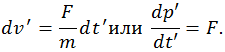
Let us consider the motion of this body in the frame of reference K', moving along the axis 0x with speed V equal to the speed of the body before the force acted on it, that is V = v. This is the so-called co-moving frame of reference; in this frame of reference the body was initially (before the force began to act) at rest, and after the action of the force it acquired a speed dv'. Since we are dealing with an infinitesimal speed of the body, the laws of non-relativistic mechanics are applicable in this frame of reference. Consequently, in K' the speed acquired by the body is equal to
|
|
(6.7.6) |
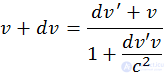
The speeds of the body in K – v + dt and in K' – dv' are related by the relativistic law of transformation of velocities, in which one must set V = v :
|
|
(6.7.7) |
The infinitesimal smallness of dv' allows us to rewrite the fraction 1/(1 + vdv'/c2) in the following form: 1/(1 + vdv'/c2) = 1 – vdv'/c2. Substituting this relation into (6.7.7), we obtain
|
|
(6.7.8) |
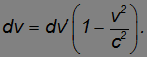
In the rightmost expression in (6.7.8), the term of second order of smallness proportional to (dv')2 has been omitted. Cancelling the speed v on the left and right, we obtain the relation between the increments of speed in the frames of reference K and K'
|
|
(6.7.9) |
Substituting Newton's second law in the form (6.7.6) into (6.7.9) gives
|
|
(6.7.10) |
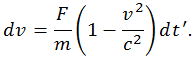
And finally, substituting (6.7.10) into the expression for the increment of momentum (6.7.5)
|
|
(6.7.11) |
The duration of the force dt' in the system K' is related to its duration dt in the system K by the relation
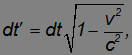
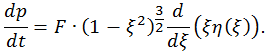
which allows the increment of momentum in the system K to be expressed in terms of the duration of the force dt in that same system K. Thus, for the rate of change of momentum in the system K we have:
|
|
(6.7.12) |
Now the most important part: following the principle of relativity, which states that the laws of nature must look the same in all inertial frames of reference, we require that in the system K (compare with the second equation in (6.7.6)) Newton's second law take the form
|
dp/dt=F |
(6.7.13) |
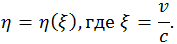
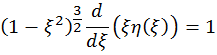
Comparing (6.7.12) and (6.7.13) for the function η(ξ), we obtain the following differential equation
|
|
(6.7.14) |
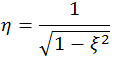
By direct differentiation of the function
|
|
(6.7.15) |
it is easy to verify that it is a solution of equation (6.7.14) and satisfies the condition of transition to the non-relativistic limit (6.7.4).
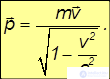
The relativistic expression for momentum, which satisfies all the conditions formulated above and holds at any speed, has the form:
|
|
(6.7.16) |
Or more briefly, using the relativistic factor 
|
|
(6.7.17) |
At low speeds, the expression v << c reduces to the non-relativistic expression of Newtonian mechanics 
The relativistic momentum grows without bound as the speed of the body approaches the speed of light. The dependence of the relativistic momentum of a particle on its speed is shown in Fig. 6.13.
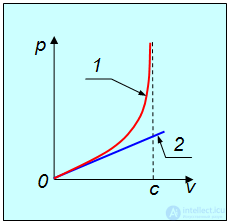
Fig. 6.13. Dependence of the particle's momentum on its speed: 1 — relativistic momentum; 2 — Newtonian momentum
Example. A body begins to move from rest under the action of a constant force F. Let us find the dependence of the body's speed on time and compare it with the classical result.
Since the body's velocity in this case will be directed along the line of action of the force, we can write the fundamental equation of motion in scalar form:
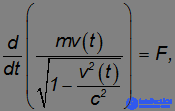
where v(t) — is the speed of the body at time t, with v(0)=0. Integrating, we find:
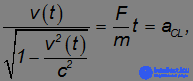
where we have introduced the notation aCL = F/m for the classical acceleration of the body. Squaring the equation, we easily obtain the law of dependence of speed on time:
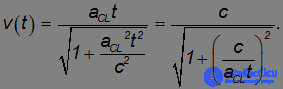
Thus, at any moment of time v(t) < c, and as

For small values of time (t << c/aCL) we obtain the result of classical non-relativistic mechanics for uniformly accelerated motion:

Let us give some numerical estimates. Suppose a rocket moves with a (classical) acceleration aCL=g = 9.8 m/s2 (that is, the astronauts experience the familiar terrestrial force of gravity). According to the classical law of motion, the rocket reaches the speed of light after a time
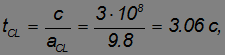
that is, after about a year. In reality, at that moment its speed will be equal to
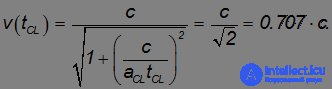
After two years of travel the speed becomes equal to

after five years it will be

after 10 years we obtain

and so on.
No matter how long the rocket accelerates, its speed will never reach the speed of light. The rocket's speed, as mathematicians say, will asymptotically approach the speed of light in vacuum and become equal to it only after an infinite time.
So, the relativistic equation of motion of a point particle, or the fundamental equation of relativistic dynamics, has the usual form of Newton's second law equation, but with a different dependence of momentum on speed:
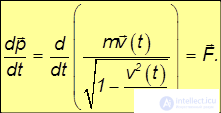
Let us transform the increment of momentum on the left-hand side of this equation:
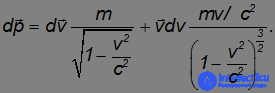
Let us multiply the fundamental equation of relativistic dynamics, in scalar form, by the displacement vector

On the right we have the usual expression for the change in the body's kinetic energy:

On the left, after taking into account that
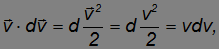
we can obtain
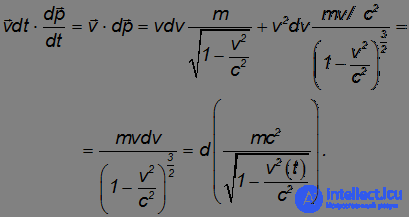
Thus,
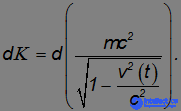
Consequently, the expression in brackets on the right, up to a constant of integration, represents the kinetic energy of a point particle moving with speed v. The value of this constant is fixed by the condition that K = 0 at v = 0.
Finally we obtain the relativistic expression for kinetic energy
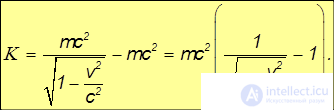
Or more briefly, using the relativistic factor  :
:

At low speeds v << c we can expand the square root in a Taylor series in powers of the ratio v/c. Keeping the first two terms of the series, we have
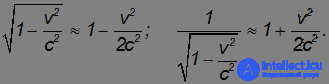
In this approximation the kinetic energy is given by the classical formula
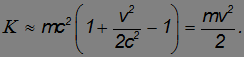
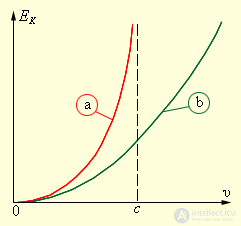
Fig. 6.14. Dependence of kinetic energy on speed. a – relativistic value, b – classical value of kinetic energy.
In the theory of relativity, space and time are no longer independent: from the Lorentz transformations and the invariance of the interval it follows that they enter the equations on an equal footing, forming a single spacetime. Recall that the conservation laws of momentum  and energy
  of a body are related to the homogeneity of space and time, respectively. When transforming to a moving frame of reference, the expressions for momentum and energy must transform in the same way as the coordinates and time in the Lorentz transformations. The transformations carried out below on the basis of analogies and dimensional analysis are not entirely rigorous, but they lead to the correct result. A rigorous derivation requires the use of the apparatus of 4-vectors in a four-dimensional spacetime continuum, which is beyond the scope of our present tasks. Let us look at the equations describing the Lorentz transformations
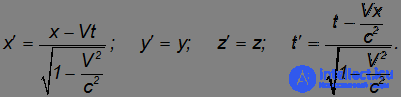
If we replace in the first of them

then the time  must be replaced by a quantity proportional to the energy in the frame of reference
  . The coefficient of proportionality follows from dimensional considerations: the energy must be divided by the square of some speed. We have only one distinguished speed — the speed of light. Similarly, in the last equation we replace

and the coordinate  — by a quantity proportional to the momentum
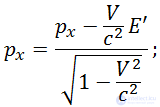
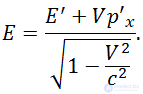
  . As a result we write the Lorentz transformations for momentum and energy in the frames of reference
  and
and  :
:


The inverse transformations have the form:
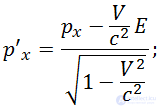


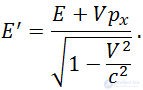
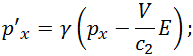
Or, more briefly, using the relativistic factor 
|
|
(6.9.1) |

We already know what relativistic momentum is. But what is relativistic energy  ? It is precisely this quantity that plays the role of the partner of momentum in the Lorentz transformations for momentum and energy; it is this quantity that is related to the properties of spacetime and must be conserved in closed systems. Let us apply the formulas obtained to a point of mass
  , moving along the axis
  with constant speed
  . Its momentum is equal to
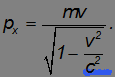
Let us attach to the point a frame of reference  . In this frame the point is at rest, that is
  . Substituting these relations into the first of formulas (6.9.1)
|
|
(6.9.2) |
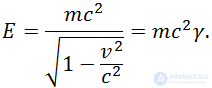
From which, for the energy of a particle of mass m, moving in our frame of reference with speed v, we obtain
|
|
(6.9.3) |
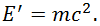
In the frame of reference in which the particle is at rest, as follows from (6.9.3), its energy is equal to
|
|
(6.9.4) |
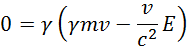
Result (6.9.4) can also be obtained as follows. Into the last of formulas (6.9.1) let us substitute the momentum p = mvγ and the energy E = mc2γ from (6.9.3), and we obtain
|
|
(6.9.5) |
We have obtained a very interesting result. In the system  the point is at rest, but its energy is different from zero. It is called — the rest energy and is denoted

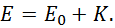
We have arrived at Einstein's famous formula. The total energy of a moving body is given by the sum of the rest energy and the kinetic energy
The rest energy contained in a body is enormous. For example: a kilogram of coal when burned yields about 30 MJ = 3·107 J of energy. The rest energy of the same kilogram is equal to  J, that is, three billion times greater. Under certain conditions rest energy can be released. Unfortunately, in practice this was first accomplished in the explosion of an atomic bomb.
From the relativistic expressions for momentum  and energy
  it is easy to obtain the relation between them:

It follows that the left-hand side of the resulting expression is an invariant, that is, it does not depend on the frame of reference. This can also be obtained from the Lorentz transformations. So, knowing the momentum of a body, one can find its energy

and speed
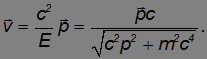
The relation between kinetic energy and momentum:

The relativistic relations between the energy of a body, its momentum and its speed can be represented graphically in the form of a right triangle (Fig. 6.15), which makes the formulas easier to remember.
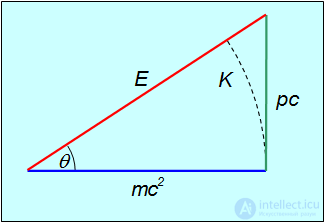
Fig. 6.15. Graphical representation of the relation between the energy and momentum of a body
At infinitely large momenta the energy of the body grows without bound, and the speed approaches the speed of light. Conversely, at small momenta we have:
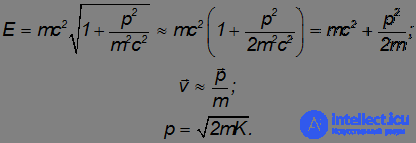
We have again arrived at the non-relativistic relations for the kinetic energy and speed of a particle as functions of its momentum.
From everything said, the criteria for the applicability of classical Newton — Galileo mechanics follow:

or
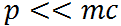
or
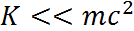
All the relations written out are equivalent; each of them follows from any of the others.
Example. The solar constant C (the density of the flux of radiant energy from the Sun incident on the Earth) is equal to  . Let us determine the mass
  that the Sun loses in one year.
The Earth is located from the Sun at a distance  m. In a time
  , an energy
  falls on a unit area. Multiplying by the area of a sphere of radius
  , we obtain the total energy radiated by the Sun in time :

This energy arises as a result of thermonuclear reactions due to a decrease in the Sun's rest energy. Consequently, its mass will decrease over a year by an amount
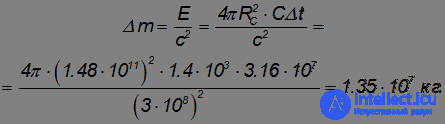
Over its lifetime (5 billion years) the Sun has lost in mass  kg. Given that the mass of the Sun is equal to
  kg, the mass loss to radiation amounts to 0.03%. This example demonstrates an important conclusion of the theory of relativity:
There is no law of conservation of mass in nature — there is only the law of conservation of total energy.
The law of conservation of mass arose in classical physics only because the kinetic energies of the products of chemical reactions are hundreds of millions of times smaller than their rest energies. So, in chemical reactions mass is conserved to within an accuracy of the order of millionths of a percent.
Let us consider the relativistic expression relating energy and momentum:
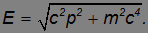
Setting in this relation  , we obtain

On the other hand, the magnitude of the momentum of a particle is related to its speed by the relation

Substituting here the obtained expression for the energy of a particle with zero mass, we get  . Particles of zero mass cannot be at rest and cannot move otherwise than at the speed of light! Among such particles is the particle of light, called the photon (denoted by the symbol
  ), as well as the neutrino (denoted
  ). Such particles have no rest energy
  , since they are never at rest. But they do possess energy, which everyone can feel in practice while sunbathing on a beach. In Fig. 10 this corresponds to the limiting case where the lower leg is equal to zero, and the hypotenuse coincides with the other leg and with the kinetic energy:
  .
.
Example. An elementary particle called the neutral pi meson (notation  ) decays into two photons:

Let us determine the momenta of the photons, given that the decaying pi meson was at rest. The mass of the particle is  kg.
kg.
Since the pi meson was initially at rest, the total momentum of the system was equal to zero. By the conservation of momentum, the momenta of the photons  are equal in magnitude and directed in opposite directions. Consequently, the energies of the photons
  are also equal. Let us write the law of conservation of energy for this reaction:

from which the momenta of the photons are equal to

In this case the energy of each photon is equal to half the rest energy of the pi meson.
Further on we will learn that the energy of a photon is related to the frequency of the light wave  by the relation

The photon also possesses momentum
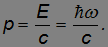
Falling on a surface, photons transfer their momentum to it and thereby exert pressure. Light pressure was first detected and measured by P.N. Lebedev in 1900.
In 1916, A. Einstein, generalizing the ideas of special relativity (SR) to non-inertial frames of reference, created a theory of gravitation, also called general relativity — GR. According to this theory, any object possessing energy  will be subject to the action of a gravitational field as if it had a gravitational mass
  . The relation of to the energy of a body is given by the already familiar relation

The mass of a photon is equal to zero, but in any gravitational field it must behave like a particle with gravitational mass

When a photon moves vertically upward near the Earth's surface, the photon must expend part of its energy to perform work against the force of gravity:
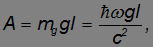
where  — is the distance traveled vertically. Correspondingly, the initial energy of the photon, equal to

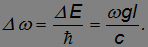
must decrease by the amount  . This means the frequency of the photon at the end of its path will be smaller by the amount
  :
:
The relative decrease in the frequency of the photon
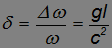
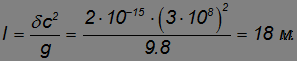
upon propagation along the vertical was measured in 1960 by the American scientists Pound and Rebka. Under the conditions of the experiment it amounted to a small value equal to  . This means the difference in height in the Pound — Rebka experiment was
The effect of the change in the frequency of light when moving away from a large gravitating mass is called gravitational redshift.









Comments