
Lecture
If a body moves under the action of a force, we say that the force does work. In mechanics the concept of work is closely linked to the concept of energy.
Energy is probably the most well-known concept in physics, one that most people have heard of in one way or another. The history of ideas about energy was quite dramatic. For forty years a dispute raged between the followers of Descartes and Leibniz. The former argued that in collisions of bodies the product of mass and the value of velocity remains unchanged (Descartes understood momentum in the algebraic, not the vector, sense), while the latter maintained that the product of mass and the square of velocity, then called vis viva ("living force"), is conserved. As often happens, both sides turned out to be right: in elastic collisions both the vector of momentum and the vis viva, now called kinetic energy, are conserved.
Later the deep physical meaning of the law of conservation of energy was revealed: it turned out to be connected with a fundamental symmetry of our world — the homogeneity of time. Scientists discovered new forms of energy, and the law of conservation of total energy became an indispensable attribute of all physical theories. In this section we begin our acquaintance with the simplest forms of energy — the potential energy of a body in a force field and the kinetic energy of a moving body.
Consider a perfectly inelastic collision of two balls of equal mass made of clay. If these balls fly toward each other with the same speed, then upon collision they stick together and come to rest. In this case the total momentum of both balls remains equal to zero, although the state of the system has changed. The balls become heated in the process. This example shows that momentum cannot always serve as a measure of motion. Energy is such a measure. In this case the mechanical energy of the impact was converted into another form of energy (heat).
First let us consider an important characteristic — work. Let a point particle move along the trajectory AB (Fig. 1). During its motion the point is acted on, in the general case, by a variable force F. On a segment ds (small enough that the magnitude of the displacement equals the distance travelled) the force F can be regarded as constant.
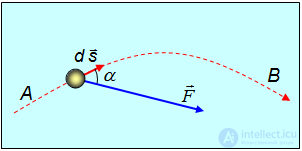
Fig 4.1. Elementary work
The elementary work of a force  equals the scalar product of the force vector and the displacement vector of its point of application

Work is a scalar quantity, and its sign depends on the sign of  . Positive work is done by a force if its direction makes an acute angle
  with the direction of motion of the body. Negative work is done by a force whose direction makes an obtuse angle with the direction of motion, in which case the force decelerates the motion. The quantity
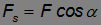
— is the projection of the force F onto the direction of displacement. Consequently,

The total work of a force is found as the sum (integral) of the elementary work terms along the entire trajectory L of the point:
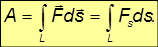
When moving along the x axis, the work can be represented graphically as the area under the curve Fx(x) (Fig. 4.2), where areas below the x-axis should be assigned a negative value.
Fig. 2. Graphical interpretation of the work of a force. Here, for brevity, we set F = Fx(x)
If the displacement is orthogonal to the force, then = 0 and the work is zero:

The latter shows that the concept of work in mechanics differs from the everyday notion of work. Thus, when a load is moved at constant speed in a horizontal direction, the force of gravity does no work. Work is also not done when a body is at rest, since the point of application of the force does not move and = 0. Here and below and  denote one and the same thing — an infinitesimal displacement, and ||=||=
 — the corresponding infinitesimal path length.
If several forces act on the body, then

that is, the work of the resultant of several forces equals the algebraic sum of the work done by each of the forces separately.
As an example, let us consider the work done by an external force in compressing and stretching a spring of stiffness  . Let us direct the 0x axis along the spring, choosing as the origin 0 the position of the free end of the spring when it is in the unloaded state. We represent the process of compression/extension as a sequence of equilibrium states: at each moment in time we apply an external force equal in magnitude to the elastic force exerted by the spring. Then, according to Hooke's law,

where x — is the elongation of the spring. For positive x (stretching of the spring) the external force is directed to the right, for negative (compression) — to the left (Fig. 4.3).
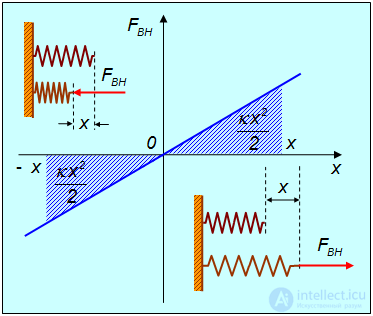
Fig. 4.3. Work done in compressing/stretching a spring
The scalar product for the elementary work of the external force takes in this case the form

so that for the total work of elastic deformation of the spring we obtain
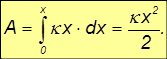
Note that A does not depend on the sign of x: both when stretching and when compressing the spring, the external force does the same positive work.
Let us write the equation of motion of a point particle:

where F — is the resultant force. Let us multiply the equation of motion scalarly by ds = vdt:

On the right-hand side of the equation we obtained the elementary work  , and on the left — an expression that can be transformed into the form of a total differential:

As a result we obtain
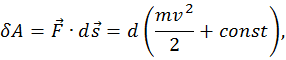
that is, the elementary work done by the force F during a displacement ds of a point particle of mass m equals the increment of the quantity mv2/2 + const. By its dimension this is energy (energy has the same dimension as work). It turns out that the force does a certain amount of work, and by the same amount the quantity of the dimension of energy increases — specifically, the energy due to the very fact of motion at speed v. Therefore in non-relativistic (Newtonian) mechanics the arbitrary constant is set equal to zero, and what remains is called the kinetic energy of a particle of mass m moving at speed v. We shall denote kinetic energy by the letter K; another commonly accepted notation is the letter T. Thus, by definition:

The kinetic energy of a point particle can also be expressed in terms of its momentum  :
:
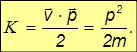
If F = 0 (the system is closed), then the work of the forces equals zero, and consequently the increment of kinetic energy equals zero. In other words, in this case kinetic energy is conserved: K = const. At this stage of our acquaintance with the laws of nature it is difficult to see any special meaning in introducing a new concept — kinetic energy — since it is fully determined by the momentum of the particle. But let us not rush to conclusions. The full depth of the concept of energy will be revealed later, when it becomes clear that kinetic energy is only one of the many forms of energy.
The expression for kinetic energy establishes the unit of measurement of energy.
In the SI system the unit of measurement of work is the joule (J):

Example. Find the kinetic energy of the Earth in its annual motion around the Sun. The distance to the Sun is R = 150 million km, and the mass of the Earth is ME = 6 • 1024 kg.
We know that the Earth covers the distance

in a time of

From this the orbital speed of the Earth's motion is
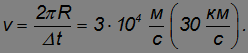
The kinetic energy of the Earth will be

Fig. 4.4 shows characteristic energy values of some physical processes.
Fig. 4.4. Energy of some physical processes
Let us again represent the elementary work in the form

The specific quantity equal to the ratio of the work done in a time dt to that time is called power:
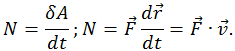
In other words, the power developed by a given force equals the rate at which that force does work. It can also be said as follows: the average power over a unit of time is numerically equal to the work done in that unit of time. If the power over the chosen unit of time is practically unchanging, the word “average” can be dropped: the power is numerically equal to the work per unit of time.
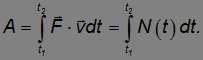
As is clear from the definition, power equals the scalar product of the force and the velocity of its point of application, so the work of a force over the time from t1 to t2 can be computed as follows:
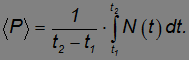
The average power over this same interval of time equals
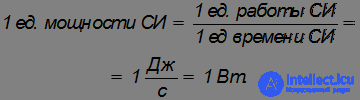
The unit of power is defined as the power at which a unit of work is done in a unit of time.
In the SI system the unit of measurement of power is the watt (W):
A non-SI unit of power — horsepower (hp) — equals 736 W. In everyday life the unit of energy often used is 1 kWh = 103 W•3600 s=3.6 MJ.
Example. A helicopter of mass m = 3 m hovers in the air. Determine the power developed by the helicopter's motor if the rotor diameter is d = 8 m. In the calculation assume that the rotor throws down a cylindrical jet of air with diameter equal to the diameter of the rotor. The density of air is 1.29 kg/m3.
To solve this problem we must apply all the laws of dynamics known to us. Since this is not a one- or two-step problem, let us first try to find the form of the final expression using dimensional analysis (see topic 1.3). The sought power depends on: 1) the weight of the helicopter mg; 2) the diameter of the rotor d, 3) the density of air  , that is, the sought formula must have the form
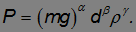
The dimension of power is [N] = [ML2T–3]. Let us set up the equality of dimensions on both sides of the sought formula:
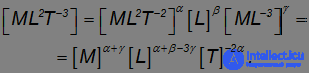
Solving the system of equations
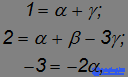
we find

that is, the sought power of the helicopter engine will be
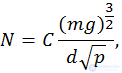
where C — is some numerical coefficient.
Let us now solve this same problem exactly. Let  — be the speed of the air jet thrown down by the rotor. In a time
  the air particles travel a distance
  . In other words, in a time the helicopter's rotor imparts speed to all the air particles contained in a cylinder with base area
  and height
  . The mass of air
  in this volume equals
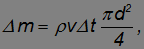
and its kinetic energy  is given by the expression
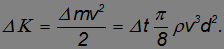
Since the motor transfers kinetic energy to the air, such is also the work it performs. Therefore the power developed by the motor (without accounting for power losses in all the transmissions along the way from the engine to the rotor) equals
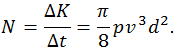
In this expression we still need to find the speed of the air jet thrown down by the rotor. The momentum  imparted to the air particles in a time equals
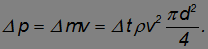
From Newton's second law it follows that the average force acting on the air being thrown downward equals  . By Newton's third law the same force acts on the helicopter from the air. This force compensates for the weight of the helicopter:

From this we obtain the equation
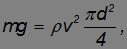
which allows us to find the speed of the air jet:

Substituting the speed we found into the expression for the power of the helicopter's engine, we obtain the final result:
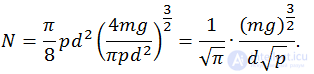
We see that the expression for power indeed turned out to be exactly as expected on the basis of dimensional analysis. Substituting the numerical data, we find

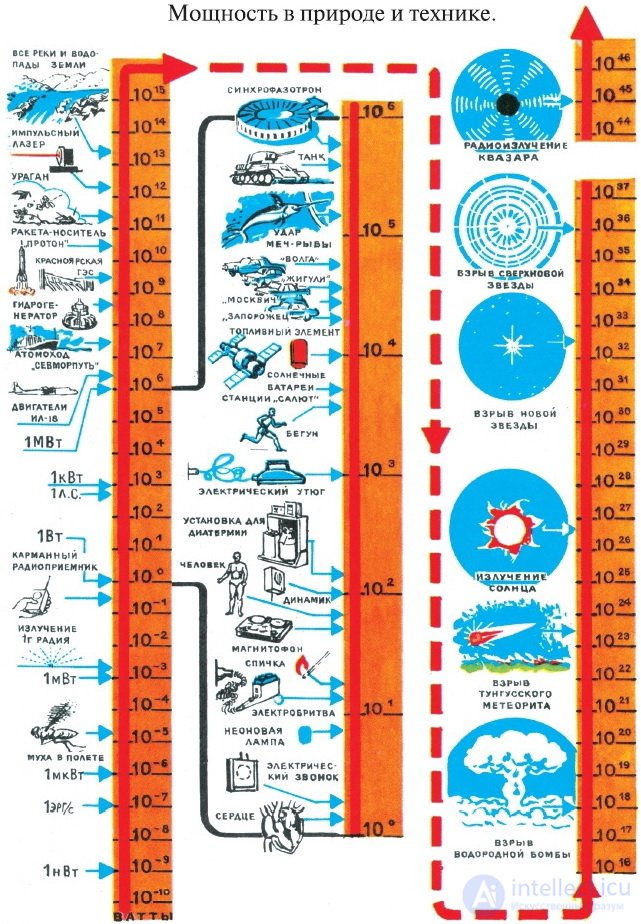
Fig.4.5. Power in nature and technology
Above we already obtained the expression for the work done when stretching a spring. Let us consider the following system. An unstretched spring lies on a smooth horizontal plane, one end fixed, and a mass m attached to the other. Let us place the origin of the coordinate axis at the point where the free end of the spring is located. We pull the spring back a distance xmax and release the mass with no initial velocity. What is the motion of the mass?
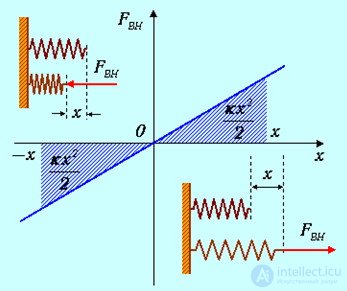
Fig 4.6. Work done when the length of a spring changes.
In the horizontal plane, only the elastic force of the deformed spring acts on the mass, tending to return it to the origin (the equilibrium position). Under the action of this force the mass sets into motion. If its coordinate at some moment in time equals x, then at that moment the elastic force  acts on the mass from the spring. Therefore the equation of motion of the mass has the form

Let us multiply both sides of the equation by the velocity of the mass

The product on the left-hand side can be represented in the form of a derivative
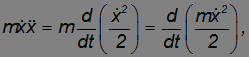
and the product on the right-hand side — in the form of a derivative
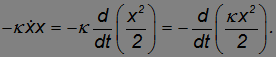
Therefore the equation of motion of the mass can now be written in the form
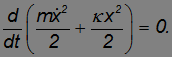
Since the derivative of the expression in brackets equals zero, this expression itself does not depend on time — it is constant (it retains its initial value):
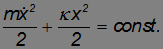
No matter how the mass on the spring moves, the sum of the two terms written out does not change. In the first term we recognize the kinetic energy of the mass, and in the second — the work done in stretching (compressing) the spring by a distance x. By doing this work, we store the energy of elastic deformation of the spring (it is called potential energy). At any moment in time the mass has some kinetic energy, and the spring — potential energy.
The sum of the kinetic and potential energies is called the total mechanical energy E of the system.
We find the value of the integration constant in the expression for the total mechanical energy of the system “mass — spring” by recalling the initial conditions: at t = 0 we released the mass with no initial velocity v(0) = 0 at a distance x(0) = xmax from the origin. From this the total mechanical energy of the system will equal
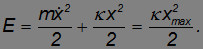
At the initial moment of time the kinetic energy of the mass equals zero, and the total energy of the system equals the work that we initially performed in stretching the spring by a distance xmax. Then the mass moves toward the origin with increasing speed. At the moment of passing through the equilibrium position (x = 0) the potential energy of the spring equals zero, and consequently the kinetic energy reaches its maximum. The mass passes through the equilibrium position, the elastic force changes sign and begins to decelerate it. The velocity of the mass becomes zero at x = –xmax, when the total energy of the system again consists solely of the potential energy (this time of the compressed) spring. Further, the process of "pumping" potential energy into kinetic energy and back repeats.
In this particular example we noted that

Potential force field. Let us now generalize our particular case. Suppose that at every point of space a particle is acted on by a definite force F (r,t), depending only on the position of the particle and, possibly, on time. Since the acting force does not depend on the motion of the particle, we can regard it as an attribute of space. In this case we say that a force field is defined in space. For example, we can regard the Earth's gravitational field as an external force field with respect to such bodies moving in this field as people, cars, trains, airplanes, satellites, water in rivers, clouds in the sky, and so on, for the simple reason that their motion has no effect whatsoever on the characteristics of this field. This is obviously due to the size of the Earth.
Video 4.1. Ballistic pendulum — a two-stage process demonstrating conservation of momentum in the first stage and conservation of total mechanical energy in the second stage.
Among force fields we shall single out potential fields, which can be described by a certain scalar function

such that

Here Fx, Fy, Fz are the projections of the force onto the directions of the axes of some Cartesian coordinate system, and its expansion in the basis has the form

As will become clear later, the connection between potential energy and force turns out to be genuinely useful when the function P does not depend on time. Only this case will be considered throughout the entire course.
The expression for the force vector can be written more compactly. For this, the operation gradient is introduced — a kind of “vector” differentiation of a function (not to be confused with simply differentiating a vector, for example with respect to time):

The minus sign placed in front has nothing to do with the “gradient” operation itself and is present in the expression for the force vector for the sake of convenience (see the example with the spring above and the text below). Applying the “gradient” operation (grad) to a scalar field (a scalar function of coordinates) generates a vector field. It is clear that calculations of motion in potential fields ought to be simpler, if only because instead of three functions (the projections of the force) we will be dealing with only a single function P(x,y,z)..
Let us consider a stationary potential force field (that is, a potential field P(x,y,z) not explicitly depending on time). Let us find the elementary work of the field forces during a displacement ds:
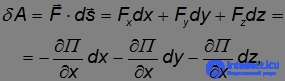
that is, the elementary work

is represented as the total differential of the function P taken with the opposite sign. On the other hand, since the work equals the increment of the kinetic energy of the body

we obtain from this

or
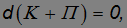
that is, the sum

is conserved. Thus, for stationary potential fields all the conclusions we drew when considering the particular case of the mass on the spring hold. It follows that the scalar function P (r), describing such a field, is nothing other than the potential energy of the particle in this force field.
Conservative forces. Let us integrate the relation we obtained

along the trajectory of the body and obtain an important property of stationary potential fields:
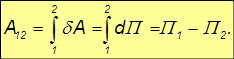
Here P1 = P(r1) and P2 = P(r2) — are the values of the potential energy at the initial r1 and final r2 points of the displacement. The relation connecting the work of the force and the change in the potential energy of the body means that
The work A12, done on a particle by the forces of a stationary potential field, does not depend on the shape of the particle's trajectory of motion and is determined only by its initial and final position in space.
The forces of a stationary potential field are called conservative.
If the work of the field forces is positive (the particle moves under the action of the field forces), then its potential energy decreases: P2 < P1. If, however, the work of the field forces is negative (for example, an external force compels the particle to move against the field forces), then the potential energy of the particle increases. In stretching the spring in our example, we did work against the elastic forces and increased the potential energy of the system.
The work of a conservative force, when the point of its application moves along a closed path, equals zero.
Indeed, in this case the initial and final points coincide, P2 = P1 and A12 = 0. Let us show this in more detail. Consider two arbitrary points 1 and 2 and two arbitrary paths I and II connecting them (Fig. 4.7).
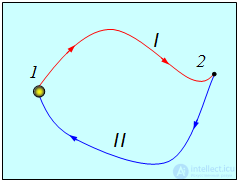
Fig 4.7. Work done when a body moves along a closed contour
Let the force field be conservative, that is, the work along these paths coincides:

Let us now move the body from point 1 to point 2 along path I, and then — from point 2 to point 1 along path II. The total work done along the closed contour equals the sum

Let us compare the work along path II, traversed in the forward and reverse directions. At each point of the path the same forces act, but reversing the direction of motion replaces ds with –ds. Thus, the sought work equals

Taking into account the relations obtained, we rewrite the expression for the work along the closed contour in the form

We have proved the equivalence of the statements that 1) the work of conservative forces does not depend on the shape of the trajectory and 2) the work of such forces when traversing a closed contour equals zero.
So, a stationary potential field is conservative. But the converse is also true: a conservative field is potential. Let us show this. We take an arbitrary point r0 and assign at this point an arbitrary value of the potential energy P(r0). When passing from the point r0 to any other point r, work A01 is done, which does not depend on the path of transition. Therefore we can define the function P for every point by the equality

Let us emphasize once again: it is possible to define the function P at every point of space only as a consequence of the independence of the work from the path. Otherwise, in passing from point r0 to point r, we would obtain different results, and the function P would be multivalued (more precisely, continuously infinitely-valued).
Let us apply the expression obtained for a neighboring point r+dr:

We represent the work of displacement from point r0 to point r+dr as the sum of the works of displacement from r0 to r and from r to r+dr:

(again using the independence of work from the path). Carrying out the transformations, we obtain

On the left stands the increment –dΠ, and on the right — the elementary work  A. The relation obtained
entails, as we have seen, the conservation of the quantity K+Π, that is, the function Π we introduced is indeed the potential energy of the system. Thus, the field of conservative forces is potential.
One should not think that all fields in nature are potential, and all forces conservative. For example, friction or drag forces are always directed against the displacement and, consequently, have the same sign along the entire trajectory of the body. When summing the elementary works over a closed path, we do not obtain zero: the work will depend on the length of the path traveled. This means these forces are not conservative.
The arbitrary constant Π(r0) appearing in the formula for the change in potential energy plays no role, since what is physically observable is the change in potential energy, not its absolute value. Often, when possible, a point at infinity is chosen as r0, and the value of the potential energy at it is taken to be zero. But this choice is not always possible, as demonstrated in the following section.
Constant uniform field of gravity. Near the surface of the Earth all bodies fall with constant acceleration g, directed toward the center of the planet. If we consider motion in a region whose linear dimensions are much smaller than the radius of the Earth, the Earth's surface can be considered flat. In this approximation the gravitational field is uniform: the forces acting on a body have the same direction and magnitude F = mg at every point. Let us show the potential nature of the gravitational field near the Earth's surface (Fig. 4.8).
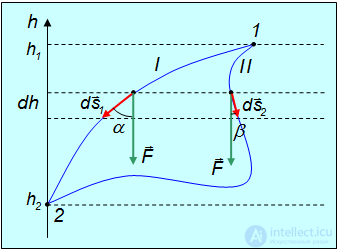
Fig. 4.8. Finding the potential energy of the gravitational field
The elementary work for displacement ds equals

where –dh — is the projection of the displacement onto the direction of action of the force, that is, dh — is the change in the height of the body. The total work for displacement of the body from point 1 to point 2 equals
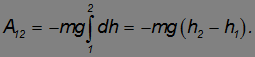
Thus, in the gravitational field the work does not depend on the path along which the particle moves, but is determined only by the initial and final positions of the particle in space. Accordingly, the potential energy in the gravitational field is found, in accordance with the general recipe, as

If we measure the height from the Earth's surface, assigning zero potential energy to the point on the surface Π(h0 = 0) = 0, then for an arbitrary height h we obtain the well-known formula
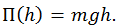
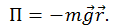
Or in vector form
|
|
(4.4.1) |
In the last formula the position vector  starts at any point lying on the Earth's surface, and the potential energy on the Earth's surface, as before, is taken to be zero.
Example. Starting from the equations of motion, show the conservation of the total energy of a body moving in a uniform gravitational field.
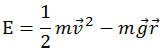
Solution. Taking (4.4.1) into account, we write the total mechanical energy of the body as
|
|
(4.4.2) |
The conservation over time of some quantity means that the total time derivative of this quantity is equal to zero at any moment in time. And conversely, if the total time derivative of some quantity is identically equal to zero (at any moment in time), then this quantity is conserved. Let us compute the total time derivative of the mechanical energy from (4.4.2):
|
|
(4.4.3) |
In obtaining (4.4.3) it was taken into account that  and, according to the equation of motion, the acceleration
Video 4.2. Galileo's pendulum — a demonstration of the conservation of total mechanical energy during motion in a uniform gravitational field.
Central force field
A central force field (a centrally symmetric force field) is one in which the force at every point is directed along the position vector, which starts at the center of symmetry of the field, and the magnitude of the force depends only on the distance to this center.
Another example. Let us compute the work of an arbitrary central stationary force during displacement of its point of application from some arbitrary point in space 1, located at a distance r1 from the center of the field, to some arbitrary point 2, located at a distance r2 from the center of the field. The derivation reproduced below shows that the trajectory of displacement of the point of application of the force can be arbitrary — the result does not depend on its shape.
The general form of a central force is as follows
|
|
(4.4.4) |
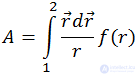
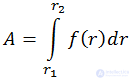
Here the position vector starts at the center of the field. Examples are the field of a point electric charge located at the origin, or the gravitational field of a spherically symmetric object centered at the origin. Substituting (4.4.4) into the general definition of work, we obtain:
|
|
(4.4.5) |
A curvilinear integral of the form (4.4.5) is easily turned into an ordinary integral with the help of the very useful identity (4.4.6) below. Differentiating the definition of the square of the modulus of a vector

and dividing by two we have for any vector:(4.4.6)
|
|
(4.4.6) |
That is, the scalar product of a vector with its increment equals the product of the modulus of this vector by the increment of its modulus. Replacing in (4.4.5) the scalar product  with the ordinary product rdr and dividing by r, we obtain
|
|
(4.4.7) |
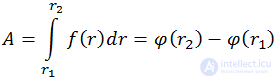
If the function φ(r) is the antiderivative of f(r), then finally we have:
|
|
(4.4.8) |
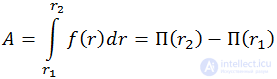
From formula (4.4.8) it is evident that the value of the work is determined only by the position of the initial and final points and indeed does not depend on the shape of the trajectory of displacement of the point of application of the force. It is often said more briefly: the work does not depend on the path. The work turned out to be equal to the increment of the antiderivative φ(r), so it is inconvenient to identify it with the potential energy: it would turn out that when positive work is done, the function f(r) also grows. The potential energy is introduced as Π = –φ(r), then, when positive work is done, the potential energy decreases, and one can also say: the work is done at the expense of the decrease in the potential energy of the body in the force field. Then
|
|
(4.4.9) |
The computation of the integral with the help of identity (4.4.6) is illustrated by the following figure
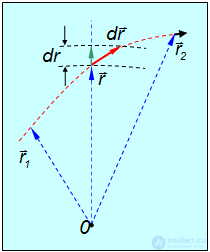
Fig. 4.8. Work of a central force
Setting the potential energy at the point with position vector  equal to
  , for its value at an arbitrary point with position vector , we obtain
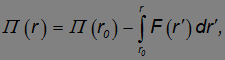
Let us show that the operation “gradient”, applied to the potential energy Π(r), indeed gives us a field of central forces, directed along the position vector and with modulus F(r). Let us take the derivative of Π(r) with respect to the coordinate x as the derivative of a composite function:
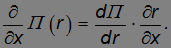
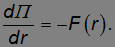
The derivative with respect to r is computed without difficulty from the formula for the potential energy:
The derivative of r with respect to x equals

Thus,
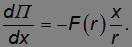
Similar expressions are obtained by differentiating with respect to the coordinates y, z. As a result
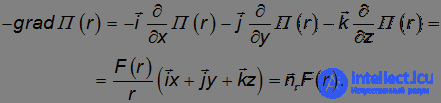
We have confirmed that the original central force field is recovered from the potential energy function:
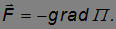
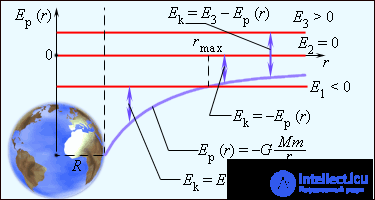
Fig.4.9. Potential of the Earth's gravitational field.
Speaking of central forces, we are also using a certain abstraction. What does the force center, toward which (or from which) the force field is directed, mean? We assume that the center is stationary, but in reality it is formed by some physical bodies — charges in the case of an electric field, masses in the case of a gravitational one. Simply, under certain conditions, the motion of the center can be neglected. Say, when studying the motion of a satellite around the Earth, we should, strictly speaking, take into account that the satellite and the Earth move around a common center of mass. But the mass of the Earth greatly exceeds the mass of the satellite, the center of mass of the system practically coincides with the center of the Earth, and it can be considered a stationary center of the gravitational field.
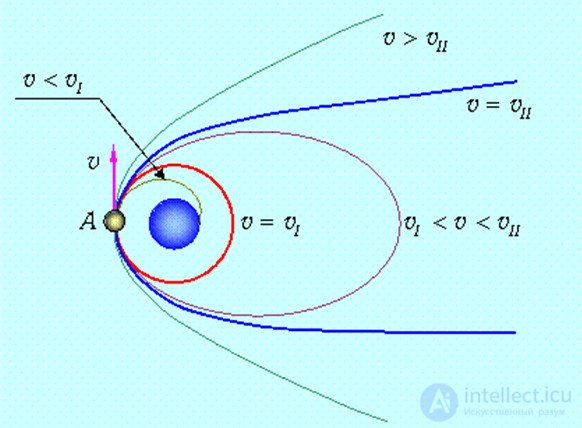
Fig.4.10. Dependence of the shape of the trajectory on the initial speed of the body.
If such an assumption cannot be made, then one considers the interaction forces between bodies. When the forces are directed along the line connecting the bodies, and their magnitude depends only on the mutual distance
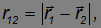
we are dealing with an analog of central forces. Here too one can introduce the potential energy of interaction of the bodies with each other Π(r12), so that the force F12 between bodies 1 and 2 satisfies the relation

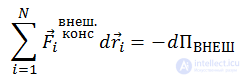
Let us consider a system of N point particles with masses m1, m2, ..., mN. Suppose that on the particle numbered i there act: 1) the total internal conservative force  , 2) the total internal non-conservative force
  , 3) the total external conservative force
  , and 4) the total external non-conservative force
  . Then the equation of motion of the i-th particle has the form (4.5.1)
|
|
(4.5.1) |
Let us multiply both sides of equation (4.5.1) by the elementary displacement

and sum all the equations for particles numbered i = 1, ..., N. In doing so, let us take into account that
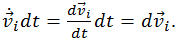
We obtain
|
|
(4.5.2) |
Let us consider each term in this equation separately. On the left-hand side stands the quantity
|
|
(4.5.3) |
which is obviously the increment of the total kinetic energy K of the particles of the system.
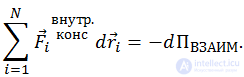
The first term on the right-hand side of (4.5.2) is the total work of all internal conservative forces. The second term is the total work of all external conservative forces. By virtue of the conservativeness of the forces, both terms can be represented as the decrease of the corresponding potential energy. In the first case — internal — conservative forces, as the decrease of the potential energy of interaction of the bodies of the system:
|
|
(4.5.4) |
In the second case — external — conservative forces, as the decrease of the potential energy of the system in the external conservative force field
|
|
(4.5.5) |
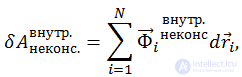
The third and fourth terms represent the total work of the internal and external non-conservative forces and therefore cannot be represented as the decrease of some scalar function of coordinates alone, for the simple reason that no such function exists. Let us introduce the following notations for these terms: the elementary work of all internal non-conservative forces
|
|
(4.5.6) |
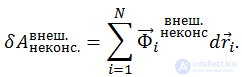
and the elementary work of all external non-conservative forces
|
|
(4.5.7) |
Let us move (4.5.4) and (4.5.5) to the left and use the notations (4.5.6) and (4.5.7), then equation (4.5.2) takes the form.
|
|
(4.5.8) |
The sum standing on the left-hand side under the differential sign is, by definition, the total mechanical energy of the system.
|
|
(4.5.9) |
Thus, finally we obtain the relation, which can be called the theorem on the increment of total mechanical energy:
|
|
(4.5.10) |
which states: the increment of the mechanical energy of a system equals the total work of all non-conservative forces, both internal and external.
As follows from (4.5.10), if the system is closed, then the increment of its mechanical energy equals the work of the internal non-conservative forces. That is, the mere fact of the system being closed (the absence of external forces) is not sufficient for the mechanical energy to be conserved. What is sufficient is the complete absence — both among external and among internal — of non-conservative forces.
Thus, the law of conservation of mechanical energy states:
In the absence of non-conservative forces, the total mechanical energy of a system is conserved:

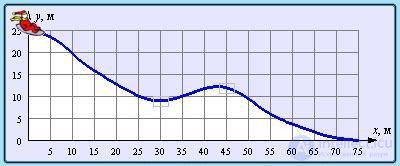
Fig.4.11. The acceleration of a point particle is equal to zero at points of extrema of the potential energy.
Hence the name: conservative (to conserve — to keep, protect, preserve, conserve) forces are forces under whose action mechanical energy is conserved/
The law of conservation of mechanical energy of a closed system can be formulated as follows:
In the absence of non-conservative forces inside a closed system, the total mechanical energy of the closed system is conserved:

There is a clear difference between the law of conservation of mechanical energy of a closed system and the law of conservation of momentum of a closed system: the momentum of a closed system is conserved regardless of the nature of the forces acting inside the system, while the mechanical energy of a closed system is conserved only when there are no non-conservative forces inside the closed system. This is easy to understand. The mechanical momentum of a system
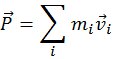
this is all the momentum there can possibly be — no other momentum exists. But the mechanical energy of a system ( ) is not all of its energy — it does not account for the internal (thermal, chemical, etc.) energy of the bodies making up the system. Non-conservative forces are precisely what convert mechanical energy into internal energy, or vice versa, internal energy into mechanical energy. Let us emphasize that the mechanical energy of a closed system, as a result of the action of non-conservative forces within it, can not only decrease but also increase. For example, during the explosion of a flying shell, the total kinetic energy of its fragments and of the powder gases formed during the explosion is greater than the kinetic energy of the shell (together with the powder inside it) immediately before the explosion. To make this quite obvious, let us switch to the frame of reference in which the shell is at rest immediately before the explosion (the frame of its center of mass). All parts of the shell are stationary, so the total kinetic energy is zero. After the explosion, the fragments of the shell and the powder gases are moving — the kinetic energy is greater than zero and equals the energy released during the combustion of the powder.
The law of conservation of energy is all-encompassing insofar as the postulate of the homogeneity of time for a closed system is universal, and the general definition of energy is as follows: energy is the conserved characteristic of a closed system, whose conservation is due to the homogeneity of time. So far we — in this textbook — have dealt only with mechanical energy, but there are other forms of it as well, including, without doubt, ones still unknown to us (to humanity). For example, quite recently astrophysicists discovered the presence of a certain kind of matter, which they called “dark matter”. As of today (early 2010) it is known about it only that it is subject to gravitational attraction. If it is found that in some physical process energy is not conserved, we look for a new form of energy in order to ensure its exact balance. In doing so, we are by no means “cheating” or making a dishonest attempt to conceal a lack of our knowledge of nature. This is how scientists “invented” thermal, electromagnetic, nuclear, and other forms of energy. One of the founders of the theory of relativity, Henri Poincaré, wrote: “Since we are unable to give a general definition of energy, the law of conservation of energy should be regarded simply as an indication that there exists “something” that remains constant (in any physical process). Whatever discoveries future experiments may lead us to, we know in advance that there will then, too, be “something” possessing the ability to be conserved, and this something we will most likely be able to call energy”.
The law of conservation of energy allows us to analyze the general regularities of motion if the dependence of the potential energy on the coordinates is known. Let us consider, as an example, one-dimensional motion of a point particle (particle) along the axis 0x in the potential field shown in Fig. 4.12.
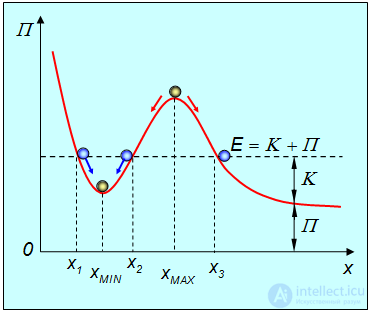
Fig.4.12. Motion of a particle near positions of stable and unstable equilibrium
Since in a uniform gravitational field the potential energy is proportional to the height of the body's rise, one can imagine an icy slide (neglecting friction) with a profile corresponding to the function Π(x) in the figure.
From the law of conservation of energy E = K + Π and from the fact that the kinetic energy K = E - Π is always non-negative, it follows that the particle can only be located in regions where E > Π. In the figure, a particle with total energy E can move only in the regions

In the first region its motion will be bounded (finite): with the given store of total energy, the particle cannot overcome the “hills” on its path (they are called potential barriers) and is doomed to remain forever in the “valley” between them. Forever — from the point of view of classical mechanics, which we are studying now. At the end of the course we will see how quantum mechanics helps a particle escape confinement in a potential well — the region

In the second region the motion of the particle is unbounded (infinite), it can move arbitrarily far away from the origin to the right, but on the left its motion is still bounded by a potential barrier:

Video 4.6. Demonstration of finite and infinite motion.
At the points of extremum of the potential energy xMIN and xMAX the force acting on the particle is equal to zero, because the derivative of the potential energy is equal to zero:
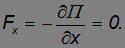
If a particle at rest were placed at these points, it would remain there ... again forever, if not for fluctuations in its position. In this world there is nothing strictly at rest, a particle can experience small deviations (fluctuations) from the equilibrium position. In doing so, forces naturally arise. If they return the particle to the equilibrium position, such equilibrium is called stable. If, however, when the particle is displaced the arising forces move it even further away from the equilibrium position, then we are dealing with unstable equilibrium, and the particle usually does not stay long in such a position. By analogy with the icy slide one can guess that the position at the minimum of the potential energy will be stable, and at the maximum — unstable.
Let us prove that this is indeed so. For a particle at the extremum point xM (xMIN or xMAX) the force acting on it Fx(xM) = 0. Suppose that, owing to a fluctuation, the coordinate of the particle changes by a small amount  x. With such a change in coordinate, a force begins to act on the particle

(the prime denotes the derivative with respect to the coordinate x). Taking into account that Fx=-Π', we obtain for the force the expression

At the minimum point the second derivative of the potential energy is positive: U"(xMIN) > 0. Then for positive deviations from the equilibrium position x > 0 the arising force is negative, and for x<0 the force is positive. In both cases the force opposes the change in the coordinate of the particle, and the equilibrium position at the minimum of the potential energy is stable.
Conversely, at the maximum point the second derivative is negative: U"(xMAX)<0. Then an increase in the coordinate of the particle Δx leads to the appearance of a likewise positive force, which further increases the deviation from the equilibrium position. For x<0 the force is negative, that is, in this case too it promotes further deviation of the particle. Such an equilibrium position is unstable.
Thus, the position of stable equilibrium can be found by jointly solving the equation and the inequality
Video 4.7. Potential wells, potential barriers and equilibrium: stable and unstable.

Example. The potential energy of a diatomic molecule (for example, H2 or O2) is described by an expression of the form
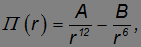
where r — is the distance between the atoms, and A, B — are positive constants. Determine the equilibrium distance rM between the atoms of the molecule. Is the diatomic molecule stable?
Solution. The first term describes the repulsion of the atoms at small distances (the molecule resists compression), the second — attraction at large distances (the molecule resists rupture). In accordance with what has been said, the equilibrium distance is found by solving the equation

Differentiating the potential energy, we obtain
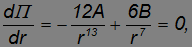
whence
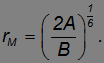
Let us now find the second derivative of the potential energy
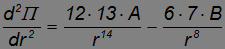
and substitute into it the value of the equilibrium distance rM :
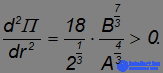
The equilibrium position is stable.
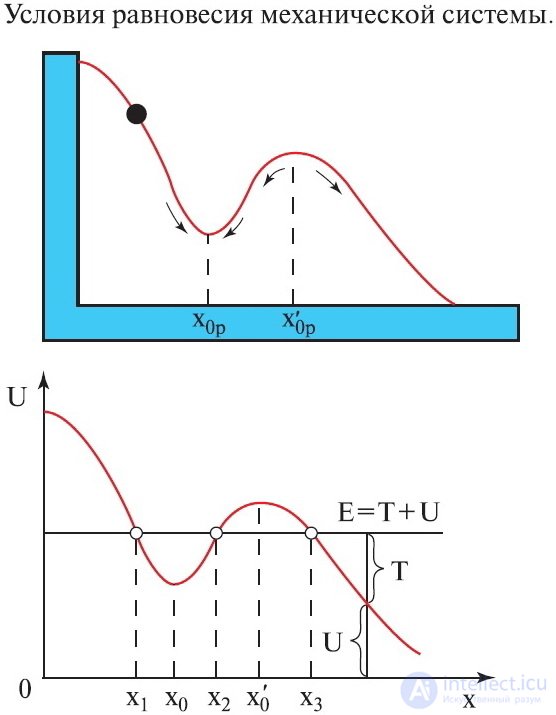
Fig. 4.13 presents an experiment on the study of potential curves and the equilibrium conditions of a ball. If, on a model of the potential curve, a ball is placed at a height greater than the height of the potential barrier (the ball's energy is greater than the energy of the barrier), the ball overcomes the potential barrier. If the initial height of the ball is less than the height of the barrier, the ball remains within the potential well.
A ball placed at the highest point of the potential barrier is in unstable equilibrium, since any external action leads to the ball transitioning to the lower point of the potential well. At the lower point of the potential well the ball is in stable equilibrium, since any external action leads to the ball returning to the lower point of the potential well.
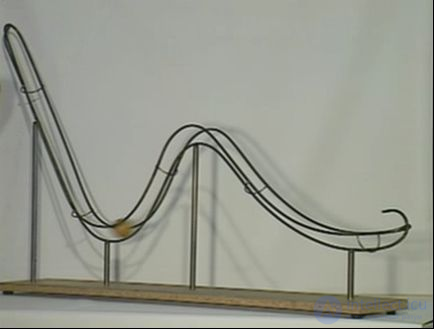
Fig. 4.13. Experimental study of potential curves
Let us first give examples of order-of-magnitude estimation problems, where an exact solution is not required, but only a more or less adequate estimate of the order of magnitude.
Example 1. A nail was driven in with five hammer blows. Estimate what force must be applied to pull the nail out.
Solution. Let m — be the mass of the hammer, and  — its speed at the moment of impact. For the estimate we can assume that the entire kinetic energy of the hammer is transferred to the nail. For n blows this energy is equal to

The nail's energy is spent overcoming the friction force F as the nail enters the wall: as the nail is driven a distance l, the work done is

From the equality A = K we find

This same force resists pulling the nail out. For a numerical estimate let us take reasonable input data: m = 1 kg, v = 5 m/s, l = 5 cm. We then obtain:
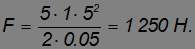
This force is roughly equivalent to the weight of a mass of 130 kg.
In this solution we neglected the energy losses to heating the hammer, the nail and the wall, but our task was only to obtain an estimate, not an exact solution.
Example 2. Estimate the power of heat release during emergency braking of a truck.
Solution. Let m — be the mass of the truck, which was moving at speed . The kinetic energy of the truck before braking is equal to

after — to zero. The difference between these kinetic energies is converted into heat:

The average speed of the truck during braking can be taken equal to /2. If the braking distance is l, then the time elapsed before the truck stops is

From this we find the power of heat release:
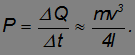
For a numerical estimate let us take: m = 10 t, v = 72 km/h, l = 20 m. Then we find:

Let us now give examples of the combined use of the conservation laws of momentum and energy in studying the collision of two bodies. During a collision the bodies undergo deformation. In doing so, the kinetic energy that the bodies possessed before the impact is partially or fully converted into the potential energy of elastic deformation and into the internal energy of the bodies. An increase in the internal energy of the bodies leads to a rise in their temperature. There are two limiting types of collision: perfectly elastic and perfectly inelastic.
A perfectly elastic collision is one in which the mechanical energy of the bodies is not converted into other forms of energy.
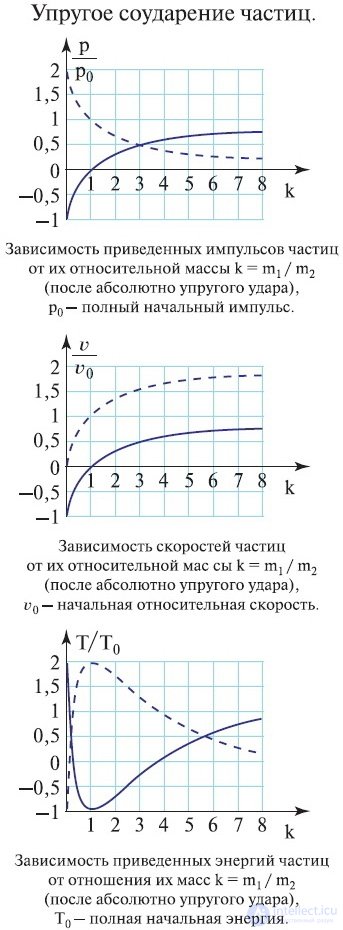
In such a collision the kinetic energy is converted fully or partially into the potential energy of elastic deformation. The bodies then return to their original shape, pushing each other apart, and fly apart with speeds whose magnitude and direction are determined by two conditions — conservation of the total energy and conservation of the total momentum of the two-body system.
Video 4.9. Elastic collision of carts. “Exchange of velocities” when the masses of the elastically colliding bodies are equal.
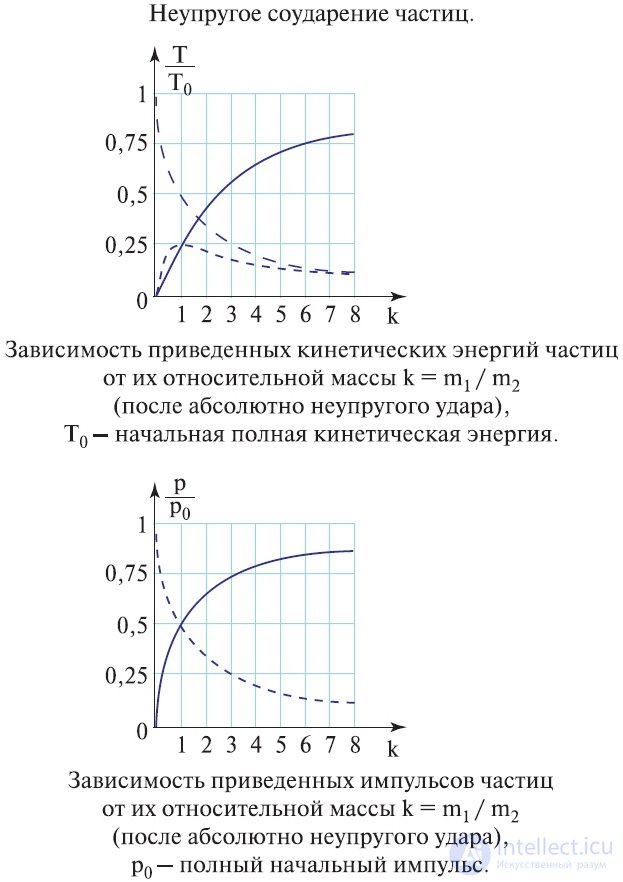
A perfectly inelastic collision is characterized by the fact that no potential energy of elastic deformation arises: the kinetic energy of the bodies is fully or partially converted into internal (thermal) energy.
After a perfectly inelastic collision the colliding bodies join together and either move with the same velocity or remain at rest.
In a perfectly inelastic collision of bodies only the law of conservation of momentum operates; mechanical energy is not conserved, being converted into thermal (internal) energy, so the law of conservation of total energy — mechanical and internal — holds.
Let two colliding balls form a closed system. Let us first consider a perfectly inelastic collision (fig. 4.16).
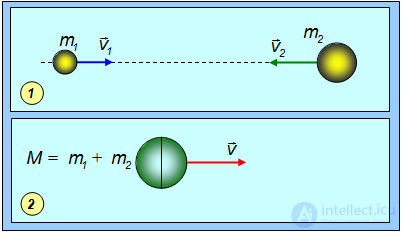
Fig. 4.16. Perfectly inelastic collision of two balls: 1 — state before impact; 2 — state after impact
The initial velocities of the balls are 1 and 2, and their masses are m1 and m2 the final velocity of the balls — . During the collision the law of conservation of momentum holds:

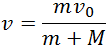
from which we find the velocity of the resulting composite particle
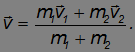
As expected, the joined balls continue to move after the collision at the velocity of the centre of mass of the system before the collision.
The energy that is converted into the internal energy of the balls in this process equals the difference between the kinetic energies before and after the collision:

where 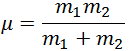 — is the so-called “reduced mass” of the balls, and
  — is the relative velocity of the balls before impact, namely: the velocity before impact of the second ball (
  minus
minus  ) relative to the first. From this it is clear that Q equals the kinetic energy of the relative motion of the balls before impact. Only this part of the total kinetic energy of the balls before impact can be fully converted into thermal (internal) energy. Therefore a perfectly inelastic collision can also be defined as follows: in a perfectly inelastic collision the entire energy of relative motion is converted into thermal (internal) energy.
Video 4.10. Perfectly inelastic collision of balls in the centre-of-mass frame and in the laboratory frame of reference.
Example 3. Artillerymen fire so that a cannonball hits an enemy camp located at a distance of l0 = 7.2 km from the cannon. At the moment the cannonball leaves the muzzle, Baron Munchausen jumps onto it (a perfectly inelastic collision), his mass being n = 5 times greater than the mass of the cannonball. Because of this the cannonball falls short of the target. What distance will the baron have to walk to reach the enemy camp? Neglect air resistance.
Solution. If the cannonball left the muzzle at speed 0, then after the baron jumps onto it its speed becomes equal to

where m — is the mass of the cannonball, and M — is the mass of Munchausen. Using the formulas of topic 2.7, the artillerymen calculated the elevation angle  of the gun by the formula
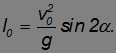
Since the speed changed but the angle remained the same, the range will be

So the baron will have to walk a distance

In other words, the baron managed to fly on the cannonball only 200 m.
Now let us consider a perfectly elastic collision. We will limit ourselves to the case of a central collision of two homogeneous balls. A collision is called central if the velocity vectors of the centres of the balls before impact are directed along the line passing through the centres of the colliding balls (fig. 4.17).
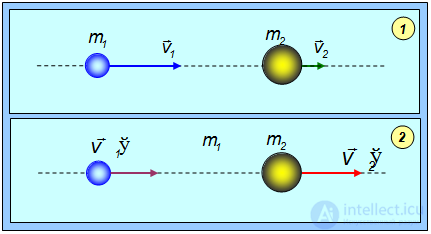
Fig. 4.17. Perfectly elastic central collision of two balls: 1 – state before impact; 2 – state after impact
We treat the balls as point particles, that is, we neglect their possible rotation. As in the previous case, we also neglect friction against the surface on which the balls move. Let us write the equations for the conservation of mechanical energy and momentum.
In the case of a central collision under consideration, the velocities of the balls after the collision will be directed along the same line along which the centres of the balls moved before the collision. Therefore the velocity vectors can be replaced by their projections onto the line of collision:
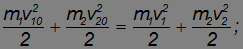

where m1 and m2 — are the masses of the balls, v10 and v20 — the velocities of the balls before impact and v1 and v2 — the velocities of the balls after impact (the velocities are understood in the algebraic sense: the sign indicates the direction of motion along the line of collision).
Let us transform the equations of conservation of energy and momentum to the form:


We will consider the expressions on the left- and right-hand sides of the equations to be nonzero (otherwise v10 = v1 and v20 = v2 — the velocities of the balls would not have changed, that is, no collision occurred). Let us divide the first equation by the second, after which we obtain:

Let us multiply the resulting equation by m2 and subtract from it the transformed equation of conservation of momentum. We find:
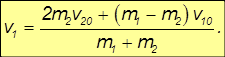
Similarly, let us multiply the resulting equation by m1 and add to it the transformed equation of conservation of momentum. We obtain:
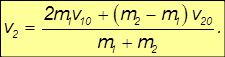
Unlike an inelastic collision, here the velocities of the balls after the collision cannot be equal. Indeed, if v1 = v2, then from the resulting expressions for the velocities of the balls after impact it follows that before the collision the velocities were also equal, v10 = v20. But in that case the collision could not occur. In a central collision the balls will collide if they are moving toward each other or if one ball is catching up with the other.
Analysis of the resulting relations
1. If the second ball was initially at rest (v20 = 0), then after the collision the velocities of the balls are determined by the relations

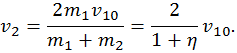
Here η = m2/m1 — is the ratio of the masses of the colliding balls. Note that for a given speed of the incoming ball before the collision, the velocities of the balls after the collision are determined exclusively by the ratio of the masses of the balls.
The sign of the velocity v2 coincides with the sign of v10: the ball that was at rest will necessarily begin to move in the direction of motion of the incoming ball. The sign of the velocity v1 depends on the ratio of the masses of the balls: if the ball that was at rest is more massive, then the incoming ball will bounce back in the opposite direction; if the incoming ball is more massive, it will continue moving in the same direction. If the masses are equal, the incoming ball will stop.
Let us consider two limiting cases:
Then

(that is, the heavy ball remains stationary) and

(the light ball bounces back at the same speed in the opposite direction).
Then

(the heavy ball does not change its speed) and

2. If the masses of the balls are equal (m1 = m2 or η=1), then from the formulas obtained for the velocities of the balls after the collision it follows that

that is, the balls exchange velocities upon collision. We encountered a special case of this phenomenon above: before the collision ball 2 was at rest, after — ball 1.
3. If both balls are moving, but the mass of one ball is much greater than the mass of the other (m2>>m1), then

In other words, the massive ball does not "notice" the collision with the light ball and continues to move at its previous speed. The speed of the light ball, however, changes. We have obtained a combination of the previously obtained results.
The laws of collisions between balls are illustrated using an interactive computer model (fig. 4.18).
Fig. 4.18. Investigating the laws of ball collisions using an interactive computer model
Let there be a row of identical touching elastic balls. An identical ball moving at speed v0 collides with the ball at the end of the row (fig. 4.19). As a result of the collision it stops, and the last ball in the row starts moving at the same speed v0.
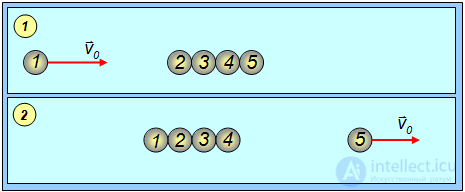
Fig 4.19. Elastic collision of a ball with several stationary balls: 1 – position before collision; 2 – after collision
This phenomenon is explained by the fact that in the collision of balls 1 and 2, ball 1 stops, and ball 2 acquires speed v0. Ball 2 immediately collides with ball 3 and stops, and so on.
Let two identical balls moving at speed v0 each strike a stationary row of identical balls (fig. 4.20).
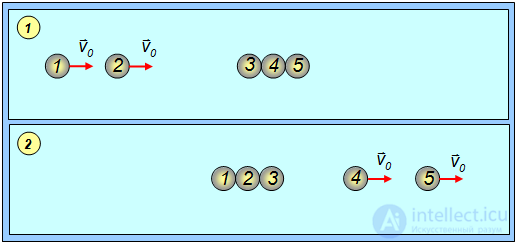
Fig 4.20. Elastic collision of two balls with several stationary balls: 1 – position before collision; 2 – after collision.
First, when ball 2 collides with ball 3, ball 2 stops, and ball 3 acquires speed v0, passing it on to ball 4 and so on. Immediately after this, ball 1 collides with ball 2, stops, passing its speed to ball 2, and the process repeats. As a result, all the balls except the last two, which move at speeds v0, remain stationary.
Central elastic collisions in a chain of identical balls are demonstrated in fig. 4.21.
Fig. 4.21. Central collisions in a chain of identical balls
Here all the balls are suspended on long threads, and the problem reduces to studying their pairwise collisions. In this case the outermost balls will alternately bounce back with the same speed and deflect on their threads through equal angles, while all the other balls between them remain at rest.
Video 4.11. Non-central elastic collision of balls of equal mass. The effect of the balls spinning after impact.
Acquaintance with specific examples allows us to formulate some important general propositions. Not all of them follow, it is true, from what has been said above, but this is not surprising: the very concept of energy is far broader than its manifestation in mechanics, and we are only beginning to become acquainted with it. So:
We have already said that the conservation laws of energy and momentum are connected with the homogeneity of time and space, respectively. But three-dimensional space, unlike one-dimensional time, has yet another symmetry. Space is isotropic, there are no preferred directions in it. Connected with this symmetry is the law of conservation of angular momentum. This connection will manifest itself in the fact that angular momentum, as we shall see later, is one of the fundamental quantities describing rotational motion.
The angular momentum L of an individual particle equals the vector product of the particle's position vector r and its momentum p:

The direction of the vector L is determined by the right-hand (corkscrew) rule, and its magnitude equals
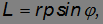
where  — is the angle between the vectors r and p. The quantity l = r
  equals the distance from the origin 0 to the line along which the particle's momentum is directed. This quantity is called the lever arm of the momentum (fig. 4.22). The vector L depends on the choice of origin, so when speaking of it one usually specifies: “angular momentum relative to point 0”.
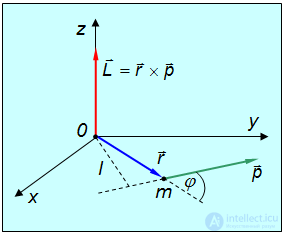
Fig. 4.22. Angular momentum L of a particle of mass m
Let us consider the time derivative of the angular momentum:

The first term equals zero, since  and
and  are obviously parallel
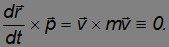
In the second term, according to Newton's second law, the derivative of the momentum can be replaced by the force acting on the particle.
The vector product of the position vector and the force is called the torque (moment of force) relative to point 0 :

The direction of the torque is determined by the same corkscrew rule. Its magnitude

where  — is the angle between the position vector and the force. Analogously to what was done above, the lever arm of the force is also defined l = r
  — the distance from point 0 to the line of action of the force. As a result, from the relation obtained by differentiation we find the equation of motion for the angular momentum of a particle:

In form the equation is analogous to Newton's second law: in place of the particle's momentum stands its angular momentum, and in place of the force — the torque.
If M = 0, then L = const, that is
The angular momentum of a particle is constant in the absence of torques acting on it.
For central forces
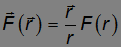
and the torque relative to the force centre equals zero:

Thus, for central forces

that is, L = const.
In other words,
In motion in a field of central forces, the angular momentum of a particle is conserved.
An important consequence follows from this. Since the angular momentum is orthogonal to the plane defined by the body's momentum and the position vector drawn from the force centre, this plane does not change its position over time. In other words, the orbit of each body in a field of central forces lies in a single plane passing through the force centre (although for different bodies these planes may differ). Thus, helical trajectories are impossible, for example, in a field of central forces.
Let us now consider a system consisting of two interacting particles (fig. 4.23).
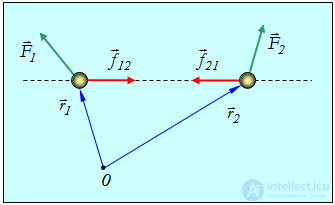
Fig. 4.23. A system consisting of two interacting particles
The equations of motion of these particles have the form:
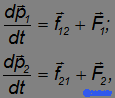
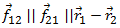
where F1 and F2 — are the external forces, and f12=-f21 — are the internal forces of interaction between the particles, directed along the line connecting them
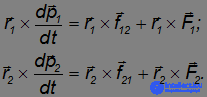
Let us multiply the first equation vectorially on the left by the position vector of the first particle r1, and the second — vectorially on the left by the position vector of the second particle r2
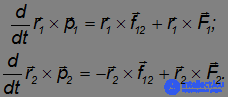
Let us take into account that

since

and
Using Newton's third law f12 = –f21, let us rewrite the system of equations of motion of the particles in the form:
Let us add the resulting relations:

There is a relation between the vectors
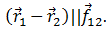
Therefore their vector product equals zero.
Thus, we obtain

On the left side of the equality stands the derivative of the sum of the angular momenta of the particles (it is called the total angular momentum L of the system), and on the right — the sum of the moments of the external forces — the total torque M of the external forces acting on the bodies of the system. The generalization to the case of a system of many particles (or a rigid body) is obvious.
The angular momentum of a system of N particles equals
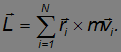
The total torque of the external forces will be
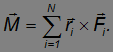
The equation determining the time evolution of the angular momentum of a system of particles has the form:
From this it follows that when M = 0 and, correspondingly, L = const, we obtain the law of conservation of angular momentum of a system:
If a system is closed, or if the total torque of the external forces acting on it is equal to zero, then the total angular momentum of the system is conserved.
Example. Let us determine under what conditions the angular momentum of a system does not depend on the choice of origin 0.
Let us first find how the angular momentum changes when the origin is changed. Take some point 0', whose position relative to point 0 is given by the position vector r0. The position vectors ri', drawn from 0', are related to the position vectors ri by the relations

Let us substitute this expression into the formula for the angular momentum L relative to point 0:
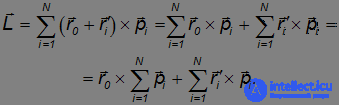
In the first term we introduce the total momentum of the system

and the second term is none other than the angular momentum L' relative to point 0'.
We have
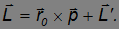
We seek the condition under which

for an arbitrary vector r0. This is possible only if the total momentum of the system equals zero, p = 0. In other words, the angular momentum does not depend on the choice of origin in a frame of reference connected with the centre of mass of the system.
Let us consider in more detail the motion of a particle in a central force field. As already noted above, its angular momentum relative to the force centre is conserved

or in scalar form

Let the displacement of the particle in time dt be vdt. The area “swept” by the particle's position vector (hatched in fig. 4.24) during this time will be

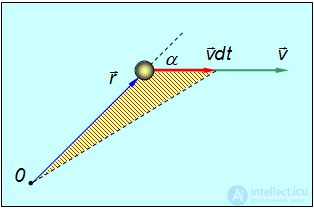
Fig. 4.24. Sectorial velocity of a particle
The area swept by the particle's position vector per unit time is called the sectorial velocity:

Substituting the expression for the area into the formula for the sectorial velocity, we obtain
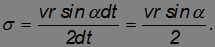
Taking into account that
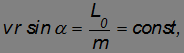
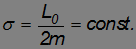
we arrive at the law of areas.
The sectorial velocity of a particle moving in a central force field is a constant quantity:
Example. Let a satellite move around the Earth in an elliptical orbit (fig. 4.25), with the minimum and maximum distance from the Earth being Rmin and Rmax. Let us find its velocity at perigee and apogee.
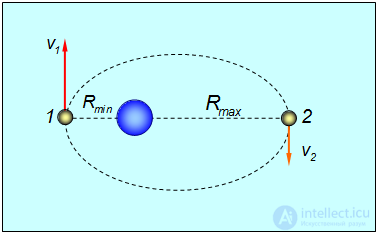
Fig. 4.25. Motion of a satellite in an elliptical orbit around the Earth
Let us write the law of conservation of angular momentum for the satellite at points 1 and 2:

Let us write the law of conservation of energy for the same points:
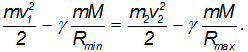
Expressing v2 from the law of conservation of angular momentum

and substituting the resulting expression into the law of conservation of energy, we find the required velocities
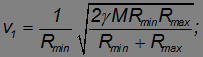
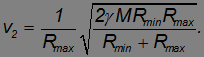
It is seen that at the point of minimum distance the satellite's velocity is maximal, and, conversely, at the point of maximum distance its velocity is minimal.









Comments