
Lecture
Hamilton's principle of least action, also simply Hamilton's principle (more precisely — the principle of stationary action) — a way of obtaining the equations of motion of a physical system by finding the stationary (often — extremal, usually, owing to the established tradition of defining the sign of the action, — least) value of a special functional — the action. Named after William Hamilton, who used this principle to construct the so-called Hamiltonian formalism in classical mechanics.
The principle of stationary action is the most important among the family of extremal principles. Not all physical systems have equations of motion that can be obtained from this principle, but all fundamental interactions obey it, which is why this principle is one of the key tenets of modern physics. The equations of motion obtained with its help are called the Euler — Lagrange equations.
The first formulation of the principle was given by P. Maupertuis (fr. P. Maupertuis) in 1744, immediately pointing out its universal nature and considering it applicable to both optics and mechanics. From this principle he derived the laws of reflection and refraction of light.
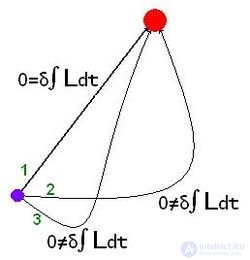
Even ancient natural philosophers (for example, Aristotle) supposed that “nature does nothing in vain and in all its manifestations chooses the shortest or easiest path” . However, the specific meaning of the terms “shortest” or “easiest” was not clarified . Claudius Ptolemy showed that upon reflection of a ray of light its total path is shortest when the angle of reflection equals the angle of incidence, which is indeed observed in practice. He warned, however, that in the case of refraction of light the path (the broken line) would no longer be the shortest.
The first variational principle in the history of science was formulated by Pierre Fermat in 1662, and it concerned precisely the refraction of light. Fermat showed that the criterion in this case is not the path but the time — the ray is refracted at such an angle that the total time along the path is minimal . In modern notation, Fermat's principle can be written as
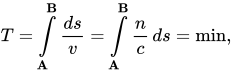
where n — the refractive index of the medium, c
 — the speed of light in vacuum.
The mathematical investigation and development of Fermat's principle was carried out by Christiaan Huygens , after which the topic was actively discussed by the greatest scientists of the 17th century. In 1669 Leibniz introduced into physics the fundamental concept of action: “The formal actions of motion are proportional… to the product of the quantity of matter, the distances over which they move, and the speed”.
In parallel with the analysis of the foundations of mechanics, methods for solving variational problems were developed. Isaac Newton, in his “Mathematical Principles of Natural Philosophy” (1687), posed and solved the first variational problem: to find the shape of a body of revolution, moving in a resisting medium along its axis, for which the resistance experienced would be least. Almost simultaneously other variational problems appeared: the brachistochrone problem (1696), the shape of the catenary, and others.
The decisive events occurred in 1744. Leonhard Euler published the first general work on the calculus of variations (“A Method for Finding Curves Having the Properties of a Maximum or Minimum”), while Pierre Louis de Maupertuis, in the treatise “Agreement between Different Laws of Nature That Had Seemed Incompatible”, gave the first formulation of the principle of least action: “the path followed by light is the path for which the quantity of action is least”. He demonstrated that this law holds both for reflection and for refraction of light. In response to Maupertuis's article, Euler published (in the same year, 1744) the work “On the Determination of the Motion of Thrown Bodies in a Non-resisting Medium by the Method of Maxima and Minima”, and in this work he gave Maupertuis's principle a general mechanical character: “Since all phenomena of nature follow some law of maximum or minimum, there is no doubt that for the curved lines described by thrown bodies, when some forces act on them, there also holds some property of maximum or minimum”. Euler then formulated this law: the trajectory of a body realizes the minimum of ∫mvds . He then applied it, deriving the laws of motion in a uniform gravitational field and in several other cases.
In 1746 Maupertuis, in a new work, agreed with Euler's opinion and proclaimed the most general version of his principle: “When some change occurs in nature, the quantity of action necessary for this change is the least possible. The quantity of action is the product of the mass of the bodies by their velocity and by the distance which they travel”. In the broad discussion that followed, Euler supported Maupertuis's priority and argued for the universal character of the new law: “the whole of dynamics and hydrodynamics can be disclosed with surprising ease by means of the single method of maxima and minima”.
A new stage began in 1760—1761, when Joseph Louis Lagrange introduced the rigorous concept of the variation of a function, gave the calculus of variations its modern form, and extended the principle of least action to an arbitrary mechanical system (that is, not only to free point particles). This laid the foundation of analytical mechanics. A further generalization of the principle was carried out by Carl Gustav Jacob Jacobi in 1837 — he treated the problem geometrically, as finding the extremals of a variational problem in a configuration space with a non-Euclidean metric. In particular, Jacobi pointed out that in the absence of external forces the trajectory of the system is a geodesic line in configuration space.
In 1834—1835 William Rowan Hamilton published an even more general variational principle, from which all the earlier ones followed as special cases:
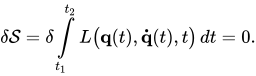
Here L — the Lagrangian of the dynamical system, q
 — the generalized coordinates. Hamilton made this principle the basis of his “Hamiltonian mechanics” and gave the solution of the variational problem in the form of “canonical equations”.
Hamilton's approach proved universal and highly effective in the mathematical models of physics, especially for quantum mechanics. Its heuristic power was confirmed in the creation of general relativity, when David Hilbert applied Hamilton's principle to derive the final equations of the gravitational field (1915).
The principle of least action serves as the fundamental and standard basis of the Lagrangian and Hamiltonian formulations of mechanics.
Let us first consider the construction, on this basis, of Lagrangian mechanics. Using the example of a physical system with one degree of freedom, let us recall that the action is a functional of the (generalized) coordinates (in the case of one degree of freedom — a single coordinate q(t) ), that is, it is expressed through q(t) so that every conceivable variant of the function q(t) is assigned a certain number — the action (in this sense one can say that the action as a functional is a rule that allows, for any given function q(t), the computation of a perfectly definite number — also called the action). The action has the form
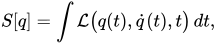
where 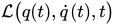 is the Lagrangian of the system, depending on the generalized coordinate q, its first time derivative q˙
 , and, possibly, also explicitly on time t
 . If the system has a larger number of degrees of freedom n, then the Lagrangian depends on a larger number of generalized coordinates
  and their first time derivatives. Thus, the action is a scalar functional depending on the trajectory of the body.
The fact that the action is a scalar makes it easy to write it in any generalized coordinates; the only requirement is that the position (configuration) of the system be uniquely characterized by them (for example, instead of Cartesian coordinates these could be polar coordinates, the distances between points of the system, angles or functions of them, etc.).
The action can be computed for a perfectly arbitrary trajectory q(t) , however “wild” and “unnatural” it may be. However, in classical mechanics, among the whole set of possible trajectories there exists one single one that the body will actually follow. The principle of stationary action gives precisely the answer to the question of how the body will actually move:
|
Between two given points the body moves so that the action is stationary. |
This means that if the Lagrangian of a system is given, then, using the calculus of variations, we can determine exactly how the body will move, first by obtaining the equations of motion — the Euler — Lagrange equations — and then solving them. This allows not only a substantial generalization of the formulation of mechanics, but also the choice of the most convenient coordinates for each particular problem, without being limited to Cartesian ones, which can be very useful for obtaining the simplest and most easily solvable equations.
Similarly, Hamiltonian mechanics is obtained from the principle of least action. In this case it is most natural to write the action as

where  — the Hamiltonian function of the given system; q≡q1,q2,…,qN — the (generalized) coordinates, p≡p1,p2,…,pN — the (generalized) momenta conjugate to them, together characterizing the dynamical state of the system at each given moment of time and, each being a function of time, thereby characterizing the evolution (motion) of the system. In this case, to obtain the equations of motion of the system in the form of Hamilton's canonical equations, one must vary the action written in this way independently with respect to all
  and
and  .
.
It should be noted that if, from the conditions of the problem, it is in principle possible to find the law of motion, this automatically does not mean that a functional can be constructed that takes a stationary value for the true motion. An example is the joint motion of electric charges and monopoles — magnetic charges — in an electromagnetic field. Their equations of motion cannot be derived from the principle of stationary action. Similarly, some Hamiltonian systems have equations of motion that cannot be derived from this principle[source not specified for 1198 days].
Trivial examples help to evaluate the use of the action principle through the Euler — Lagrange equations. A free particle (mass m and velocity v) in Euclidean space moves along a straight line. Using the Euler — Lagrange equations, this can be shown in polar coordinates as follows. In the absence of a potential, the Lagrangian is simply equal to the kinetic energy
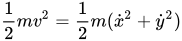
in the orthogonal coordinate system (x,y) .
In polar coordinates (r,φ) the kinetic energy, and hence the Lagrangian, becomes
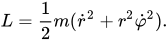
The radial and angular components of the equations become, respectively:


The solution of these two equations:
rcosφ=at+b,
rsinφ=ct+d,
with constants a, b, c, d, determined by the initial conditions. Thus, indeed, the solution is a straight line, given in polar coordinates.
The concept of action is introduced analogously in continuum mechanics and classical field theory. In these the action includes an integral of the Lagrangian density, depending on the parameters of the medium (field) at each point of space and their derivatives with respect to the spatial coordinates and time. The equations of motion obtained by varying the action become partial differential equations.
The principle of stationary action has proved to be one of the simplest ways to ensure the relativistic invariance of the equations of motion — for this it is enough that the Lagrangian density be a scalar (invariant) under transformations of the reference frame, for example, Lorentz transformations. Because of this, the role of the principle has grown substantially in relativistic physics. In particular, Noether's theorem, which determines the conserved quantities under the temporal evolution of field systems, applies precisely to Lagrangian systems.
It should be noted that the application of the principle of stationary action to gauge field theory (for example, to electrodynamics) sometimes encounters certain specific problems, which are, however, solvable.
In quantum mechanics, in accordance with the Copenhagen interpretation, there is no need to know precisely how a particle moves. Moreover, in Feynman's formulation it is asserted that:
|
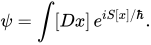
a particle moves from the initial state to the final state simultaneously along all conceivable trajectories (of which, obviously, there is an infinite number). The probability amplitude of a transition from one given state to another is the sum of the amplitudes over all these trajectories and is written in the form of a functional integral
|
Here ∫[Dx] — is a conventional notation for an infinite-dimensional functional integration over all trajectories x(t), and  — is Planck's constant. Let us emphasize that, in principle, the action appears (or may appear) in the exponent by itself, when studying the evolution operator in quantum mechanics, but for systems having an exact classical (non-quantum) analogue, it is exactly equal to the ordinary classical action.
Mathematical analysis of this expression in the classical limit — for sufficiently large  , that is, for very rapid oscillations of the imaginary exponential — shows that the overwhelming majority of the possible trajectories in this integral mutually cancel in this limit (formally, at
  ). For almost any path there is found another path for which the phase advance is exactly opposite, and together they give a zero contribution. Only those trajectories do not cancel for which the action is close to the extremal value (for most systems — the minimum). This is a purely mathematical fact from the theory of functions of a complex variable; the method of stationary phase, for example, is based on it.
As a result, a particle, in full agreement with the laws of quantum mechanics, moves simultaneously along all trajectories, but under ordinary conditions only trajectories close to the stationary ones (that is, the classical ones) contribute to the observable values. Since quantum mechanics passes over into classical mechanics in the limit of large energies, this can be regarded as the quantum-mechanical derivation of the classical principle of stationary action.
The discovery of the formulation of quantization in terms of functional integrals (often also called “path integrals”, “trajectory integrals”, or “sum over histories”), as well as the establishment of its connection with the classical limit, belongs to Richard Feynman, who creatively developed the idea of Paul Dirac.
The Schrödinger equation can be obtained from the principle of least action, treating it as the Euler equation
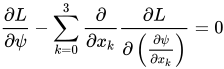
of a variational problem in which the Lagrangian density has the form
 .
.
In quantum field theory the principle of stationary action is also applied successfully. The Lagrangian density here includes the operators of the corresponding quantum fields. Although, strictly speaking, it would be more accurate here (except in the classical limit and, in part, the quasi-classical case) to speak not of the principle of stationary action but of Feynman path integration in the configuration or phase space of these fields — using the Lagrangian density just mentioned.
More broadly, the action is understood as a functional that defines a mapping from the configuration space onto the set of real numbers and, in general, it need not be an integral, because nonlocal actions are in principle possible, at least theoretically. Moreover, the configuration space need not be a functional space, because it may have a noncommutative geometry.

Comments