
Lecture
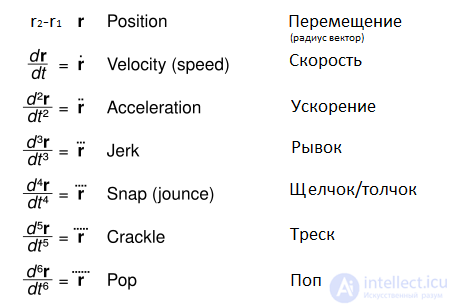
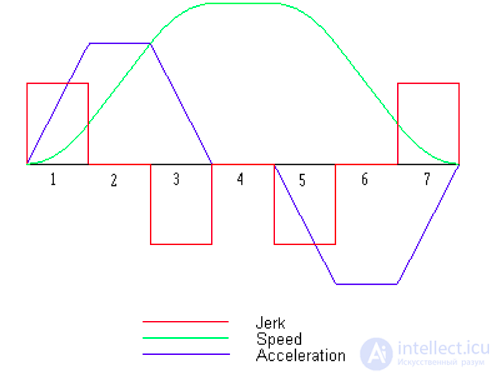
Jerk — a vector physical quantity characterizing the rate of change of a body's acceleration. It is the third time derivative of the position vector.
| Units of measurement | |
|---|---|
| SI | m/s3 |
| CGS | cm/s3 |
| Other units | g/s |
The jerk vector  at any point in time is found by differentiating the particle's acceleration vector with respect to time:
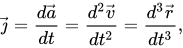
where:
 — acceleration,
 — velocity,
 — position vector.
Accordingly, the formulas for motion with constant jerk take the form:

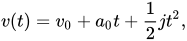

The formulas can be further generalized to higher derivatives of the position vector by introducing ever more terms into the power-series expansion of the coordinate. By tradition, or simply for convenience given their frequent use, the first 3 coefficients in the expansion have their own names: velocity, acceleration and jerk, respectively.
The force acting on an accelerating charge (radiation reaction, or the reaction force of radiation) is proportional to the third time derivative of the coordinate (i.e. the first time derivative of the acceleration).
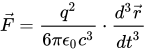
(in the SI system).
The concept of jerk is applied in the transportation of passengers, as well as of fragile and valuable cargo.
A passenger adapts to acceleration by tensing muscles and adjusting posture. When the acceleration changes, the posture naturally changes too. The passenger needs time to react and change it — otherwise a standing passenger will lose balance, and a seated one will be jolted. A typical example is the moment a subway car comes to a complete stop after braking: standing passengers, who have leaned forward during braking, do not have time to adapt to the new acceleration that arises at the moment of stopping, and lean backward.
Similarly, a load subjected to acceleration deforms. Frequent and rapid changes in acceleration mean frequent and rapid deformation, which can lead to the destruction of fragile cargo. Jerk can be partially reduced by using cushioning packaging.
For many instruments and devices, technical specifications set a limiting value for jerk.
Higher-order derivatives are rarely used in transport. A well-known case in which the position vector was examined up to the fourth derivative is the deployment of the Hubble Space Telescope into orbit .
It is applied in Verlet integration for the fast numerical solution of differential equations of motion of point particles.
In the article by I. I. Smulsky and Ya. I. Smulsky, “Asteroid Apophis: orbital evolution and possible use,” derivatives up to sixth order and a Maclaurin series are used in the computation program
In the work of the Finnish mathematician K. Sundman, devoted to solving the “three-body problem,” higher derivatives and series are used
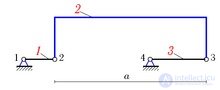
The concept of jerk also finds application in the problem of computing the angular velocities and angular accelerations of the links of a four-bar hinged linkage — in a situation where all the hinges lie on a single straight line .
In electronically controlled metal-cutting machine tools, the change in acceleration is also important — rapid deformations of the tool, which occur at high jerk, prematurely wear the tool out of service.
In the social sciences, acceleration is understood as an increase in the pace of technological development, which for some (transhumanists) is an inevitable historical process leading to the transformation of the human, while for others it is a mode of existence of post-Fordist capitalism. The latter can be divided into two camps: accelerationists, according to whom capitalism stimulates acceleration while simultaneously hindering it, thereby endlessly postponing truly revolutionary change, and various critics of accelerationism, who believe that acceleration is a parallel road that does not coincide with the revolutionary path (“It accelerated, but it didn't manage to restructure”).
All three of these positions share a realist conception of acceleration: it is regarded as existing in reality, rather than as an abstraction with its own history. Against this realism of acceleration one should set a nominalist view: in reality only some movement of things exists (at least, in a Heraclitean universe), and velocity and acceleration are merely ways of describing that movement. These ways arise in the course of the development of modern European mechanics and differential calculus: velocity is the first derivative of path with respect to time (of the position vector), acceleration is the derivative of velocity (the second derivative of the position vector); both presuppose a coordinate system in which the measurement is made, i.e. they trace back to the Cartesian invention. These, we repeat, are abstractions describing motion, but not motion itself.
What sheds light on the true state of affairs is precisely the movement of abstractions: there is also a name for the third derivative of path, i.e. for the derivative of acceleration itself — jerk. Jerk is the moment of the beginning/end of acceleration/deceleration (taken into account, say, in the design of vehicles). Higher derivatives of the position vector are not used in classical mechanics, although there are conventional names for the fourth, fifth and sixth: Snap, Crackle and Pop (the names of the gnomes — drawn characters from a corn flakes box), and further on (Lock, Drop, Shot, Put…).
In the light of this expanded conception of motion, one can say that the notion of acceleration is limited, since it obscures the acceleration of velocity itself, the change of its change. Observed technological development, on closer examination, consists rather of a series of jerks, i.e. transitions to “new discoveries in a whole universe of possibilities,” in the accelerationists' phrase, and it is precisely these jerks that contain invisible micro-revolutions (in this sense the position set out here is post-accelerationist). However, even such a description would be far from complete. If the transhumanists are right that we are dealing with exponential acceleration, then as we approach the infinite velocity of the curve of technological development (the technological singularity), we, as it were, zoom in on this curve, discerning ever more derivatives of path with respect to time within it. In every jerk, Snap, Crackle and Pop are already contained, and a genuine science of change (which Simondon called allagmatics) must investigate the movement of these abstractions, rather than the sociocultural effects (or more precisely, the homologies) of the abstractions taken by themselves, be it velocity or acceleration.
In a well-known and strange sense, it is precisely such an investigation, i.e. the zooming-in on the velocity curve, that computer science engages in. Those moments of motion which may have no mechanical (physical) significance acquire metaphysical significance in the evolution of computing abstractions. According to the dialectical scheme of the development of computer science (see the published “Genesis of the Graphical User Interface”), the historically first abstraction — the variable — is motion as such, i.e. something possessing velocity. This is the “thesis” of the first stage of evolution, culminating in a “synthesis” in the concept of the object, which becomes the “thesis” of the second stage, and so on. The post-accelerationist hypothesis is that each abstraction serving as the thesis of a new stage in the evolution of computer science corresponds to the “discovery” of the next derivative of path in its sociocultural and techno-economic projection.
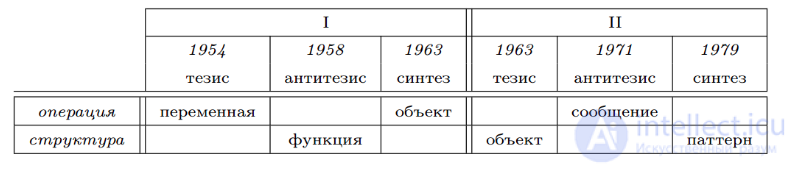
Every invention of a new “thesis” abstraction in computer science triggered an increase in the speed of software development and, at the same time, a zooming-in of the velocity curve: the variable (first stage) — velocity, the object (second stage) — acceleration, the pattern (third stage) — jerk. The beginning of the cultural life of the variable in the 1960s coincides with complaints about the increasing “pace of life” (velocity), the spread of the object abstraction (from the late 1970s) coincides with the first discussions among science-fiction writers and futurologists about acceleration, and the introduction of pattern language coincides with the software jerk of the 1990s. Today's situation in computer science is a transition from the concept of the model in systems engineering as the synthesis of the third stage (pattern — ontology — model) to the model as the thesis of the fourth stage, i.e. to the fourth derivative of path, called snap (“click”) or jounce (“throw, jolt”). This transition is carried out through a structural redescription of the concept of the model by means of the apparatus of category theory and mathematical logic. The introduction of this technology can therefore be figuratively likened to a throw or a click (a “switching over”!), which will coincide with new changes in social and cultural life and which will be even “faster” (i.e. demonstrating velocity on an even larger scale) than all the previous moments of history.
The proposed scheme of correspondence between the movement of computing abstractions and the movement of differentiation of the position vector is, of course, speculative, but it may serve as an important bridge between the theory of operational recapitulation and social studies of technocultural evolution.
In physics the fourth, fifth and sixth derivatives of position are defined as derivatives of the position vector with respect to time – with the first, second and third derivatives being velocity, acceleration and jerk, respectively. Higher-order derivatives occur less often than the first three; therefore their names are not as standardized, although the concept of minimum-snap trajectories has been used in robotics.
The fourth derivative is called snap, following which the fifth and sixth derivatives are sometimes “somewhat jokingly” called crackle and pop, inspired by the Rice Krispies mascots Snap, Crackle and Pop. The fourth derivative is also called jounce.
Snap or jounce is the fourth derivative of the position vector with respect to time, or the rate of change of jerk with respect to time. Equivalently, it is the second derivative of acceleration or the third derivative of velocity, and is defined by any of the following equivalent expressions
 In civil engineering, the design of railway tracks and roads involves minimizing snap, especially around bends with different radii of curvature. When snap is constant, jerk changes linearly, allowing a smooth increase of radial acceleration, and when, as is preferable, snap equals zero, the change in radial acceleration is linear. Minimizing or eliminating snap is usually done using the mathematical function of a clothoid.
Minimizing snap improves the performance of machine tools and roller coasters.
For constant snap, the following equations are used: 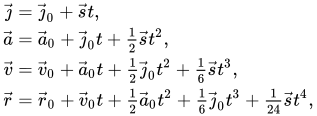
where
 is the constant snap,
 is the initial jerk,is the final jerk,
 is the initial acceleration,is the final acceleration,
 is the initial velocity,is the final velocity,
 is the initial position,is the final position,
 is the time between the initial and final states.
The notations→(used by Visser ) should not be confused with the displacement vector, usually denoted in a similar way.
The dimensions of snap are distance to the fourth power of time (LT −4). The corresponding SI unit is metre per second to the fourth power, m/s 4, m⋅s −4.
The fifth derivative of the displacement vector with respect to time is sometimes called crackle. It is the rate of change of snap with respect to time. Crackle is defined by any of the following equivalent expressions: 
For constant crackle, the following equations are used: 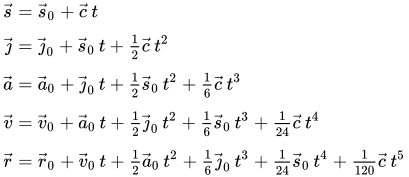
where
 : the constant crackle,
 : the initial snap, : the final snap, : the initial jerk, : the final jerk, : the initial acceleration, : the final acceleration, : the initial velocity, : the final velocity, : the initial position, : the final position, : the time between the initial and final states.
The dimensions of crackle are LT −5. The corresponding SI unit is m/s5.
The sixth derivative of the displacement vector with respect to time is sometimes called pop. It is the rate of change of crackle with respect to time. Pop is defined by any of the following equivalent expressions:

For constant pop, the following equations are used 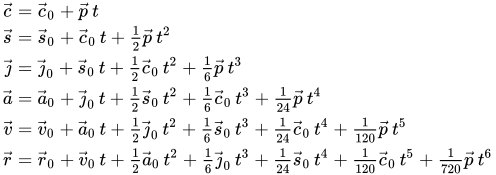
where
 : the constant pop,
 : the initial crackle, : the final crackle, : the initial snap, : the final snap, : the initial jerk, : the final jerk, : the initial acceleration, : the final acceleration, : the initial velocity, : the final velocity, : the initial position, : the final position, : the time between the initial and final states.
The dimension of pop is LT −6. The corresponding SI unit is m/s 6.
There is a wide range of applications for trajectory optimization, primarily in robotics: industry, manipulation, walking, path planning, and the aerospace industry. It can also be used for modeling and evaluation.
Depending on the configuration, open-chain robotic manipulators require a certain degree of trajectory optimization. For example, a robotic arm with 7 joints and 7 links (7-DOF) is a redundant system in which a single Cartesian position of the end effector can correspond to an infinite number of joint-angle configurations, so this redundancy can be used for trajectory optimization to, for example, avoid any obstacles in the workspace or minimize joint torque.
Trajectory optimization is often used to compute trajectories for quadcopter helicopters. These applications typically use highly specialized algorithms. One interesting application, demonstrated by the U.Penn GRASP Lab, computes a trajectory that allows a quadcopter to fly through a hoop as it is thrown. Another, this time from ETH Zurich's Flying Machine Arena, involves two quadcopters throwing a pole back and forth between them, balancing it as an inverted pendulum. The problem of computing minimum-energy trajectories for a quadcopter has also recently been studied
Trajectory optimization is used in manufacturing, in particular for controlling chemical processes or computing the desired path for robotic manipulators.
There are many different applications of trajectory optimization in the field of walking robotics. For example, one paper used trajectory optimization of bipedal gaits on a simple model to show that walking is energetically favorable for low-speed motion, while running is energetically favorable for high-speed motion. As in many other applications, trajectory optimization can be used to compute a nominal trajectory around which a stabilizing controller is built. Trajectory optimization can be applied in the detailed motion planning of complex humanoid robots such as Atlas. Finally, trajectory optimization can be used for path planning of robots with complex dynamic constraints using reduced-order models.
For tactical missiles, flight profiles are determined by thrust and lift histories. These histories can be controlled by a number of means, including methods such as using an angle-of-attack command history or an altitude/descent schedule that the missile must follow. Each combination of missile design factors, desired missile characteristics, and system constraints leads to a new set of optimal control parameters.
Minimizing acceleration (the second derivative of trajectory) reduces the load on actuators, decreases wear on mechanical parts, and improves control accuracy.
Minimizing jerk (the third derivative of trajectory) makes motion smooth, which is especially important for industrial manipulators and medical robots.
Maximizing velocity (the first derivative) is used when it is important to complete a task in minimum time (for example, on an assembly line or in competitive robotics).
Minimizing jerk provides passenger comfort and reduces the load on the vehicle's suspension.
Maximizing velocity is applied for rapid arrival at the destination, but with account taken of acceleration limits and road conditions.
Optimizing trajectory curvature reduces the likelihood of skidding, especially on slippery surfaces.
In game engines and 3D animation, minimizing jerk makes character motion realistic.
Maximizing velocity is used for scenes with sharp jerks or accelerations (for example, explosions, jumps, or races).
Minimizing acceleration reduces g-loads on the crew and structure.
Maximizing velocity and acceleration can be critically important during takeoff or evasive maneuvers.
In CNC machines, minimizing jerk improves machining accuracy and reduces vibration.
In logistics, maximizing velocity and acceleration is used for rapid transport of cargo, but with constraints taken into account.
In transportation systems (conveyors, autonomous carts, drones), it is important to take into account:
Load capacity – excessive acceleration or jerk can cause a load to fall.
Balancing – especially for unstable objects (for example, liquids poured into tanks).
Time optimization – maximizing velocity, but with smooth transitions between sections.

Comments