
Lecture
Это окончание невероятной информации про содержание жира в теле человека.
...
cellulite and localized obesity. But before trying to stir up this "cellulite" fat by various methods, one must think about how to dispose of the products of lipolysis. If this is not taken care of in advance, the resulting triglycerides will simply move to another place. It is fine if that place is adipose tissue. But the products of lipolysis may also be deposited as atherosclerotic plaques on the walls of blood vessels.
How does this disposal take place? Through movement! It is in the "furnace" of a working muscle that free triglycerides are burned. When performing lipolysis, we always include myostimulation and/or physical exercise in the set of procedures.
Metabolism in adipose tissue is influenced most of all by its blood circulation. And, as we have already understood, it is precisely congestion that leads to an increase in the layer of adipose tissue. An abundant blood flow ensures rapid removal of the fats released by adipocytes. Therefore, the better and more abundant the blood supply to the tissues, the sooner the fat gets to where it is needed. Consequently, to reduce a fat fold, it is necessary to improve circulation, including with the help of devices and physical exercise.
Lipolysis is a hormonal process. This means that a lipocyte will "release" the fat stores contained in it only when the appropriate hormone comes into contact with the lipocyte's receptor. Hormones are secreted by various glands of our body, and the activity of a given gland depends on both internal and external conditions. After the gland has secreted a hormone capable of signaling the need to break down fat stores, it enters the bloodstream. Blood bathes all the cells of our body — lipocytes are no exception — so at a certain moment the lipocyte's receptor reacts with the corresponding hormone and releases the substance contained within it.
It would be quite appropriate here to consider a process such as localized fat burning, or spot fat reduction. The opinions of modern scientists, bodybuilders and people close to the fitness field differ radically on this issue. Some believe that localized fat burning is impossible, while others, on the contrary, claim that it is quite feasible to create conditions for spot fat reduction. Both sides have many arguments. The topic of localized fat burning is discussed in the publication "Is localized fat burning possible?"
There is a whole list of hormones capable of initiating the fat-burning process. Which particular hormone will trigger the fat-burning mechanism in a given situation depends directly on the circumstances and, to a slightly lesser extent, on the state of the body at the moment it encounters those circumstances. Let us consider several examples:
The ability of a hormone to initiate the process of fat breakdown is called lipolytic capacity.
After fatty acids and glycerol have been released from the lipocyte, the body faces another task — to use the resulting substances as intended. Otherwise, as already mentioned, the process of fat burning and, accordingly, weight loss will not occur, since unused fat from the bloodstream will return to the lipocyte again. Another negative consequence of the absence of the second stage is a high risk of cholesterol plaques appearing on the walls of blood vessels.
From the above it can be concluded that any ways of influencing the lipolysis process by additional initiation or by introducing hormones from outside will be ineffective and even dangerous if the fat breakdown products are not cleared from the bloodstream.
Perhaps the only means of utilization within human control is muscular work. During physical exertion involving muscle work, energy from the bloodstream is used precisely for that work. Although, when doing fitness or training in a gym, the fat utilization stage occurs automatically. Moreover, the process of utilization and breakdown continues even after the workout is finished, particularly after strength training. That is why those who want to lose weight are strongly advised to combine aerobic exercise with strength exercises that engage the muscles in high-volume work.
Most women and some men are built in such a way that they lose weight from the top down. On almost any diet, weight loss begins with the face, then moves to the arms and breasts, descends to the waist, then the buttocks and, finally, the thighs, the "saddlebag or love handle" area (on the outer parts of the thighs). The kilograms come off most noticeably from this last zone. Therefore, to lose weight specifically in the abdominal area, you need to be patient. Diets for losing belly fat, of course, have a certain effect by shifting the emphasis for our body, but they cannot be relied on 100%.
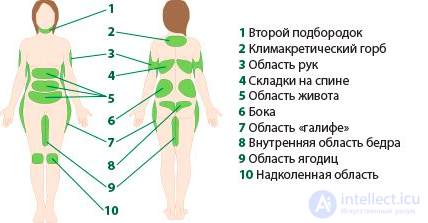
The body always has so-called fat "traps" that do not perform any important functions but are simply unaesthetic formations. Important! Fat "traps" are characteristic of both men and women. The only difference is in where they are located.
In the male body, fat "traps" are concentrated on the abdomen. In women, fat deposits are localized in the following places:
Any trainer or doctor will tell you that, first of all, water leaves the body of a person who is losing weight. After that the intestines are cleared, then muscle tissue is broken down, and only after that, fat tissue. For this reason, you should not expect the hated fat to disappear after a couple of days on a diet for losing belly fat, but do not give up what you have started either — in time you will achieve the necessary effect. Do not forget about physical exercise and abdominal exercises either, because we want not just to reduce the belly but to make it toned and attractive.
In modern medicine and cosmetology there is the term "gynoid lipodystrophy". It refers to unaesthetic fat deposits in problem areas, which are only a cosmetic defect. The causes and provoking factors for the appearance of the "saddlebag" area and other problem zones are as follows:
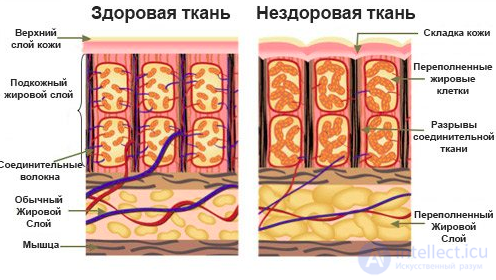
The main role in the formation of "saddlebags" is played by disturbances of blood and lymph flow with the subsequent development of cellulite.
It is important to understand that excess fat deposits are always accompanied by "orange peel" skin at various stages.
Most often the face slims down first on a diet. This is because weight loss occurs mainly through burning subcutaneous fat, and on the face its layer is thinner than on other parts of the body.
There is no need to worry if it seems to you that your cheeks have become hollow or your nose has become sharper. Firstly, you are simply not yet used to your new appearance, because the face changes first. Secondly, you are comparing your face with your still-unchanged body, so it seems that the face has slimmed down more than it actually has.
But it may also be that the face, on the contrary, does not slim down, or hardly slims down. Sometimes this depends on body structure — there are women who lose weight from the bottom up. However, much more often it means that you have swelling (edema) in your face.
If this has happened to you:
see a doctor and have your thyroid, heart and kidneys checked. If there are problems, treatment will be required
get rid of the habit of slouching when walking and lowering your head when sitting or walking
take a larger pillow for sleeping at night than the one you used before
while lying in bed, do not read or use any gadgets.
And in any case, remember that during weight loss the face needs special care. Maintain the tone and firmness of the skin so that it does not sag.
Again, the particularly difficult areas for weight loss are different for everyone. Therefore, when starting the fight against excess weight, you must identify those areas from which fat is reluctant to "leave". After that you can decide which weight-loss methods to use.
There are a number of foods that are "deposited" in specific places. For example, to lose weight at the waist, you need to give up flour-based foods, sausage and alcoholic drinks. To reduce the volume of the thighs and buttocks, you will have to give up fast food, sweets and fried food.
On the basis of such restrictions you can draw up an individual diet for yourself or use an existing diet, since there are plenty of programs aimed specifically at losing weight in a particular part of the body.
Physical exercise should also not be forgotten. Of course, all muscle groups need to be trained, but you can place an emphasis on those areas where losing weight is especially difficult for you. For example, if your workout lasts 20–25 minutes on average, 10 minutes can be devoted to the problem zones and the remaining time to all the muscles of the body.
In addition, you can regularly apply a number of different anti-cellulite procedures to the necessary areas: massage, body wraps, etc. This will not only help reduce the volume of that part of the body but also make the skin smooth, attractive and firm.
If you are determined to lose weight but want to preserve your bust size as much as possible, remember a few important rules:
1. Forget about crash diets and fasting days; they have a very bad effect on the elasticity of connective tissues. Your choice is proper nutrition, giving up flour-based foods, sweets and late dinners. This way you will lose weight more slowly, but your breasts will remain beautiful.
2. Choose protein foods; they stimulate collagen production, thereby strengthening muscles and increasing tissue elasticity.
3. Drink protein shakes; they also help the synthesis of the collagen fibers of the skin.
4. Buy a good, expensive sports bra that fits you perfectly. It is the key to proper breast support and preservation of their shape.
5. If your breasts are larger than a size C (third size), do not overdo jumping, bounding and running. Give preference to strength training, yoga, Pilates and stretching.
Many people face the following problem when losing weight — the legs slim down last or not at all. Why does this happen? What needs to be done to lose weight in the legs and make them slim and attractive? We will try to answer these questions in this article.
First, it is worth understanding why fat continues to be deposited precisely on the thighs and legs even if you are on a diet and exercising. The point is that nature itself made provision for this, since it must first of all support the woman's reproductive function. It is thanks to this well-thought-out design of nature that women deposit fat in the so-called problem zones — on the buttocks, abdomen and legs.
In addition, unfavorable conditions, poor-quality nutrition and other accompanying factors have a significant effect on the work of the internal organs, which no longer fully cope with the digestive function. This also leads to the body, for the purpose of self-preservation, starting to deposit fat in reserve in those very problem zones.
So, in order to lose weight in the legs and remove fat deposits on the thighs, it is not so much a matter of going on diets as of carefully choosing what you eat. The point is that many of us simply do not notice how much fat we eat every day. Meanwhile, in order to lose weight, the daily fat intake should not exceed 30–40 grams.
You are on a diet without "good" fats (that is, without monounsaturated fatty acids).
You have stress or depression
You do not do enough cardio exercise. Such exercise should last about 30 minutes, but during the session the heart rate should not exceed: (220 − age) × 0.55 and (220 − age) × 0.65.
You eat harmful foods — chocolate, fried and fatty foods, ice cream, pastries, egg yolk, fatty cheese, smoked meats, nuts,
seeds, fast food, beer, alcohol and their derivatives.
You do not drink enough water — the norm is about 30 ml per 1 kg of body weight, that is, about 1.5–2.5 liters of pure water should be consumed per day
You do not get enough physical exercise, including training of the lower and upper abdominal muscles.
You do not do enough prolonged aerobic exercise of moderate intensity — running, walking, swimming, tennis, roller skating, ice skating, cycling, etc. Otherwise the abdominal muscles will remain under a layer of fat, and what is needed is precisely fat burning.
The cause of your enlarged abdomen is not the presence of fat but, for example, gastroenterological problems or, in women, gynecological diseases such as uterine fibroids, so a consultation with a specialist doctor is needed.
These simple and accessible investigations will allow you to understand exactly what is happening with your figure and why your weight changes. And by operating with such knowledge, you will be able to adjust your weight and body composition as precisely as possible, because you will know what to aim for. If you have health problems, then in addition to diet and exercise, medical intervention correctly selected by an endocrinologist or another specialist is necessary
Good luck with your calculations and plans for building the ideal figure and weight!
References
Часть 1 Body Fat Percentage: Measurement Methods, Analysis and How to Reduce It
Часть 2 7. Stages of fat burning (lipolysis) - Body Fat Percentage:

Comments