Generations of optical discs and comparison - Optical Discs: CD-ROM,

Lecture 59 min.


Это окончание невероятной информации про оптические диски.

...

velocity. The angular velocity (rotation rate) gradually decreases from the center toward the edge of the disc. When the read speed at the start of the disc exceeds 16x (2400 KB/s), vibration becomes so strong that poorly centered ("pirated") discs can break apart.

  • Zone CLV (16x in the inner zone).
  • CAV, PCAV (Zone CAV) - constant and partially constant angular velocity. The rotation rate changes in steps on moving from one area of the disc to another. The rated data read (write) speed is reached only at the end of the disc.
  • TrueX - simultaneous reading from several tracks.
  • The interface and its version (SCSI, ATAPI (IDE), USB, USB 2.0, FireWire (IEEE 1394), nonstandard and obsolete ones (Sony, Panasonic, Mitsumi)). It determines the transfer rate from the device buffer to the computer and the CPU load. Particular attention should be paid to the presence of DMA.
  • Read quality, the error correction algorithm (reducing the speed and then restoring it).
  • Average access time.
  • Loading the disc into the device:
    • a sliding tray
    • a caddy
    • a slot
    • a magazine holding several discs
  • Buffer underrun protection while writing:
    • BURN-Proof (aka BurnProof, aka BufferUnderRuN-Proof, Sanyo)
    • SafeBurn (Oak, Yamaha)
    • JustLink (Ricoh)
    • Seamless Link (ACER)
    • ExacLink (Oak, Mitsumi)
    • SMART-BURN (Lite-On)
  • Buffer size.
  • The ability to extract "raw" data from a sector (Read Long, Read Raw, DAE). Used for reading CD-DA in digital form and for bypassing copy protection systems.
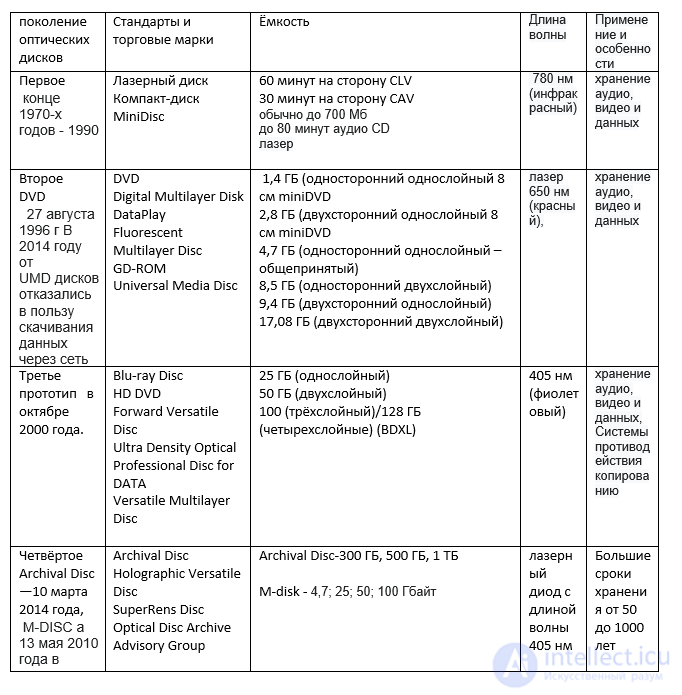
  • Generations of optical discs and comparison

    optical disc generation

    Standards and trade names

    Capacity

    Wavelength

    Applications and features

    First

    late 1970s - 1990

    LaserDisc

    Compact disc

    MiniDisc

    60 minutes per side, CLV

    30 minutes per side, CAV

    usually up to 700 MB

    up to 80 minutes of audio on a CD

    laser

    780 nm (infrared)

    storage of audio, video and data

    Second

    DVD

    August 27, 1996. In 2014 UMD discs were abandoned in favor of downloading data over the network

    DVD

    Digital Multilayer Disk

    DataPlay

    Fluorescent Multilayer Disc

    GD-ROM

    Universal Media Disc

    1.4 GB (single-sided single-layer 8 cm miniDVD

    2.8 GB (double-sided single-layer 8 cm miniDVD

    4.7 GB (single-sided single-layer – the generally accepted one)

    8.5 GB (single-sided dual-layer)

    9.4 GB (double-sided single-layer)

    17.08 GB (double-sided dual-layer)

    650 nm laser (red),

    storage of audio, video and data

    Third

    prototype in October 2000.

    Blu-ray Disc

    HD DVD

    Forward Versatile Disc

    Ultra Density Optical

    Professional Disc for DATA

    Versatile Multilayer Disc

    25 GB (single-layer)

    50 GB (dual-layer)

    100 (triple-layer)/128 GB (quadruple-layer) (BDXL)

    405 nm (violet)

    storage of audio, video and data, copy protection systems

    Fourth

    Archival Disc — March 10, 2014,

    M-DISC and on May 13, 2010 in

    Archival Disc

    Holographic Versatile Disc

    SuperRens Disc

    Optical Disc Archive Advisory Group

    Archival Disc-300 GB, 500 GB, 1 TB

    M-disk - 4.7; 25; 50; 100 GB

    laser diode with a wavelength of 405 nm

    Long storage life, from 50 to 1000 years

    Optical Discs: CD-ROM, CD-R, CD-RW, DVD-ROM, DVD-R, DVD-RW, DVD+R DL

    See also

    • Eternal 5D
    • 3D optical data storage
    • Stacked volumetric optical disc
    • Fluorescent Multilayer Disc (FMD)
    • Video CD
    • Optical Disc Archive
    • Optical disc image
    • CD and DVD drive emulator
    • Stacked volumetric optical disc
    • Copy protection

    Продолжение:


    Часть 1 Optical Discs: CD-ROM, CD-R, CD-RW, DVD-ROM, DVD-R, DVD-RW, DVD+R DL
    Часть 2 Generations of optical discs and comparison - Optical Discs: CD-ROM,

    Comments

    To leave a comment

    If you have any suggestion, idea, thanks or comment, feel free to write. We really value feedback and are glad to hear your opinion.
    To reply

    Lectures and tutorial on "Electromechanical devices of electronic devices"

    Terms: Electromechanical devices of electronic devices