
Lecture
In probability theory, the statement known as the law of total expectation , law of iterated expectations , tower rule , Adam's law or smoothing theorem states that if  is a random variable with a defined expectation
  , and
, and  is an arbitrary random variable on the same probability space.

that is, the expectation of the conditional expectation of given equals the expectation of .
In the special case where  is a finite or countable partition of the sample space, then

Suppose that two factories supply light bulbs to the market. Light bulbs from factory work on average 5000 hours, while bulbs from factory work on average for 4000 hours. It is known that factory supplies 60% of the total number of bulbs available. What is the expected lifetime of a purchased light bulb?
Applying the law of total expectation we get:

where
 is the lifetime of the bulb;
 is the probability that the purchased bulb was made at factory X;
 is the probability that the purchased bulb was made at factory Y;
 is the expected lifetime of a bulb made at factory X;
 is the expected lifetime of a bulb made at factory Y.
Therefore, the expected lifetime of each purchased light bulb equals 4600 hours.
Let the random variables and be defined on the same probability space, taking a finite or countable set of finite values. Suppose that  is defined, that is
  . If
. If  is a partition of the probability space Ω , then
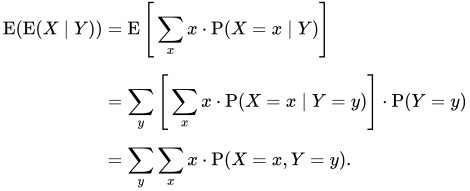
If the series is finite, we can change the order of summation and the previous expression becomes
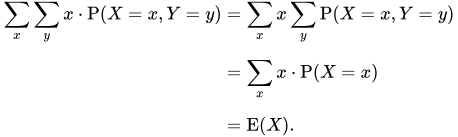
If, on the other hand, the series is infinite, its convergence cannot be conditional because of the assumption that  The series converges absolutely if both,
  and
and  are finite, and diverges to infinity if either or is infinite. In both cases, the order of summation can be changed without changing the sum.
Let  be a probability space with σ-algebras
  defined on it. For a random variable on such a space, the smoothing theorem states that if is defined, that is , then
.  (almost surely)
Proof . Since the conditional expectation is a Radon–Nikodym derivative, proving the smoothing theorem reduces to verifying the following two properties:
 is
is  -measurable
 for all
The first of these properties follows from the definition of conditional expectation. To prove the second,

hence the integral  is defined (not equal to±∞
 ).
).
The second property holds because  implies

Conclusion. In the special case where  and )
and ) , the smoothing theorem reduces to

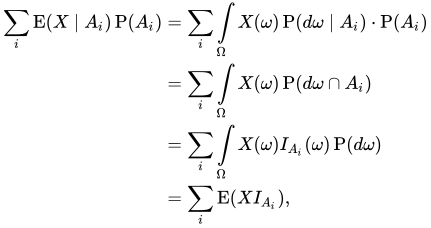
where  is the indicator function of the set
  .
.
If the partition  is finite, then, by the linearity property, the preceding expression is written as
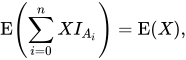
which is what needed to be shown.
If, on the other hand, the partition  is infinite, then applying the dominated convergence theorem we can show
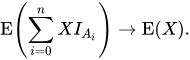
Indeed, for every  ,
,
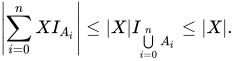
Since every element of the setΩ belongs to a specific element of the partition , it is easy to verify that the sequence 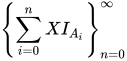 converges pointwise to X. By the assumption of the statement,
  . Applying the dominated convergence theorem gives the desired result.

Comments