Lectures
Tests
Circus
Tools
Images rating
Authorization
Premium
0
×
You get a bonus - 1 coin for daily activity. Now you have 1 coin
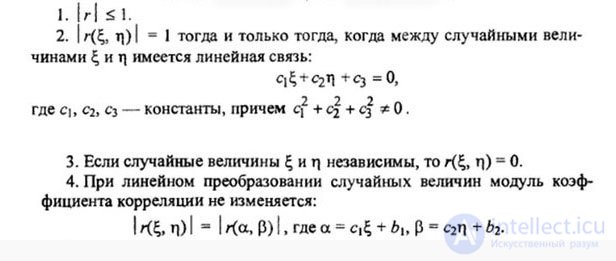
Correlation coefficient properties
Lecture
Intellect
› Mathematical disciplines, reliability and modeling
› Probability theory. Mathematical Statistics and Stochastic Analysis
No sorting by Partitions
Computer siences and Programming
Matheematics and modeling
Artifacal intellect
Psihilogy and pedagogic siences
Electrotechnical disciplines, Electronics
Phisics and chemistry siences
Philosofty and logic and sosial siences
Military sciences, military affairs and military art
Agrotechnics, crop production and agronomy
Veterinary medicine
Experiments and results
Search
The designations ξ and η are random variables.
Comments
To leave a comment
If you have any suggestion, idea, thanks or comment, feel free to write. We really value feedback and are glad to hear your opinion.
To reply
Comment
To confirm that you are not a bot, answer:
Name
Email(not published)
Vote
Super
Okay
Average
Bad
Horror
Save
Lectures and tutorial on "Probability theory. Mathematical Statistics and Stochastic Analysis"
Terms: Probability theory. Mathematical Statistics and Stochastic Analysis
Random Variables: Ways to Define Them and Examples
Event. Random events. Event probability
Discrete random variables
Continuous random variables
Mathematical statistics
Laplace function and other tabular statistical functions: in Excel formula
Tables The value of the Laplace function f (x), tγ, q Critical points of the distribution of χ2 and Student
Expected value
Random Variance
Correlation
Regression analysis
Coefficient of determination
Linear regression
Least square method
Confidence interval
The confidence interval for the expectation of a normal sample
Confidence interval for normal sample variance
Normal distribution
Generating function
Generating function of moments
Generating function of a sequence (gentris)
Generating function of canonical transformation
Generatrix
Elementary event space
Numerical Characteristics of Random Variables
Poisson formula and an example of solving a problem
Bernoulli formula and an example problem solution
Bayes formula and examples of tasks
Full probability formula
The addition theorem for probabilities of incompatible events
Random events Event algebra Classical and statistical definitions of the probability of an event
the table of the main generating functions and the proof (conclusion).
Uniform distribution of random variable.
Geometric distribution
Binomial distribution
Poisson distribution
Standard normal distribution
Exponential distribution
. Multidimensional random variables. Random functions
Correlation coefficient properties
Distribution density of a system of two random variables
Polygon and histogram
Variance analysis
Random moments
Bertrand Paradox (probability)
Galton's board (quincunks) to demonstrate the central limit theorem
Probability
Probability distribution
Probability density
Quantile
Bayesian Spam Filtering
Rows of distribution. Polygon, Bar Graph, Cumulate, Ogiva
Summary and grouping of statistical data, Concept and types of grouping, Principles of grouping, Secondary grouping
Population and sampling method, Sampling errors, Sampling volume required
Types and analysis of time series. Methods for calculating the average level in the series of dynamics
Correlation and regression analysis. Linear correlation
Blind Signature Blind Signature
Random graph
2.5. Almost impossible and almost reliable events. The principle of practical universality
1.1. Subject of probability theory
1.2. Brief historical information
2.2. Direct calculation of probabilities
2.3. Frequency, or statistical probability, of an event
3.1. Purpose of the main theorems. Sum and Event
3.2. Probability addition theorem
3.3. Probability multiplication theorem
3.4. Full probability formula
3.5. Theorem of hypotheses (Bayes formula)
4.1. Private theorem on repetition of experiments
4.2. General repetition theorem
5.1. A number of distribution. Polygon distribution
5.2. Distribution function
5.3. The probability of hitting a random variable on a given area
5.4. Distribution density
5.5. Numerical characteristics of random variables. Their role and purpose
5.6. Position characteristics (expected value, mode, median)
5.7. Moments. Dispersion. Standard deviation
5.8. Uniform density law
5.9. Poisson law
6.1. Normal distribution law and its parameters
6.2. Moments of normal distribution
6.3. The probability of hitting a random variable in a given area. Normal distribution function
6.4. Probable (median) deviation
7.1. The main tasks of mathematical statistics
7.2. Simple statistical aggregate. Statistical distribution function
7.3. Statistical series. bar chart
7.4 Numerical Characteristics of the Statistical Distribution
7.5. Alignment of statistical series
7.6. Consent Criteria
8.1. The concept of a random variable system
8.2. The distribution function of the system of two random variables
8.3. Distribution density of a system of two random variables
8.4. The laws of distribution of individual quantities included in the system. Conditional laws of distribution
8.5 Dependent and independent random variables
8.6. Numerical characteristics of a system of two random variables. Correlation moment. Correlation coefficient
8.7. System of an arbitrary number of random variables
8.8. Numerical characteristics of a system of several random variables
9.1. Normal law on the plane
9.2 Ellipses of dispersion. Reduction of the normal law to canonical form
9.3. The probability of hitting a rectangle with sides parallel to the main axes of dispersion
9.4. The probability of hitting an ellipse
9.5. Probability of hitting an area of arbitrary shape
9.6. Normal law in the space of three dimensions.
10.1. Expectation function. Function dispersion
10.2. Numerical Characteristics Theorems
10.3. Applications of theorems on numerical characteristics
11.1. Method of linearization of functions of random arguments
11.2. Linearize the function of one random argument
11.3. Linearization of the function of several random arguments
11.4. Refinement of the results obtained by the method of linearization
12.1. The distribution law of the monotone function of one random argument
12.2. The law of distribution of a linear function from an argument subject to the normal law
12.3. The distribution law of a nonmonotonic function of one random argument
12.4. The distribution law of the function of two random variables
12.5. The distribution law of the sum of two random variables. The composition of the laws of distribution
12.6. Composition of normal laws
12.7. Linear functions of normally distributed arguments
12.8. Composition of normal laws on the plane
13.1. The law of large numbers and the central limit theorem
13.2. Chebyshev Inequality
13.3. The law of large numbers (Chebyshev theorem)
13.4. The generalized Chebyshev theorem. Markov's theorem
13.5. Consequences of the law of large numbers: theorems of Bernoulli and Poisson
13.6. Mass random phenomena and the central limit theorem
13.7. Characteristic functions
13.8. Central limit theorem for equally distributed terms
13.9. Formulas expressing the central limit theorem and occurring in its practical application
14.1. Features of processing a limited number of experiments. Estimates of the length of the unknown parameters of the distribution law
14.2. Estimates for expectation and variance
14.3. Confidence interval Confidence probability
14.4. Exact methods for constructing confidence intervals for random variable parameters
14.5. Frequency probability estimate
14.6. Estimates for the numerical characteristics of a system of random variables
14.7. the task of processing the results of experimental firing (bombing).
14.8. Smoothing of experimental dependencies by the least squares method
15.1. Theory of random functions. Concept of random function
15.2. The concept of a random function as an extension of the concept of a system of random variables. Distribution law of a random function
15.3. Characteristics of random functions
15.4. Characterization of a random function from experience
15.5. Methods for determining the characteristics of the transformed random functions from the characteristics of the original random functions
15.6. Linear and nonlinear operators. Dynamic system operator
15.7. Linear transformations of random functions
16.1. The idea of the method of canonical decompositions. Representation of a random function as a sum of elementary random functions
16.2. Canonical decomposition of a random function
16.3. Linear transformations of random functions defined by canonical decompositions
17.1. The concept of stationary random process
17.2. Spectral decomposition of a stationary random function on a finite time interval. Dispersion spectrum
17.3. Spectral decomposition of a stationary random function on an infinite segment of time. Spectral density of stationary random function
17.4. Spectral decomposition of a random function in a complex form
17.5. Transformation of stationary random function by stationary linear system
17.6. Applications of the theory of stationary random processes to solving problems associated with the analysis and synthesis of dynamic systems
17.7. Ergodic property of stationary random functions
17.8. Characterization of an ergodic stationary random function in one implementation
Geometric Probability, Buffon's Needle
The Monty Hall Paradox and Problem
Bertrand's Paradox (probability)
The Picky Bride Problem, or the Secretary Problem
Basic statistics and Student's t-test
The Simpson paradox in statistics with examples
Moving average - definition and purpose
Questions to test your understanding of logistic regression
Questions for testing a data specialist on linear regression
Statistics questions for data scientists and analysts
Correlation Questions for Exams and Interview Tests
Questions and Tests with Answers on Probability Theory for Exams and Interviews
Machine Learning / Data Science Interview Questions
Variogram
Kriging as an Interpolation Method, or Gaussian Process Regression
Sample (Empirical) Distribution Function with Examples
Mixed random variable
Benford's Law, or the Law of the First Digit
The Law of Total Expectation (Tower Rule, Adam's Law, Smoothing Theorem)
Survival Analysis and Censoring in Statistics
Censoring in Statistics
Deterministic random numbers by seed


Comments