
Lecture
Bertrand's Paradox — a problem in the classical definition of probability theory. Joseph Bertrand described the paradox in his work Calcul des probabilités (1888) as an example of the fact that probability cannot be clearly defined until the mechanism or method of selecting a random variable is defined.
Bertrand's paradox has significant theoretical importance for mathematical statistics and probability theory. It is an example of how an incorrectly formulated question can lead to contradictory results, when the solution of the problem depends on which method is chosen for selecting the random variable.
However, the practical application of Bertrand's paradox may be related to fields where it is necessary to correctly define the probability of events based on the choice of a random variable. For example, in financial mathematics and economic analytics, where it is necessary to assess risks and make decisions based on probabilistic calculations, a correct understanding of probability is a key factor.
In addition, Bertrand's paradox can be used to illustrate that statistical data can be interpreted differently depending on which methods were used to obtain and analyze them. It can also help people better understand the concept of probability and its application in various spheres of life, such as science, business, sociology, and so on.
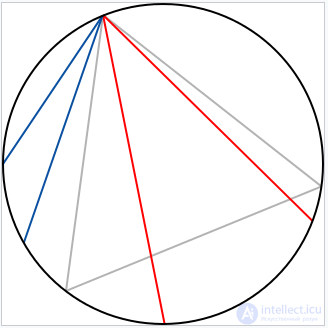
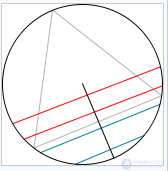
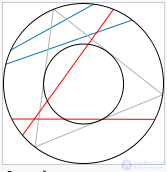
Suppose we have a circle on which a random point has been chosen. It is required to choose a random arc on this circle. There are three possible methods of choosing the arc:
What will the probabilities of choosing the arc be when using these three methods?
In the first method, the probability of choosing the arc is equal to 1/3, since the arc can only fall into a third of the circle, corresponding to the random angle.
In the second method, the probability of choosing the arc is equal to 1/2, since each arc intersects two of the three points
In the second method, the probability of choosing the arc is equal to 1/4, since among the four possible positions of the point on the arc, only one intersects one of the three points.
Bertrand's paradox is as follows: consider an equilateral triangle inscribed in a circle. A chord of the circle is chosen at random. What is the probability that the chosen chord is longer than a side of the triangle?
Bertrand proposed three solutions, all apparently valid, but giving different results.
 .
.
 .
.
 .
.
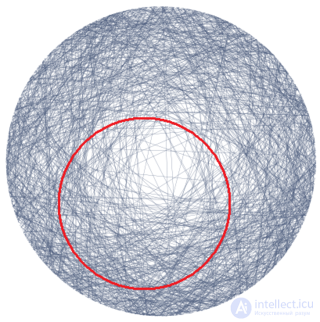
The choice of method can also be illustrated as follows. A chord is uniquely determined by its midpoint. All three methods described above give different distributions of the midpoint, each its own. Methods 1 and 2 represent two different non-uniform distributions, while the third method gives a uniform distribution. On the other hand, if we look at the images of the chords below, it is noticeable that the chords in method 2 give a uniformly shaded circle, whereas the 1st and 3rd methods do not give such a picture.
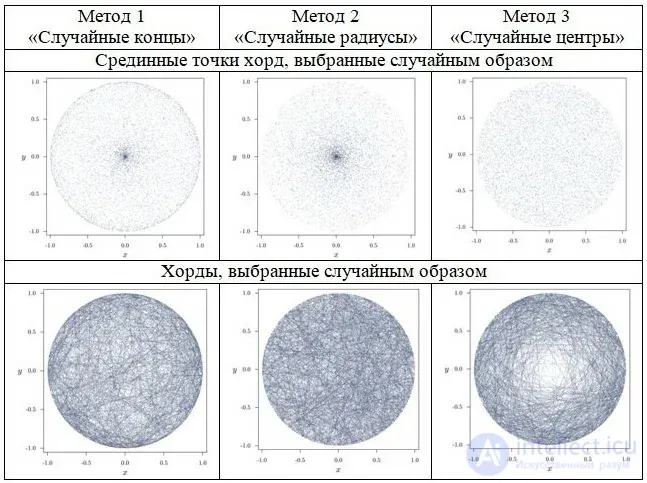
Other distributions can also be devised; many of them will give different fractions of chords having a greater length than the side of the inscribed triangle.
The classical solution of the problem thus depends on the method by which the chord is randomly chosen. If and only if the method of random selection is specified does the problem have a well-defined solution. The selection method is not unique, so there cannot be a single solution. The three solutions presented by Bertrand correspond to different selection methods, and in the absence of additional information there is no reason to prefer any one of them.
This and other paradoxes of the classical definition of probability justify stricter formulations, including frequentist probabilities and subjective Bayesian probabilities.
Edwin Jaynes, in his 1973 paper «The Well-Posed Problem» proposed a solution to Bertrand's paradox based on the principle of maximum ignorance: we should not use information that is not given in the statement of the problem. Jaynes pointed out that Bertrand's problem does not specify the position or size of the circle, and argued that in such a case any precise and objective solutions must be «indifferent» to the size and position. In other words, the solution must be invariant to scale and to transformations.
To illustrate: suppose chords are randomly laid down on a circle of diameter 2 (say, after straws have been thrown from a distance onto the circle). Then another circle with a smaller diameter (for example, 1.1) is superimposed on the larger one. Now the distribution of chords in the smaller circle should be the same as in the larger one. If the smaller circle is moved around within the larger one, the probability should not change. This can be clearly demonstrated in the case of changes to method 3: the distribution of chords in the small circle may look qualitatively different from their distribution in the large circle.
The same situation applies to method 1, although it is more complex to depict graphically. Only method 2 is invariant both under scaling and under transformations, method 3 has only scale invariance, method 1 — neither.
However, Jaynes did not use invariance alone to accept or reject these methods: that would mean the same as leaving open the possibility of the existence of some as yet undescribed method that also satisfies common-sense criteria. Jaynes used integral equations describing the invariance to precisely determine the probability distribution. For the given problem, the integral equations indeed have a unique solution — the one named above as method 2, the random radius method.
Method 2 is the only solution possessing transformational invariance, which is present in certain physical systems (such as statistical mechanics and the physics of gases), as well as in the experiment proposed by Jaynes of randomly throwing straws from a distance onto a circle. Nevertheless, someone could conduct other experiments yielding results corresponding to other methods. For example, in order to arrive at the solution given by method 1, the random endpoints method, one could attach a rotating pointer to the center of the circle and let the results of two independent spins mark the starting and ending points of the chords. In order to arrive at the solution given by method 3, one would need to cover the circle with molasses and mark the first point where a fly randomly lands as the midpoint of the chord. Several researchers have devised experiments to obtain various solutions and to verify the results empirically.


Comments