Probability theory conceals many puzzles and questions that play an important role not only in mathematics but also in the real world. This discipline provides tools for analyzing random events and predicting their probabilities. Understanding the fundamentals of probability is of great importance for making informed decisions in various fields, whether in scientific research, economic analysis, or everyday decisions.
Preparing for exams and interviews on probability theory involves not only understanding basic concepts but also the ability to apply them to solve a variety of problems. In this preparation, questions and tests with answers play a key role, helping students and candidates assess their knowledge and readiness. In this review, we will look at various questions on probability theory, providing detailed and clear answers to help you successfully prepare for exams and interviews, gaining a deeper understanding of the world of chance and probability.
Probability forms the foundation of many important data science concepts, from statistical inference to Bayesian networks. It would be wrong to say that the path to mastering statistics begins with probability. This test was created to help you determine your skill level with probability.
The test was designed to check conceptual knowledge of probability. If you are one of those who missed this test, here are the questions and solutions. You missed the real-time test, but you can read this article to find out how you could have answered correctly.
Instructions for taking the probability theory test at an interview:
Step 1: Preparation
1.1 Study the basic concepts: Before the interview, review the basic concepts and definitions in probability theory, such as events, probability, random variables, etc.
1.2 Review the formulas: Familiarize yourself with the basic formulas and methods for solving problems in probability theory.
1.3 Practice: Solve a variety of problems and exercises in probability theory to strengthen your skills and confidence.
Step 2: During the test
2.1 Read the questions carefully: Read each question carefully before you begin solving it. Understanding the problem statement is very important for a correct answer.
2.2 Use logic: Apply a logical approach when solving problems. Identify which known rules and methods are applicable for solving a given problem.
2.3 Analyze the answer options: When choosing an answer, pay attention to the remaining options and exclude those that are obviously incorrect.
2.4 If necessary, draw diagrams: In complex probability theory problems, visualization can help. Draw flowcharts, probability trees, or other diagrams to better understand the solution process.
2.5 Beware of traps: Some questions may be designed to confuse you or test your attentiveness. Be careful and attentive.
Step 3: Don't rush
3.1 Give each question enough time: Don't rush, but don't get stuck too long on one question either. Leave complex problems for later if needed.
3.2 Check your answers: If you have time at the end of the test, go through all the questions again and check your answers.
Step 4: After the test
4.1 Analysis of results: After completing the test, evaluate your results. Study the problems in which you made mistakes to understand how you can improve your knowledge of probability theory.
4.2 Learn from mistakes: Use the mistakes made during the test as lessons for improving your skills and knowledge.
By following these instructions, you will increase your chances of successfully passing the probability theory test at an interview. Good luck!
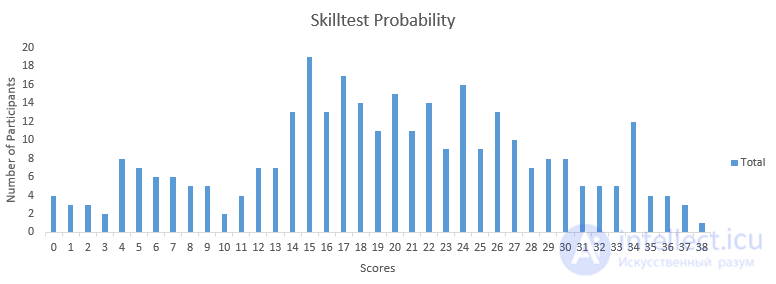
Overall scores
Below are the scores of those who have already answered these questions; they will help you assess your knowledge.
1. Let A and B be events in the same sample space, with P(A) = 0.6 and P(B) = 0.7. Can these two events be mutually exclusive?
Solution: (b)
These two events cannot be mutually exclusive, since P(A) + P(B) > 1.
P (AꓴB) = P (A) + P (B) -P (AꓵB).
The event is mutually exclusive if P (AꓵB) = 0. If A and B are mutually exclusive, P (AꓴB) = 0.6 + 0.7 = 1.3
And since probability cannot be greater than 1, these two mentioned events cannot be mutually exclusive.
2. Alice has two children, one of whom is a girl. What is the probability that the second child is also a girl? You may assume that there are equal numbers of men and women in the world.
- a) 0.5
- b) 0.25
- c) 0.333 *
- d) 0.75
Solution: (c)
The outcomes for two children can be {BB, BG, GB, GG}
Since it is mentioned that one of them is a girl, we can remove the BB option from the sample space. Thus, the sample space has 3 options, and only one matches the second condition. Therefore, the probability that the second child will be a girl is also 1/3.
3. A fair six-sided die is rolled twice. What is the probability of getting a 2 on the first roll and not getting a 4 on the second?
- a) 1/36
- b) 1/18
- c) 5/36 *
- d) 1/6
- e) 1/3
Solution: (C)
The two mentioned events are independent. The first roll of the die does not depend on the second roll. Therefore, the probabilities can be multiplied directly.
P (getting a 2 first) = 1/6
P (not getting a 4 second) = 5/6
Therefore, P (getting a 2 first and not getting a 4 second) = 1/6 * 5/6 = 5/36
4.
Solution: (A)
P (AꓵCc) will be just P (A). P (only A) + P (C) will make it P (AꓴC). P (BꓵAcꓵCc) equals P (only B), so P (AꓴC) and P (only B) together form P (AꓴBꓴC)
5. Take a four-sided die and roll it twice. What is the probability that the number on the first roll is strictly greater than the number on the second? Note: a four-sided die has only four sides (1, 2, 3, and 4).
- a) 1/2
- b) 3/8 *
- c) 16/7
- d) 16 September
Solution: (B)
| (1,1) |
(2,1) |
(3,1) |
(4,1) |
| (1,2) |
(2,2) |
(3,2) |
(4,2) |
| (1,3) |
(2,3) |
(3,3) |
(4,3) |
| (1,4. |
(2,4. |
(3,4) |
(4,4) |
There are 6 out of 16 possible options where the first outcome is strictly higher than the second.
6. Which of the following cannot be the probability of any event? A) -0.00001 B) 0.5 C) 1.001
- a) Only A
- b) Only B
- c) Only C
- d) A and B
- e) B and C
- f) A and C *
Solution: (F)
Probability is always in the range from 0 to 1.
7. Anita randomly selects 4 cards from a deck of 52 cards and puts them back in the deck (any set of 4 cards is equally likely). Then Babita randomly selects 8 cards from the same deck (any set of 8 cards is equally likely). Assume that Anita's selection of 4 cards and Babita's selection of 8 cards are independent. What is the probability that all 4 cards selected by Anita are included in the set of 8 cards selected by Babita?
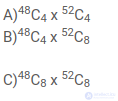
- a)
- b)
- c)
- d) None of the above
Solution: (A)
The total number of possible combinations will be 52 C 4 (for Anita to choose 4 cards) * 52 C 8 (for Babita to choose 8 cards).
Since the 4 cards Anita chooses are among the 8 cards Babita chose, the number of possible combinations is 52 C 4 (for choosing the 4 cards chosen by Anita) * 48 C 4 (for choosing any other 4 cards by Babita, since the 4 cards chosen by Anita are fixed)
8. If you were dealt 13 cards, what is the probability that the 13th card is a king? Context for question 8: A player is randomly dealt a sequence of 13 cards from a deck of 52 cards. All sequences of 13 cards are equally likely. In an equivalent model, cards are drawn and dealt one at a time. When drawing a card, the dealer is equally likely to choose any of the cards remaining in the deck.
- a) 1/52
- b) 1/13 *
- c) 1/26
- d) 1/12
Solution: (B)
Since we are not told anything about the first 12 cards dealt, the probability that the 13th card dealt is a king is equal to the probability that the first card dealt, or in fact any particular card dealt, is a king, which equals: 4/52
9. A fair six-sided die is rolled 6 times. What is the probability that all outcomes will be unique?
- a) 0.01543 *
- b) 0.01993
- c) 0.23148
- d) 0.03333
Solution: (A)
For all outcomes to be unique, we have 6 options for the first roll, 5 for the second roll, 4 for the third roll, and so on.
There are no restrictions on the first roll. The die can show any of 6 equally likely values. Thus, the probability that after the first roll there will be no duplicate numbers is 6/6, or100%.
With each subsequent roll, the number of "successful" rolls decreases by 1. For example, if our first roll was  , then the second roll must be anything but
  , which means that there are 5 "successful" outcomes (out of 6 possible) for roll 2. So, since each roll is independent of the previous rolls, we multiply their "success" probabilities. The probability that after two rolls there will be no repeats is 6/6×5/6=5/6, that is, with a probability of 83.3%.
Continuing this pattern, the third roll will have 4 "successful" outcomes out of 6, so we get
3 unique values=6/6×5/6×4/6=55.6%
and then
4 unique values=6/6×5/6×4/6×3/6=27.8%
5 unique values=6/6×5/6×4/6×3/6×2/6=9.26%
and finally
6 unique values=6×5×4×3×2×1/66 = 0.01543 = 1.54%.
Therefore, the probability of getting all unique outcomes is 0.01543.
10. A group of 60 students is randomly divided into 3 classes of equal size. All partitions are equally likely. Jack and Jill are two students belonging to this group. What is the probability that Jack and Jill end up in the same class?
- a) 1/3
- b) 19/59 *
- c) 18/58
- d) 1/2
Solution: (B)
Assign each student a different number from 1 to 60. Numbers 1 through 20 belong to group 1, 21 through 40 to group 2, and 41 through 60 to group 3.
All possible partitions are obtained with equal probability by randomly assigning these numbers; it doesn't matter which student we start with, so we can start by assigning a random number to Jack, and then we assign a random number to Jill. After Jack has been assigned a random number, 59 random numbers are available for Jill, and 19 of them will place her in the same group as Jack. Therefore, the probability is 19/59.
11. We have two coins: A and B. For each flip of coin A, the probability of getting heads is 1/2, and for each flip of coin B, the probability of getting heads is 1/3. All flips of a single coin are independent. We choose a coin at random and flip it until we get heads. The probability of choosing coin A is ¼, and coin B is 3/4. What is the expected number of flips needed to get the first heads?
- a) 2.75 *
- b) 3.35
- c) 4.13
- d) 5.33
Solution: (A)
If coin A is chosen, then the number of times the coin must be flipped to guarantee heads is 2; similarly, for coin B it is 3. Thus, the number of flips will be
Flips = 2 * (1/4. [probability of choosing coin A]) + 3 * (3/4. [probability of choosing coin B])
= 2.75
This is simply an application of the Law of Total Expectation [[b12326]] .
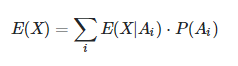
In our case the definitions are as follows:
x - the random variable for the number of flips needed to get heads,
А1 : the coin with a probability of landing heads equal to 1/2 of being chosen,
А2 : the coin with a probability of landing heads equal to 1/3 of being chosen.
From the geometric distribution
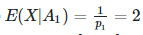 and
and
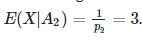 And
And
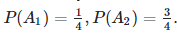 .
.
Therefore, we have
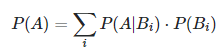
I think you're already familiar with the Law of Total Probability. It has a structure similar to the Law of Total Expectation, but for probabilities:
We can say that E(X) is the weighted average of the conditional expectations.
12. Suppose a life insurance company sells a one-year, $240,000 life insurance policy to a 25-year-old woman for $210. The probability that the woman will survive the year is 0.999592. Find the expected profit of this policy for the insurance company.
- a) $131
- b) $140
- c) $112 *
- d) $125
Solution: (c)
P (company loses money) = 0.000408 (probability that the woman dies)
P (company does not lose money) = 0.99592 (probability that the woman survives the year.)
The amount of money the company must pay out (loses) if the woman dies is $240,000 - $210 (cost of the policy) = $239,790.
Meanwhile, the money it receives is $210
Expected money the company will have to pay out = 239790 * 0.000408 = $97.8
Expected money the company will receive = $210
Expected profit = Revenue - Expenses
Revenue for the insurance company is $210 (policy price), and expenses are the expected payouts on policies, which equal $98.
Thus, the expected profit of the insurance company is:
Expected profit = $210 - $98 = $112.
the expected profit of the insurance company is $112.
13. 
Solution: (A)
The above statement is true. You need to know that
P (A / B) = P (AꓵB) / P (B)
P (C c A | A) = P (C c AꓵA) / P (A) = P (C c A) / P (A)
P (B | A ꓵ C c ) = P (AꓵBꓵC c ) / P (A ꓵ C c )
Multiplying these three, we get - P (AꓵBꓵC c ), therefore the equations hold
14. When is an event A independent of itself?
- a) Always
- b) if and only if P (A) = 0
- C) If and only if P (A) = 1
- D) If and only if P (A) = 0 or 1 *
Solution: (D)
An event can be independent of itself only when it never occurs or when it necessarily occurs. Events A and B are independent if P (AꓵB) = P (A) * P (B). Now, if B = A, P (AꓵA) = P (A), when P (A) = 0 or 1.
15. Suppose you are in the final round of the game show "Let's Make a Deal" and must choose one of three doors - 1, 2, and 3. Behind one of the three doors is a car, and behind the other two are goats. Suppose you choose Door 1, and the host opens Door 3, which has a goat behind it. To guarantee the probability of your win, which of the following would you choose?
- A) Switch your choice *
- b) Keep your choice
- c) It doesn't matter, since the probability of winning or losing is the same with or without opening one door.
Solution: (A)
I would recommend reading this article for a detailed discussion of the Monty Hall problem.
16. Cross-fertilizing red and white flowers produces red flowers 25% of the time. Now we cross-fertilize five pairs of red and white flowers and produce five offspring. What is the probability that none of the five offspring are red-flowered plants?
- a) 23.7% *
- b) 37.2%
- c) 22.5%
- d) 27.3%
Solution: (A)
The probability that an offspring will be red is 0.25, so the probability that an offspring will not be red is 0.75. Since all pairs are independent of each other, the probability that all offspring are not red will be (0.75)^5 = 0.237. You can think of this as a binomial with all failures.
17. A roulette wheel has 38 slots - 18 red, 18 black, and 2 green. You play five games and always bet on red slots. How many games can you expect to win?
- a) 1.1165
- b) 2.3684 *
- c) 2.6316
- d) 4.7368
Solution: (B)
The probability that any spin will be red is 18/38. Now you play the game 5 times, and all games are independent of each other. Thus, the number of games you can expect to win is 5 * (18/38) = 2.3684.
18. A roulette wheel has 38 slots, 18 red, 18 black, and 2 green. You play five games and always bet on red. What is the probability that you win all 5 games?
- a) 0.0368
- b) 0.0238 *
- c) 0.0526
- d) 0.0473
Solution: (B)
The probability that any spin will be red is 18/38. Now you play the game 5 times, and all games are independent of each other. Thus, the probability that you win all games is (18/38)^ 5 = 0.0238.
19. Some test scores have a normal distribution with a mean of 18 and a standard deviation of 6. What proportion of test-takers scored between 18 and 24?
- a) 20%
- b) 22%
- c) 34% *
- D) None of the above
Solution: (C)
So, here we need to calculate the Z scores for the values 18 and 24. We can easily do this by setting the sample mean as 18 and the population mean as 18 with σ = 6 and calculating Z. Similarly, we can calculate Z for a sample mean of 24.
Z = (X-μ) / σ
Therefore, for 26 as X,
Z = (18-18) / 6 = 0, looking at the Z table, we find that 50% of people have scores below 18.
For 24 as X
Z = (24-18) / 6 = 1, looking at the Z table, we find that 84% of people have a score below 24.
Thus, about 34% of people have a score between 18 and 24.
20. There are 4 marbles in a bag. 3 red and 1 white. After each draw, two marbles are drawn with replacement. What is the probability that a marble of the same color is drawn twice?
- a) 1/2
- b) 1/3
- c) 5/8 *
- d) 1/8
Solution: (C)
If the marbles are the same color, this will be 3/4 * 3/4 + 1/4 * 1/4 = 5/8.
21. Which of the following events is most likely?
- a) At least one 6 when 6 dice are rolled *
- b) At least 2 sixes when 12 dice are rolled
- C) At least 3 sixes when 18 dice are rolled
- D) All of the above have the same probability
Solution: (A)
The probability of rolling a 6 on a die is P (6. = (1/6. & P (6 ') = (5/6). Thus, the probability
Case 1: (1/6) * (5/6) 5 = 0.06698
Case 2: (1/6) 2 * (5/6) 10 = 0.00448
Case 3: (1/6) 3 * (5/6) 15 = 0.0003
Thus, the highest probability is Case 1.
22. Suppose you were hired for an interview for a technical role. 50% of the people who attended the first interview received an invitation for a second interview. 95% of the people who were called for a second interview felt satisfied with their first interview. 75% of the people who were not called a second time also felt satisfied with their first interview. If you felt good after the first interview, what is the probability that you will be called for a second interview?
- a) 66%
- b) 56% *
- c) 75%
- d) 85%
Solution: (B)
Suppose the first round of interviews was given to 100 people. 50 people received an invitation for a second-round interview. 95% of them rated their interview positively, which is 47.5%. 50 people were not called for an interview; of them, 75% felt about good, which is 37.5. Thus, the total number of people who felt good after the interview is (37.5 + 47.5) 85. Thus, of the 85 people who felt good, only 47.5 received a call to the next round. Therefore, the probability of success (47.5 / 85) = 0.558.
Another more common way to solve this problem is Bayes' theorem. I leave that up to you.
23. A coin 1 inch in diameter is thrown onto a table covered with a grid of lines spaced two inches apart. What is the probability that the coin lands inside a square without touching any of the grid lines? You may assume that the thrower doesn't know how to throw a coin and throws it randomly. You may assume that the thrower doesn't know how to throw a coin and throws it randomly.
- a) 1/2
- b) 1/4 *
- c) Π / 3
- d) 1/3
Solution: (B)
Think about where the entire center of the coin could be when it lands on the 2-inch grid and does not touch the grid lines.
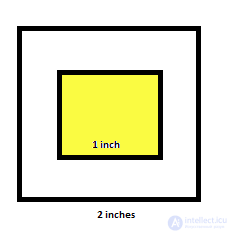
If the yellow area represents a 1-inch square and the outer square is 2 inches. If the center falls in the yellow area, the coin will not touch a grid line. Since the total area is 4 and the area of the yellow region is 1, the probability is.

24. There are a total of 8 bows, 2 each of green, yellow, orange, and red colors. In how many ways can you choose 1 bow?
Solution: (C)
You can choose one of four different bows, so you can choose one bow in four different ways.
25. Consider the following probability density function: What is the probability for X≤6, i.e. P (x≤6) 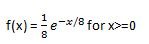 What is the probability for X≤6, i.e. P (x≤6)
- a) 0.3935
- b) 0.5276 *
- c) 0.1341
- d) 0.4724
Solution: (B)
To calculate the area of a specific region of a probability density function, we need to integrate the function within the limits of the values for which we need to calculate the probability.
Therefore, integrating the given function from 0 to 6 gives us 0.5276
26. In a class of 30 students, what is the approximate probability that two of the students will have a birthday on the same day (defined by the same day and month) (assuming it is not a leap year)? For example, students whose birthdays are January 3, 1993 and January 3, 1994 would be a favorable event.
- a) 49%
- b) 52%
- c) 70% *
- d) 35%
Solution: (C)
The total number of possible combinations, when no two people can have the same birthday in a class of 30, is 30 * (30-1) / 2 = 435.
So, there are 365 days in a year (assuming it is not a leap year). Thus, the probability that people will have a different birthday is 364/365. Now 870 combinations are possible. Thus, the probability that two people have the same birthday is (364/365) ^ 435 = 0.303.
Thus, the probability that two people's birthdays fall on the same day is 1 - 0.303 = 0.696.
27. Ahmed plays a lottery where he must choose 2 numbers from 0 to 9, followed by an English letter (out of 26 letters). He can choose the same number both times. If his ticket matches 2 numbers and 1 letter, written in order, he wins the grand prize and receives $10,405. If only his letter matches, but one or both numbers don't match, he wins $100. Under any other circumstances, he wins nothing. The game costs him $5. Suppose he chose 04R for the game. What is the expected net profit of playing this ticket?
- a) -$2.81
- b) $2.81 *
- c) -$1.82
- D) $1.82
Solution: (B)
The expected value in this case is
E (X) = P (grand prize) * (10405-5. + P (small) (100-5. + P (loss) * (- 5.
P (grand prize) = (1/10) * (1/10) * (1/26.
P (small) = 1 / 26–1 / 2600, the reason we need to do this is that we need to exclude the case where he gets the correct letter as well as the correct numbers. Therefore, we need to remove the scenario of getting the letter right.
P (loss) = 1-1 / 26-1 / 2600
Therefore, we can fit the values to get an expected value of $2.81.
28. Suppose you sell sandwiches. 70% choose egg, the rest chicken. What is the probability of selling two egg sandwiches to the next three customers?
- a) 0.343
- b) 0.063
- c) 0.44 *
- d) 0.027
Solution: (C)
The probability of selling an egg sandwich is 0.7, and a chicken sandwich is 0.3. Now the probability that the next 3 customers will order 2 egg sandwiches is 3 * 0.7 * 0.7 * 0.3 = 0.44. They can be arranged in any sequence; the probabilities remain the same.
29. What is the probability that a new recruit is infected with HIV if he has a positive result on the first Elisa test? The prior probability of anyone being infected with HIV is 0.00148. The true positive rate for Elisa is 93%, and the true negative rate is 99%.
- a) 12% *
- b) 80%
- c) 42%
- d) 14%
Solution: (A) I recommend reviewing the Bayesian updating section of this article to understand the question posed above. Context for question: 29 - 30. HIV is still a very frightening disease, one worth getting tested for. The US military tests its recruits for HIV upon enlistment. They are tested in three rounds of Elisa (HIV test) before being declared positive. The prior probability of anyone being infected with HIV is 0.00148. The true positive rate for Elisa is 93%, and the true negative rate is 99%.
30. What is the probability of HIV infection if he has a second positive Elisa test result.
The prior probability of anyone being infected with HIV is 0.00148. The true positive rate for Elisa is 93%, and the true negative rate is 99%.
- a) 20%
- b) 42%
- c) 93% *
- d) 88%
Solution: (C)
I recommend reviewing the Bayesian updating section of this article to understand the question posed above.
31. Suppose you are playing a game in which we flip a fair coin several times. You have already lost three times, guessing heads, but tails came up. Which of the following statements would be correct in this case?
- A) You should guess heads again, since tails has already come up three times, and the probability of heads is higher.
- b) You should say tails, because guessing heads does not lead to a win
- C) You have the same probability of winning by guessing either one, so no matter what you guess, the probability of winning or losing is 50-50. *
- D) None of these
Solution: (C)
This is the classic gambler's fallacy / Monte Carlo fallacy problem, where a person falsely begins to think that outcomes must even out after a few turns. The player starts to believe that if we got 3 tails, we should get 3 heads. However, this is not true. The outcomes would only even out over an infinite number of trials.
32. Inference using the frequentist approach will always give the same result as the Bayesian approach.
Solution: (B)
The frequentist approach depends heavily on how we define the hypothesis, while the Bayesian approach helps us update our prior beliefs. Therefore, the frequentist approach can lead to the opposite conclusion if we formulate the hypothesis differently. Therefore, these two approaches may not produce the same results.
33. Hospital records show that 75% of patients suffering from a certain disease die from it. What is the probability that 4 out of 6 randomly selected patients will recover?
- a) 0.17798
- b) 0.13184
- c) 0.03295 *
- d) 0.35596
Solution: (C)
Think of this as binomial, since there are only 2 outcomes: either the patient dies or survives.
Here n = 6, and x = 4. p = 0.25 (probability of living (success)) q = 0.75 (probability of dying (failure))
P (X) = n C x p x q n-x = 6 C 4 (0.25. 4 (0.75. 2 = 0.03295
34. Students in a class were given two tests for grading. Twenty-five percent of the class passed both tests, and forty-five percent of the students were able to pass the first test. Calculate the percentage of students who passed the second test, given that they were able to pass the first test.
- a) 25%
- b) 42%
- c) 55% *
- d) 45%
Solution: (C)
This is a simple conditional probability problem. Let A be the event of passing the first test.
B is the event of passing the second test.
P (AꓵB) is passing both events
P (passing the second, given that he passed the first) = P (AꓵB) / P (A)
= 0.25 / 0.45, which is about 55%
35. Although it is said that the probability of having a boy or a girl is equal, let's assume that the actual probability of having a boy is slightly higher, at 0.51. Suppose a couple plans to have three children. What is the probability that exactly two of them will be boys?
- a) 0.38 *
- b) 0.48
- c) 0.58
- d) 0.68
- E) 0.78
Solution: (A)
Think of this as a binomial distribution, where success is a boy and failure is a girl. Therefore, we need to calculate the probability of getting 2 out of three successes.
P (X) = n C x p x q n-x = 3 C 2 (0.51) 2 (0.49) 1 = 0.382
36. The height of 10-year-olds, regardless of gender, follows a normal distribution with a mean of 55 inches and a standard deviation of 6 inches. Which of the following statements is true?
- A) We expect more 10-year-olds shorter than 55 inches than those taller than 55 inches.
- b) Approximately 95% of 10-year-olds are between 37 and 73 inches tall.
- C) A 10-year-old who is 65 inches tall would be considered more unusual than a 10-year-old who is 45 inches tall.
- D) None of these *
Solution: (D)
None of the above statements are true.
37. About 30% of human twins are identical, the rest are fraternal. Identical twins are necessarily the same sex, half being male and the other half female. A quarter of fraternal twins are both male, a quarter are both female, and half are mixed: one male, one female. You have just become the father of twins, and you are told they are both girls. Given this information, what is the probability that they are identical?
- a) 50%
- b) 72%
- c) 46% *
- d) 33%
Solution: (C)
This is a classic Bayes' theorem problem.
P (I) denotes the probability of being identical, and P (~ I) denotes the probability of not being identical.
P (identical) = 0.3
P (not identical) = 0.7
P (FF | I) = 0.5
P (MM | I) = 0.5
P (MM | ~ I) = 0.25
P (FF | ~ I) = 0.25
P (FM | ~ I) = 0.25
P (I | FF) = 0.46
38. Vasily has a high fever, and the doctor suspects it is typhoid fever. Naturally, the doctor wants to run a test. The test results are positive when the patient actually has typhoid fever in 80% of cases. The test gives a positive result if the patient does not have typhoid fever in 10% of cases. If 1% of the population has typhoid fever, what is the probability that Vasily has typhoid fever given a positive test result?
- a) 12%
- b) 7% *
- c) 25%
- d) 31.5%
Solution: (B)
Solution:
We need to determine the probability of having typhoid fever given a positive test result.
Using Bayes' theorem:
P(typhoid|positive result) = P(positive result|typhoid)*P(typhoid fever)/P(positive result)
P(positive result|typhoid fever) = 0.8
P (typhoid fever) = 0.01
P(positive result) = P(positive result|typhoid fever) P(typhoid fever) + P(positive result|no typhoid fever) P(no typhoid fever) = 0.8*0.01+0.1*0.99
P (typhoid | positive result) = 0.0747.
39. Volodya has two coins in his hand. Of the two coins, one is fair, and the second is defective with tails on both sides. He blindfolds himself, chooses a random coin, and flips it in the air. The coin lands tails up. What is the probability that the defective coin shows this tails result?
- a) 1/3
- b) 2/3 *
- c) 1/2
- d) 1/4
Solution: (B)
We need to find the probability that the coin is defective, given that it landed tails.
P (defective) = 0.5
P (getting tails) = 3/4
P (defective and tails) = 0.5 * 1 = 0.5
Therefore, the probability that the coin turns out to be defective, given that it lands tails, will be 2/3.
40. A fly lives 4-6 days. What is the probability that the fly will die exactly at 5 days?
- a) 1/2
- b) 1/4
- c) 1/3
- d) 0 *
Solution: (D)
Here, since the probabilities are continuous, the probabilities form a mass function. The probability of a specific event is calculated by finding the area under the curve for the given conditions. Since we are trying to calculate the probability that the fly dies exactly at 5 days, the area under the curve will be 0. Also, if you think about it, the probability that the fly dies exactly at 5 days is impossible for us to even determine, since we cannot measure with infinite precision whether it was exactly 5 days.
Discrete model (4, 5, 6 days equally likely): probability of 5 days = .
Continuous model (uniform distribution on [4,6]): probability of exactly 5 days = 0, but one can compute the probability for an interval around 5.
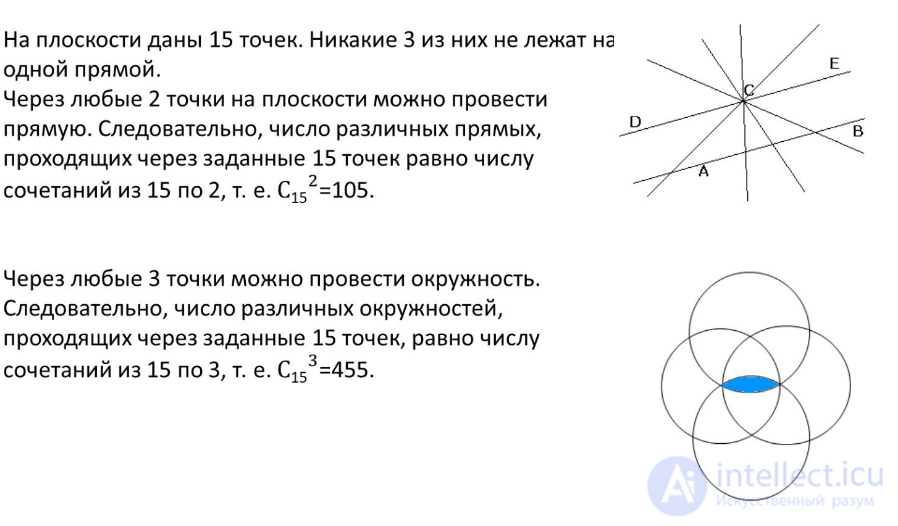
41. The problem of points on a plane. a) 15 points are given on a plane. No 3 of them lie on the same line. How many distinct lines can be drawn? b) How many circles do these points determine?
- а 105 * and б 455
- а 10 and б 20
- а 5 and б 3
- а 1005 and б 103
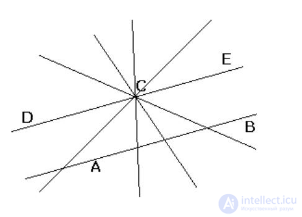
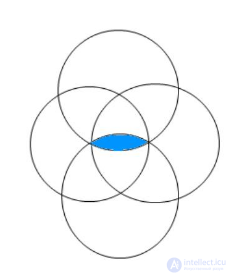
Solution to the problem of points on a plane
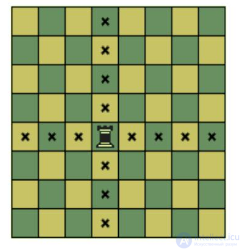
42. The rook problem. In how many ways can a white rook and a black rook be placed on a chessboard so that they do not attack each other?
Solution
The white rook can be placed on any of the 64 squares. It attacks 15 squares: 7 vertically, 7 horizontally, and the one it stands on, regardless of where it stands. That leaves 64 - 15 = 49 places to put the black rook. This means the number of ways to place both rooks so that they do not attack each other is 64*49=3136. Answer: 3136 ways.
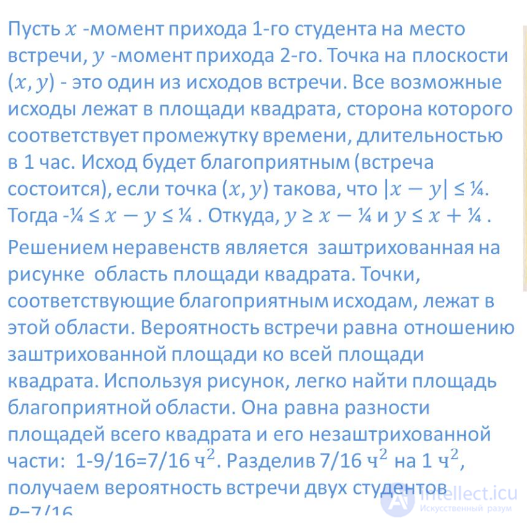
43. The meeting problem. Two students agreed to meet at some place between 9 and 10 o'clock. Moreover, each waits for the other for a set time. What is the probability that they will meet?
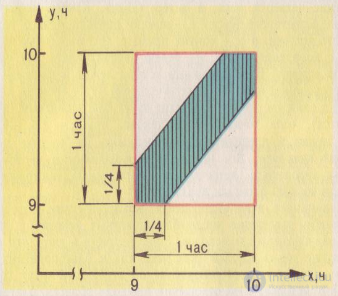
solution
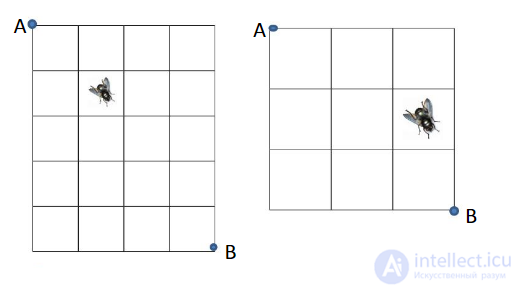
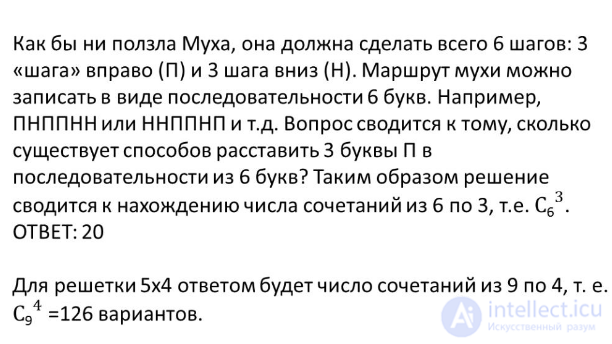
44. The fly problem. A fly crawls along a 3x3 grid from point A to point B, moving all the time to the right or down. How many different routes can the fly choose? How does the answer change for a 4x5 grid?
- 15 and 20
- 5 and 16
- 20 and 126 *
- 100 and 200
45. The problem of the astrologer. A certain ruler grew angry with an astrologer and ordered the executioner to cut off his head. However, at the last moment, the ruler softened and decided to give the astrologer a chance to save himself. He took 2 black balls and 2 white balls and offered the astrologer to arbitrarily distribute them into 2 urns. The executioner must choose one of the urns at random and randomly draw a ball from it. If the ball turns out to be white, the astrologer will be pardoned, and if black, he will be executed. How
should the astrologer distribute the balls into 2 urns to have the greatest chance of being saved?
- answer a
- answer b
- answer c *
- answer d
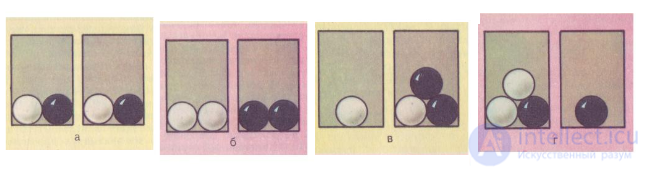
Solution
Let the astrologer place 1 white ball and 1 black ball in each urn (fig. a). In this case, it doesn't matter which urn the executioner approaches.
From either urn, he will draw a white ball with probability Р= ½. So the astrologer's probability of being saved is also ½.
The probability of being saved will also be ½ if the astrologer places 2 white balls in one urn and 2 black balls in the other (fig. b).
The executioner is equally likely to approach either the "white" or the "black" urn.
Let the astrologer place 1 white ball in one urn, and 1 white and 2 black balls in the other (fig. c). If the executioner approaches the 1st urn, the astrologer will certainly be saved (Р=1). If the executioner approaches the 2nd urn, the astrologer's probability of being saved is Р=⅓.
Since the probability of choosing a given urn is ½, the total probability of being saved is Р=(½*1)+(½*⅓)=⅔.
If the astrologer places 1 black ball in one urn, and 1 black and 2 white balls in the other (fig. d), then the probability of being saved is the smallest:
Р=(½*0)+(½*⅔)= ⅓.
Thus, the greatest chances of being saved correspond to (fig. c).
46. The "Wandering in the Labyrinth" problem. The figure shows a labyrinth in which treasure is stored and there is a trap (a cobra). Unlucky treasure hunters who fall into the trap perish. What is the probability of avoiding the trap and reaching the treasure?
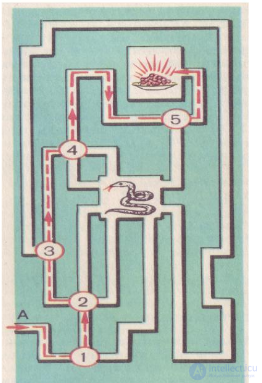
Solution to the problem
Having gone from A to point 1, the seeker can go straight or turn left. Clearly, the probability of the choice is Р= ½.
Arriving at point 2, the seeker chooses a path - straight, or right, or left.
The probability of the choice is Р=⅓. Then the probability of getting from A to point 3 is Р= ½ * ⅓, i.e. turning left at point 1 with Р= ½ and left at point 2 with Р=⅓.
To get from A to point 4, one must go straight from point 3 with Р= ½, i.e. Р= ½ * ⅓* ½.
Clearly, Р of getting from A to point 5 is Р= ½ * ⅓* ½* ⅓.
The probability of getting from A to the treasury is Р= ½ * ⅓* ½* ⅓* ½=1/72.
The probability of falling into the trap and perishing is Р=71/72.
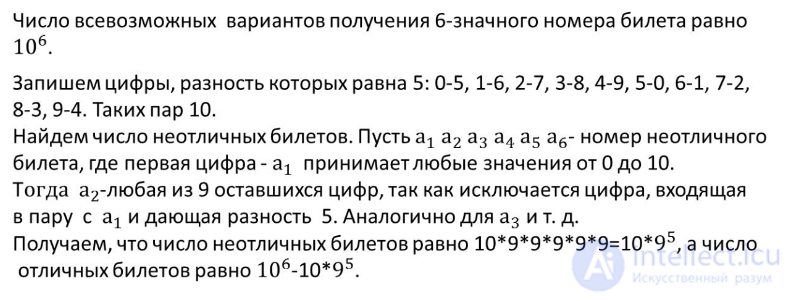
47. The problem of the excellent ticket. Call a ticket with a number from 000000 to 999999 excellent if the difference between two adjacent digits equals 5. Find the number of excellent
tickets.
- 106
- 10 * 95
- 106 - 10 * 95 *
- 1- 10 * 95
solution
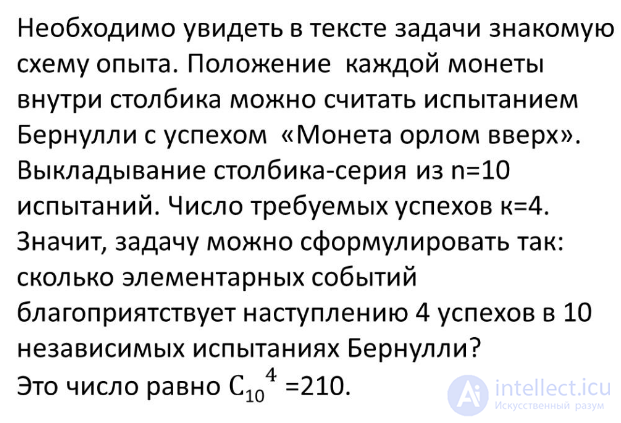
48. The "Cashier" problem. To count coins faster at the end of the workday, a cashier stacks ruble coins in advance in columns of 10 coins each. In doing so, each coin in the column is equally likely to lie heads or tails up. How many total ways are there to place 10 coins in a column so that exactly 4 of them lie heads up?
solution
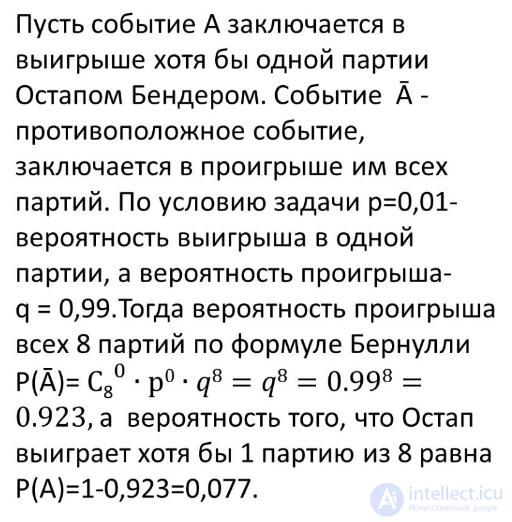
49. The "Chess Game" problem. Ostap Bender plays 8 chess games against members of the chess club. Ostap plays poorly, so the probability of him winning any given game is 0.01. Find the probability that Ostap wins at least 1 game.
Solution
50. The problem of the balls in an urn. A white ball is dropped into an urn containing two balls, after which one ball is randomly drawn from it. Find the probability that the drawn ball turns out to be white, if various assumptions about the original color of the balls are equally likely.
Solution
Event A - a white ball is drawn. Possible hypotheses about the original composition of the balls: B1 - no white balls, B2 - one white ball, B3 - two white balls. Since they are equally likely, the probability of each hypothesis is 1/3. The conditional probability of drawing a white ball, if the first hypothesis is true, i.e. there were no white balls in the urn, is Р(А/В1)=1/3, the conditional probability of drawing a white ball with two white balls in the urn is Р(А/В2)=1, and the probability of drawing a white ball if there was one white ball in the urn is Р(А/В3)=2/3. We calculate the probability of drawing a white ball using the total probability formula: Р(a)=1/3*1/3+1/3*2/3+1/3*1=2/3.
51. the problem of balls. In one urn there are 10 white and 6 black balls, in the other - 7 white and 9 black balls. An urn is chosen at random and a ball is taken from it. It is white. What is the probability that a second ball, randomly drawn from this same urn, will also turn out white?
Solution
Event A - a white ball is drawn in each of two trials.
B1 - the hypothesis of choosing the first urn, B2 - choosing the second urn, Р(В1)=Р(В2)=1/2.
Conditional probabilities: Р(А/В1)=10/16*9/15=15/40 - probability of drawing a white ball
from the first urn on the first and second trial.
Р(А/В2)=7/16*6/15=7/40 - probability of drawing a white ball in a row from the second urn.
Р(a)=1/2*15/40+1/2*7/40=1/2*22/40=11/40
52. the problem of balls in an urn. In the first urn there are 10 balls, of which 8 are white; in the second urn there are 20 balls, of which 4 are white. One ball is randomly drawn from each urn, and then one ball is randomly taken from these two balls. Find the probability that the ball taken is white. (Р=0.5)
Solution. Let us introduce hypotheses about the color of the balls drawn from each urn: B1 - a white ball is drawn from each urn. Р(В1)=8/10*4/20=4/25. В2 - a black ball is drawn from each urn. Р(В2)=2/10*16/20=4/25. В3 - 1 white and 1 black ball are drawn from the urns. Р(В3)=8/10*16/20 + 2/10*4/20 = 17/25. Event A - the ball is white. Consider the conditional probabilities of drawing a white ball out of the two balls under these hypotheses: Р(А/В1)=1, Р(А/В2)=0, Р(А/В3)=1/2, then by the total probability formula Р(a)=1*4/25+ 0*4/25 + 1/2*17/25=4/25+17/50 = ½.
If you have any questions or doubts, feel free to post them below.
See also
- Event
- Probability
- Random variable
- Random event
- Discrete random variable
- Continuous random variable
- Probability density
- Monty Hall paradox
- Linear partial information
- Mathematical statistics
- Probability space
- Interpretations of probability
- Bayes' theorem
- Predictive modeling



Comments