
Lecture
The Monty Hall paradox — one of the well-known problems of probability theory, whose solution, at first glance, contradicts common sense. This problem is not a paradox in the narrow sense of the word, since it does not contain a contradiction; it is called a paradox because its solution may seem unexpected. Moreover, many people find it difficult to accept the correct solution even after it has been explained to them .
The problem was first published (together with a solution) in 1975 in the journal «The American Statistician» by Steve Selvin, a professor at the University of California. It became popular after appearing in the magazine «Parade» in 1990.
The problem is formulated as a description of a game based on the American TV game show «Let’s Make a Deal», and is named after the host of that show. The most common formulation of this problem, published in 1990 in the magazine Parade Magazine, reads as follows:
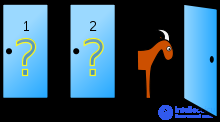
| Imagine that you have become a participant in a game in which you need to choose one of three doors. Behind one of the doors is a car, behind the other two doors are goats. You choose one of the doors, for example, number 1, after which the host, who knows where the car is and where the goats are, opens one of the remaining doors, for example, number 3, behind which there is a goat. After that, he asks you — would you like to change your choice and pick door number 2? Will your chances of winning the car increase if you accept the host’s offer and change your choice? |
After publication, it immediately became clear that the problem was incorrectly formulated: not all conditions were specified. For example, the host might follow the «Monty from Hell» strategy: offering to switch the choice if and only if the player picked the car on the first move. Obviously, changing the initial choice in such a situation would guaranteedly lead to a loss (see below).
The most popular version is the problem with an additional condition — the game participant knows the following rules in advance:
The text below discusses the Monty Hall problem specifically in this formulation.
| Door 1 | Door 2 | Door 3 | Result if switching | Result if not switching |
|---|---|---|---|---|
| Car | Goat | Goat | Goat | Car |
| Goat | Car | Goat | Car | Goat |
| Goat | Goat | Car | Car | Goat |
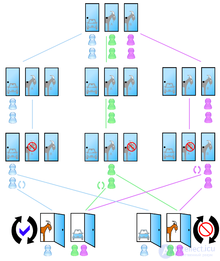
For a winning strategy, the following is important: if you change your choice of door after the host’s actions, you win if you originally chose the losing door. This will happen with probability 2⁄3, since there are 2 ways out of 3 to initially choose a losing door.
But often when solving this problem, people reason approximately as follows: the host always ends up removing one losing door, and then the probabilities of the car being behind either of the two unopened doors become equal to ½, regardless of the initial choice. But this is incorrect: although there are indeed two remaining choices, these possibilities (taking into account prior history) are not equally probable. This is because initially all doors had equal chances of being the winning one, but then they had different probabilities of being excluded.
For most people, this conclusion contradicts intuitive perception of the situation, and due to the resulting discrepancy between the logical conclusion and the answer that intuition tends toward, the problem is called the Monty Hall paradox.
The situation with the doors becomes even more illustrative if we imagine that there are not 3 doors but, say, 1000, and after the player’s choice the host removes 998 extra ones, leaving 2 doors: the one chosen by the player and one more. It seems more obvious that the probabilities of the prize being behind these doors are different, and not equal to ½. If we change the door, we lose only if we initially chose the prize door, the probability of which is 1:1000. We win if our initial choice was incorrect, and the probability of that is 999 out of 1000. In the case with 3 doors the logic is the same, but the probability of winning by switching is accordingly 2⁄3, rather than 999⁄1000.
Another way of reasoning is replacing the condition with an equivalent one. Imagine that instead of the player making an initial choice (let it always be door No. 1) and the host subsequently opening a door with a goat among the remaining ones (that is, always among No. 2 and No. 3), the player needs to guess the door on the first try, but is beforehand told that behind door No. 1 the car may be with the original probability (33%), and among the remaining doors it is indicated behind which one the car is definitely not (0%). Accordingly, the last door will always account for 67%, and the strategy of choosing it is preferable.
An even more illustrative line of reasoning — knowing the full conditions of the game in advance (that a change of choice will be offered) and having agreed to these conditions beforehand, the player is in fact, for the first time, choosing the door behind which, in their opinion, there is no prize (and may be wrong with probability 1⁄3). At the same time, indirectly they are pointing to the two remaining doors, behind one of which, in their opinion, there is a prize, which gives a chance of winning of 2⁄3. This is equivalent to a game in which the host, at the very beginning, would offer the player once to exclude one "extra" door and guaranteedly open the two remaining ones.
An intuitively clear explanation — there are 111 sets of 3 doors. The player makes their initial choice in all 111 sets. It is known that they guessed correctly in 37 sets. The host removes 1 door from each of the 111 sets. We get 111 sets with two doors, where the first choice has already been made. In these 111 sets, the choice was correct 37 times. If the player changes their choice, then those 37 will turn out to be wrong, but the remaining 74 will be correct.
The classic version of the Monty Hall paradox states that the host will necessarily offer the player to switch doors, regardless of whether they chose the car or not. But more complex host behavior is also possible. This table briefly describes several behavior options. Unless stated otherwise, prizes are placed behind doors with equal probability, the host knows where the car is, and if there is a choice — he chooses between the two goats with equal probability. If the host influences the probabilities rather than following a rigid procedure, then his goal is to keep the car away from the contestant. The contestant’s goal, accordingly, is to get it.
| Host behavior | Result |
|---|---|
| «Monty from Hell»: the host offers to switch if the door is correct . | Switching will always give a goat. |
| «Angelic Monty»: the host offers to switch if the door is incorrect . | Switching will always give a car. |
| «Ignorant Monty» or «Monty Fall»: the host accidentally falls, a door opens, and it turns out there is no car behind it. In other words, the host himself does not know what is behind the doors, opens a door completely at random, and it just happens by chance that there was no car behind it . | Switching gives a win in ½ of cases. This is exactly how the American show «Deal or No Deal» works — except that the random door is opened by the player themselves, and if there is no car behind it, the host offers to switch. |
| The host chooses one of the goats and opens it, if the player chose the other door. | Switching gives a win in ½ of cases. |
| The host always opens a goat. If the car was chosen, the left goat is opened with probability p and the right one with probability q=1−p. [10] | If the host opened the left door, switching gives a win with probability  . If the right one — . If the right one —  . However, the contestant cannot in any way influence the probability that the right door will be opened — regardless of their choice, this will happen with probability . However, the contestant cannot in any way influence the probability that the right door will be opened — regardless of their choice, this will happen with probability  . . |
| The same, p=q=½ (the classic case). | Switching gives a win with probability 2⁄3. |
| The same, p=1, q=0 («powerless Monty» — a tired host stands by the left door and opens whichever goat is closer). | If the host opened the right door, switching gives a guaranteed win. If the left one — probability ½. |
| The host opens a goat always, if the car was chosen, and with probability ½ otherwise.[11] | Switching gives a win with probability ½. |
| General case: the game is repeated many times, the probability of hiding the car behind one door or another, as well as opening one door or another, is arbitrary, but the host knows where the car is and always offers to switch, opening one of the goats.[12][13] | Nash equilibrium: it is most advantageous for the host to play exactly the classic version of the Monty Hall paradox (probability of winning 2⁄3). The car is hidden behind any of the doors with probability ⅓; if there is a choice, we open any goat at random. |
| The same, but the host may not open a door at all. | Nash equilibrium: it is advantageous for the host not to open a door, probability of winning ⅓. |
The problem was proposed by Martin Gardner in 1959.
Three prisoners, A, B and C, are held in solitary cells and sentenced to death. The governor randomly chooses one of them and pardons him. The guard watching over the prisoners knows who has been pardoned, but is not allowed to say. Prisoner A asks the guard to tell him the name of the (other) prisoner who will definitely be executed: «If B is pardoned, tell me that C will be executed. If C is pardoned, tell me that B will be executed. If they are both to be executed, and I am pardoned, flip a coin and tell me the name of B or C».
The guard tells prisoner A that prisoner B will be executed. Prisoner A is glad to hear this, since he believes that his probability of survival has now become ½, rather than ⅓, as it was before. Prisoner A secretly tells prisoner C that B will be executed. Prisoner C is also glad to hear this, since he still believes that prisoner A’s probability of survival is ⅓, while his own probability of survival has increased to 2⁄3. How can this be?
Someone familiar with the Monty Hall paradox now knows that C is right and A is wrong.
So the statement «B will be executed» leaves options 1 and 4 — that is, 2⁄3 probability that C is pardoned, and ⅓ that A is.
People think the probability is ½ because they ignore the essence of the question that prisoner A asks the guard. If the guard could answer the question «Will prisoner B be executed?», then in the case of a positive answer the probability of A’s execution would indeed decrease from 2⁄3 to ½.
The question can also be approached from another angle: if A is pardoned, the guard will say either name at random; if A is executed — the guard will name whichever of the two is executed along with A. So the question gives A no additional chance of being pardoned.

Comments