
Lecture
In addition to discrete random variables, which have a finite or countable set of possible values, and continuous random variables, there exist random variables that are called mixed. This is, as it were, an intermediate type between discrete and continuous random variables.
Definition 1. The RV ξ is called mixed if its distribution function Fξ(x) is continuous on some intervals and has discontinuities at individual points.
On the intervals where Fξ(x) is continuous, the probability of each individual value equals zero; the probabilities of those values at which Fξ(x) jumps are nonzero and each equals the magnitude of the corresponding jump. In addition, the DF Fξ(x) of the mixed RV ξ must be differentiable everywhere except at the individual points where it has a jump.
The formula for the probability of falling into the interval [a; b)

is also valid for mixed random variables.
As with discrete RVs, the DF Fξ(x) of mixed random variables is left-continuous.
A mixed random variable is a random variable whose cumulative distribution function (CDF) is neither piecewise-constant (a discrete random variable) nor everywhere continuous. It can be realized as the sum of a discrete random variable and a continuous random variable; in this case the (CDF) will be a weighted average of the (CDFs) of the component variables.
An example of a random variable of mixed type can be based on an experiment in which a coin is tossed and a spinner is spun only if the outcome of the coin toss is heads. If the outcome is tails, X = -1; otherwise X = the value of the counter, as in the previous example. There is a probability of 1 / 2 that this random variable will take the value -1. The other ranges of values will have half the probabilities of the previous example.
In most cases, every probability distribution on the real line is a mixture of a discrete part, a singular part, and an absolutely continuous part; see the Lebesgue decomposition theorem.
The discrete part is concentrated on a countable set, but this set can be dense (like the set of all rational numbers).
Let us give an example of a mixed random variable
Example 1. A worker's earnings ξ over the course of a month depend on his output ζ.
The quantity ζ — is random (we shall regard it as continuous) and has the DF Fξ(x) .
The worker's earnings are proportional to his output ξ = a ζ but cannot be less than the guaranteed x1 or greater than x2.
Let us find the DF of the random variable ξ
Solution. It is obvious that
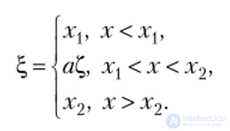
The RV ξ, — is mixed: on the interval (x1;x2) its distribution function is continuous.
At the points x1 and x2 jumps are observed.
Let us find the magnitudes of these jumps:
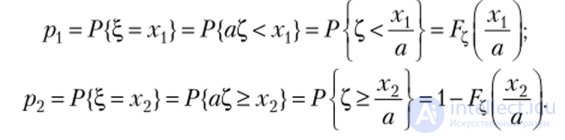
Between x1 and x2 the RV ξ = a ζ , and its distribution function


Comments