
Lecture
Geometric probability is a notion of probability introduced as follows: let be some subset of a line, plane, or space. Let the random event
 be a subset of . Then the probability of the random event is defined by the formula:
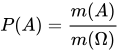 where
where 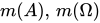 is the length, area, or volume of the sets and .
This is related to interpreting probability as a measure on the chosen space of elementary events. In this case it coincides with Euclidean space.
Suppose a random trial can be thought of as throwing a point at random into some geometric region G (on a line, plane, or in space). Elementary outcomes are individual points of G, and any event A is a subset of this region, the space of elementary outcomes G.
If, for simplicity, we assume that all points of G are «equal» (points are chosen uniformly within the region), then the probability of a point falling into some subset is proportional to its measure (length, area, volume) and does not depend on its location or shape.
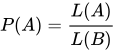
Geometric probability of event A is defined by the ratio:
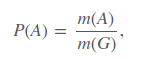
where m(G) , m(A) – are the geometric measures (lengths, areas, or volumes) of the entire space of elementary outcomes GG and of event АА respectively.
Most often, in the one-dimensional case we will be dealing with lengths of segments, in the two-dimensional case with areas of figures, and in the three-dimensional case with volumes of solids.
The main difficulty in solving problems of this type is to construct a mathematical model of the experiment, choose the space of elementary outcomes in the appropriate way, designate the event, and express it mathematically as some region. Unfortunately, there is no single recipe for solving such problems; one needs to "get the hang of it" by practicing on different problems
Problems of the following type and the methods for solving them were first studied in the 18th century, and the general topic became known as geometric probability.
(Buffon's needle) What is the probability that a needle dropped at random onto a floor marked with identical parallel lines will cross one of the lines?
For mathematical development see Solomon's short monograph.
By the end of the 20th century the topic had split into two subjects with different emphases: integral geometry and stochastic geometry.
Integral geometry arose from the principle that mathematically natural probabilistic models are those that are invariant with respect to certain groups of transformations. In this subject particular attention is paid to the systematic development of formulas for calculating expected values associated with geometric objects derived from random points, and in part they can be regarded as a sophisticated branch of multivariable calculus.
Stochastic geometry emphasizes the random geometric objects themselves. For example: various models for random lines or for random tessellations of the plane; random sets formed by taking the points of a spatial Poisson process to be (say) the centers of disks.
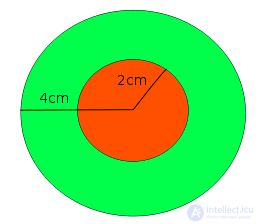
A simple geometric probability solution: if you shoot an arrow at random, what is the probability of staying within the small circle? The area of the large circle equals π4 2 = 50.26 cm 2, and the area π2 2 = 12.56 cm 2 is the area of the small circle. Thus, the probability of hitting the small circle, which can occur at any moment, is 12.56 / 50.26 = 0.25.
Within the circle above, randomly chosen points falling into the central region depend only on the areas of the areas of the circle. The radius of the largest circle is 4 centimeters, and the radius of the central circle is only 2 centimeters. The area of a circle is calculated as , so the size of the large circle is
  and the small one
  . Then the requested probability equals

Cutting a thread of one meter in length in a single motion with scissors can be turned into a geometric problem if we assume that the cut point is chosen at random. Initially the string can be represented as straightened along a reading line, allowing it to settle in the reading range . When the string is cut at the chosen point
 , two pieces of string are obtained. On the reading line they correspond to the intervals
 and
and  with length and
  . Probability calculations can be reduced by listing the favorable numbersvalues as the combined lengths of the gaps and comparing them with the total length of the string (which equals one).
Buffon's needle is a problem in which a needle or match is thrown onto the floor. What is the probability that the needle will cross a gap in the floor? The problem can be reduced to a problem with two parameters: the center of the stick and the position of the stick relative to the floor's cracks.
A stochastic experiment consists in choosing a point at random from a set . As its mathematical model it is customary to consider the probability space
  , where
  is a Borel set from
 ,
,  is the class of Borel subsets of the set ,
  is the probability on the class, which for each in this class is defined by the equality:
 ,
,
where  is the Lebesgue measure on (the value on parallelepipeds
  equals
  ).
).
The probability thus defined we call geometric (it is understood that the set must satisfy the condition  .
.
Example. On a plane ruled with parallel strips of width 2d , the distance between whose center lines equals 2D2D, a circle of radius rr is thrown at random (r+d<D ). Find the probability that the circle intersects some strip.
Solution. As the elementary outcome of this trial we take the distance xx from the center of the circle to the center line of the strip nearest to the circle (we denote it as 0). Then the entire space of elementary outcomes is a segment equal to half the distance between the axes of the strips G={x:0≤x≤D} . Its measure is the length of the segment, that is m(G)=Dm(G)=D.
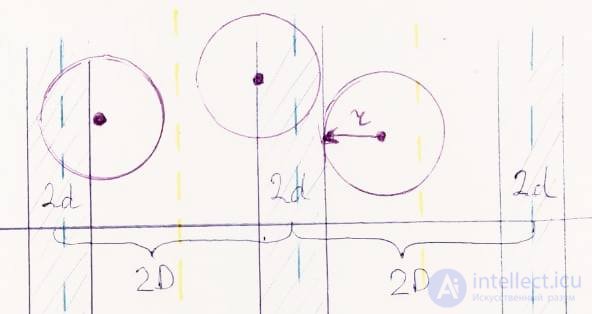
Let us now consider the cases favorable to the event AA = (the circle intersects the strip), and find the measure of the corresponding region of points. In the drawing above we show the various ways the circle can fall.
The circle will obviously intersect the strip if its center falls within the strip (more precisely, its half), i.e. the coordinate of the center of the circle satisfies the inequality 0≤x≤d , the length of this segment being dd.
The circle will also intersect the strip if its center is located from the edge of the strip at a distance less than the radius (if it equals the radius, the circle touches the strip; if greater, it is separated from the strip), i.e. when d≤x≤d+r (the length of this segment being r ).
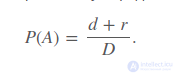
Then the probability of event AA according to the geometric definition of probability:
Example. Two people agreed to meet at a certain place between 17:00 and 18:00. Each of them undertook to wait for the other for 30 minutes after arriving at the meeting place. What is the probability that these people meet, if each of them is equally likely to arrive at any moment within the specified time interval?
Solution. Let us denote the arrival times of the first and second person as x and y . Since they arrive within an interval of 60 minutes duration (from 17:00 to 18:00), the following conditions hold: 0≤x≤60 and 0≤y≤60 .
Let us consider the rectangular coordinate system xOy In this coordinate system all possible values of the people's arrival times correspond to points of a square with side 60.
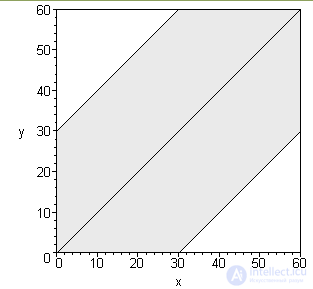
The people will meet if one person arrives before the other leaves, that is if y<x+30 , when y>x (the second arrived later than the first, but no more than 30 minutes after him) and x<y+30 , when y<xy
More compactly, let us write the conditions
Let us construct the lines y=x , y=x−30 , y=x+30 and shade the region lying inside the square whose points satisfy conditions (*). The points of this figure (the gray hexagon in the center) are favorable to the event AA =(the people meet).
Then the desired probability of the meeting, by the geometric definition of probability, equals the ratio of the area of this figure to the area of the square:


Comments