
Lecture
The variance of a random variable is a measure of the spread of a given random variable, that is, its deviation from the mathematical expectation. Denoted by  in Russian literature and
 (English variance ) in foreign. The statistics often used designation
 or
 .
The square root of the variance is equal to  , is called standard deviation, standard deviation, or standard variation. Standard deviation is measured in the same units as the random variable itself, and variance is measured in the squares of this unit of measurement.
From Chebyshev's inequality, it follows that the probability that a random variable is more than k standard deviations from its expectation is less than 1 / k². For example, at least in 95% of cases, a random variable with a normal distribution is no more than two standard deviations from its average, and about 99.7% is no more than three.
Let be  - a random variable defined on a certain probability space. Then the variance is called

where is the symbol  denotes the mathematical expectation [1] [2] .
real, then, by virtue of the linearity of the expectation, the formula is valid: 
 :

 :
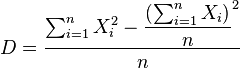
 . Thus, the final formula will look like:
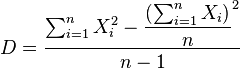

 The reverse is also true: if
 that
 almost everywhere;
 where
 - their covariance;
 where
 ;
 for any independent or uncorrelated random variables, since their covariances are zero;



Let the random variable  has a standard continuous uniform distribution on
 that is, its probability density is given by
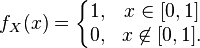
Then the mathematical expectation of a square of a random variable
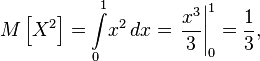
and expectation of a random variable
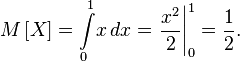
Then the variance of the random variable

Sign in and the lectures you have studied will be marked in this list.
Choose a course
Comments