
Lecture
Introduction to military political science — this is a branch of political science that studies the relationship between war, the armed forces, the state, power, security and international relations.
The last decade of the twentieth century is, as is well known, indisputably associated with the transformation of a multipolar world into a unipolar one and with the spread of democracy within the world community. However, as the international experience of recent years shows, the military questions of politics and of the political process have not lost their essential significance since the end of the Cold War. Rather the opposite: the transition of military-political relations into a stage of balancing interests has raised new questions that have yet to be answered. Nor has the military-force component of policy been removed from the agenda; its relevance is revealed ever more clearly in the actions of the United States and Western states in imposing the values of "their" democracy on other peoples. As in the past, the historical choice made by peoples requires reliable military backing.
All this indicates that the questions of peace, war and the armed forces are relevant today both in academic, scholarly terms and in practical, political terms. Politics, war and military affairs have always been organically interconnected. One of the outstanding political and military figures of the twentieth century, Charles de Gaulle, rightly observed that as long as wars and military violence exist, politicians and the military will walk in pairs, step for step, hand in hand.
The diversity of the areas in which dangers and threats arise, the substantial differences in the causes that generate them and in the very nature of their manifestation have led to the emergence of specialised studies that differ greatly in content and make it possible to develop appropriate security measures, especially those concerning its military component.
The military profession involves activity in a particular sphere of society's socio-political relations — military-political relations. In this sphere of activity it is impossible to accomplish the tasks of ensuring the country's military security, of further developing its Armed Forces, and of creating a professional army for the twenty-first century without a profound theoretical understanding of the dominant trends in the development of the military aspects of policy.
A military professional at any level must have a well-rounded understanding of the phenomenon of war, of the role of the armed forces in modern society, and of the foundations of military policy for ensuring the national security of the state. Military policy and military doctrine are the basis of the managerial activity of military personnel.
This textbook is devoted to the analysis and profound examination of the military-political problems of the public life of the modern state and is aimed at equipping military personnel with the theoretical foundations of the military aspects of political science.
The textbook is addressed to instructors, cadets and students of the military educational institutions of the Ministry of Defence, and may also be used by commanders, staff officers and officers of educational structures who are studying questions of military political science independently.
Military political science answers the following questions:
1. Why do states go to war?
It studies the causes of wars: the struggle for resources, territory, power, security, ideology and influence.
2. How does politics influence the armed forces?
The armed forces are an instrument of the state. The political leadership determines the aims of a war, its strategy, its budget, and its allies and adversaries.
3. How do the armed forces influence politics?
In different countries the armed forces may be entirely subordinate to civilian authority or, conversely, may play an independent political role.
4. What is national security?
Military political science studies the protection of the state against external and internal threats: military, informational, economic, cyber and terrorist.
5. How are wars of the modern type structured?
Today war is not only tanks, missiles and soldiers. Drones, intelligence, satellites, cyberattacks, propaganda, sanctions, diplomacy and the economy also matter.
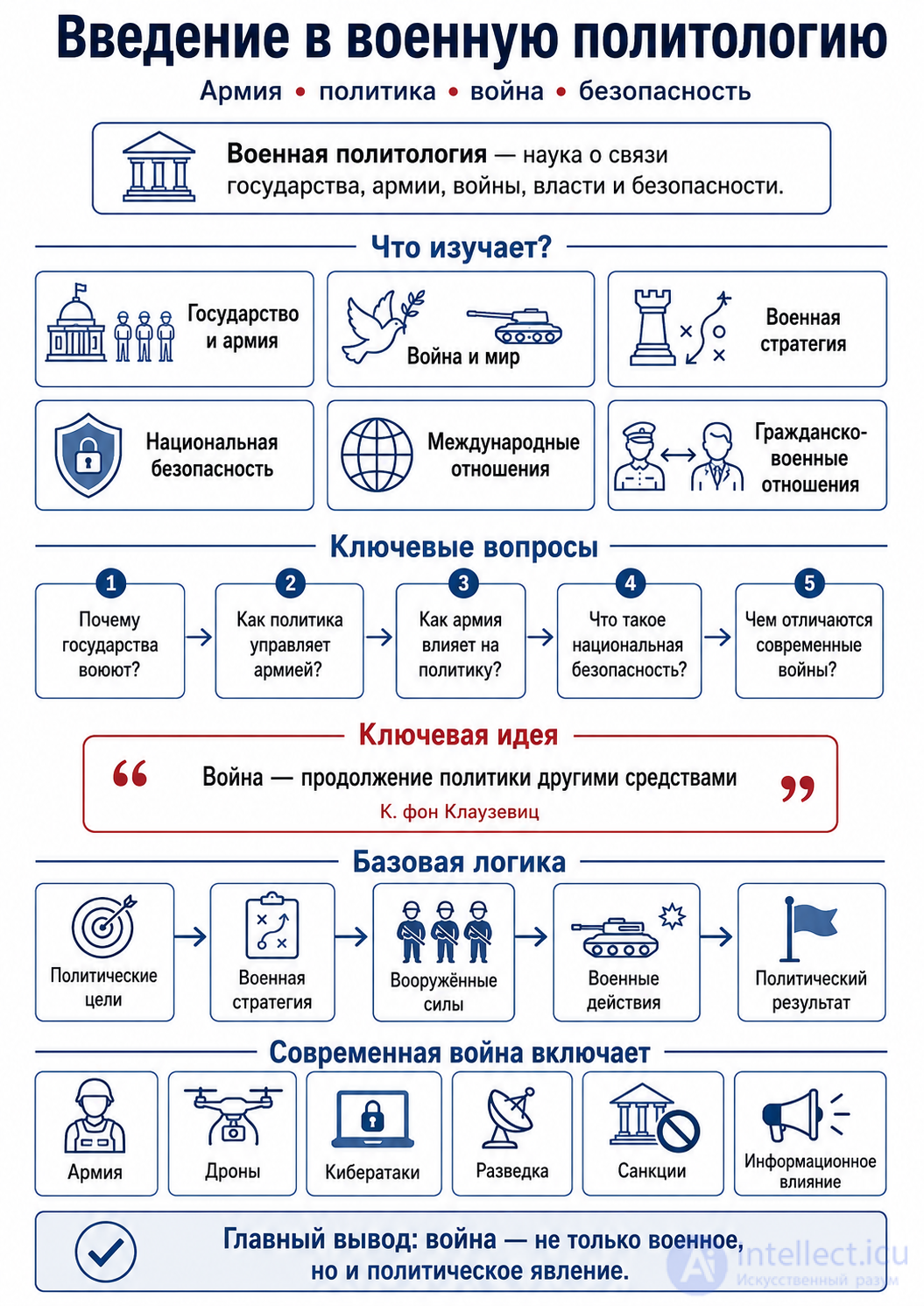
| Topic | What it studies |
|---|---|
| The state and the armed forces | Who controls the armed forces |
| War and peace | The causes, forms and consequences of wars |
| Military strategy | How political aims are achieved by military means |
| National security | How the state defends itself |
| International alliances | NATO, military blocs, coalitions |
| Hybrid warfare | The combination of military, informational and economic methods |
| Civil-military relations | The balance between politicians and the military |
Military political science proceeds from the principle:
War is not only a military but also a political phenomenon.
The classic formula of Carl von Clausewitz:
War is the continuation of policy by other means.
That is, a war does not begin of its own accord. Behind it there are usually political aims: to compel the adversary to change its behaviour, to seize territory, to defend the state, to alter the balance of power, or to gain a strategic advantage.
The author will gratefully accept all comments and suggestions aimed at improving the quality of this textbook.

Comments