
Lecture
The military-political thought of the Middle Ages and the Renaissance studies how war, power, the army, law, religion, the state and the role of the ruler were understood in these epochs.
The main difference from the Ancient World:
In the Middle Ages war was often explained through religion, feudal fealty and the divine order, whereas in the Renaissance it was explained through the interests of the state, the strength of the ruler, diplomacy and rational calculation.
The epoch of the Middle Ages is characterised by numerous wars and military invasions and by the dominance of brute military force. Wars went on for decades (the Thirty Years' War, the Hundred Years' War). Military violence was an inseparable feature of feudal society. For this reason the problems of military policy occupied one of the central places in the social thought of that time. In this epoch these problems were examined from religious worldview and methodological positions.
In the Middle Ages, politics and war were closely bound up with religion. The ruler's power was often explained as established by God, and war could be regarded as the defence of the faith, of order and of Christendom.
| Feature | Meaning |
|---|---|
| Religious justification of war | War could be considered permissible if it defended the faith or justice |
| The feudal army | The host was built on the personal fealty of vassals to their lord |
| Chivalric culture | The warrior was required to observe honour, loyalty and courage |
| The Crusades | War could receive religious justification |
| The idea of the just war | War must have a lawful cause and a moral foundation |
Following the representative of Christian philosophy Augustine (354–430), who called war a divine predetermination, an act of divine will, and the army an instrument of God's judgement, the scholastic Thomas Aquinas (1225–1274) declared, from the standpoint of objective idealism, that the army and its soldiers were an organisation and men in the service of the Lord. The teaching of Thomas Aquinas received further development in the works of Francisco de Vitoria (c. 1485–1546) and Francisco Suárez (1518–1617). According to their views, which became the official philosophy of Catholicism, the role and place of the army in society are determined by divine will. War appears as God's punishment for the sinfulness of people, their imperfection and their violation of the divine commandments.
Many thinkers of the Middle Ages spoke out against such rigid theocratic views and prescriptions. For instance, Marsilius of Padua (d. 1348) and John of Jandun (d. 1340) wrote the famous anti-clerical treatise Defensor pacis (The Defender of the Peace) (1324), in which the head of the Vatican was accused of usurping not only ecclesiastical but also secular power. The struggle against the pope was therefore characterised as the first condition of universal peace. Nicholas of Cusa (1401–1464), in the no less famous treatise On the Peace of Faith (1453), passionately condemned wars sanctified by religion and put forward ideas of uniting all religions and peoples in order to prevent wars and bloodshed among peoples.
In this period the Jewish conception of the "holy war" acquired a particular interpretation, based on the dogmas of the Old Testament, according to which wars are sent down to the Earth by the god Yahweh. The warriors of Israel taking part in such wars should go fearlessly into battle and make sacrifices to the god Yahweh at the enemy's expense.
In the Middle Ages there also arose the Muslim conception of the "holy war" against the infidels ("jihad" or "ghazawat"), whose dogmas are still used today by radicals and fanatics to justify terrorist activity.
In the 15th century, capitalist social relations began to emerge in Western Europe. In this connection the nascent class — the bourgeoisie — demanded the creation of a new ideology of its own and the working out of new forms of policy, above all military policy, since armed force was the decisive factor in relations between states and between social strata (classes) in the society of that time. In the process of the political and social confrontation of political actors, a "socio-political commission" objectively took shape for a new military-political ideology and its theoretical elaboration, corresponding to the realities of the time. Society had accumulated a rich empirical base of political and military knowledge, which required theoretical comprehension and the development of forms and methods of applying it in practice under changed conditions.
This task was in large measure accomplished by the outstanding Italian political thinker Niccolò Machiavelli (1469–1527), whose body of military-political views constitutes a fairly coherent system, the main elements of which include the following propositions:
the foundation of the state is military force;
policy determines the use of military force as a means of achieving its aims;
the end, consisting in the salvation of the state, justifies any means, including war, if it is necessary. War is an instrument of policy and has its own classification. Only the state should possess the right to declare and wage war;
the decisive role in military policy is played by outstanding personalities — sovereigns, great commanders, heroes;
the actors of military policy bear responsibility for the fate of the country and its people. They must choose their advisers and allies with the utmost care and, in taking decisions, constantly forecast the development of events on the basis of a carefully verified assessment of the real alignment of political and military-political forces;
military force finds its embodiment in the armed organisation of the state — the army, which should be manned by conscription from the citizens of one's own country, be kept in constant combat readiness, and improve the combat training of its soldiers through instruction.
Machiavelli is often called the forerunner of military political science, since it was he who first not only set out views on military policy systematically but also gave this knowledge an applied character in the form of concrete practical recommendations to the actors of military-political activity.
The problems of politics and war engaged the Dutch thinker Hugo Grotius (1583–1645), the French thinker of the Enlightenment Émeric Crucé (1590–1648), the eminent Czech philosopher, humanist and public figure Jan Comenius (1592–1670), the English statesman William Penn (1644–1718), the brilliant diplomat and philosopher the Abbé Charles-Irénée de Saint-Pierre, and the French Enlightenment philosopher Jean-Jacques Rousseau.
Of considerable interest are the military-political ideas of the eminent representative of English materialism Thomas Hobbes. In his works the philosopher continued the struggle against clerical views of politics and the state from the standpoint of political anthropologism. The basis of his political conception was the doctrine of the contradictory nature of man. According to it, all people were originally equal and each had a "right to everything". But at the same time man is by nature aggressive, greedy, ambitious and gripped by fear, since he is surrounded by the envious and by enemies. Because of this, the principle "man is a wolf to man" inevitably prevails in society, giving rise to the war of all against all.
Thus, in Hobbes's opinion, the primary cause of all wars, upheavals and political cataclysms is to be sought in man's original imperfection. In the army the philosopher saw an organ of the state, an instrument for waging external and internal wars. He considered it necessary that the army and the military leadership be subordinated to the political leadership.
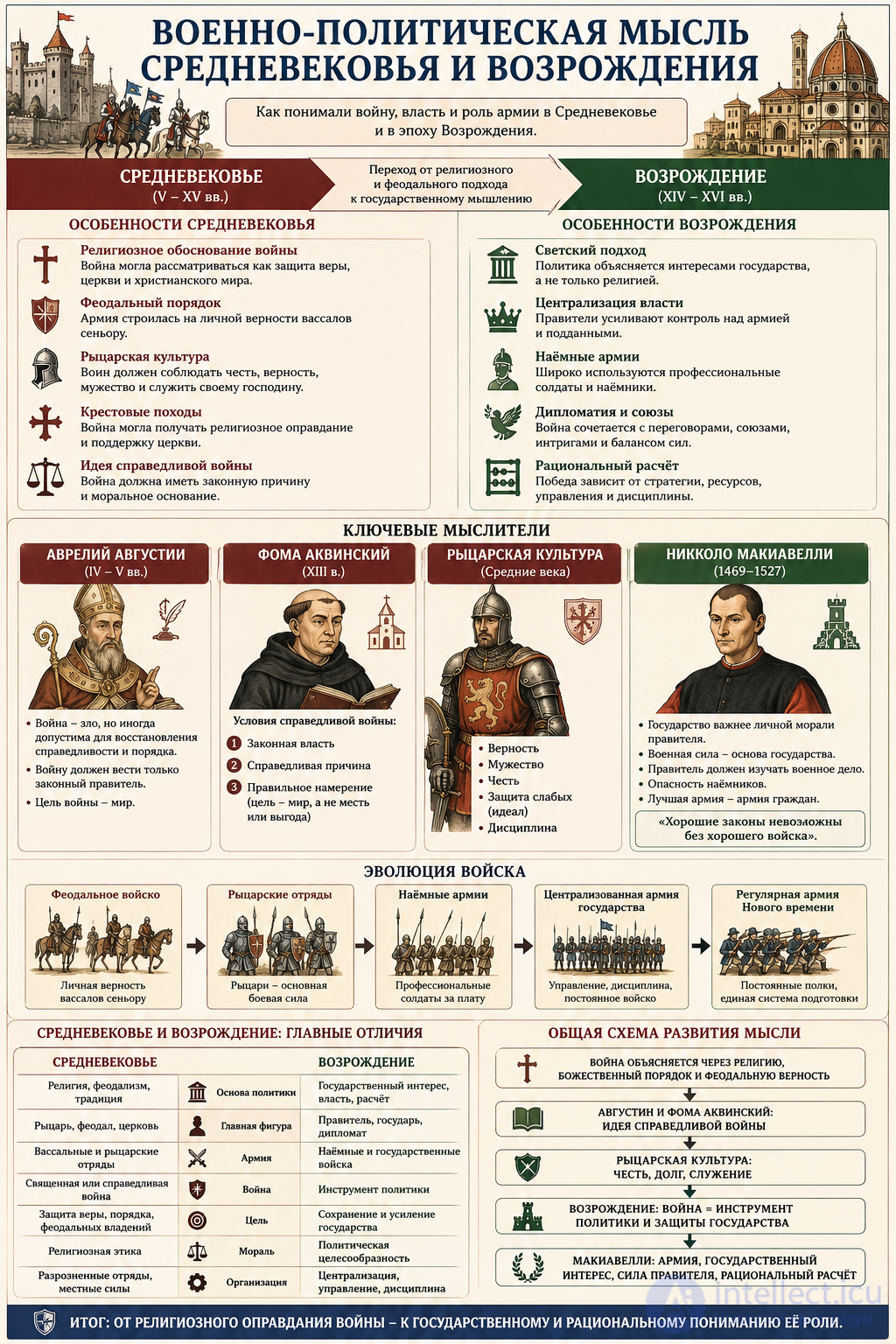
Aurelius Augustine developed the idea of the just war. He held that war is in itself an evil, but that it may sometimes be permissible if it is directed at restoring justice and order.
| Idea | Explanation |
|---|---|
| War is an evil | It is bound up with violence and suffering |
| Sometimes war is permissible | If it defends order and justice |
| Lawful authority matters | War should be waged not by a private person but by a lawful ruler |
| The aim of war is peace | War must not be for the sake of revenge or plunder |
In brief:
War is permissible only when
it serves the restoration of peace and justice.
Thomas Aquinas systematised the doctrine of the just war.
He distinguished several conditions under which a war may be considered justified.
| Condition | Meaning |
|---|---|
| Lawful authority | War is declared by the ruler, not by a private individual |
| Just cause | For example, defence against attack or punishment for an injustice |
| Right intention | The aim must be peace, not revenge, gain or cruelty |
Schematically:
Lawful authority
        +
Just cause
        +
Right intention
        ↓
A just war
In the Middle Ages the figure of the knight was of great importance. The knight was not merely a warrior but part of the social and political system.
| Quality | Significance |
|---|---|
| Loyalty | Service to one's lord, king or God |
| Courage | Readiness for battle |
| Honour | Observance of the rules of conduct |
| Protection of the weak | Ideally — the protection of the church, of women, of the poor |
| Discipline | Submission to the military hierarchy |
In practice, however, knightly wars were often accompanied by plunder, internecine strife and the struggle of feudal lords for power.
The Renaissance changed the approach to war and politics. Gradually it is not the religious explanation of war but the interest of the state that comes to the fore.
The state begins to be perceived as an independent political force that must defend its territory, power, order and influence.
| Feature | Meaning |
|---|---|
| A secular approach | Politics begins to be explained not only by religion but also by the interests of the state |
| Centralisation of power | Kings and princes strengthen their control over the army |
| Mercenary armies | Professional soldiers are widely employed |
| Diplomacy | War is combined with negotiations, alliances and intrigue |
| Rational calculation | Victory depends on strategy, resources, command and discipline |
The central figure of the military-political thought of the Renaissance is Niccolò Machiavelli.
He regarded war as the most important instrument of policy and statecraft. For him the ruler must be able to defend the state, command the army and act decisively.
| Idea | Explanation |
|---|---|
| The state matters more than the ruler's personal morality | The ruler must preserve power and order |
| Military force is the foundation of the state | A weak state without an army becomes dependent |
| The ruler must study the art of war | Without knowledge of war it is impossible to govern a state |
| The danger of mercenaries | Mercenary troops may prove unreliable |
| An army of one's own citizens is better | The state must rely on its own armed citizens |
The key thought:
Good laws are impossible without good troops.
In the Middle Ages the host was often assembled from vassals, knights and retinues. In the Renaissance a transition to more organised armies begins.
The feudal host
        ↓
Knightly detachments
        ↓
Mercenary armies
        ↓
The centralised army of the state
        ↓
The future regular army of the Modern Era
| The Middle Ages | The Renaissance |
|---|---|
| Feudal fealty | State interest |
| Knightly honour | Political calculation |
| War for one's lord or for the faith | War for the state |
| Scattered detachments | More centralised command |
| Religious justification | Secular strategy |
| Criterion | The Middle Ages | The Renaissance |
|---|---|---|
| The basis of policy | Religion, feudalism, tradition | State interest, power, calculation |
| The central figure | The knight, the feudal lord, the church | The ruler, the sovereign, the diplomat |
| The army | Vassal and knightly detachments | Mercenary and state troops |
| War | May be "holy" or just | An instrument of policy |
| The aim | Defence of the faith, of order, of possessions | Preservation and strengthening of the state |
| Morality | Religious ethics | Political expediency |
The military-political thought of the Middle Ages and the Renaissance travelled a path:
From a religious explanation of war
        ↓
to a state-centred and rational understanding of war.
In the Middle Ages war was viewed through the prism of God, justice, feudal duty and knightly honour.
In the Renaissance war was increasingly understood as an instrument of policy, of the strengthening of the state and of the ruler's power.
On the whole, the military-political thought of the Middle Ages bore an extremely contradictory character, which was conditioned by the dominance of the theological approach to comprehending military-political realities, especially in the initial period of the epoch, and by the intellectual "breakthrough" of the Renaissance, as a result of which the scientific foundations of contemporary military political science were born.

Comments