
Lecture
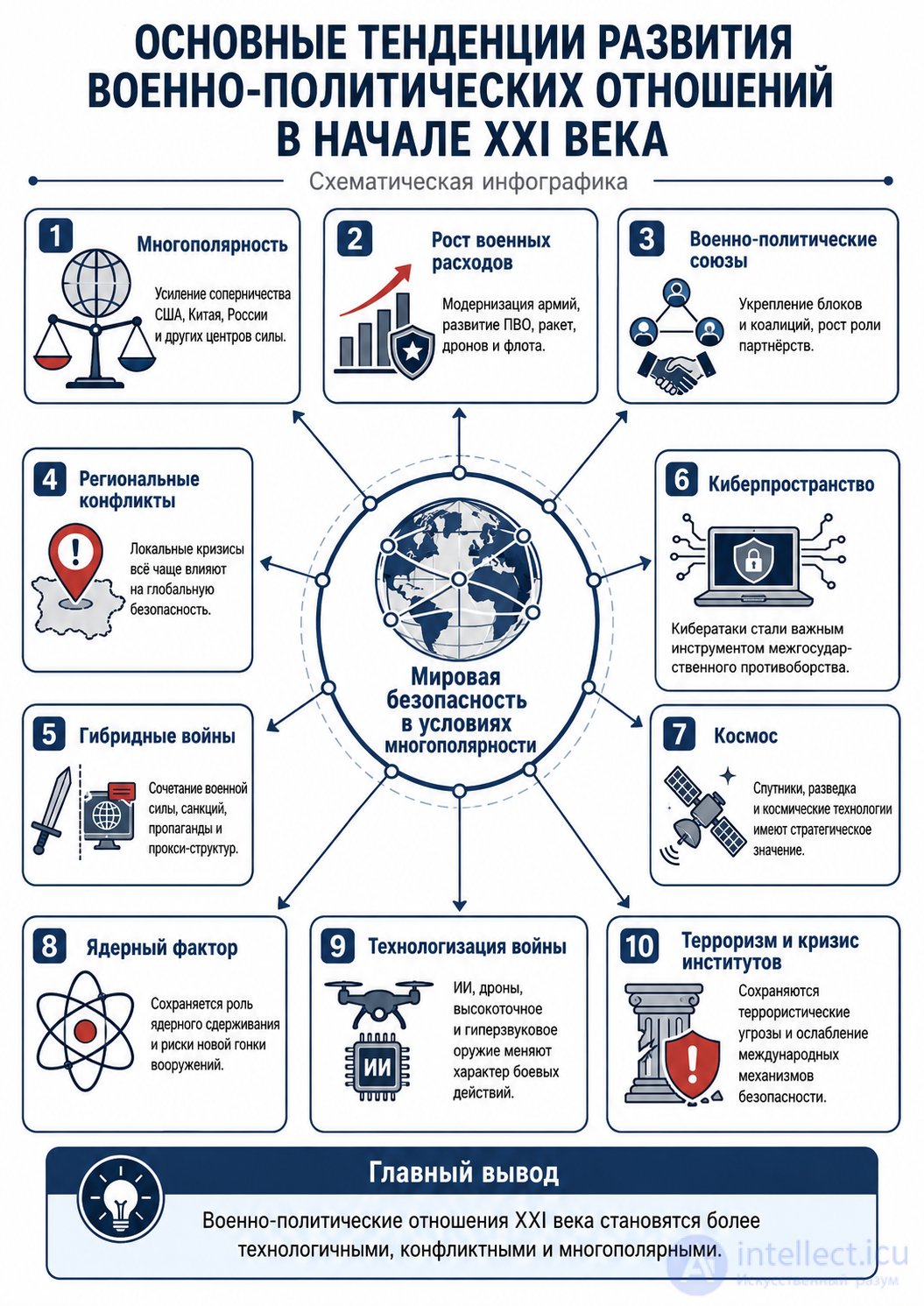
At the beginning of the twenty-first century, military-political relations are developing amid a transition from the relatively unipolar system that took shape after the end of the Cold War to a more complex and conflict-prone multipolarity. The chief feature of the period is the combination of traditional great-power rivalry with new threats: terrorism, cyberattacks, hybrid wars, the technological race, and the struggle for influence in various regions.
The contemporary world is undergoing fundamental and dynamic changes that deeply affect the interests of the Russian Federation and its citizens. Russia is an active participant in this process. As a permanent member of the UN Security Council, possessing significant potential and resources in all spheres of activity, and maintaining intensive relations with the world's leading states, it exerts a substantial influence on the formation of a new world order.
Military-political relations represent the totality of ideologically motivated interactions between political actors (socio-political communities, institutions and military organizations) that take shape in the course of a specific activity aimed at realizing economic, political and other interests through the use, or the possibility of the use, of armed violence.
Among the many methodological approaches to the analysis of military-political relations, three traditional schools are of the greatest interest. The first is the school of realism, which proceeds from the premise that the logic of international relations is determined by the interaction of sovereign states in an "anarchic" world. The sole measure of national interests and, at the same time, the guarantee of security is the power of the state.
The second, the school of Marxism, examines the entire history of international relations and the problem of state security through the prism of the theory and practice of class struggle. The class content of states' policies determines their behaviour in military-political relations. From the 1960s onward this approach was developed in world-systems theory, and from the late 1970s in North-South theory.
The third, the school of liberalism, holds that under conditions of globalization all the most complex problems in the military-political relations of contemporary states can be resolved by establishing international institutions (such as the League of Nations, the UN, the OSCE and others), as well as by spreading and strengthening democratic regimes in the countries of the world.
In terms of their scope and orientation, military-political relations are divided into domestic and international.
For military political science, the most relevant subject is the examination of international military-political relations, which may be represented as a system of interaction between actors in international relations concerning the production, redistribution and use of the means of armed violence for the purpose of achieving their political objectives.
In this case political goals or objectives acquire a distinctly military-political character, which finds expression in the corresponding formulations. They are distinguished by a fairly pronounced radicalism, since they presuppose reliance on the most radical means of achieving them, that is, through the use of weapons in the form of the threat of their use or through the very fact of their use. Such goals may include, for example, the destruction of a state, a change in its social order, the limitation of its sovereignty, a change in its domestic policy, an adjustment of the state's course in the international arena, and so on. A state's military-political goals may also consist of objectives aimed at preventing all of the above, including through reliance on the security services and armed forces. These are, above all, ensuring military security and strengthening one's influence in the region or in the world as a whole.
International military-political relations manifest themselves as interactions of differing character and at different levels (global, regional, multilateral and bilateral) among various political forces: state, political, social, religious and others. Depending on the role they play in the formation and functioning of military-political relations, these and other possible forces are divided into two main types: actors and participants.
In identifying the actors of military-political relations, their characteristic features should be noted. The main ones, in the opinion of some authors, are the presence of motives, purposefulness, will and the capacity to act for the sake of achieving strategic, long-deferred goals, including by sacrificing more particular, nearer and more immediate ones (at times to the detriment of the actor's real, non-illusory interests). Other authors, alongside the proactive character of actors' actions, also note their status under international law, whereas participants in military-political relations do not possess such status.
Consequently, the principal actors of military-political relations in the world have been and remain states.
Within the system of essential attributes of states as the principal actors of military-political relations, alongside territory, population, public authority and other possible attributes, the sovereignty of the state is of particular importance. It should be emphasized here that "sovereignty is not power itself; it is the most important organizational-political and functional principle and precondition of state power, ensuring the supremacy and full authority of the people, the autonomy and freedom of the nation in establishing its political status and determining its economic, social and political development, as well as the territorial supremacy of the state and its independence in external relations." This definition of state sovereignty is especially important in analysing and determining the military-political goals of states in the modern world.
The fundamental distinction of states as actors of military-political relations in the world lies in the fact that they confer legitimacy on these relations, determined by their own legislative base, and also resolve the various problems that arise in the process on the basis of the international legal framework. A significant role is also played by the fact that states possess such powerful and legal instruments of action as a military organization encompassing all the security services, above all the armed forces.
The fundamental distinction of the composition of the actors of military-political relations in our day lies in the fact that its spectrum has expanded extraordinarily through the addition of new active participants. Many of them have acquired solid grounding in theoretical inquiry or considerable support in the practical realization of their military-political objectives. Among the former undoubtedly belong, in the definition of S. Huntington and his adherents, civilizations. Among the latter may be counted confessional, nationalist, terrorist, mafia and other formations. Not infrequently they act in the international arena far more actively than states and their coalitions. And herein often lies the cause of the emergence of acute military-political situations in one region or another.
In their character, military-political relations may likewise be many-faceted. They may be relations of broad cooperation, which is characteristic, as a rule, of countries belonging to a single military-political bloc with common structures of military-political leadership. These relations may also be neutral in character, which distinguishes countries with a declared peace-loving military policy. Military-political relations of rivalry as a type of relations indicate the presence of fairly pronounced divergences between political actors on questions of principle. Military-political relations of the confrontational type vividly demonstrate the crisis of the old system of relations, as well as the impossibility of creating a new one within the former system of coordinates. And the final stage in terms of the degree of tension in military-political relations is open confrontation, armed conflict, which must undoubtedly be followed by a stage of relations involving the peaceful settlement of problems, in which military questions occupy one of the central places.
The character of military-political relations bears the imprint of the trends in their development and also exerts a marked influence on those trends. The question of the trends in the development of contemporary military-political relations is not a simple one from the standpoint of their analysis. On the other hand, this task is fundamentally important. For only through such analysis is it possible to arrive at a comprehensive assessment of the military-political situation as a reliable basis for elaborating a state's military policy and for the adoption of specific military-political decisions.
The military-political situation is nothing other than the state of military-political relations between political actors of various levels and scales, connected directly with the conception, preparation and employment of armed forces in the interests of realizing their political objectives. As for the assessment of the military-political situation, in the most general terms it consists of the study and analysis of the system of factors and conditions that exert a fundamental influence on the state of military-political relations between the principal political actors.
The development of military-political relations in the world at the beginning of the twenty-first century is characterized by a dynamic transformation of the system of international relations. After the end of the era of bipolar confrontation, two mutually exclusive trends came to the fore.
The first trend manifests itself in the strengthening of the economic and political positions of a considerable number of states and their integration associations, and in the improvement of mechanisms for the multilateral management of international processes. In the future Russia will contribute to shaping the ideology of the emergence of a multipolar world on this basis.
The second trend manifests itself through attempts to create a structure of international relations based on the dominance of the developed Western countries within the international community under the leadership of the United States, and designed for unilateral solutions to the key problems of world politics, above all through military force, bypassing the fundamental norms of international law.
In addition, the present stage in the development of contemporary military-political relations is characterized by a sharp increase in interdependence and in "permeability" both vertically and horizontally. Attempts are making themselves felt to profit from the new balance of forces in the international arena and to launch another round of "geopolitical games" with the threat of renewed tension and an arms race (for example, the US withdrawal from the ABM Treaty, the cornerstone of strategic stability). At the same time the world is genuinely integral, and in this respect the possibility of forming new structures in the spheres of politics and security is increasing. Confirmation of this may be seen in the Treaty on the Reduction of Strategic Offensive Nuclear Potentials signed by the United States and Russia in May 2002.
The transformation of military-political relations taking place today, the cessation of open confrontation and the consistent overcoming of the consequences of the "Cold War", and the advancement of Russian democratic reforms have substantially expanded the possibilities for Russia's cooperation with other countries. The threat of a global nuclear conflict has been reduced to a minimum. While military force retains its significance in relations between states, economic, political, scientific-technical, environmental and information factors are playing an ever greater role.
Coming to the forefront as the main components of Russia's national power are its intellectual, information and communication capabilities, the welfare and educational level of the population, the degree of integration of scientific and industrial resources, the concentration of financial capital and the diversification of economic ties. The achievement of a major breakthrough along a number of key lines of scientific and technological progress, leading to the creation of a unified worldwide information space, together with the deepening and diversification of international economic ties, is giving the interdependence of states a global character. Preconditions are being created for building a more stable and crisis-resistant world order.
Practice shows, however, that despite the reduction of the military potentials of the world powers, the significance of military-force aspects in international relations continues to be substantial; examples of this are the relations between India and Pakistan, Israel and Palestine, NATO and Yugoslavia, the United States and Iraq, and others. As is well known, first fiddle in this process is played by the United States, which believes that after the demise of the Soviet Union only the American elite possesses the means necessary for developing planetary programmes and can afford to think in global categories. In the opinion of the US Secretary of Defense, expressed in 2000 in his Report to the President and the Congress of the United States: "At present the United States has no global rival, and one is unlikely to appear, at least before 2015."
The principal aim of the United States is to turn Washington into the main centre of mediation and settlement required for the inevitable integration of the planet. Moreover, the design is not to create in the United States some sort of control centre dominating the world, but to make the United States a crossroads through which all the flows moving across a world that has embarked on the path of internationalization will necessarily pass. Thus, for example, J. S. Nye, in the article "US Security Policy: Challenges for the Twenty-First Century", assesses the changes in the disposition and correlation of military-political forces in the world as follows: "The Soviet Union has collapsed, and Russia's power continues to wane. China's influence, on the contrary, is growing very rapidly, and by all appearances this growth will continue in the future. Yet despite these dramatic events, the basic factor of the world balance of forces has remained unchanged since 1990: the United States still remains the only superpower possessing global advantages in the key dimensions - military, economic and political."
The assessment of the contemporary military-political situation from the standpoint of ensuring Russia's security is bound up with considerable uncertainty regarding potential sources of threats, the techniques and methods of disrupting stability in the world in the future, and the forms in which these threats will be embodied. History has clearly shown that rapid and unexpected changes, such as the collapse of the Soviet Union, can fundamentally alter international stability in the world. It also demonstrates that new technologies can change the forms of interstate confrontation and the very nature of interstate conflicts so radically that the security concepts of a number of great powers will fail to meet the demands of the times. Despite the fact that the existence of the phenomenon of uncertainty is the principal difficulty in planning Russia's security, certain features and trends in the development of the world situation not only characterize present-day international challenges but also highlight problems that are extremely complex from the standpoint of ensuring the country's security and that will have to be resolved in this process in the future.
On the whole, four main groups of factors influencing the formation of the military-political situation and Russia's place in the world community may be identified:
The first group comprises factors influencing the reduction of the danger of unleashing a large-scale war, including a nuclear one, as well as the formation and consolidation of regional centres of power. Today three "rings" of states have formed around Russia, occupying different positions with respect to Russia's national interests. The first "ring" - the near abroad - is formed by the independent states that emerged from the Soviet Union. The second "ring" is formed by the Northern European states and the former member states of the Warsaw Pact - the middle abroad. The third "ring" - the far abroad - consists of the states to the West, South and East. The principal geopolitical centres of power here are the United States, Germany, Japan, India and China. Each of the centres listed has clearly defined its own interests in the world and in specific regions, and these frequently do not coincide with the interests of Russia.
The well-known American political scientist Z. Brzezinski wrote in his book "The Grand Chessboard", published in 1996: "Russia has become the main bargaining chip of American geopolitics. The new world order under US hegemony is being created against Russia, at Russia's expense and on the ruins of Russia." These words, confirmed by the events of recent years, prove once again that the main strategic tasks of the United States and its allies still remain the dismemberment of Russia's geopolitical space and the systematic removal of individual regions from Russia's jurisdiction with the aim of obtaining unlimited access to our country's colossal natural resources and its vast market for imported goods, as well as the aspiration to rule out in the longer term the possibility of the emergence in the Eurasian space of a powerful state capable of laying claim to world leadership - Russia.
The second group consists of factors influencing the continuing expansion of the NATO bloc. NATO's transformation reflects the desire of the United States to retain control over the countries of Europe, to limit their sovereignty and to infringe upon their economic interests. In the new "NATO Strategic Concept" there is not a word about "common human interests" or equal security for all countries, and it is oriented toward preventive action beyond NATO's area of responsibility. In this connection the European Command has been expanded. Russia, Estonia, Latvia, Lithuania, Moldova, Ukraine, Belarus, Georgia, Armenia and Azerbaijan have additionally been included in its area of responsibility. At present, on the European continent, NATO has an advantage over Russia on the order of 3:1 in armoured vehicles, 3:1 in artillery, and 2:1 in combat aircraft and helicopters. The states of the Persian Gulf and the Caspian Sea, including Turkmenistan, Kazakhstan, Kyrgyzstan and Tajikistan, have fallen within the area of responsibility of Central Command.
The third group of factors may be said to consist of the persisting crisis trends in the economic and social development of the states of the world community, as well as the rivalry among states over the division of spheres of influence in politics and the economy. Today countries compete with one another across every parameter of economics and politics: in the size of the tax burden, in the level of security of the country and its citizens, in the guarantees of protection of property rights. They compete in the attractiveness of the business climate, in the development of economic freedoms, in the quality of state institutions. Competition has acquired a truly global character.
During Russia's period of weakness it had to cede many niches in the world market. And these were immediately seized by others, who have no wish to return them and will not simply give them up. At the same time, the general contemporary civilizational level of development of neighbouring states on the whole has a favourable effect on Russia's external security. The countries surrounding it have entered the post-industrial stage of civilizational development, have developed economies, and adhere to liberal values with respect to the individual and society.
Today, however, the efforts of a number of states aimed at weakening Russia's positions in the political and economic spheres are intensifying. This is especially evident in attempts to ignore Russia's interests in resolving major problems of international political and economic relations, including conflict situations, which in the final analysis are capable of undermining international security and stability and of slowing the positive changes taking place in international relations.
Russia has not yet been able to integrate fully into the new system of international relations and has no economic allies to speak of. The economic agreements reached with the CIS countries are declarative in nature, and the common economic space is degrading. Against this background the role of recognized economic leader is still held by the United States, which deliberately wrecked the entire economy of Africa and drove Latin America into debts from which it will not extricate itself for decades to come. The 20 per cent wealthiest people in the world receive 83 per cent of world income, while the poorest 20 per cent receive only 1.4 per cent; moreover, only 4 per cent of the population of the developing countries is catching up with the population of the developed countries, while 96 per cent is falling ever further behind. And this trend - wealth at one pole and poverty at the other - continues.
The world's research centres, the Club of Rome, politicians, and some American leaders themselves say that the further path of the United States is a road to nowhere. "If America does not renounce the role of a planetary stomach that digests and sucks in everything, if there are no moral constraints, then global catastrophe awaits us."
At present it may also be stated that, owing to a whole range of circumstances, Russia and its individual regions are becoming a strategic node of world politics. Thus, for example, the Caucasus region has become an arena for the clash of the interests of states both at the regional level and on a global scale. What is involved is a global confrontation between Russia, the Western states and the Islamic world.
Today dozens of countries, in one way or another, are declaring their interests in this region, including the United States, Germany, Great Britain, France, Turkey, Iran, China and others.
In the "great game" for Caspian oil, attempts to "emiratize" the eastern part of Transcaucasia are intensifying, which in turn is accompanied by political, economic and ideological formulations in the shape of the doctrine of "defending the vital interests of the Western states" and of "expanding the sphere of American global responsibility" in this important economic and geostrategic region. Nor can one fail to note the persistence with which the idea of a "common Caucasian home" - but without the Russian Federation - is being discussed.
The political and economic situation in the Asia-Pacific region is traditionally determined by the leading role of Japan.
On the whole, analysis of the economic situation in the world attests to an emerging trend toward the creation of three trade and economic zones under the aegis of the United States, Japan and Germany, toward diminishing Russia's influence on the common economic space, and toward blocking its attempts and opportunities to enter the world market for high technologies.
The conclusion is obvious: in the contemporary world no one wishes to be at enmity with Russia, and no one needs that. At the same time, no one is particularly waiting for Russia either, and no one will go out of their way to help it.
The fourth group of factors comprises the global spread of terrorist and extremist movements and groups. The problem of terrorism has of late acquired particular acuteness. After 11 September 2001 very many people in the world understood that the "Cold War" was over and that other threats had come onto the agenda, that a different war was under way - a war against international terrorism. Russia, on the basis of international conventions and treaties, cooperates with foreign states in the field of combating terrorism and acts as one of the most reliable guarantors of international stability.
It was precisely Russia's principled position that made it possible to form a solid anti-terrorist coalition. In the context of allied relations, the leadership of Russia, together with the leadership of a number of CIS countries, took the corresponding decision. For our state, which had long since encountered terrorism, there was no problem of choosing whether or not to support the efforts to destroy its lair in Afghanistan. All the more so since this genuinely contributed to strengthening security on Russia's southern frontiers and, to a relative degree, helped to improve the situation on this issue in many CIS countries.
Thus, the military-political relations of the present day are characterized by a dynamic transformation of the system. After the end of the era of bipolar confrontation, mutually exclusive trends arose toward the formation of a multipolar world and toward the establishment of the dominance of a single country or group of countries in world affairs.
In recent decades Russia has advanced substantially along the path of integration into the system of world economic ties and has joined a number of influential international organizations and institutions. At the cost of strenuous efforts, it has managed to strengthen Russia's positions on the world stage along several fundamental lines.
At the beginning of the twenty-first century, military-political relations are characterized by growing instability, intensifying rivalry among the great powers, increasing military expenditures, the development of hybrid and technological forms of warfare, and the weakening of the former arms control mechanisms. The world is becoming more multipolar, but at the same time more conflict-prone. The chief problem of contemporary international security lies in the fact that the old threats - wars, nuclear weapons, the struggle for territory - have not disappeared but have been supplemented by new ones: cyberattacks, information warfare, terrorism and the technological race.

Comments