
Lecture
The army is one of the key institutions of the state, intended to ensure its security and to defend its sovereignty, territorial integrity and political interests. Throughout history the army has acted not only as a military force but also as an important instrument of domestic and foreign policy.
The emergence of the army is bound up with the formation of the first states. So long as human communities existed in the form of clans and tribes, armed defence was irregular in character: in time of danger all able-bodied members of the community took up arms. However, with the appearance of private property, social hierarchy, territorial borders and political power, the need arose for a permanent organised force.
The first armies appeared in the states of the Ancient East — Egypt, Mesopotamia, Assyria and Persia. Their tasks were to protect the ruler, guard the territory, suppress revolts and wage wars of conquest. In the states of antiquity the army became a most important element of civic and political life: in Sparta, for example, the military organisation effectively determined the entire social order, while in Rome the army became the basis for the expansion of the state and the consolidation of imperial power.
In the Middle Ages the army was largely built on feudal relations: military service was performed by vassals obliged to their lord. With the strengthening of centralised monarchies there appeared regular armies subordinated directly to the sovereign. In the modern era the army was definitively transformed into a professional institution of the state, financed from the budget, administered by centralised authority and acting in accordance with state interests.
The history of human civilisation is bound up with one of the eternal problems of social practice — the problem of violence, whose cruellest form of manifestation has been and remains war. This is because the main content of any war is armed struggle, and the principal instrument for waging it is the army.
The army has always been created by the state as a special institution for realising the aims of its military policy. In time it also came to be used by the political leadership as a military-power factor in relations of authority, for maintaining social stability and for securing national and state interests. It is precisely for this reason that the question of the interrelation between the army and political power constitutes one of the fundamental problems of the political life of society.
The question of the origin of the army and its connection with politics has interested people since ancient times. This problem has received fairly extensive treatment in the philosophical and sociological works of Aristotle, Hegel, Machiavelli, Commynes and Clausewitz, and of Chernyshevsky, as well as in the military-scientific works of contemporary researchers. The methodological basis for a scientific understanding of the process of the army's origin and of its place and role in the life of society is the materialist doctrine of politics, political power and the state.
The history of the development of society testifies that already in primitive society there arose a need to create detachments of armed men to protect the territory of the clan or tribe from the raids of neighbours. During the period of the disintegration of primitive society, brought about by the rapid growth of the productive forces and, on that basis, by the emergence of private property, permanently operating armed detachments of men defending the interests of the upper stratum of the given clan gradually became separated out from the clan military organisation. With the transition to class society (in which the chief institution of social administration is the state), the organs for defending clan and tribal society gradually began to be transformed into a special organ of the state — the army. The army becomes the state's principal instrument of violence, of resolving not only the internal contradictions of society but also a force intended for waging war.
Two most important tendencies can be clearly traced in the genesis of the army. On the one hand, there is the spontaneous process of people uniting into an armed organisation with a single purpose — the defence of the natural conditions of their existence. This may be said to be the objective cause of the army's genesis, one that follows logically from the highly complex and contradictory process of the formation and development of society itself.
On the other hand, the emergence of the army is a process consciously organised by people, the aim of which is to defend the fundamental interests of classes and social strata. It was regularly conditioned by the development of a particular mode of production, by the appearance of economic and social inequality, and by the emergence of the state as an organ of class domination. Such an approach to understanding the genesis of the army most accurately reveals its connection with the state and its policy.
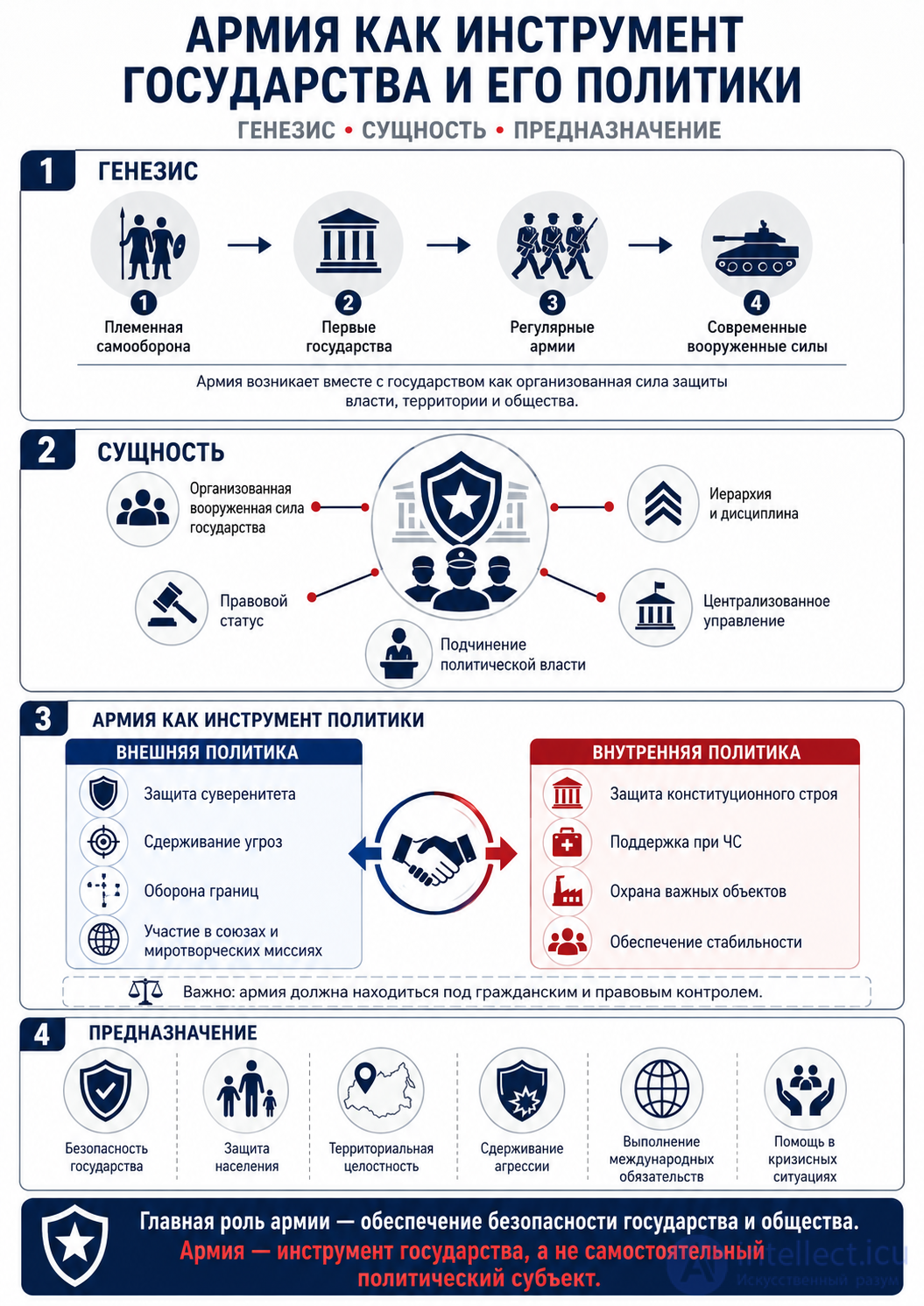
The essence of the army lies in the fact that it constitutes the organised armed force of the state. It is distinguished by strict hierarchy, discipline, centralised command and control, and the presence of special training, armament and legal status.
The army is part of the machinery of the state. It does not exist in and of itself, but is subordinate to political power and acts within the framework of the aims determined by the state. In democratic systems the army is under civilian control: decisions on war, peace, defence policy and military expenditure are taken by the political leadership, and the army executes those decisions.
At the same time the army has a special nature. Unlike most state institutions, it has the right to the organised use of armed violence. It is precisely for this reason that the army requires strict legal regulation and control, since its force may be used both to defend society and to exert pressure on it should the balance between military and civil authority be upset.
What, then, does the army represent as a social institution of political violence? Before answering this question it is necessary to have a clear conception of the essence of the army in general. Let us dwell on the features inherent in the army.
First, the army is an organ of the state, by virtue of which it enters into the political system of society as a derivative element of it. The army arises, develops and functions within a concrete system of economic, political, social-class, spiritual and other social relations.
Second, a characteristic feature of the army is that it is an organisation of armed men maintained by the state, which serves as a political instrument of organised armed violence. It is in this characteristic feature that the socio-political nature of the army is vividly manifested, since it is an instrument of policy, and policy in its turn expresses the interests of particular classes, social strata and states.
Third, the army is intended for waging war in the name of concrete political goals and interests. It is precisely the army that, as a reliable instrument of policy, facilitates the latter's realisation by means and methods peculiar to it alone — combat operations. In comparison with other armed organisations, the army is characterised by a special method of manning, by particular methods of training personnel and by a specific way of life.
The concept of "army" is most often used to denote the armed forces of a state, that is, the structures specially created by it and capable of conducting combat operations. In the scholarly literature the following definition is the most widespread. The army (from the Latin armare — to arm) is an organised association of armed men, created and maintained by the state for waging offensive or defensive war.
As a special institution of the state, the army has always been subordinate to the policy of the organs of state power; nevertheless, it cannot be fully identified with an "institution of politics". Unlike genuine institutions of politics, the army is not connected with direct political activity and is not an independent subject of politics taking part in the struggle for power, in the formation of state policy or in the political process. At the same time the army constitutes a specific political institution, a necessary and most important element of the political organisation of society. Real political power constantly relies on force, including military force. The army and political power stand in an objectively conditioned interrelation. Just as the functioning of the army is impossible without day-to-day political leadership, so the existence of power is unthinkable without such an effective instrument of force. This connection is confirmed by the following factors.
First, the army has always been and remains at the centre of political events by virtue of the fact that it is the most mobile, organised and disciplined institution of the state and, most importantly, the one that possesses weapons. "The Armed Forces of the Russian Federation are a state military organisation constituting the foundation of the defence of the Russian Federation", states Article 10 of the Law of the Russian Federation "On Defence". No institution of the state possesses such force as the army. It realises the aims and tasks of the military policy determined by the legislative organs of state power.
If one analyses the history of countries and peoples, one may conclude that the army has been used for the following purposes:
Of course, these aims constantly changed and were levelled out. The changes were determined by the international situation, by the state of affairs in the region, by the character of political power in the particular country, and by the level of the state's development. If a country's stable position is maintained by other means of policy that are officially adopted, legalised and recognised by the international community, the army remains, as it were, "in the shadows", occupied with its everyday activity.
Second, the army has acted and continues to act as the force that guarantees the stability of the political regime in the given state. It is precisely for this reason that the organs of legislative power, on the basis of the Constitution and of other laws and decrees, determine the purpose, tasks, role and place of the army in their society, the forms of its manning, its size, composition and overall organisational structure. In addition, they determine its deployment, the principles of higher military administration, and the rights and duties of other elements of the political superstructure in relation to the armed forces, and they draw up and approve military budgets. In doing so, the international situation is comprehensively taken into account.
History testifies that in most cases the army has been used as an exceptional instrument of the state, when other methods of political leadership have failed to yield the desired result and the non-use of the armed forces threatened social upheaval. Thus, in the states of Asia and Africa and in Latin America, the armed forces openly intervened in the resolution of acute socio-political problems and in essence became the chief instrument for overthrowing the existing political regimes.
Third, the army constantly ensures the achievement of those political goals set by the leadership of the state (the seizure of foreign territories, the overthrow of an undesirable government, the defence of one's own country's territory against external enemies, and so on). Among the means of achieving political goals, the army has always occupied one of the central positions. In peacetime the army acts as a means of:
At the same time, history knows instances in which the political goals set for the armed forces by the state leadership exceeded the army's capabilities. Thus, for example, the German fascist Wehrmacht proved unable to realise the course towards world domination adopted by the Hitlerite leadership. The armed forces of the USA, over many years of military operations, were unable to accomplish the goal of forcibly overthrowing the existing order in Vietnam. Nor did Soviet military units accomplish the task set before them of strengthening the position of the political regime established in Afghanistan.
Fourth, in cases of political instability, of the emergence of crisis situations and conflicts, or of the likelihood of a coup within the country or in other countries, individual military units or the entire army have almost always been brought to heightened combat readiness, and special army units have been formed. For example, in accordance with the Law of the Russian Federation "On Defence", the Russian Federation considers it lawful to employ the Armed Forces of the Russian Federation and other troops to repel aggression against it.
The Armed Forces of the Russian Federation and other troops may also be employed to protect against unconstitutional actions and unlawful armed violence that threaten the integrity and inviolability of the territory of the Russian Federation, to carry out tasks in accordance with the international treaties of the Russian Federation, and to carry out other tasks in accordance with federal legislation.
An analysis of the events in the Caucasus shows that the army has no right to refrain from coming to the defence of nationwide interests when detachments of militants are being formed, when criminal attacks are being carried out on arms depots and on soldiers on guard duty, when bridges and roads are being mined, administrative buildings and dwelling houses blown up, and hostages seized. In such circumstances the army may be the only body capable of ensuring firmness and consistency in the actions of state power and of preventing an entire people from being turned into a hostage.
Fifth, the army is the most stable political institution of the state. Most committees and state structures, when the country's leadership changes, resign or are dissolved, and as a result of crisis situations are abolished and replaced by new ones. The armed forces, as a rule, undergo only minor reform, remaining the mainstay of whichever political grouping has come to power
Sixth, under conditions of political instability in society the armed forces almost always become an object of vilification, slander and rivalry among the political groupings struggling for power. Attempts are made to draw the officer corps into inter-party and inter-group political struggle.
The army, however, is called upon to ensure the stability of society by its non-participation in political struggle, by the absence of party sympathies and antipathies, by making it impossible for any forces whatsoever to use it for political or other ends, and by the firmness and consistency of its state positions, oriented towards support for the law, for the foundations of the state, and for the legislative and executive authorities.
Today the problem of ensuring the social protection of servicemen is acquiring a political colouring. Throughout the civilised world the humiliation of a soldier or officer and the infringement of their interests are regarded as an immoral, anti-social and anti-state act. In our country, however, the spiritual crisis brought about by the reassessment of the country's history, together with certain pacifist attitudes in society, have unfortunately led to a decline in the prestige of military service.
Seventh, the army has almost always been subordinate, in the most general terms, to civilian political leadership. The elaboration and adoption of fundamental normative acts in the field of defence — of military policy and military doctrine — have been and remain the prerogative of the country's highest political leadership. On the basis of Article 10 of the Constitution of the Russian Federation, the Supreme Commander-in-Chief of the country's Armed Forces is the President of the Russian Federation. The following questions fall exclusively within the competence of the highest organs of power: the country's international treaties on joint defence and military cooperation; collective security and disarmament; the use of the Armed Forces of the Russian Federation beyond the country's borders in accordance with its international obligations; the introduction and lifting of martial law throughout the territory of the Russian Federation or in particular localities; and the declaration of a state of war and the conclusion of peace.
Besides the army, there also exist the armed police (militia), internal troops (the troops of the Ministry of Internal Affairs), border troops, the national guard and other formations. In the USSR more than three dozen ministries and departments had their own armed formations; in the Russian Federation by the mid-1990s there were 13 such state structures. They are intended to ensure public order, to guard important state facilities and the state borders, and to address other security matters. Proceeding from this, the following definition of the army may be given. The army is a historically transient armed military-political organisation of classes, nations and their states, conditioned by the economic order of society, intended for the preservation, consolidation and defence of political power, and ready to wage war or to employ armed violence. At present, according to the military doctrines of certain states, the army is, among other things, also a real force for preventing possible wars and conflicts.
The executive organs of power exercise direct control over the armed forces and take decisions on their direct employment. However, one must not underestimate the degree of influence exerted on the army by parties and movements of various kinds. They exert an indirect influence on the army through elements of the state machinery, thereby realizing their own concrete political goals and interests. At the same time the army, closely bound up with the policy of the state and with the political superstructure, must not be turned into the blind instrument of a single party, as was the case until recently in some countries, nor become an arena in which political parties struggle for spheres of influence within the army.
A number of functions are inherent in the army as a socio-political institution. By these are meant its purpose and obligation, the principal directions and scope of the army's activity, and the role it is called upon to perform in relation to the needs of society and the state.
In general theoretical terms, one should distinguish here between public functions, which coincide with the openly proclaimed aims and tasks of the army; latent (hidden) functions, which reveal themselves only over time and are a by-product of the army's life and activity (for example, the development of the personality of service members and the increase of social mobility in society, the preservation and cultivation of a people's military traditions, or the development of dual-use technologies); situational functions, which manifest themselves in extraordinary circumstances when the army is called upon to resolve urgent problems, including non-military ones, that threaten the well-being and stability of society; anomalous functions, which, although imposed upon the army by the authorities, do not fit within the framework of its official purpose, are not proper to it by definition and are, as a rule, concealed from society; in addition, it is necessary to recognize the possibility that, under certain conditions, dysfunctions of the army may appear (under certain conditions the army may also acquire a hypertrophied character, when it "leaves the barracks" in order to dictate its terms to civil society.).
The political realities of contemporary political life are such that, at the existing level of military danger, no concrete military threat to our state, for example, is as yet observable. Under these conditions it is legitimate to pose the questions: "Why do we need an army if there is no enemy against which it will have to fight?"; "Perhaps the army is not needed at present?" In answering these questions one must not substitute one concept for another, as, for example, some contemporary military theorists do. Proceeding from the dialectical interconnection of the army and politics, two approaches must be distinguished within this problem.
The first approach is political. Under conditions in which the principles of new political thinking are becoming established in international relations, only fanatical militarists can continue to regard war as the optimal means of achieving political aims. This means that a civilized democratic state must regard its armed forces not as a means of waging war, but as a means of preventing it. That is, the basis of interstate relations is determined by a policy of good-neighborly, mutually advantageous relations that excludes the use of armed violence.
The second approach is the properly military one. As long as armies exist, the measure of their condition will remain their level of readiness to defend state interests, or the interests of allies, in the event of aggression. That is, the level of their capability to withstand a military adversary in a possible armed conflict in the course of resolving some political aims.
A skillful combination of these approaches in the practice of military development enables the political and military leadership to resolve successfully the contradiction between recognizing the priority of universal human values and the objective necessity of a military guarantee of national security.
The army is an instrument of both the foreign and the domestic policy of the state.
In foreign policy the army is used to defend national interests, to deter potential adversaries, to participate in alliances and peacekeeping operations, to demonstrate strength and, in extreme cases, to wage war. The possession of a combat-capable army strengthens a state's international position and enhances its ability to defend its interests and to take part in world politics.
In domestic policy the army may perform the tasks of ensuring stability, defending the constitutional order, assisting the population in emergency situations, and guarding important installations. However, the use of the army within the country is always associated with particular risks, since excessive involvement of the military in political life can lead to the militarization of society, the restriction of civil liberties, or even military coups.
The chief purpose of the army is to ensure the security of the state. This includes several principal directions:
Thus the army performs not only a combat function, but also political, social, and symbolic ones. It is an expression of state power, organization, and the state's capacity to defend itself.
The army arose together with the state as a response to the need for the organized defense of authority, territory, and society. Its essence consists in the fact that it is an institutionalized armed force, subordinate to the state and intended for the realization of the state's policy. The principal aim of the army is to ensure the security, sovereignty, and territorial integrity of the country.
However, the army must remain an instrument of the state and not an independent political subject. Only where there is lawful political control, professional discipline, and clear legal regulation is the army able to fulfill its purpose — to defend the state and society without becoming a source of threat to them.
Thus the army is a product of policy. Its purpose, character, and the principles of its development and activity are the realization of clearly defined and formulated political guidelines, political decisions, and political actions.
The army acts as a means, an instrument of policy. It is created by the state, and created as an implement for realizing the state's will. As such, it may be used by policy for various purposes, including purposes other than its direct designation.
At the same time, the army is an object of policy. The authorities and the opposition, the state and civil society, actively strive to influence it.

Comments