
Lecture
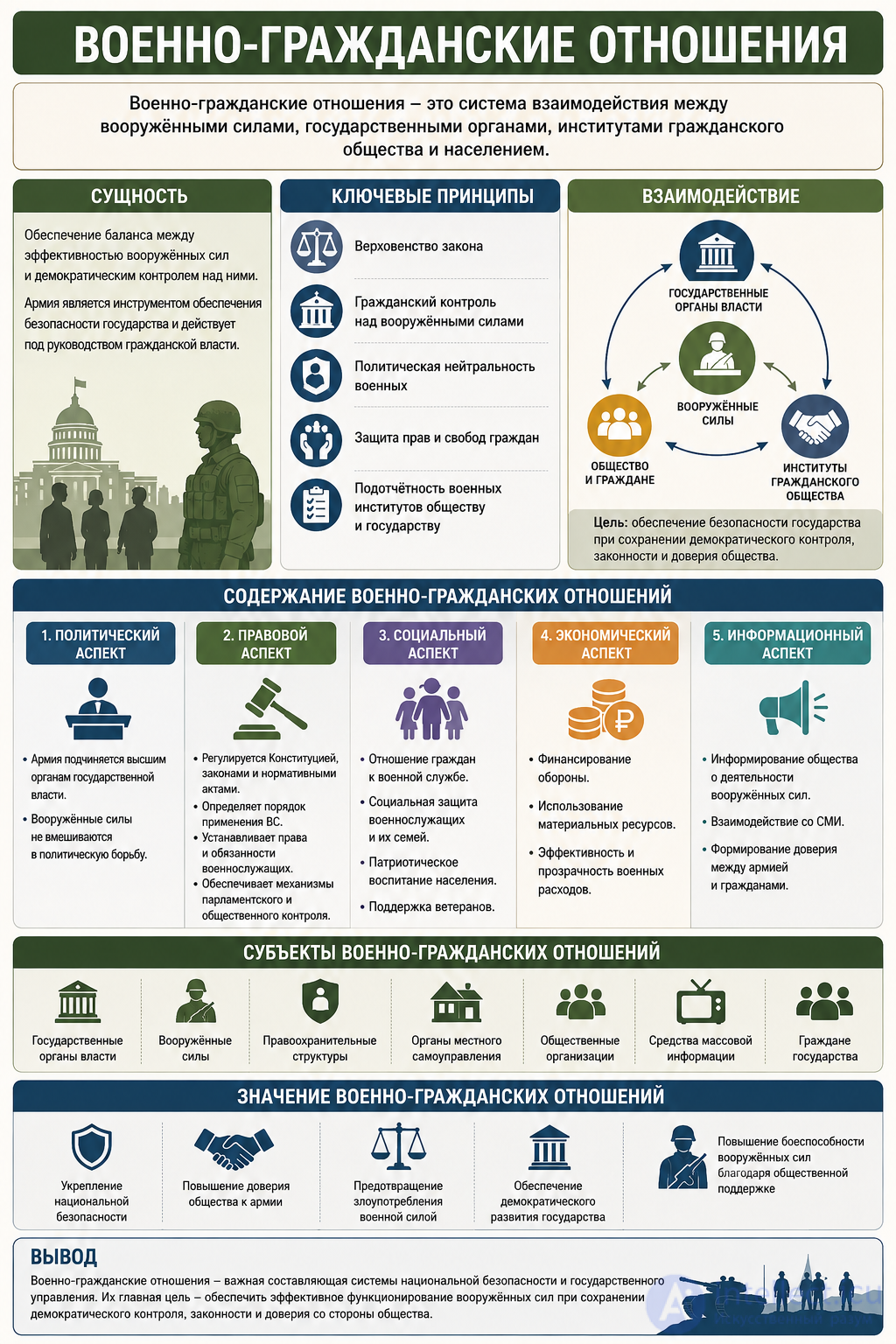
Civil-military relations are a system of interaction between the armed forces, state bodies, the institutions of civil society and the population. They define the place of the army in society, the manner of its subordination to civilian authority, and the mechanisms of control over the military sphere.
The essence of civil-military relations lies in maintaining a balance between the effectiveness of the armed forces and democratic control over them. In modern states the army is an important instrument for ensuring security, yet its activity must be conducted under the direction of lawfully elected civilian authorities.
Key principles:
The problem of civil-military relations has a long history. Even the thinkers of antiquity, in describing the structure of society, devoted a great deal of attention to the interaction within it between military and civilian people. Life altered the relations between them and introduced considerable adjustments to their content, but the role of civil-military relations as a factor in the stable development of society and in its security has never lost its significance.
Interest in studying this problem under present conditions is prompted by the profound processes of modernisation now taking place in the world, which carry with them radical changes in every aspect of social life. The problem of civil-military relations is particularly acute in contemporary Russia, which is going through a difficult period of its historical development, a transition to a fundamentally new form of statehood.
Traditionally, in both world and Russian political thought, civil-military relations were considered predominantly through the prism of the military organisation's belonging to the state. In contemporary scholarship the "state factor" is no longer regarded as the sole source of the armed forces' strength. There is also the army's own spirit. It is formed not so much by the army's belonging to the state as by its attachment to the values of its own generations, and by its distinctive social character as a source of strength and power.
Undoubtedly, the activity of the military organisation is regulated and directed by the state and by its socio-political and legal structures. Its substantive content depends in large measure on the level and competence of these structures and on how effectively they pursue their policy. Yet the military organisation cannot but be influenced by the traditions, values and qualities of civil society. All of the latter's qualitative components without exception (rights, interests, values, traditions, culture, institutions) are manifested in one way or another in the social portrait of the military organisation and in the life and activity of service personnel and military collectives. Moreover, the influence of society's civic values on the military organisation always imparts to it a definite meaning and orientation.
On the other hand, the reverse influence is also possible. The military organisation — above all the army as its principal element — may under certain conditions exert influence on civil society. For example, in a number of countries of the present-day world community the traditions of the armed defence of one's state have simultaneously become civic traditions as well, and the military component has become part of the content of the national mentality.
In short, civil-military relations constitute a complex system of mutual ties and mutual influences between the military organisation and civil society. Possessing such a qualitative character, they appear as a social phenomenon that has the character of an integral phenomenon with its own specific features.
Such is the defining approach to understanding civil-military relations in the broadest sense. In the narrow sense, their parties are conventionally identified as the military and civilians, as bearers of a particular social representation. This point of view is most often held by foreign researchers working on civil-military relations. They push the categories of "civilian" and "military" to an absolute opposition, evidently holding that these reflect different worlds — "the world of the military" and "the world of civilians", the spheres of civilian and of military life. Both, as social entities, differ from one another by many criteria. Thus the military are, in their view, a distinct social group of armed people called upon to resolve political problems by means of military violence. They perform a special kind of state service in the armed forces. Their profession is the ability to wage armed struggle and to use their skills to defend the country's vital interests. The military possess a specific style of thinking and act on the basis of particular principles that require the capacity to fight with weapons in hand. The image of the enemy — overt or covert — determines the character of their abilities, skills, worldview and mores. The military differ from civilians in their way of life and in the limitations placed on their rights and freedoms.
Civilians, who make up the majority of the population, are the chief engine of progress. Through their activity they ensure the reproduction of life as such, including the satisfaction of the state's needs.
Indeed, the military and civilians possess many specific qualities conditioned both by their status position and by their goal orientation. But this, in our view, can hardly be considered grounds for setting the military and civilians in opposition to one another, or for regarding them as existing autonomously. Thus, in particular, in ancient and medieval times, when caste-based military estates existed, an influx into them from the lay population was practically impossible. Today, however, contemporary social practice testifies to an entirely different social transformation of society.
Today even those who are not formally military personnel, but who are to one degree or another involved in supporting the armed forces, are assigned to the "world" of the military. It is well known that the armies of developed states include, alongside service personnel, a rather numerous civilian staff amounting to between 25% and 50% of the number of service personnel. The civilian staff of Russia's Armed Forces likewise makes up a significant portion of the army's personnel.
One cannot fail to note a further historical tendency: the military emerge from civilians and ultimately return into their structure. What we see is a process in which the military are formed out of civilians and, conversely, the military undergo civilian socialisation. The character and level of this process serve as an important indicator of the interaction and mutual influence of the military and civilians.
In political-science terms, what is decisive for an understanding of the essence and content of civil-military relations is their societal level — the interaction and mutual influence of the military, state and civil structures of society. Examining civil-military relations at this level makes it possible to see them in their full scope and diversity, together with the character and particular features of their development as the condition of their bearers and other social factors change.
In contemporary scholarship civil-military relations are classified on a number of grounds, the chief and defining one being their social content, that is, the interests and aims of the army in relation to society and of society in relation to the army. On this basis civil-military relations are divided into the following models: civil-military relations of accord (convergent); civil-military relations of separation (divergent); and civil-military relations of conflict (opposed). All the models of civil-military relations exist in the contemporary world and differ from one another. Each has its own particular features and forms of interaction among its principal subjects, and its own specific character.
The first model of civil-military relations is characteristic mainly of countries marked by a traditional and historical predominance of state principles in social life. Civil-military relations of accord are the consequence of a high level of integration between military and civilian institutions, "fertilised" by the value-based and cultural ties between the state and civil society. Their emergence is bound up with a lengthy period of the formation and development of states and their military organisations under the prolonged impact of a constant factor of external military threat. It is precisely the constantly existing threat of attack that largely determines the character of the link between the armed forces and political institutions, and between the armed forces and society itself. Accord between them is not merely a mode of their interconnection but a form of the existence and development of society and the state. The emergence and development of civil-military relations of accord are also substantially influenced by the territorial formation and stationing of military contingents, the presence of predominantly universal military obligation as the principle for manning the armed forces, the ethnic and confessional identification of service personnel, and so forth.
The most characteristic indicator of accord between the military and civilians is the organisationally formalised public self-activity of service personnel. The presence of voluntary associations within the armed forces differs in no way, in terms of values, from analogous structures of civil society. The activity of the voluntary associations functioning within the armed forces has its own specific features, but a deep accord between the military and civilians is present.
The second model of civil-military relations is characteristic of Western democracies — states with developed and autonomously functioning institutions of civil society. The central idea of civil-military relations of separation is a legislatively established condition in which military and civilian institutions function separately, and in which relations between them are established on the basis of strict "rules of the game", compliance with which becomes habitual in society. They are characterised by: the existence of an active and developed civil society with well-established and well-understood civilian control over the military sphere; strict limitation of the socio-political activity of service personnel; the legal codification of the military's non-interference in the internal life of society, especially its political life; and the manning of the armed forces on a predominantly voluntary basis.
In the view of many military political scientists, such a system of civil-military relations ensures the stability of society through the non-participation of service personnel in political struggle, through their lack of party sympathies and antipathies, and through their orientation towards supporting the legislative and executive authorities. The main substantive burden in the content of civil-military relations of separation is carried by the idea of civilian control over the military organisation and over the entire military sphere of social life.
The third model of civil-military relations is characteristic of states at a transitional stage of development and in the process of forming a new type of statehood. As a rule, in such countries the transitional condition itself constitutes the model of the socio-economic and state-political order. Russia is at present among such states.
Civil-military relations of the conflictual type are characterised by: the social stratification of society and a change in the social status of service personnel and of civilian structures; the excessive politicisation and ideologisation of civil-military relations; the weakness of the constitutional and legal mechanisms for taking and implementing the most important military-political decisions; the aggravation of internal problems of ensuring military security and the real possibility of the military being drawn into domestic political processes; the inevitable change in the principles of manning the armed forces and the accompanying change in military service relations; a decline in the prestige of the military and of the military organisation in society; and the intensification of the public self-activity of service personnel, up to and including the emergence of organisations pursuing political aims.
It should be noted that in Western political science this type of civil-military relations is termed indeterminate. Practice, however, testifies that at the root of all the indeterminacies in relations between the military and civilians lies the conflictual nature of the transitional condition: a conflict of values, of political authorities, of political interests and parties, of state and public principles, and so on. Conflictuality itself, therefore, serves as an indicator of the depth and systemic character of the crisis conditions of the transitional state, as a mode of existence and survival for social structures, and as a form of the contradictoriness of social development in the transitional period. Thus a transitional society, in which neither the forms of statehood nor the institutions of civil society and their values have settled, experiences the impact of civil-military relations of the conflictual type.
As the outcome of interaction and mutual influence, civil-military relations appear as a phenomenon with its own specific character. The constantly operating factors that determine the specific character of civil-military relations and their qualitative distinctiveness are as follows.
First, the form of the state's structure and the established character of the relationship between the state and civil society. The modern foundations of state structure are, as is well known, defined by several fundamental parameters: constitutionality, forms of government, and territorial and national-territorial organisation. The character of the state's structure determines the legal foundations of the military sphere of social life, that is, the lawful norms and procedures according to which the military factor is incorporated into the social fabric in order to ensure its safe existence. It is precisely the state that determines the purpose of the armed forces, the principles of manning personnel, the means of employing military force, the conditions of military service and the other circumstances through which the military interact with society. Thus the social and political rights of service personnel, which are an indicator of the qualitative character of civil-military relations, are established and guaranteed precisely by the structure of the state, by constitutional acts, or by lawful legitimate authority.
A most important consequence of the influence of state structure on the qualitative distinctiveness of civil-military relations is the social composition of service personnel, especially of the officer corps, and their social status. It is precisely this characteristic of service personnel that either isolates their life and activity from society or joins it to society, determining the social profile of civil-military relations. The stability and dignified social status of service personnel are, as practice shows, a guarantee of the security of civil society, of the high prestige of military service, of accord between the military and civilians, and of close interaction between military and civilian collectives.
The character of the state's structure also determines the national and ethnic features of civil-military relations. This is especially characteristic of multi-ethnic states. Under conditions of multi-ethnic existence, priority is always given not to national and ethnic interests but to state interests, which should not obscure the socio-psychological foundations of communication and interaction among service personnel of different nationalities. The social and everyday dimension of civil-military relations is conditioned by national and ethnic factors to the extent that the latter are unproblematic or problematic for the existence of society and the state themselves. This is an axiom of contemporary social practice in many states with a pronounced national and ethnic composition.
Second, the character of the political regime and the type of political decision-making that prevails in society as a result of it. If, let us say, the structure of the state forms the legal field within which civil-military relations are realised, then the political regime determines the more concrete functional mode of interaction between the military and political elites, and between the armed forces and society's political system. The main point, however, lies in how and by what means political decisions on military questions are taken, what political rights service personnel are granted, and what political mechanism exists for formulating and implementing solutions to the most important problems of military security.
Third, the historically established value-based and cultural (mental) foundations of interaction between the military and civilian components of social life. It may be said without exaggeration that for a number of states the value-based and cultural factor in the emergence, formation and development of civil-military relations is not merely constantly operative but a priority under present conditions. For each state the scale of value-based and cultural parameters has its own measure. Thus for Russia these are collectivism, the priority of the interests of the state over those of society, great-power status, the tradition of heroism, patriotism and others. All of them are proof that the national "dominant" (mentality) is a value-based and cultural characteristic of civil-military relations, characteristic to one degree or another of every people and state. Herein lies the national distinctiveness of civil-military relations as a reflection of the historical military-political experience of peoples and states.
It should also be noted that the national idea is a reflection of the traditional and historical values of society, which ultimately motivate the behaviour of the military and of civilians. It constitutes the principal content of national and state consciousness and permeates their social actions, imparting to them a socially significant meaning.
Fourth, the condition of the state-political development of a given state. For particular countries this condition may take various forms — stable development, a transitional condition, a condition of the disintegration of state integrity, and so on. In every case, one or another condition gives rise to a particular type of civil-military relations.
Stable state-political development stimulates the evolutionary improvement of the established civil-military relations, lends them solidity and reliability, makes military force safe for civil society, and makes civil society a cradle of values for service personnel. Practice testifies that under stable conditions the prestige of the armed forces and of military service grows steadily, the status of service personnel is strengthened, and circumstances are created that do not allow the army to interfere in domestic political processes or in the life of civil society.
Entirely different processes take place in a society undergoing a period of change in the form of statehood and radical political reform. Such processes are inevitably bound up with the breakdown of the established social status of service personnel and with the loss of their authority and prestige in society, as contemporary Russian experience demonstrates. Civil-military relations under conditions of the disintegration of an established statehood and the formation of a new one are, as a rule, conflictual in character. The consequence of this is the possibility of the armed forces interfering in the life of civil society, internal social tension among service personnel themselves, and the loss of combat capability and combat readiness by military collectives. If, in addition, the army is manned on the basis of universal military obligation, then all the problems associated with the social stratification of society are reproduced almost exactly within the armed forces, undermining from within the army's capacity to perform its tasks.
A most important group of factors affecting the condition of civil-military relations is also the aggregate of geopolitical, demographic, confessional, informational and other circumstances that make up the social facets of military security. In combination with other factors, they are capable of exerting a dynamic influence on civil-military relations and of imparting particular features and properties to them.
The distinctive character of civil-military relations in twentieth-century Russia consisted in their possessing features of all three traditional models: accord, separation and conflict. The composition of the officer corps, the manner of manning and the military mentality of the nation made it possible to build relations on the basis of the "unity of the army and the people". At the same time, the ruling elite kept the military organisation under unremitting control. Political decisions on questions of defence and security were the exclusive prerogative of the highest civilian authority. Nevertheless, relations of accord existed in the Soviet Union between society and the Armed Forces. Interactions between the military and civilians were quite close and fruitful. Thanks to this, the military organisation performed its tasks and functions in the most reliable manner, and military service and the defence of the Fatherland were regarded as the sacred duty of every citizen. Society considered the army and the navy its finest offspring, bearers of the ideas of freedom, equality, brotherhood and justice — especially after the Great Victory over Nazi Germany — and spared neither effort nor resources for their strengthening and development, which made the Armed Forces a factor in the consolidation of society, a symbol of the friendship of all the country's peoples, and evidence of the might of the Soviet state.
Civil-military relations encompass several main dimensions:
This is bound up with the role of the army in the political system of the state. The armed forces are subordinate to the supreme bodies of state power and do not interfere in political struggle.
This is governed by the constitution, laws and other normative acts, which determine:
This reflects the interaction of the army and society:
This is bound up with the financing of defence, the use of material resources and ensuring the transparency of military expenditure.
This includes informing society about the activity of the armed forces, engagement with the mass media, and the building of trust between the army and citizens.
The socio-political processes that unfolded in the country at the beginning of the 1990s led to a sharp deterioration in the social position of the Russian army, as of society as a whole. For the second time in that century Russia entered a transitional period. Assessing its contemporary civil-military relations by their principal indicators — the social composition and status of the officer corps, the procedure for taking and implementing military-political decisions, and the manner of manning the armed forces — the following conclusions may be drawn.
First, the officer corps under the conditions of a transitional period, especially where the formation of a new statehood is concerned, experiences a change in its social and state status, with all the consequences that follow from this. In Soviet times the officer corps was a kind of reference group for the rest of the population in terms of standard of living, value orientations and moral qualities. The loss of such status and the impossibility of compensating for the accustomed image compel the officer corps to seek ways of satisfying their interests along paths far removed from the direct duties of career military personnel. Second, military relations begin to develop not according to the logic of military-professional activity but according to the logic of the individual survival of service personnel themselves. Material motivation begins to take hold as the dominant motive in officers' behaviour.
Thus, under the conditions of a transitional period, the officer corps becomes an ambivalent (dual in nature and hence conflictual) social and professional community oriented towards standards of behaviour that are at times far removed from a military-professional orientation. In public opinion, military service gradually loses the character of an honourable privilege for the best part of the population. Herein lies one of the causes of the conflictual nature of civil-military relations under transitional conditions.
The unsettled and conflictual nature of civil-military relations under transitional conditions is also revealed and manifested in the ways in which political decisions on military questions are taken. This process is characterised by a number of features. They are: the absence of a constitutional and legal mechanism for taking the most important military-political decisions; the ruling political elite's overt reliance on the military and security structures, extending to the justification of an internal function for the armed forces; the economic and social impossibility of fully implementing the decisions taken on military questions; the possibility of pressure being brought to bear on service personnel and on the armed forces as a whole by particular political parties and movements; and the politicisation of service personnel, especially of the generals, extending to participation in the domestic political struggle for power, and so on.
The presence of the features noted above leads either to authoritarianism as a method of taking military-political decisions, or to such decisions being taken on the basis of the departmental interests of the military themselves. The opposition between these approaches is unmistakable, which is further proof of the conflictual nature of civil-military relations under transitional conditions.
A further cause and manifestation of the conflictual nature of civil-military relations is the problem of manning the armed forces, since the manner of manning serves as a generally recognised intermediary between the army and civil society. On this question it must be acknowledged from the outset that where a change in the forms of statehood is concerned, a corresponding change in the principles of manning — indeed their radical alteration — is the rule. In this respect the greater advantage lies with those states that move to a new political regime without changing the form of their socio-economic order.
Russia does not fit this variant of transition, and therefore for Russia the change in the principles of manning the Armed Forces is not so much a military as a nationwide task. Moreover, changing the principles of manning under conditions of the formation of a new statehood runs up against the problem of the need to ensure reliable military security for the state. To coordinate the resolution of these two tasks without a conflictual state of civil-military relations is practically impossible. The situation that has taken shape in the country testifies with complete clarity that there is an urgent need for decisive steps to ensure genuine social protection for career service personnel, to raise their standard of living and the prestige of officer service, and to change the population's views on military service. And the value positions and attitudes of the officers themselves.
The situation in the military sphere and the condition of the armed forces are becoming intolerable and require extraordinary measures. These measures, however, must be legitimate and effective in character and therefore cannot be worked out by a limited group of people behind closed doors, without the participation of society. Society and its institutions must not be pushed aside from this work, nor can they withdraw from it of their own accord. What is meant here is their right and duty to monitor the extent to which the principles of development and the actual condition, the internal organisation and the living and working conditions of the armed forces correspond to their purpose, and also to influence the state of affairs. What is at issue is civilian control over the military sphere and over all military activity. World experience testifies that it is precisely civilian control over the armed forces that serves as the factor enabling them not only to be an appropriate institution of the state but also to act as a most important instrument for defending the interests of civil society, and to fill civil-military relations with civilised content.
Effective civil-military relations contribute to:
Civil-military relations constitute an important component of the system of national security and state administration. Their principal aim is to ensure the effective functioning of the armed forces while preserving democratic control, legality and the trust of society.

Comments