
Lecture
The fundamentals of a state's national security are a system of measures, principles and institutions aimed at protecting the individual, society and the state from internal and external threats.
At the beginning of the third millennium the economic, scientific-technical and spiritual potential of humanity has grown many times over, accelerating the formation of a post-industrial civilisation. The world has become more integral and interdependent by virtue of objective processes of integration, and its political climate has changed.
The shaping of international relations today is accompanied by competition, as well as by the striving of a number of states to strengthen their influence on world politics, including through the creation of weapons of mass destruction. World experience shows that the significance of military-force aspects in international relations continues to be substantial.
Our country is one of the largest countries in the world, with a centuries-long history and rich cultural traditions. Despite the complex international situation and difficulties of an internal nature, by virtue of its considerable economic, scientific-technical and military potential and its unique geopolitical and strategic position on the Eurasian continent, it objectively continues to play an important role in world processes.
At the same time, the efforts of a number of states aimed at weakening our country's positions in the political, economic, military and other spheres are intensifying. Attempts to ignore our country's interests in resolving major problems of international relations, including conflict situations, are capable of undermining international security and stability and of slowing the positive changes taking place in international relations.
In many countries, including our own, the problem of terrorism has sharply intensified; it is transnational in character and threatens stability in the world, which makes it necessary to unite the efforts of the entire international community, to increase the effectiveness of existing forms and methods of combating this threat, and to take urgent measures to neutralise it.
There are security constants for our country. Russia faces the surrounding geopolitical space with three fronts: the western, turned toward the Euro-American world; the southern, turned toward the highly heterogeneous Islamic world; and the eastern, turned toward Asia and the Asia-Pacific region. For this reason the European, Near Eastern, Middle Eastern, Central Asian and Asia-Pacific regions are of natural interest to Russia from the standpoint of national security.
Under these conditions the military-political leadership of our country has to devote ever greater attention to forming a highly effective system for ensuring the state's security. "One's own security is the supreme law in politics...", wrote our great compatriot N. Karamzin.
National security means a condition of the state in which the following are ensured:
protection of sovereignty and territorial integrity; stability of the political system; the security of citizens; sustainable development of the economy; protection of culture, information, science, the environment and defence capability.
In other words, national security is the ability of a state to preserve its independence, stability and development even amid crises, conflicts and external pressure.
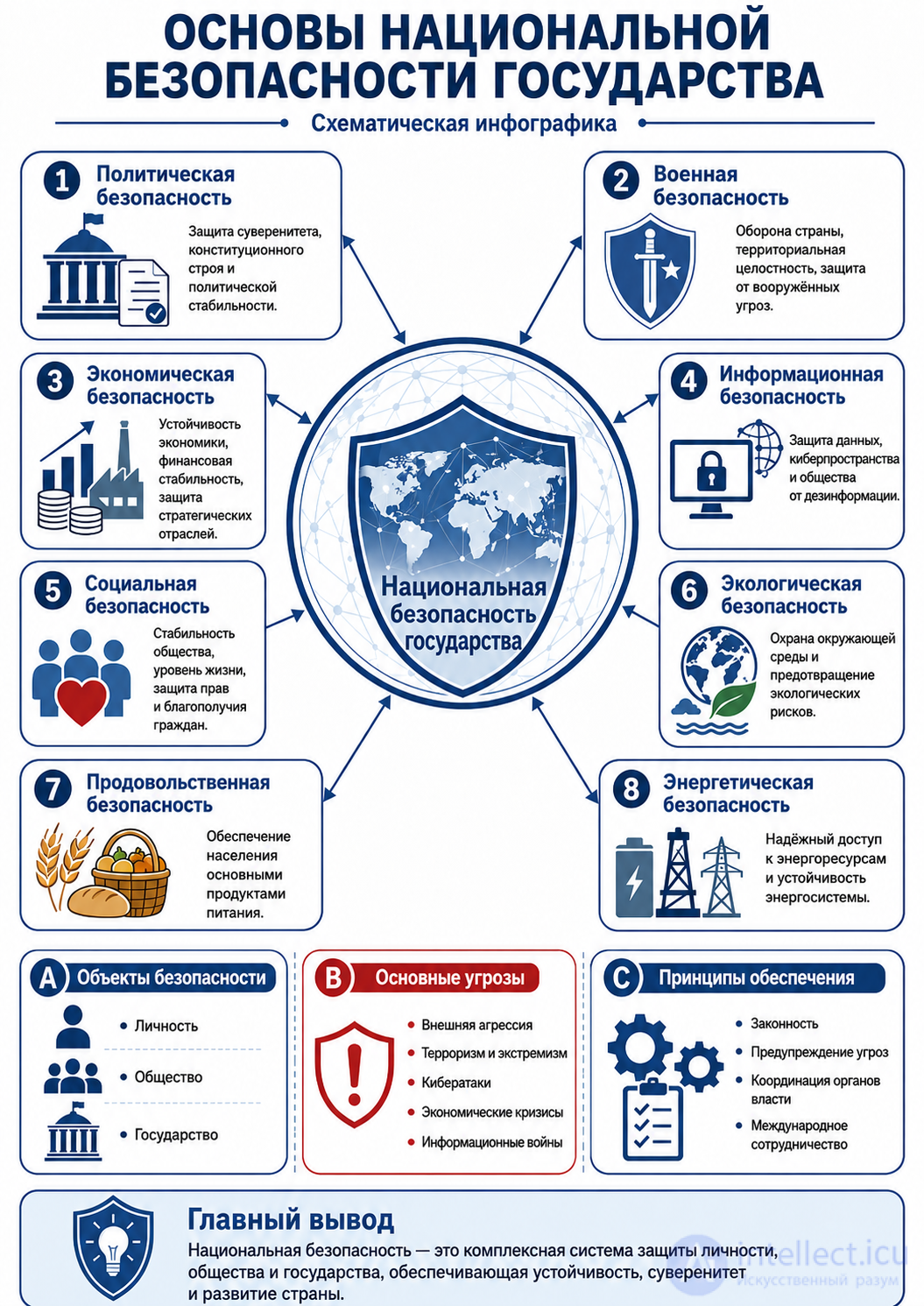
The objects of national security include:
The individual — his or her rights, freedoms, life, health and conditions of development.
Society — social stability, culture, traditions, interethnic and interreligious concord.
The state — sovereignty, territory, constitutional order, organs of power, defence and international standing.
The principal subject of national security is the state. It acts through organs of power, the army, law-enforcement structures, special services, diplomatic bodies, the civil defence system and economic institutions.
Civil society, local self-government, scientific institutions, business, the mass media and citizens themselves also play an important role.
It is connected with protecting state sovereignty, the stability of power, the constitutional order and political independence. Its task is to prevent destabilisation, a coup d'état, external interference and the destruction of the institutions of power.
This is the protection of the state from armed aggression, terrorism, military threats and violations of territorial integrity. It includes combat-capable armed forces, defence planning, the defence industry, mobilisation preparation and a system of alliances.
Economic security means the state's ability to develop sustainably, to ensure financial stability, energy independence, food security and the protection of strategic sectors. A weak economy makes a state vulnerable to external pressure and internal crises.
It is aimed at protecting the information space, state data, critical infrastructure and society from disinformation, cyberattacks and propaganda influence. In the twenty-first century this is one of the key areas of security.
Social security is connected with the population's standard of living and access to education, medicine, employment, social protection and justice. The higher the social tension, the greater the risk of protests, radicalisation and internal instability.
It includes protection of the environment, the rational use of natural resources, prevention of man-made disasters, climate change, and pollution of the air, water and soil. Environmental problems can directly affect people's health and the economy.
Food security means the state's ability to supply the population with basic foodstuffs. Energy security is the availability of stable access to fuel, electricity and other resources. These areas are especially important during wars, sanctions and economic crises.
The main threats include:
external aggression and military conflicts; terrorism and extremism; cyberattacks; economic crises; corruption; political instability; social inequality; separatism; demographic problems; ecological catastrophes; information wars; dependence on external resources and technologies.
National security is built on several principles:
legality; the priority of human rights and freedoms; protection of sovereignty; a balance of the interests of the individual, society and the state; prevention of threats; coordination of the actions of all organs of power; international cooperation; readiness for crisis situations.
The state ensures national security through:
the adoption of laws and strategies; the activity of the army and law-enforcement bodies; intelligence and counterintelligence; diplomacy; economic regulation; protection of borders; civil defence; the fight against corruption; the development of science and technology; the education of citizens; international agreements and alliances.
National security is essential to the existence of the state. Without it, sustainable development, the protection of citizens, a stable economy, an independent foreign policy and the preservation of territorial integrity are impossible.
A state's national security is a comprehensive system for protecting the vital interests of the individual, society and the state. It encompasses political, military, economic, information, social, environmental, food and energy security. Under contemporary conditions national security depends not only on the army, but also on the economy, technology, information, the unity of society and the effectiveness of state institutions.

Comments