
Lecture
The origins of the military-political views of the thinkers of the Ancient East that have come down to us from the depths of the centuries lie in such countries as Egypt, Babylon, China and India, which as early as the 24th and 23rd centuries BC already possessed a rich and varied military-political practice. Wars elevated or destroyed states, altered the form of government, and replaced one ruler with another. For this reason, in the military-political thought of that time, recorded in numerous military-political treaties, funerary inscriptions, proclamations, letters and other literary sources, wars are regarded as an effective means of expanding the borders of the state, seizing new slaves, riches and fertile lands, and establishing control over trade routes. Thus, in the 27th century BC the Egyptian commander Weni, describing his campaign into the depths of Africa, emphasises that it ended successfully and that the Egyptians captured many slaves as prisoners, having destroyed the land of the sand-dwellers.
A special place in the history of military-political theory belongs to the thinkers of ancient China. Among them the commander and philosopher Sun Tzu (5th–4th centuries BC) undoubtedly stood out; he linked war to the policy of the state and formulated the principles of waging it. Sun Tzu proceeded from the dominant position of policy in relation to war and of political leadership in relation to military leadership. The interconnection of policy and war served him as the initial basis for a classification of wars, within which he distinguished three possible forms of them.
The first. The ideal form: without applying force, by using all other means, to compel the adversary to abandon his political aims and thereby make him more yielding — to subdue another's army without fighting.
The second. A less advantageous form of war: to separate the adversary from his allies, to make him feel too weak to enter into single combat, and thereby make him yielding.
In analysing the two forms of war mentioned, Sun Tzu placed great hopes on political means. For present-day conditions his famous formula sounds extraordinarily relevant: "To subdue the enemy's army without battle is the height of skill."
The third. The worst form of war consists in the use of armed force.
In essence this was the first attempt to classify wars according to their political content and the means employed.
The outstanding military theorist of ancient China Wu Qi (5th–4th centuries BC), in his treatise On the Art of Waging War, pointed to the causes, including political ones, that give rise to wars. There are five such causes, he held: the first — for the sake of glory; the second — for the sake of gain; the third — because of accumulated grievances; the fourth — because of internal disorders; the fifth — because of famine. These causes correspondingly give rise to five possible kinds of war: just wars, wars of force, wars of fury, cruel wars, and rebellious wars.
The problem of the connection between war and policy occupies an important place in the philosophical-political and military literature of ancient India. This is confirmed by the treatise Arthashastra (4th–3rd centuries BC), whose author is considered to be Kautilya (Chanakya), the influential adviser and minister of King Chandragupta I. In the treatise, alongside the traditional reverence for dharma and the recognition that "law is founded on truth", clear preference is given to practical benefit (artha) and to the military-political measures and administrative-governmental arrangements conditioned by it. At the same time, one can trace the idea of war as an instrument of policy carried out by specific violent means.
It is precisely for this reason that Chanakya is often called "the Indian Clausewitz". In the author's view, war must always serve the broader aims of policy and not become an end in itself. If it entails the destruction of both sides, this means the bankruptcy of policy. War should be waged with the help of armed forces, but far more important than the force of arms is the higher political strategy, which undermines the enemy's spirit, corrupts his forces and brings about his collapse.
The military-political views of the thinkers of Antiquity are of enduring significance for contemporary military political science. One of the founders of ancient atomism, Democritus of Abdera (460–370 BC), devoted a whole cycle of his works to the problem of the relationship between policy and war. Investigating the sources and causes that generate wars, the philosopher rejected from the outset their supernatural, divine essence. Every war has a definite cause, and to identify it, in Democritus's view, it is necessary to establish the natural connection of the events taking place. The genesis of wars, moreover, is conditioned by economic and socio-political causes and by the property inequality of the population.
Such Sophist philosophers as Protagoras, Gorgias, Alcidamas, Lycophron, Critias, Thrasymachus and others devoted much attention to the question of the origin of wars. In assessing wars these thinkers proceeded from the "theory of the social contract" they themselves had created, the main content of which is the following assertion: in order to be delivered from the constant threat of military violence and to guarantee one another mutual security, it is necessary to conclude a political contract establishing friendly relations among all citizens.
The principal views of the Sophists may be summed up as follows: wars are the constant companions of human society, since an original aggressiveness is inherent in the essence of man; at the root of the causes of wars lies the striving of citizens to deprive the strong personality of the right to rule over the weak; wars occur where the thirst for political power, ambition, envy and the passion for primacy manifest themselves most acutely.
The Athenian philosopher Socrates held, unlike the Sophists, a somewhat different point of view. In his opinion, only those people who are directly and professionally engaged in politics and possess true and profound knowledge in the field of state administration are able to judge the problems of war and peace. Socrates saw the following as the principal causes of wars and internal conflicts: the imperfection of man; the non-correspondence of law and benefit to social development; the impossibility for people to make sense of good and evil; and the violation of legality in the state by the will of its rulers.
The outstanding philosopher of Antiquity Plato (427–347 BC) repeatedly touched upon the problems of war and politics in his works. One should note Plato's unquestionable striving to reveal and demonstrate the connection of war with social relations, and above all with politics, by which he understood the direction of public and state affairs.
In his work The Republic, Plato calls politics and the political art "the art that governs all, the royal art". In the dialogue Protagoras he defines the military art as a part of the political art. It is important that the thinker did not permit any attempt to belittle or underestimate the role of politics in war. He wrote: "... we do not accept that the political art is the science of warfare, that is, an auxiliary science ...". Plato considered war to be a natural condition of society, a legitimised means of acquiring slaves and seizing foreign territories. The laws that exist in the animal world are inherent in human society as well. The governing principle of social development is the right of the strong over the weak. From this the philosopher concludes that wars are unceasing, eternal and ineradicable. By nature there exists an eternal, irreconcilable enmity among all states.
Plato assigned an important place in his works to the analysis of the socio-political causes of the outbreak of wars. Among the most essential of them he counted the imperfection of the state. Thus, for example, democracy, in the thinker's opinion, is unstable and fraught with war, since it strives excessively for freedom; oligarchy rests on the fear of the use of armed force, since under this form of government the interests of the rich and the poor will never be joined; the worst kind of political order is tyranny, which constantly strives to draw the citizens into the abyss of war so that "the people may feel the need of a leader". From this Plato concludes: the majority of forms of political order are vicious from the outset and by their very nature give rise to wars. Although Plato is the exponent of certain clearly reactionary views on the essence of wars, his ideas have exerted and continue to exert a fruitful influence on the development of contemporary military-political thought.
The outstanding representative of ancient Greek philosophy Aristotle (384–322 BC) investigated the interconnection of politics and war in greater detail and gave a comprehensive characterisation of its causes and sources. He devoted particular attention to military questions, developing such concepts as "the science of war", "the military art", "justice in war" and others. In many of his works the philosopher sought to reveal the causes that give rise to wars. Among the socio-political causes he counted the following: the existence of states in which the majority of people are in subjection to a handful of power-seekers; the disruption of the necessary equilibrium in the political structure of the social order; the violation or absence of the political rights of citizens; the strengthening of one-man rule under conditions of aristocracy; and the inclination towards demagogic forms of relations between rulers and citizens in a democratic state.
Aristotle's military-political views, unlike Plato's, are characterised by greater realism, concreteness and constructiveness. A clear practical orientation stands out in them, which determined the direction of the development of military-political thought for a millennium.
The military-political views of the philosophers of ancient Greece received further development among the thinkers of ancient Rome. Thus Titus Lucretius (c. 99–55 BC) passionately condemned wars in his works and called for peace. He saw the deep roots of wars in the existence of the phenomenon of property and in the thirst for gain, while the perfecting of weapons, in his view, only added ever new horrors of war and turned war into an ever more formidable instrument of policy.
Marcus Tullius Cicero (106–43 BC) attached considerable importance to the analysis of military-political relations. Thus, in the treatises On the Republic and On the Laws, written after Plato's example in the form of dialogues, Cicero emphasised the importance of military-political problems in state administration. He wrote of the need to centralise power during periods of military operations. The justice of waging military operations he defined by a formal act — the declaration of war. In his opinion, only after a decree of the senate and a command of the people do the holders of power wage just wars.
Thus, as early as the classical period, fundamental conclusions were formulated on the problems of politics, war and peace, and the interconnection between war and politics was traced. In the very content of war the philosophers of Antiquity distinguish two aspects: first, an armed clash always bears a violent character; second, the aims pursued by armed violence are determined by the policy of the state, which strives to extract a concrete benefit for itself from one or another military action.
Nevertheless, the military-political views of the classical epoch were empirical in character and naively idealistic in content. The representatives of philosophical thought of this period were unable to substantiate the relative independence of politics and war. They did not succeed in fully demonstrating the dependence of the military art on the possession of professional military knowledge and skills. Their works did not reflect the circumstance that war as a political phenomenon is not identical with war as a form of manifestation of purely technical, professional activity.
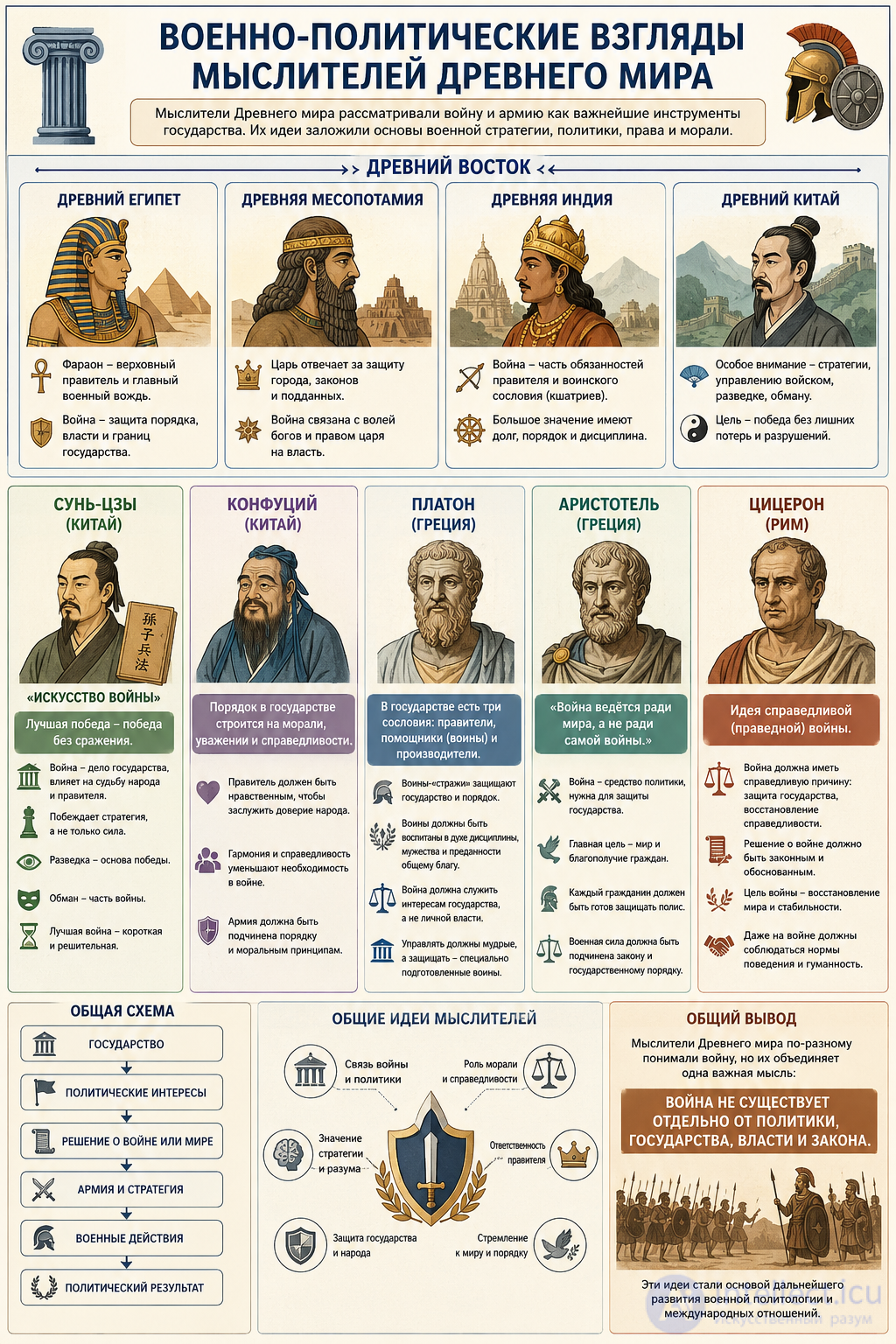
In the states of the Ancient East, war was often regarded as a means of strengthening the ruler's power, expanding territory and defending order.
Key ideas:
| Thinker / tradition | Military-political views |
|---|---|
| Ancient Egypt | The pharaoh was considered the supreme ruler and chief military leader. War was understood as the defence of order and of the power of the state. |
| Ancient Mesopotamia | The king was responsible for defending the city, the laws and his subjects. War was linked to the power of the gods and the right of the king. |
| Ancient India | War was regarded as part of the duties of the ruler and of the warrior estate. Duty, order and discipline were of great importance. |
| Ancient China | Particular attention was paid to strategy, the command of troops, deception, reconnaissance and victory without unnecessary losses. |
One of the best-known military thinkers of ancient China is Sun Tzu, author of the treatise The Art of War.
His main idea:
The best victory is victory without battle.
Sun Tzu held that war is not merely a clash of armies but a struggle of intellect, strategy, information and will.
Sun Tzu's key ideas:
| Idea | Explanation |
|---|---|
| War is an affair of state | War affects the fate of the people and of the ruler. |
| Strategy wins | Strength matters, but calculation, planning and knowledge of the adversary matter more. |
| Intelligence is essential | One must know the enemy's weaknesses and one's own capabilities. |
| Deception is part of war | The enemy must be mistaken in assessing your intentions. |
| The best war is a short one | A long war exhausts the state. |
Confucius spoke less about the technique of war than about the proper governance of the state.
He held that order in society must be built on morality, respect, duty and justice. War is permissible only when the ruler acts for the sake of restoring order, and not for personal gain.
Confucius's key ideas:
| Idea | Meaning |
|---|---|
| The ruler must be virtuous | The strength of authority depends not only on the army but also on the trust of the people. |
| Harmony is more important than violence | Good governance reduces the need for war. |
| The army must be subordinated to order | Military force must not destroy the moral foundations of the state. |
In ancient Greece, great attention was paid to the connection between war, the state and the education of citizens.
In his work The Republic, Plato singled out a special estate of warriors — the guardians. They were to defend the state and be brought up in a spirit of discipline, courage and devotion to the common good.
Plato's military-political ideas:
| Idea | Explanation |
|---|---|
| The state needs defenders | Warriors safeguard order and security. |
| Warriors must be properly educated | An army requires not only strength but also the right character. |
| War must serve the state | Military force must not be used for the sake of personal power. |
| The best should rule | Wise rulers should govern, and specially trained warriors should defend. |
Aristotle regarded war as a means, not as a supreme end. He held that the aim of the state is the good and just life of its citizens, and that war can be justified only for the sake of peace and security.
The main idea:
War is waged for the sake of peace, not for the sake of war itself.
Aristotle's military-political ideas:
| Idea | Explanation |
|---|---|
| War is an instrument of policy | It is needed to defend the state and to achieve peace. |
| The main aim is peace | The state must not live for the sake of perpetual war. |
| Citizens must be able to defend the polis | The defence of the state is the duty of its citizens. |
| Law stands above arbitrary rule | Military force must be subordinated to the political order. |
In ancient Rome the idea of the just war became important.
Cicero held that war can be justified only when there is a lawful cause: the defence of the state, the restoration of justice, or a response to the violation of a treaty.
Cicero's key ideas:
| Idea | Meaning |
|---|---|
| War must have a just cause | One must not go to war merely for plunder or glory. |
| War must be declared lawfully | The decision on war must be bound up with law and the order of the state. |
| The aim of war is the restoration of peace | Victory must lead to stability, not to endless violence. |
| The enemy too remains a human being | Even in war there must be norms of conduct. |
The thinkers of the Ancient World understood war in different ways, but they were united by one important thought:
war does not exist separately from politics, the state, power and law.
For some, war was a means of defending order; for others, an instrument of strategy; for still others, a question of justice and morality. It was precisely these ideas that became the foundation for the further development of military political science.

Comments