
Lecture
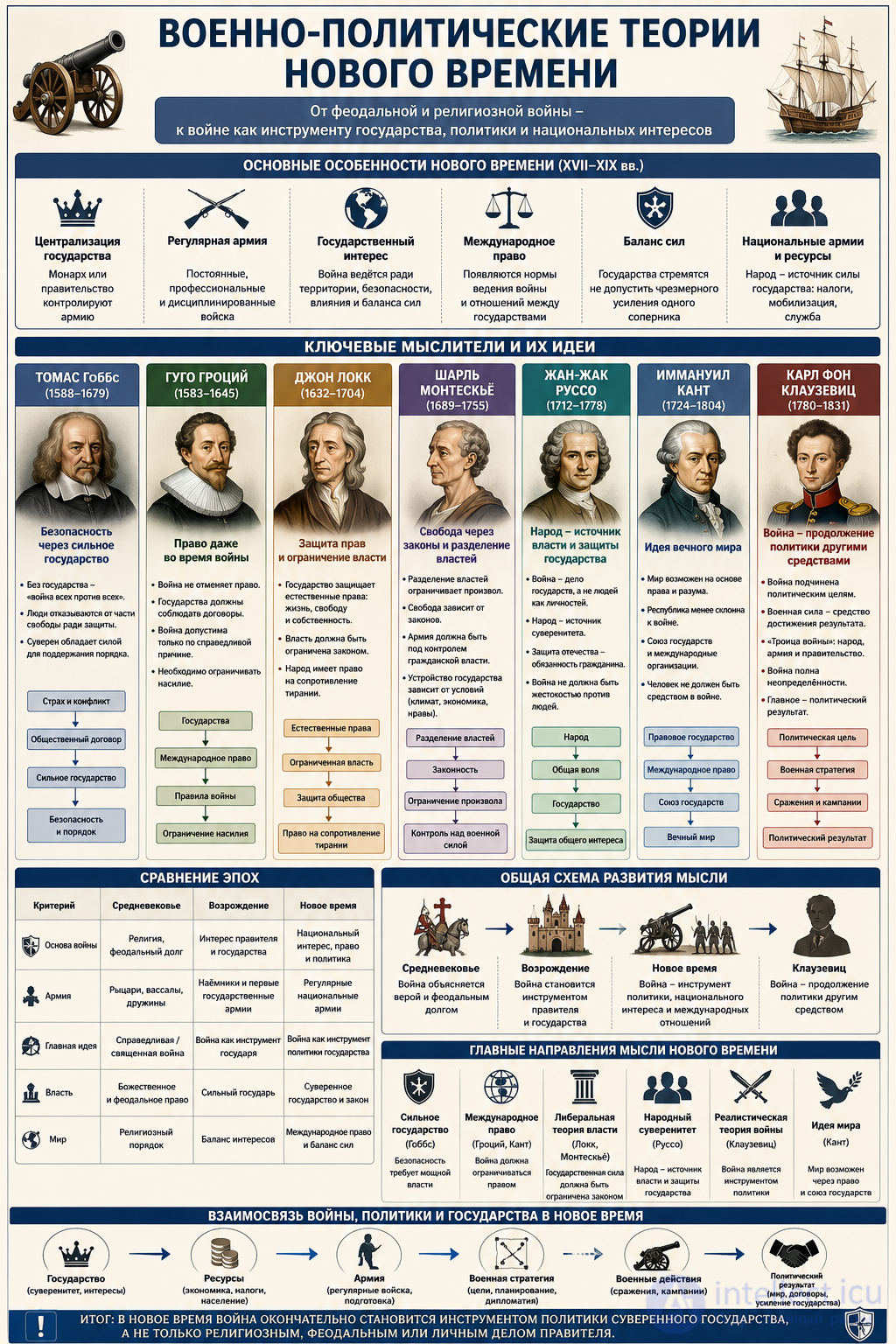
The Modern Era is the period from roughly the 17th to the 19th century, when modern states, regular armies, centralised power, diplomacy, international law and new conceptions of war took shape in Europe.
The principal transition of this epoch:
from feudal and religious war — to war as an instrument of the state, of policy and of national interests.
In the Modern Era war is increasingly regarded not as the personal affair of a ruler or a religious mission, but as a rational means of state policy.
| Feature | Meaning |
|---|---|
| Centralisation of the state | The monarch or the government gains control over the army |
| The regular army | Troops become permanent, professional and disciplined |
| State interest | War is waged for the sake of territory, security, influence and the balance of power |
| International law | Norms of waging war and of relations between states appear |
| The balance of power | States strive to prevent any one rival from becoming excessively strong |
| National armies | The people gradually become a resource of war: taxes, mobilisation, service |
The end of the 18th and the beginning of the 19th century in the history of humanity were characterised not only by a growth in the number of bloody wars but also by the appearance of a new variety of them — the revolutionary war. This impelled the military-political thought of the time towards a comprehensive study of the relationship between war and revolution and towards understanding their essence.
The German philosopher G. Hegel (1770–1831), justifying wars, considered them the engine of progress and observed that "war preserves the healthy morality of peoples". Hegel has the distinction of being the first to discover the role of the moral spirit of the people and the army, of commanders and soldiers, in war, and the conditioning of military organisation by the internal structure of the state.
One of the theorists who justified wars and violence was the German philosopher F. Nietzsche (1844–1900). He preached to the caste of masters the rejection of Christian morality, the "morality of slaves", and the acceptance of the "morality of masters", which knows neither pity nor compassion and holds that all is permitted to the strong. Man, in this philosopher's conception, is a "super-chimpanzee", and violence is a mode of mutual intercourse organic to human beings. Nietzsche considered war the principal means of realising his ideology; in his view it constitutes the vocation of every representative of the higher race. He predicted the intensification of militarism and wrote with delight that "the coming century will bring with it the struggle for dominion over the earth", and that "there will be wars such as have never yet been on earth". Much in this philosopher's views was taken up by the ideology of German National Socialism.
Besides philosophical ideas, the ideas of the military figures and politicians of Western Europe are important for understanding and resolving the problems of politics and war. Thus the 18th-century military theorist General Henry Lloyd (1720–1783) assigned a considerable role to policy in his understanding of the essence of war. He gave a profound justification of the influence of a state's political structure on the character of its people. Nevertheless, his account of the role of the element of force in war appears rather debatable. Lloyd supposed that the outcome of combat operations could be calculated with geometrical precision and that war could be waged continuously without being compelled to give battle.
The major French military theorist A.-H. Jomini (1779–1869) held entirely opposite views. He directed all his creative energy towards demonstrating the importance of conducting combat operations to achieve a complete and final victory. As a chronicler of the Napoleonic wars who knew their price, Jomini acknowledged that war is a great drama that lends itself to no forecasts. He also asserted the unconditional primacy of policy over all the combat activity of troops, and the meaning of war, in his view, consists in the attainment of the aims of that policy.
Jomini's role in the development of military-strategic thought is a great one. Serving in Russia from 1813, he was involved in planning combat operations in the Russo-Turkish (1828–1829) and Crimean (1853–1856) wars. Generalising the experience of the wars of the late 18th and early 19th centuries, Jomini worked out a system of principles making it possible to secure victory in battle. In his view, a battle is "... the decisive clash of two armies struggling for political and strategic aims". This theorist is also the author of valuable reflections on international legal restrictions against wars that destroy so many people. Since the means of destruction were being perfected with terrifying rapidity and promised "... a great revolution in the organisation, armament and even the tactics of armies", he insisted that wars be excluded from the "code of international relations".
| Current | Representatives | Essence |
|---|---|---|
| The theory of the strong state | Hobbes | Security requires powerful authority |
| International law | Grotius, Kant | War must be limited by law |
| The liberal theory of power | Locke, Montesquieu | The power of the state must be limited by law |
| Popular sovereignty | Rousseau | The people are the source of the state's power and its defence |
| The realist theory of war | Clausewitz | War is an instrument of policy |
| The idea of peace | Kant | Peace is possible through law and a union of states |
| Criterion | The Middle Ages | The Renaissance | The Modern Era |
|---|---|---|---|
| The basis of war | Religion and feudal duty | The interest of the ruler and of the state | National interest, law and policy |
| The army | Knights, vassals, retinues | Mercenaries and the first state armies | Regular armies |
| The main idea | A just / holy war | War as an instrument of the sovereign | War as an instrument of state policy |
| Power | Divine and feudal right | A strong sovereign | The sovereign state and the law |
| Peace | Religious order | A balance of interests | International law and the balance of power |
Clausewitz is one of the foremost military theorists of the Modern Era. His work On War became a classic of military-political thought.
The main idea:
War is the continuation of policy by other means.
For Clausewitz war is not an independent phenomenon. It is subordinated to political aims.
| Idea | Explanation |
|---|---|
| War is bound up with policy | Policy determines the aims of war |
| Military force is a means | The army is used to achieve a political result |
| The "trinity of war" matters | The people, the army and the government take part in war in different ways |
| War contains uncertainty | Decisions are taken under conditions of risk, chaos and incomplete information |
| Victory is not always purely military | The main thing is the attainment of the political aim |
In brief:
The political aim
        ↓
Military strategy
        ↓
Battles and campaigns
        ↓
The political result
It was precisely the German theorist C. Clausewitz (1780–1831) who investigated the essence of war and its connection with policy most fully. Clausewitz approached the analysis of war by first grasping its essence. The starting point here was violence as a specific aspect of war. It is beyond dispute that war is an act of violence which in its essence constitutes combat. "The idea underlying combat," the theorist wrote, "determines the essence of war." At the same time he emphasised that war is not … an independent act but part of a whole, that is, of policy. War as a social phenomenon is called forth by political motives, always arises out of a political situation and cannot be isolated from political relations. External and internal political relations, Clausewitz held, not infrequently play a more decisive role than everything else.
Policy is the sphere in which war develops. Every policy already contains, in latent form, the outline of a war, and therefore war "... is nothing other than the continuation of political relations with the intervention of other means". Being closely bound up with policy, war must fully take on its properties and character.
The value of Clausewitz's military-political views lies in the fact that he accurately and profoundly demonstrated the decisive influence of policy on war, which manifests itself in that the former gives rise to the latter and determines its aims, while the latter serves only as a means of attaining those aims. Policy, moreover, is of determining significance for establishing the character and scale of wars and for the choice of methods and modes of combat operations. Clausewitz was convinced that war has no logic of its own but employs only the logic of policy. Despite certain contradictions in Clausewitz's reasoning, in particular concerning spontaneous armed violence, it is beyond dispute that his fundamental ideas continue to serve as a key to understanding the contemporary problems of politics and war and the genetic essence of contemporary wars and conflicts.
At the same time, it should be noted that some major military figures of the period took a stance of active rejection of Clausewitz's ideas. Following Hegel and Nietzsche, they made the significance of violence absolute, acting as apologists for the ideology of militarism characteristic of late nineteenth-century Europe. Thus the Prussian Field Marshal H. von Moltke (1800-1890) exaggerated the role of armed violence in his works and held that policy determines only the outbreak of a war and its aims, while the course of the war itself is independent of policy. Once hostilities begin, political considerations must be subordinated to strategic ones. Moltke opposed any interference by the political leadership in strategic and operational planning.
The revolutionary-democratic school has its origins as far back as the seventeenth and eighteenth centuries, in the turbulent events of the bourgeois revolutions, in particular in Cromwell's revolutionary wars (England, seventeenth century), in the wars of independence, and in the war between North and South in North America (eighteenth-nineteenth centuries). A special role in its formation and development, however, was played by the French Revolution of 1789. In contrast to the unrestricted right of the strong that had prevailed for many centuries, it demonstratively rejected the policy of conquest and secret negotiations. It proclaimed the armed people to be a subject of history and legitimised revolutionary violence. Robespierre emphasised that violence and sacrifice are justified if they are necessary to establish freedom. Victor Hugo believed that every civilisation is prepared and established only in the course of war. In the middle of the nineteenth century Karl Marx wrote that violence is the midwife of history whenever it is pregnant with revolution.
Friedrich Engels approaches the question of the role of violence from a somewhat different position; in his work Anti-Dühring he formulates and substantiates his own theory of violence. Arguing against exaggerating the role of violence, Engels demonstrates that it is the result of definite established economic relations and of the mode of production of material goods. At the same time he warns of the harm of underestimating the role of violence, pointing to its revolutionary role in the process of historical development. War, in Engels's view, is a concrete historical phenomenon that arises with the appearance of private ownership of the means of production and the division of society into exploiting and exploited classes. Once classes have been abolished and exploitation and the exploitative order destroyed, there will be no more wars. Engels was thus one of the first to investigate military-political problems from the standpoint of historical materialism.
There was also an anti-war school in the history of social and political thought. It emerged as early as the dawn of the modern era, and its exponents included such figures as the Czech king George of Poděbrady, Hugo Grotius, Erasmus of Rotterdam, Jan Comenius and others. In the Age of Enlightenment, Immanuel Kant, Johann Herder and Johann Fichte made a substantial contribution to elaborating ideas on preventing war and securing peace in Europe. As the destructive and lethal properties of weapons grew, many humanist scholars and public and political figures spoke ever more insistently of the "law of war and peace".
Hugo Grotius is one of the founders of international law. He developed the idea that even war must be subject to legal and moral norms.
| Idea | Explanation |
|---|---|
| War does not abolish law | Even in wartime there are rules |
| States must observe treaties | International agreements are essential to peace |
| A just cause for war | War may be permissible in order to defend, to restore rights, or to punish an aggressor |
| Limitation of violence | No action can be justified merely by the fact of war |
In brief:
States
   ↓
International law
   ↓
The laws of war
   ↓
Limitation of violence
Kant proposed the idea of perpetual peace — an international order in which wars gradually become less likely thanks to law, republican government and leagues of states.
| Idea | Explanation |
|---|---|
| Peace must rest on law | The international order must be a legal order |
| A republic is less inclined to war | When citizens themselves bear the cost of war, they are more cautious about starting one |
| A league of states | States must create international mechanisms of peace |
| A human being must not be a means | War must not turn people into mere material for politics |
In brief:
The law-governed state
        ↓
International law
        ↓
A league of states
        ↓
Perpetual peace
The great German philosopher Immanuel Kant (1724-1804) was the first to surmise an objective regularity leading to the establishment of perpetual peace on the basis of a league of peoples. He noted that war was becoming ever less acceptable because of its destructive consequences, and argued that "after several transformative revolutions there will at last be realised that which nature has set as its highest goal, namely a universal cosmopolitan condition as the womb in which all the original capacities of the human race will be developed".
In Kant's view, people will be compelled to enter into a league of peoples on peaceful foundations. It is precisely wars, with their burden of military expenditure, heavy human losses and material costs, that create the need for such a league and will in the end force people to renounce self-destruction.
John Locke linked the state to the protection of natural human rights: life, liberty and property.
In his view, power exists not for its own sake but to protect society. If power violates people's rights, it forfeits its legitimacy.
| Idea | Explanation |
|---|---|
| The state protects rights | The chief function of government is to protect life, liberty and property |
| Power must be limited | A ruler must not become a tyrant |
| The people have a right of resistance | If the government destroys rights, the people may resist it |
| War may be defensive | Defence against aggression and tyranny is permissible |
In brief:
Natural rights
        ↓
Limited government
        ↓
Protection of society
        ↓
The right to resist tyranny
Thomas Hobbes regarded security as the principal reason for creating the state.
He held that without a strong authority people live in a condition of fear, conflict and the war of all against all. The state is therefore necessary in order to ensure order and protection.
| Idea | Explanation |
|---|---|
| Without the state, chaos | People may struggle constantly for survival and security |
| The state protects society | The chief task of government is to prevent internal war |
| The sovereign possesses force | Government must be able to compel and to protect |
| Security matters more than complete freedom | People surrender part of their freedom to the state for the sake of order |
In brief:
Fear and conflict
        ↓
The social contract
        ↓
A strong state
        ↓
Security and order
Montesquieu examined the connection between political organisation, liberty and military force.
He held that an excessive concentration of power is dangerous, because it can lead to tyranny, militarism and abuses.
| Idea | Explanation |
|---|---|
| Separation of powers | Power must be divided in order to limit arbitrary rule |
| Liberty depends on laws | Without the rule of law, military force can become an instrument of tyranny |
| The army must be under the control of the state | Military force must not be subordinated to the personal interests of the ruler |
| Climate, economy and customs shape the state | The organisation of a society shapes its military and political system |
In brief:
Separation of powers
        ↓
Rule of law
        ↓
Limitation of arbitrary rule
        ↓
Control over military force
Rousseau linked war not to human nature but to relations between states.
He held that war is a conflict not between individuals but between political communities.
| Idea | Explanation |
|---|---|
| War is the business of states | People become enemies not as individuals but as citizens of warring states |
| Popular sovereignty | The source of power is the people |
| The citizen is bound to the state | Defence of the state becomes the citizen's duty |
| War must not be cruelty towards people | War must not be turned into personal hatred |
In brief:
The people
 ↓
The general will
 ↓
The state
 ↓
Protection of the common interest
The Middle Ages
War is explained by faith and feudal duty
        ↓
The Renaissance
War becomes an instrument of the ruler and the state
        ↓
The modern era
War is understood as an instrument of policy,
national interest and international relations
        ↓
Clausewitz
War is the continuation of policy by other means
The military-political theories of the modern era laid the foundation of contemporary military political science.
The principal ideas of this epoch:
The sovereign state
        ↓
The standing army
        ↓
National interests
        ↓
International law
        ↓
The balance of power
        ↓
War as an instrument of policy
Thus, in the modern era the structure of military-political social consciousness became considerably more complex. Within military political science various schools began to emerge ever more distinctly:
the bourgeois-militarist school, whose content covers a fairly wide range of interpretations of war, from Clausewitz to Bismarck and Moltke the Elder;
the revolutionary-democratic school, within which, in the second half of the nineteenth century, the Marxist current was born, including in its revolutionary-militarist form;
the pacifist school, whose most prominent representative is Immanuel Kant.

Comments