
Lecture
The military-political process has a definite structure and is constantly developing under the influence of changes in the international situation, in technology, in the economy and in the character of contemporary conflicts.
The structure of the military-political process may be determined by means of an analysis of the components that constitute the basis of interaction among various political actors, and also by identifying its dynamics (the main phases of the military-political process, their succession and so on). It is customary to distinguish at least four significant components: the subjects of the military-political process; military-political interests; military-political activity; and the military-political relations that take shape as a result of the activity of the subjects of military policy.
The principal subjects of the military-political process are actors which are represented above all by the state or a union of states (to a considerably lesser degree by political parties, civil society, organized and unorganized groups of people, and also individuals). In essence, the subjects of the military-political process are the subjects of military policy. These concepts should therefore be used as synonyms.
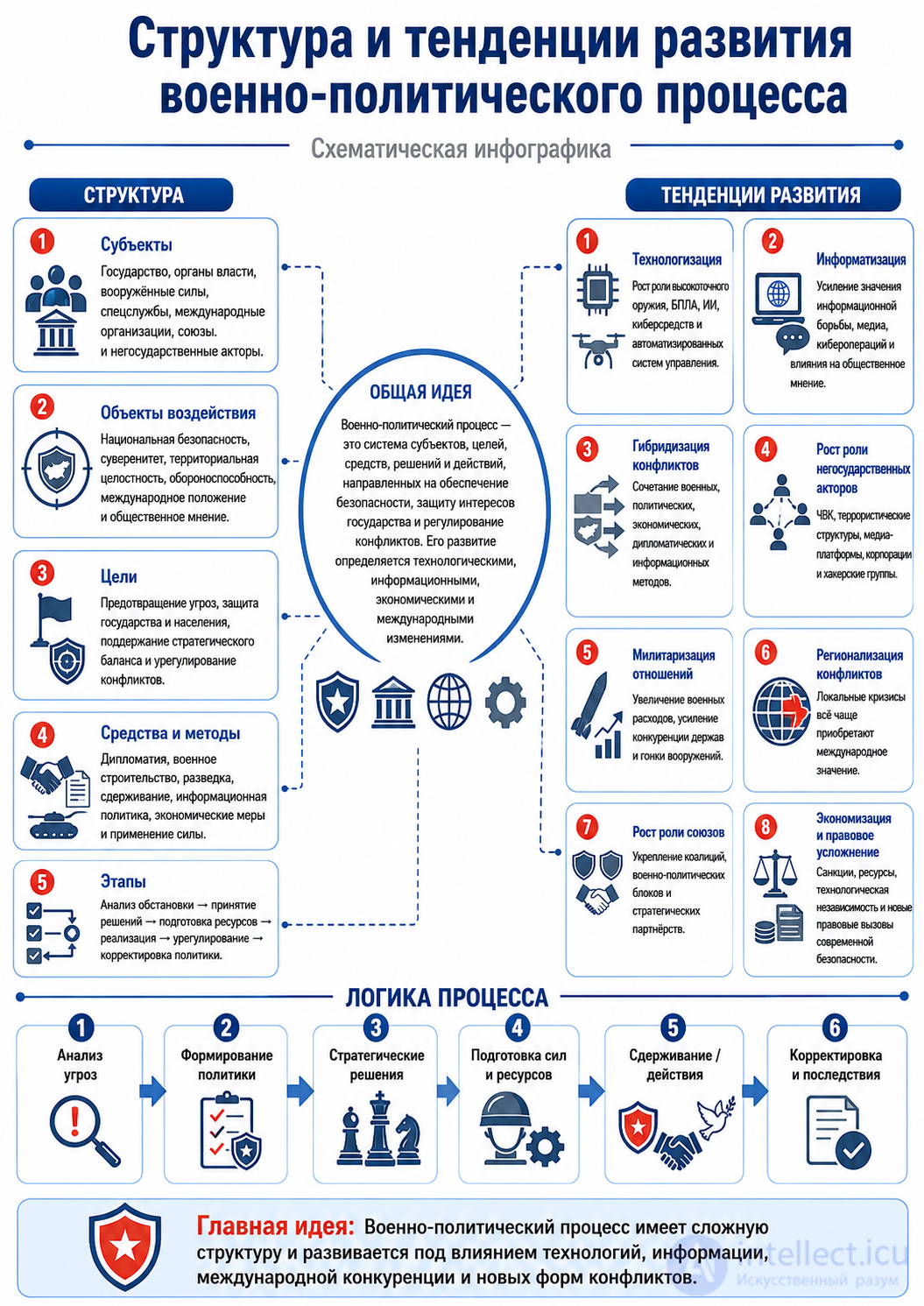
Depending on the specific nature of the objects, the character of the threats to vital interests, and the aims and tasks of ensuring military security, the state creates and legitimizes concrete subjects of the military-political process. Thus, in accordance with the Constitution of the Russian Federation and other legislative acts, such subjects of the state's military-political activity are:
Military-political relations comprise the diverse ties among individuals, communities and states, and also among the institutions and organizations they create, which take shape in the process of military activity. These ties may be allied in character and manifest themselves in close cooperation and mutual assistance, or they may be characterized by mutual suspicion and estrangement and manifest themselves in confrontation and opposition, in open armed struggle. The actual state of military-political relations is the result of military policy and at the same time a factor determining its tasks and content. Military-political relations at each period of time are characterized by a definite condition: military-political stability or military-political confrontation.
Military-political stability is a balanced state of military-political relations in which a stable position of the country's military security (or that of a region or of the world as a whole) is preserved, a relative equality of political and military capabilities (potentially dangerous to one another) is maintained, and abrupt changes in the alignment and correlation of military-political forces are precluded. It may be long-term or short-term. The basis of international military-political stability lies in ensuring equal security for large and small states, in their ability to oppose collectively the preparation and unleashing of any forms of aggression (including state terrorism), and in strict observance of international agreements and treaties.
Military-political confrontation is a state of military-political relations between rival states (or coalitions of states) determined by their competition in creating and maintaining military-strategic potentials (military might) directed against one another. Such relations include the creation and constant improvement of armed forces aimed against one another, the struggle for military and military-technical superiority, and the maintenance of armed forces and armaments at a higher degree of combat readiness relative to the probable adversary. Relations of military-political confrontation may in turn take concrete forms, among which should be included: military-political tension, military-political crisis, and direct military clash.
Military-political tension is a short-term or prolonged aggravation of the military-political situation in the world or in a region, caused by unilateral and mutually hostile actions of one or several states and by the advancing of political and economic demands unacceptable to the other side. It is characterized by an intensification of the political and diplomatic struggle, a curtailment of economic ties and an increase in direct military preparations. In a number of cases it may be accompanied by local military clashes between the opposing sides which threaten the security of neighbouring states. The level of military-political tension may periodically decrease or increase. The degree of tension is assessed by the level of aggravation of the situation and by the probability of its escalating into a military-political crisis or a military clash between states.
A military-political crisis is an extreme aggravation of the regional or international military-political situation in which the possibilities of settling disputed questions by political means are exhausted and the real possibility of the use of military force grows. It is characterized by a sharp intensification of all types of political, military and economic confrontation between the sides, by accelerated military preparations, by the deliberate demonstration of force, by the application of various kinds of political and economic sanctions, by the establishment of a military blockade and by other hostile actions. Alongside this, the negotiation process intensifies, with the possible participation of mediators. In many cases a military-political crisis leads to a direct military clash, but it may also be resolved peacefully, as was the case during the Caribbean (missile-nuclear) Crisis of 1962 between the USSR and the USA.
A military clash is a direct confrontation between states involving the use of military force. It may take the form of military provocations or of conflicts of low, medium and high intensity. It may be local or regional in character. The highest level and most acute form of military clash is world war.
Military-political interests. The starting point of people's political activity is their corresponding needs. At the same time, needs relating to military security are from the outset not so much individual as group and social in character. They are generated, above all, by the necessity of organizing (regulating) people's joint actions in order to secure militarily safe foundations for their life activity. However, needs by themselves are only capable of "switching on" the subject's search activity, in which concrete paths and means, and hence ways of satisfying the needs, must be found (for every need there exists a multitude of ways of satisfying it). If a way of satisfying a need has been found, this means that a certain interest has taken shape.
Interest in general is the orientation of a person (or a social group) towards the realization of a definite aim that satisfies certain needs. A military-political interest is the orientation of the subjects of military policy towards attaining such a level of military security as would make it possible to satisfy the vital interests of the individual, society and the state.
Military-political interests have an objective-subjective nature. Their objective nature is conditioned by the real needs of the individual, society and the state for ensuring protection against threats of a military character, for the firm internal and external sovereignty of the state, its territorial integrity and international authority. In this sense military-political interests are based on the national patrimony and are supported by the capabilities of the economy and by the social, geopolitical, spiritual-moral and intellectual potential of society and by the political and military organization of the state.
The subjective side of military-political interests consists in the fact that their bearers and concrete exponents are individuals (persons), the state and society, with the social values and needs, aspirations and attitudes peculiar to them alone in ensuring effective military security. On the whole, the role of military-political interests consists in the following:
Military-political interests are realized in people's concrete military-political activity, which constitutes another most important component of the military-political process.
Military-political activity is a process of organizational and practical interaction between the subject and the object of military policy, directed at realizing interests connected with the military security of the individual, society and the state. It is the core of the military-political process, in which the principal element consists of the actions proper of the subjects of military policy connected with attaining military-political aims.
In accordance with vital national interests, the state elaborates and formulates priority military-political aims in the sphere of domestic and foreign policy, and also determines and creates the means of their possible realization (political, economic, technical, properly military, informational and certain others). But these means are set in motion not chaotically, but within the framework of a definite political and military organization of the state, by means of systematic activity. Thus political and military activity are mutually interwoven, thereby forming a particular dialectical synthesis - military-political activity.
The structure of the military-political process, besides the identification of substantial components, may also be presented in its dynamics. With such an approach, the structure of the military-political process represents the following algorithm:
Thus, the structure of the military-political process may be defined as the totality of relationships among the actors, and also as their logical interconnectedness (the "plot", the orientation of the military-political process). Each individual military-political process has its own structure and, correspondingly, its own "plot". The actors, the totality of their relationships, the sequence, the dynamics or "plot", the temporal units of measurement, and also the factors influencing the military-political process, constitute its most important components (constituents). In analysing the military-political process, one should take into account the character of the interaction among its subjects, which depends in large measure on the scale, orientation, aims and interests of the actors participating in it.
Speaking of the trends of the contemporary military-political process, it should be noted that by the end of the twentieth century a tendency towards the peaceful resolution of inter-state disputes had emerged. However, the practical steps undertaken by the leading military powers do not permit the conclusion that a process of demilitarization has begun. Military potential continues to be built up through the use of the latest achievements in military technologies. The NATO bloc, which was created to combat the countries of the socialist commonwealth, not only did not cease to exist after the dissolution of the Warsaw Pact but, on the contrary, is building up its might, including by incorporating ever new states. The armed forces of the NATO countries are being continuously improved in accordance with the provisions of the new national security strategy and with the tasks of establishing a new world order, including by the use of military force.
An analysis of global trends in the field of military development and the employment of modern armed forces permits the conclusion that military-force factors still remain among the principal ones in relation to policy. Despite such evident fundamental conclusions, humanity has not renounced the use of military force, for a number of reasons.
Thus, in particular, the military component possesses such stabilizing properties as the deterrence of all manner of irrational (extremist, adventurist) aspirations and actions; the maintenance of the political status of states; the promotion of political equilibrium; the imparting of greater persuasiveness to political decisions; an additional trump card in disarmament negotiations or as proof of one's own restraint, and so on. Naturally, the primary purpose of the military component consists in protection and defence as the most important instrument of security - national, coalitional and international - as a guarantee of the very existence of a state or a union of states.
Finally, over the course of many centuries the military component has acted as a means of a policy of conquest, aggression and hegemonism. It created the effect of intimidation, pressure and "military presence", and sustained political prestige. The numerous alliances and misalliances in world politics have always arisen with the military component in view. It follows from this that the military component possesses both constructive and destructive functions, the latter unquestionably predominating.
Over the past century substantial changes have taken place in the military component which affect the whole of international security and the security of the individual state. To know what military force is capable of, and to what extent it is admissible as a means of policy, means to pursue a realistic and constructive policy that precludes strategic miscalculations and adventurism.
Military force consists of two components: the material and the spiritual. At the same time, the human mind, the moral and political condition of society and the state, and the social position of its citizens constitute the chief component of military potential. This should be constantly borne in mind, also because a technocratic approach is unacceptable in any sphere of society, including the military one. Meanwhile, in our time some military and state figures believe that technical superiority predetermines the course and outcome of military operations. The underestimation of the "human factor" was fully manifested in the contemporary armed conflicts in Afghanistan and Iraq.
At the same time it should be noted that the technological revolution in military affairs in the twentieth century led to a new increase in the capabilities of weapons as a means of policy. This concerns, in the first instance, the precision-guided weapons that have entered the arsenals of a number of countries and that demonstrate considerably higher combat properties and characteristics.
And yet it should be stressed once again that only the mind and will of the human being, his spiritual and moral principle, are of decisive significance in the use of the most advanced technology. For this reason the ill-considered or excessive use of military force has often led to political crises and dead ends, to social upheavals and even to the collapse of states: the revolution in Russia after the First World War, the "Cold War", the break-up of Yugoslavia, the US-initiated military forces in Iraq, and others.
The twentieth century demonstrated that the military component often attained such independence and strength that it led policy along behind it, disregarding the interests of peoples, states and international organizations (both world wars, the Cold War, many armed conflicts, the arms race initiated by the USA). Of course, the interweaving of the military and political components is very complex. It is dynamic, interconnected and mutually conditioned. On the whole, however, over the past 100 years a predominance of the military principle over the political has been observed (with brief periods of parity).
The twentieth century was characterized by a lag of military-political thinking behind dynamic socio-political, scientific-technological and information-communication processes. A manifestation of this was the substantial distinctive features of military-political processes under conditions of confrontation between two superpowers and world systems:
In other words, the twentieth century saw a devaluation of the political restraint of military violence, which manifested itself in a sharp increase in the number of armed conflicts around the world. Under these conditions there arises a need to focus attention on the limits of military violence, as well as on a whole range of other aspects of military-political processes that state policy must take into account at the present stage. These include, in particular, the following characteristic features and trends of the second half of the twentieth and the beginning of the twenty-first centuries:
the unleashing of another world war threatens all of humanity with becoming the victim of the catastrophic consequences of the use of nuclear weapons;
the international public and the world community are striving to unite their efforts in the struggle against aggressors;
more and more wars are becoming unpopular, lack broad popular support, and therefore fail to achieve their aims;
the creation of zones of peace is becoming increasingly widespread;
supranational institutions that restrain the use of military force are developing: the UN, the OSCE and others.
These and other positive changes have not yet led to the disappearance of war as a socio-political phenomenon of the modern world. The point is, above all, that limited military conflicts remain possible, and that so-called "hot spots" will exist for quite a long time (the Middle East, the state of Jammu and Kashmir in India, Afghanistan, the North Caucasus and others). An unstable situation in some countries may lead to civil wars. Ideological, ethnic, political and religious confrontation in a whole range of regions of the world (the states of Africa, Latin America, the Balkans) is not dying down. The struggle between the poor and the rich continues and leads to conflicts, including armed clashes.
Such is the dialectic of interaction between political and military development, which has determined and will still largely determine the prospects and orientation of military-political processes.
One of the problems studied by military political science is the problem of the relationship between war and peace. From the standpoint of the real military-political process, ensuring peace in modern conditions presupposes:
the organization of effective global control over all military processes, which have ceased to be the internal affair of states, since they affect not only regional but also international security;
the regulation, especially in terms of reduction, of the armed forces of all states, and the determination by international law of the procedure for their use;
the creation of international peacekeeping organizations at the global and regional levels;
the creation of collective forces to suppress aggression and violations of international stability and security.
Unfortunately, these and other important problems still remain unresolved for a number of reasons that have yet to be clarified. This can be explained, in particular, by the fact that the problem of the theoretical understanding of the relationship between peace and war has not yet been sufficiently studied. The world is steadily becoming different, and along with it the methodology for researching the problems of peace and war is changing as well.
Over time, the understanding of the essence of war and peace has grown among those responsible for formulating political decisions. They are capable of foreseeing the negative consequences of the dominance of the military component. There is an ever-growing understanding of the social consequences of military decisions for the civilian population. Thus, only many centuries later has humanity come to understand the full danger of overestimating the capabilities of military force as an instrument of policy. Overcoming the fascination with the military element of security in the twentieth century was facilitated by the gradual rejection of the ideological bias of military policy and of the dogmatization of traditional principles of military development and the use of force. Even the gigantic accumulation of force that took place in the second half of the twentieth century, many times exceeding the real requirements of military security, could not prevent the reassessment of socio-political values.
The contemporary military-political process is characterized by the activity of states aimed at the non-proliferation of nuclear weapons and of conventional weapons approaching them in combat characteristics, especially precision-guided weapons. This is explained by the fact that the spread of technological information in modern conditions makes the creation of nuclear, chemical and bacteriological weapons, as well as the means of their delivery, increasingly accessible to many countries, which may render the situation especially unstable. The temptation to take advantage of the opportunity to use weapons of mass destruction in local conflicts is growing. Already today there are instances of the use of operational-tactical missile weapons in the countries of the Persian Gulf. There is a threat of the proliferation and use of chemical and bacteriological weapons. The way out of this situation lies in developing peaceful cooperation along the following main lines:
the creation of guarantees that nuclear weapons will not be used. Russia's contemporary military policy is closely bound up with unresolved problems in the financial-economic, social, scientific-technical and other spheres, which considerably complicates the definition of long-term guidelines and the creation of a military concept designed for decades ahead. Throughout its existence Russia has always actively influenced world military-political processes with the aim of radically changing the military-political situation, eradicating the sources of wars and armed conflicts, and forming an anti-war stance among the international public.
The pressing issues of Russia's military policy at the present stage are:
Modern armed forces must correspond to changes in the military-political situation and to the long-term needs of society and the state, and be receptive to new ideas, concepts, doctrines and programmes. It is important that all of this correspond to the most important lines of activity of the UN, the Security Council, its military bodies, and regional security organizations.
Military-political processes are largely determined by the military policy of Russia, which must correspond to its national interests. This means that the ruling political elite must direct military development not toward protecting the interests of particular groups of the population or of particular institutions, bodies and organizations of society and the state, but toward ensuring the national and military security of Russia.
The structure of the military-political process includes the actors, aims, means, stages and results of military-political activity. Its development today is determined by the growth of the technological factor, the intensification of the information struggle, the hybrid character of conflicts, the increasing role of non-state actors, and the growing complexity of international security.

Comments