
Lecture
Let us provisionally divide the contemporary era into two stages and consider the first, the late nineteenth and early twentieth centuries, which were marked by rapid progress in every field of science and technology, and consequently by the appearance of even more destructive means of armed struggle. Wars came to be accompanied by even greater numbers of casualties, and not only among the direct participants in battle. Losses among the civilian population rose sharply, and enormous economic and environmental damage was inflicted on the territories that lay within the combat zone. This situation gave rise to new ideas concerning the need to limit the ruinous consequences of war.
The military political science of the contemporary era studies how views of war, the army, the state and international relations changed in the period of industrialisation, imperialism, mass armies and world wars.
The principal transition of the epoch:
from the wars of sovereigns' regular armies to the mass industrial warfare of peoples, economies and ideologies.
With the appearance of new means of destruction, views and opinions of this kind gained ever wider currency among public figures and scholars. Attempts were made, through international agreements, to limit or wholly prohibit the use of types of weapons causing unacceptably severe consequences and to prevent the deaths of civilians. Thus, in 1868, on Russia's initiative, the Declaration prohibiting the use of explosive bullets was signed in St Petersburg; it remains in force to this day. In 1898, in The Hague, again on Russia's initiative, a number of declarations and conventions on the laws and customs of war were adopted, including on the prohibition of bombardment from balloons and of the use of bullets that expand in the human body. In 1907 in The Hague and in 1925 in Geneva, conventions were adopted defining the norms of warfare, which prohibit: the treacherous killing or wounding of civilians; the killing or wounding of an enemy who has laid down his arms; the killing or wounding of envoys; the bombardment of undefended towns and the destruction of cultural property and monuments; the deportation of the civilian population from occupied territories; the use of chemical weapons, and others.
Speaking of the rapid progress in military technology, V. I. Lenin noted at the beginning of the twentieth century that modern technology may be applied on such a scale, so destructively and with such energy to the mass extermination of millions of human lives that it could lead "to the undermining of the very conditions of the existence of human society". Such a time arrived as early as the middle of the twentieth century, when nuclear missile weapons were created and began to be improved and built up. Conditions arose in which it became impossible to achieve any positive political aims through the use of modern military means. Whereas in the past weapons were a functional instrument of armed struggle, nuclear weapons have become an instrument of blackmail, threats and pressure. Their use can be spoken of only as the most extreme measure, entailing complete self-destruction. US Secretary of State Henry Kissinger wrote on this subject in 1968: "The paradox of our times is that the gigantic increase in power has undermined the possibility of applying it in politics."
The Cold War era determined the specific character of the formation and development of military-political ideas and views. Two groups of factors above all had a decisive influence on this process. The first group consists of factors connected with the emergence and struggle of two opposing social and political systems and the military-political alliances corresponding to them. The second group consists of factors arising from the revolution in military affairs. Right up to the mid-1980s, relations between the opposing systems were built on military-political and strategic rivalry, in which each side sought political and specifically military advantage. The military-political concepts of that period are well known: "massive retaliation", "realistic deterrence", "flexible response", "direct confrontation" and others.
The earliest doctrine, that of "massive retaliation", was based on the possibility of waging unlimited nuclear war. It was replaced by the concept of "flexible response", which placed the main emphasis on preparing for various types of war: global and local, large and small, nuclear and conventional. It likewise sanctioned a general nuclear war with the unrestricted use of means of mass extermination. An important element of the "flexible response" concept was the strategy of "forward defence", according to which NATO's armed forces were to be ready to wage both a major nuclear war and a "limited" war on the European continent. The doctrine of "realistic deterrence", adopted in the United States in the early 1970s, was oriented towards preparing for and waging various types of war. It emphasised the diversity of possible forms of armed conflict, among them: strategic nuclear war, nuclear war in a theatre of operations, conventional war in a theatre of operations, and conventional "limited" war.
Traditional and nuclear war differ fundamentally, and not only in their material aspect. Nuclear weapons refuted many of Clausewitz's propositions, making it impossible to achieve political aims by military means. Nevertheless, researchers in a number of countries considered war, including nuclear war, from the standpoint of so-called neo-Clausewitzianism. Representatives of orthodox Clausewitzianism (Herman Kahn, Thomas Schelling, Raymond Aron, Wilbur Schramm and others) maintained that the controlled use of weapons in battle secures both political and military superiority for states.
However, military-political concepts of a realist character also developed. Thus, for example, the concept elaborated by the American political scientist Hans Morgenthau was based on the utter futility of military confrontation and demonstrated the untenability of the views of the proponents of the Cold War.
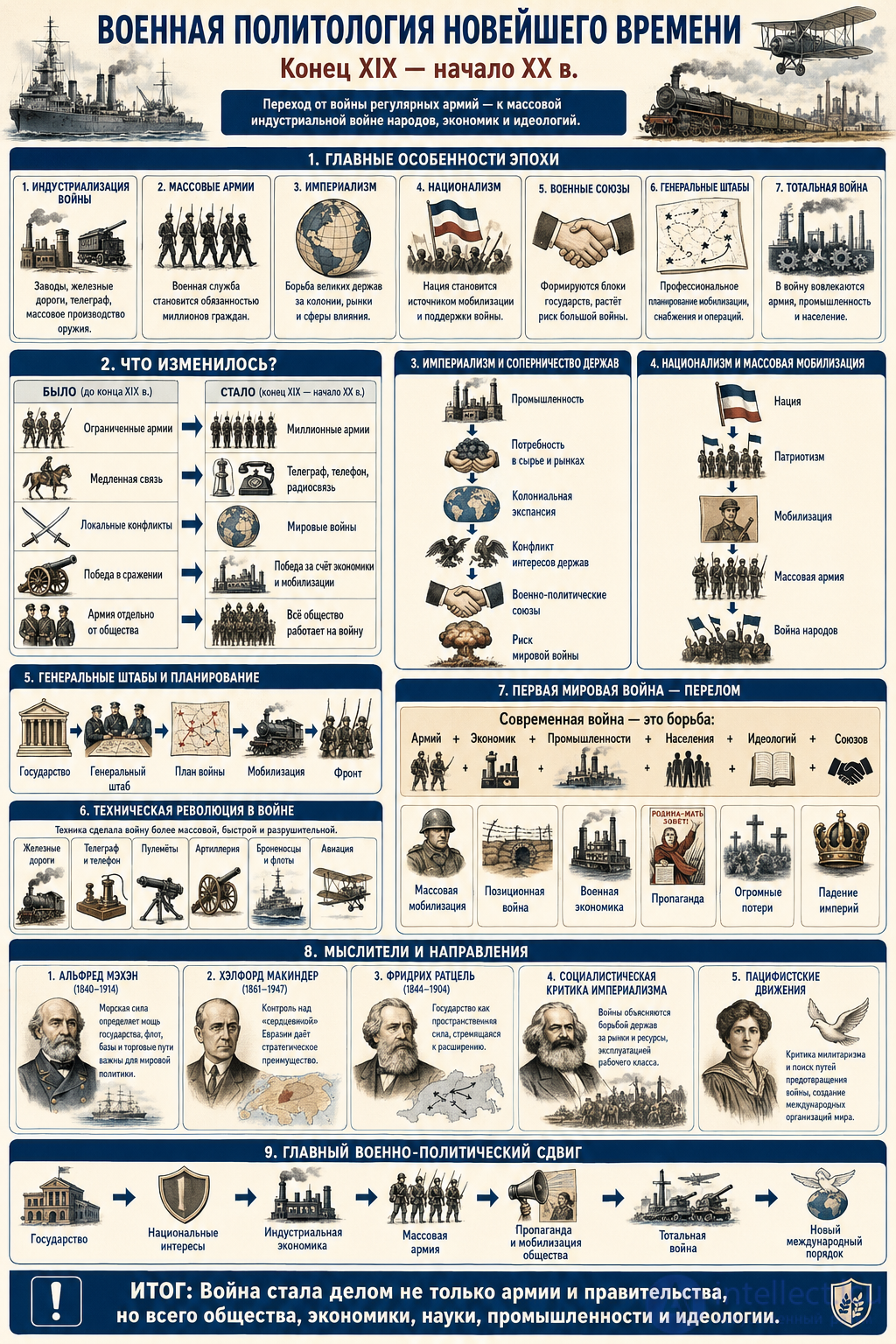
The late nineteenth and early twentieth centuries were a period in which war became far larger in scale, more technological and more destructive.
| Feature | Meaning |
|---|---|
| Industrialisation of war | Factories, railways, the telegraph, mass production of weapons |
| Mass armies | Military service becomes the duty of millions of citizens |
| Imperialism | The great powers struggle for colonies, markets and spheres of influence |
| Nationalism | The people and the nation become important sources of military mobilisation |
| Military alliances | Blocs of states are formed, raising the risk of a major war |
| General staffs | War is planned in advance by professional military structures |
| Total war | Not only armies but also the economy, industry and the population are drawn into war |
| Criterion | The modern era | The contemporary era |
|---|---|---|
| Principal actor | The sovereign state | State + nation + mass society |
| Army | A regular professional army | A mass army of citizens |
| War | An instrument of policy | An instrument of policy, economics and ideology |
| Scale | Limited wars between powers | World wars |
| Resources | The treasury and the army | The entire economy and population |
| International order | The balance of power | Blocs, alliances, international organisations |
In the modern era, war was understood as an instrument of state policy.
In the contemporary era this idea is retained, but war becomes far more complex.
Classical war
        ↓
Regular armies
        ↓
Industrial production
        ↓
Mass mobilisation
        ↓
Total war
        ↓
Political reordering of the world
| Formerly | In the late nineteenth and early twentieth centuries |
|---|---|
| Limited armies | Armies of millions |
| Campaigns of individual sovereigns | War of entire nations |
| Slow communications | Telegraph, telephone, radio communication |
| Local conflicts | World wars |
| Victory in battle | Victory through economy, resources and mobilisation |
| The army separate from society | The whole of society works for the war |
In the late nineteenth century the leading powers of Europe and the world actively competed for colonies, raw materials, trade routes and military influence.
Industry
        ↓
Demand for raw materials and markets
        ↓
Colonial expansion
        ↓
Clash of the powers' interests
        ↓
Military-political alliances
        ↓
The risk of world war
Imperialism intensified rivalry between states. War came to be seen as a possible means of redistributing territory, resources and influence.
Nationalism became one of the principal political forces of the epoch. States addressed their populations not merely as subjects but as citizens of a nation obliged to defend the Motherland.
| Element | Significance |
|---|---|
| The national idea | Unites the population around the state |
| Patriotism | Motivates military service |
| The image of the enemy | Strengthens society's readiness for war |
| Mass propaganda | Builds support for military action |
| Compulsory military service | Turns citizens into soldiers |
In brief:
The nation
  ↓
Patriotism
  ↓
Mobilisation
  ↓
A mass army
  ↓
War of peoples
In this period the role of professional military staffs grew. They drew up plans for mobilisation, offence, defence, supply and the movement of troops in advance.
| Function | Meaning |
|---|---|
| War planning | Preparing campaigns even before a conflict begins |
| Mobilisation | Rapid deployment of the army |
| Logistics | Transport of troops, weapons and provisions |
| Intelligence | Gathering information about the enemy |
| Coordination | Command of large armies |
The state
    ↓
The general staff
    ↓
The war plan
    ↓
Mobilisation
    ↓
The front
The late nineteenth and early twentieth centuries radically transformed military affairs.
| Factor | Military-political significance |
|---|---|
| Railways | Rapid movement of armies |
| Telegraph and telephone | Rapid command of troops |
| Machine guns | Growth of defensive strength |
| Artillery | Mass destruction of fortifications and positions |
| Ironclads and fleets | The struggle for the seas and colonies |
| Aviation | Reconnaissance and the first air strikes |
| Chemical weapons | A new degree of destructiveness in war |
The key point:
Technology made war more massive, faster and more destructive.
Thus, already during the period of confrontation between the blocs of opposing social and political systems, military-political concepts appeared that realistically assessed the dynamics of the changes taking place in the means and forms of armed struggle and sought to strengthen the primacy of political methods in resolving interstate contradictions.
Military-political confrontation gradually took on the character of relations based on a balance of national and regional interests. The chief result of the changes that had begun was the removal of the direct military threat in the relations between former adversaries and the gradual evolution of their relations towards strategic partnership. The military-political concepts of the Cold War era gradually lost their relevance.
The sharp reduction in the threat of unleashing a large-scale nuclear missile war as a result of the well-known political events determined the processes of the "demilitarisation" of public consciousness. These positive processes stimulated the appearance, both in the West and in the countries of Eastern Europe, of an extensive literature on the problems of war and peace, on relations between peoples and states in the modern epoch, and on the strategy, aims and means of world politics in the nuclear age.
The First World War of 1914-1918 was the principal event that revealed the new character of war.
It demonstrated that modern war is not only a clash of armies but a struggle of:
Armies
  +
Economies
  +
Industry
  +
Populations
  +
Ideologies
  +
Diplomatic alliances
| Feature | Meaning |
|---|---|
| Mass mobilisation | Millions of people were conscripted into the armies |
| Trench warfare | The fronts became stabilised for long periods |
| The war economy | Industry worked to meet the needs of the front |
| Propaganda | States mobilised public opinion |
| Enormous losses | The war became a catastrophe for societies |
| The fall of empires | The Russian, German, Austro-Hungarian and Ottoman empires collapsed |
| Idea | Meaning |
|---|---|
| War as a struggle of states and nations | Armed conflict engulfs the whole of society |
| The economy as part of the war | It is not only the army that wins, but industry too |
| Mobilisation of the people | The population becomes a resource of war |
| Alliances and blocs | A local conflict can become a world war |
| Total war | The boundary between front and rear becomes blurred |
| Peace through international institutions | After the war the idea of an international order gains strength |
| Thinker / school | Principal ideas |
|---|---|
| Alfred Mahan | Sea power determines a state's might; the navy, trade routes and bases are essential to world politics |
| Halford Mackinder | The geopolitics of land; control over the "Heartland" of Eurasia confers strategic advantage |
| Friedrich Ratzel | The state is regarded as a spatial force striving for expansion |
| The socialist critique of imperialism | Wars are explained by the struggle of the capitalist powers for markets and resources |
| Pacifist movements | Criticism of militarism and the search for mechanisms to prevent war |
| Military staffs and strategists | Drawing up plans for mobilisation, offence, defence and the conduct of a major war |
The principal military-political shift of the epoch can be represented as follows:
The state
    ↓
National interests
    ↓
The industrial economy
    ↓
The mass army
    ↓
Propaganda and mobilisation of society
    ↓
Total war
    ↓
A new international order
The military political science of the mid-twentieth to the early twenty-first century studies how war, the army, security and international politics changed after the Second World War: from nuclear deterrence and bloc confrontation to hybrid wars, cyberspace, drones, information operations and the struggle over the world order.
The principal transition of the epoch:
from industrial total war to nuclear deterrence, local conflicts, hybrid warfare and multi-domain confrontation.
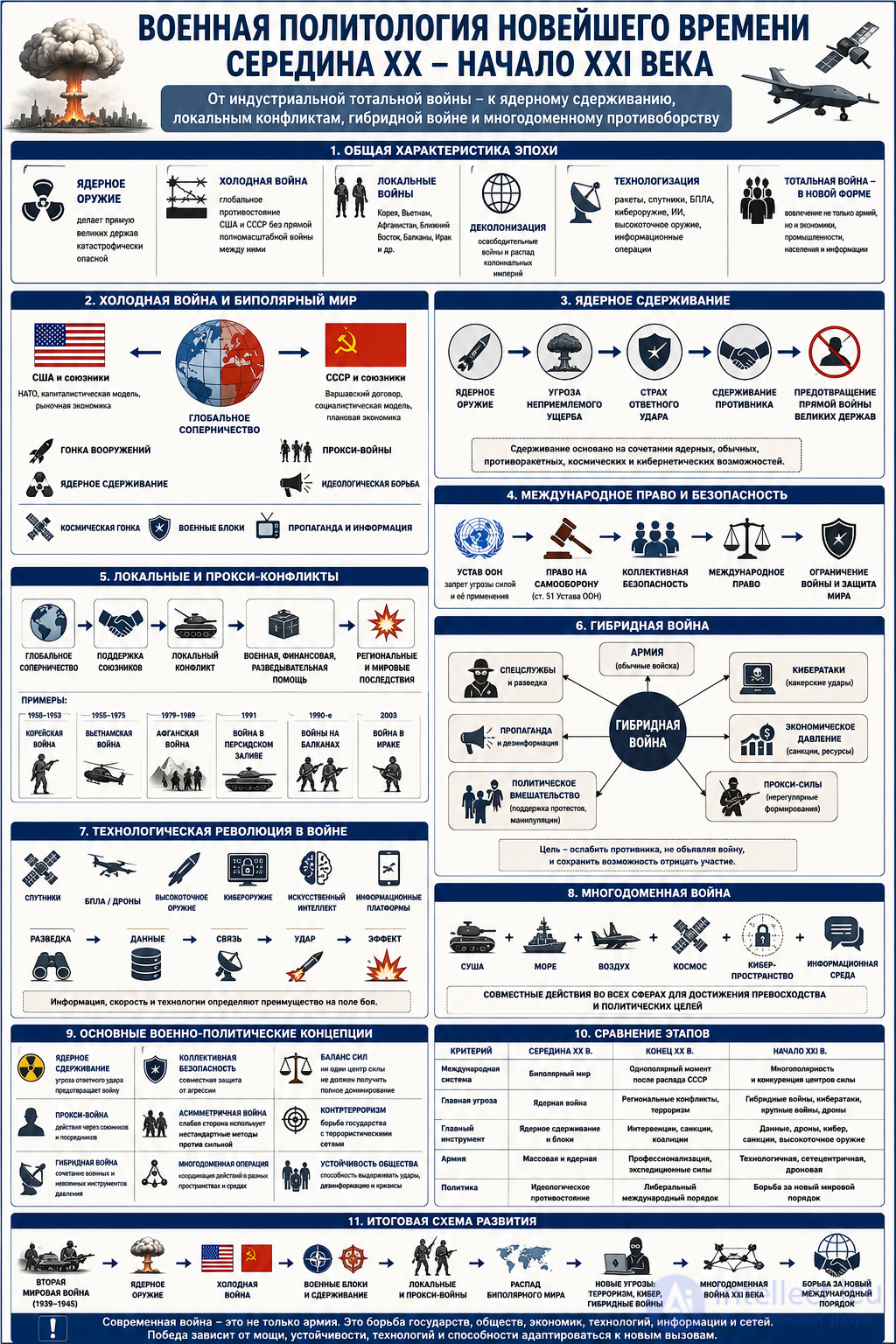
After 1945 war did not disappear, but its form changed. Direct clashes between the great powers became extremely dangerous because of nuclear weapons. Indirect forms of struggle therefore intensified: military blocs, local wars, intelligence, special services, ideological pressure, economic sanctions, information operations and technological rivalry.
| Feature | Meaning |
|---|---|
| Nuclear weapons | Make direct war between the great powers catastrophically dangerous |
| The Cold War | Global confrontation between the USA and the USSR without a direct full-scale war between them |
| Military blocs | NATO, the Warsaw Pact, systems of alliances and collective defence |
| Local wars | Korea, Vietnam, Afghanistan, the Middle East, the Balkans, Iraq and others |
| Decolonisation | Wars of liberation and the collapse of the colonial empires |
| International law | After 1945 the prohibition on aggressive war grows stronger |
| Hybrid wars | A combination of the army, special services, propaganda, cyberattacks, economics and politics |
| The technologisation of war | Missiles, satellites, unmanned aerial vehicles, cyber weapons, artificial intelligence |
The Cold War is the military-political, ideological and economic confrontation between two systems: the capitalist bloc led by the USA and the socialist bloc led by the USSR.
The USA and its allies
      ↓
NATO, the capitalist model, a market economy
      ↓
Global rivalry
      ↑
The USSR and its allies
      ↑
The Warsaw Pact, the socialist model, a planned economy
| Feature | Explanation |
|---|---|
| Bipolarity | The world was divided between two main centres of power |
| The arms race | The sides built up nuclear and conventional weapons |
| Nuclear deterrence | The adversary does not attack because the retaliatory strike would be devastating |
| Proxy wars | The superpowers backed different sides in local conflicts |
| Ideological struggle | The confrontation was waged through propaganda, culture, economics and diplomacy |
| The space race | Space became a symbol of technological and military superiority |
The appearance of nuclear weapons changed the very logic of war. Victory in a major war between nuclear powers could mean mutual annihilation.
The key idea:
The power of nuclear weapons is used not so much to wage war as to prevent it.
Nuclear weapons
      ↓
The threat of unacceptable damage
      ↓
Fear of a retaliatory strike
      ↓
Deterrence of the adversary
      ↓
Prevention of direct war between the great powers
NATO describes contemporary deterrence as a combination of nuclear, conventional, missile-defence, space and cyber capabilities.
After the Second World War the role of international law grew stronger. The UN Charter enshrined the prohibition of the threat or use of force against the territorial integrity or political independence of states. At the same time, Article 51 of the UN Charter recognises the right of individual and collective self-defence in the event of an armed attack.
A war of aggression
      ↓
Prohibited by international law
      ↓
Permissible self-defence
      ↓
Collective security
      ↓
The role of the UN and international organisations
War is no longer regarded as an ordinary "right of the state" to attack another at will. Formally, it must be constrained by the norms of international law.
Because of the risk of nuclear catastrophe, the great powers often avoided direct clashes but backed different sides in local wars.
| Type of conflict | Meaning |
|---|---|
| Proxy war | The great powers fight indirectly through their allies |
| Anti-colonial war | Peoples struggle against colonial domination |
| Civil war with external backing | An internal conflict becomes part of an international struggle |
| Regional war | A struggle between neighbouring states over territory, influence or security |
| Intervention | The involvement of an external power in a conflict |
Global rivalry
      ↓
Support for allies
      ↓
Local conflict
      ↓
Military, financial and intelligence assistance
      ↓
Regional and global consequences
After the collapse of the USSR the world briefly became more unipolar, with the USA and Western institutions dominant. But wars did not disappear. New threats came to the fore: terrorism, state collapse, ethnic conflicts, humanitarian interventions, cyberattacks and transnational networks.
| Sphere | Change |
|---|---|
| The international system | From bipolarity to unipolarity, and then to a more complex multipolarity |
| War | More asymmetric and irregular conflicts |
| The adversary | Not only states, but also terrorist organisations, private military structures and networked groups |
| Security | Military security is supplemented by cyber, energy, information and economic security |
| Interventions | Military operations are often explained by the fight against terrorism, the protection of citizens or the stabilisation of regions |
Hybrid warfare is a combination of military and non-military means of pressure. It may include regular troops, irregular formations, cyberattacks, disinformation, economic pressure, political interference and the exploitation of an adversary's internal weaknesses.
RAND characterises Russian hybrid warfare as an approach that economises on the use of force and combines various instruments of pressure.
Hybrid warfare =
the army
+ the special services
+ cyberattacks
+ propaganda
+ economic pressure
+ political interference
+ legal and diplomatic struggle
| Feature | Meaning |
|---|---|
| A blurred boundary between war and peace | Aggression may proceed without a formal declaration of war |
| Information influence | A struggle over society's perceptions |
| Cyberattacks | Strikes against infrastructure, communications and data |
| The use of proxy forces | Formally, the adversary can deny involvement |
| Economic pressure | Sanctions, energy, blockade, financial levers |
| Political destabilisation | Support for internal conflicts and crises |
In the late twentieth and early twenty-first centuries, military power depends ever more on technology.
| Technology | Military-political significance |
|---|---|
| Nuclear weapons | Strategic deterrence |
| Ballistic missiles | The capacity for long-range strikes |
| Satellites | Reconnaissance, communications, navigation |
| GPS / navigation | Precise control of troops and weapons |
| Precision-guided weapons | Strikes against specific targets |
| Drones / unmanned aerial vehicles | Reconnaissance, fire correction, strikes |
| Cyber weapons | Attacks on networks, infrastructure and command systems |
| Artificial intelligence | Data analysis, autonomous systems, decision support |
| Information platforms | Influence on public opinion and morale |
Reconnaissance
  ↓
Data
  ↓
Communications
  ↓
Precision-guided weapons
  ↓
Rapid destruction of targets
  ↓
Political effect
Contemporary war is increasingly seen as a struggle waged in several spaces at once.
Land
 + Sea
 + Air
 + Space
 + Cyberspace
 + The information environment
        ↓
Multi-domain warfare
The point is that victory depends not only on tanks, aviation or the fleet, but also on satellites, communications, data, electronic warfare, cyber defence, information resilience and society's ability to withstand pressure.
At the beginning of the twenty-first century military policy again became more tense. According to SIPRI, world military spending in 2025 reached 2887 billion dollars, having increased by 2,9% in real terms compared with 2024; this was the eleventh consecutive year of rising expenditure.
This shows that states are investing ever more in defence, technology, deterrence, weapons stockpiles and readiness for major conflicts.
| Concept | Essence |
|---|---|
| Nuclear deterrence | The threat of a retaliatory strike prevents an attack |
| Collective security | States respond jointly to aggression |
| The balance of power | No single centre of power should attain complete dominance |
| Proxy war | The great powers act through their allies |
| Asymmetric warfare | The weaker side uses unconventional methods against the stronger |
| Counter-terrorism | The state's struggle against terrorist networks |
| Hybrid warfare | A combination of military, information, cyber and economic methods |
| Multi-domain operation | Coordination of action on land, at sea, in the air, in space and in cyberspace |
| Societal resilience | The capacity of the state and the population to withstand attacks, disinformation and crises |
| Criterion | Mid-twentieth century | Late twentieth century | Early twenty-first century |
|---|---|---|---|
| The dominant system | A bipolar world | The unipolar moment after the collapse of the USSR | Multipolarity and competition between centres of power |
| The principal threat | Nuclear war | Regional conflicts, terrorism | Hybrid wars, cyberattacks, major wars, drones |
| The principal instrument | Nuclear deterrence and blocs | Interventions, sanctions, coalitions | Data, drones, cyber, sanctions, precision-guided weapons |
| The army | Mass and nuclear | Professionalisation, expeditionary forces | Technological, network-centric, drone-based |
| Politics | Ideological confrontation | The liberal international order | The struggle for a new world order |
The Second World War
        ↓
Nuclear weapons
        ↓
The Cold War
        ↓
Military blocs and deterrence
        ↓
Local and proxy wars
        ↓
The collapse of the bipolar world
        ↓
New threats: terrorism, cyber, hybrid wars
        ↓
Multi-domain warfare of the twenty-first century
        ↓
The struggle for a new international order
The military political science of the contemporary era shows that by the late nineteenth and early twentieth centuries war had turned into a mass industrial phenomenon.
In brief:
War became the business not only of the army and the government but of the whole of society, the economy, science, industry and ideology.
The summary formula of the epoch:
The industrial state
        ↓
The mass army
        ↓
Nationalism and propaganda
        ↓
Military alliances
        ↓
Total war
        ↓
A change in the world order
The role of European and American research centres in elaborating the philosophical problems of politics, peace and war is widely known. Among them the following may be singled out: the Royal Institute of International Affairs (United Kingdom), the Bundeswehr Institute of Social Sciences, the Institute for Defence Studies and Analyses (India), the Center for Russian and Eurasian Studies of the Monterey Institute (USA), the Centre for Arms Control (Canada), the Center for Defense Information (USA) and so on. The names of philosophers, political scientists and specialists on these problems have become widely known, such as Johan Galtung, D. Banerjee, Kenneth Boulding, Charles Moskos, W. Schelen, B. Flickenstein, Anatol Rapoport, G. Hagen, J. Eberle and others.
At the turn of the millennium a shift became apparent in the understanding and awareness of the operative military-political realities. The development of military-political views came to be determined by qualitatively new principles of contemporary military-political relations. These include, above all: the interdependence and integrity of the states of the world community; the multiplicity of possible paths of social development and recognition of every people's freedom of socio-political choice; and the need to resolve jointly the global problems of the present day, especially the problems of the proliferation of nuclear weapons and of terrorism.
The military political science of the mid-twentieth to the early twenty-first century shows that war has become more complex and multi-layered.
War has ceased to be merely a clash of armies. It has become a struggle of states, societies, economies, technologies, information, networks and international coalitions.
The principal formula of the epoch:
The state
   ↓
Security and interests
   ↓
Deterrence + technology + information
   ↓
Military, economic and cyber struggle
   ↓
Political outcome

Comments