
Lecture
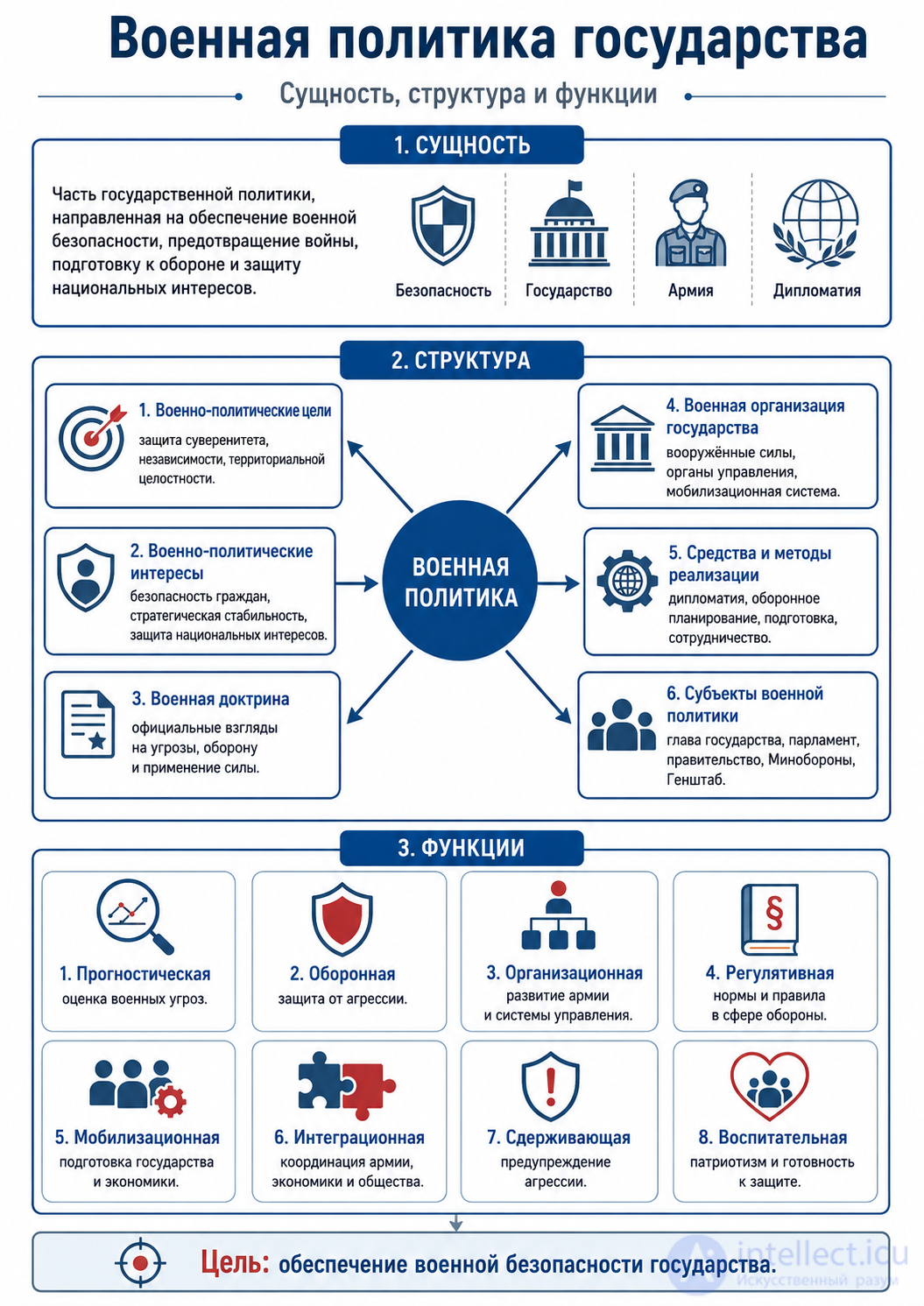
The military policy of a state is that part of overall state policy which is aimed at ensuring the country's military security, preventing war, preparing the state and society for defence and, where necessary, at employing military force to protect national interests.
The essence of military policy lies in the fact that the state determines:
Military policy is connected not only with the army. It affects the economy, science, industry, diplomacy, education, the information sphere and the moral and psychological condition of society.
Military policy constitutes a complex and very important sphere of activity of all the states of the world, including Russia. It arose in remote antiquity, when states began to form with the disintegration of the clan system and when the majority of the contradictions arising among them came to be resolved by force of arms. In the course of the evolution of humankind, military policy has travelled a long road of formation and refinement. And, despite people's aspiration to live in peace, military policy remains in demand in our own day as well. This is connected with the fact that forcible methods of resolving disputes and contradictions remain among the most effective.
In the nuclear age, when the unleashing of war carries a threat to human civilisation, there arises a real need to gain a deep and thorough understanding of the nature and specific features of a state's military policy, of the factors that determine its content, of its internal structure and the character of its external manifestations, and of the tendencies of its contemporary development.
In the broad sense, military policy is policy conducted in the military field, the properly military aspects of a state's domestic and foreign policy. In the political science sense, military policy is defined as a constituent part of a state's overall policy, directly connected with the creation of a military organisation and with the preparation and employment of the means of armed violence in order to achieve particular political aims. Military policy expresses the fundamental goals and tasks of a state's military security. A number of political scientists define military policy as the art of directing the military activity of the state.
In terms of content, military policy includes two components: an internal one and an external one.
The internal component is connected with the creation, maintenance and preparation of the state's military organisation, with the conduct of military development and the use of the means of armed violence (in one case, to maintain the existing order and thwart attempts to change it; in another, to destroy the existing political system and establish a new one as a result of a military coup).
The external component is connected with ensuring the defence of the state, protecting its sovereignty, territorial integrity and independence, with forestalling, thwarting and repelling possible aggression from without, as well as with the expansion (preservation) of borders, the establishment (maintenance) of dominance in particular regions and the attainment of defensive or else aggressive, expansionist aims.
Contemporary scholarship distinguishes between peacetime and wartime military policy.
Peacetime military policy is pursued by the state in the defence field under conditions of peace in order to ensure national and international security, to strengthen its military-political and military-strategic positions, and to prepare the state and the armed forces to repel possible military provocations and potential aggression. It encompasses:
An important place in peacetime military policy is occupied by the strengthening of the state's positions in the region and in the international arena.
In peacetime, military policy must be commensurate with the current level of military danger and must in its content be adequate to the socio-economic condition of society. At the same time, the most important criterion of its high effectiveness is the maintenance of the state's defence capability and of its strategic and mobilisation potential at a minimally sufficient level, with the greatest possible use of the latest achievements of scientific and technical progress, that is, with the minimum necessary diversion of material and human resources from the solution of socio-economic and civil tasks. As the situation grows more acute, a state's military policy may acquire an ever greater role, assume more active and decisive forms, and extend to new adjacent territories and regions.
Wartime military policy is formed and implemented in accordance with the specific aims and plans for waging the war, with the military-political situation as it actually develops, with the results of military operations and with the development of the military-economic confrontation between the sides. It is an activated continuation of peacetime military policy; it develops and is adjusted at various stages of the war depending on the degree to which particular military-political goals have been achieved and on the entry of individual states into the war or their withdrawal from it.
In accordance with the chosen course of military policy for wartime, the highest-priority general and particular military-political and strategic goals and tasks of the armed forces are determined, the strategy for waging the war as a whole and along individual axes is clarified, and a more concrete character of relations with allies and neutral states is established. Accordingly, the thrust of the economic, ideological and diplomatic struggle is clarified.
The characteristic features of military policy in the course of a war are:
The subjects of military policy are the supreme bodies of legislative and executive power, the bodies of military leadership of the state concerned, and military-political alliances.
The objects of military policy are all the fields of the life activity of society that shape the military potential and military might of the state: the economy, science and technology, socio-political relations and social structures, and public consciousness.
Military policy is socially conditioned. It may have a militaristic, reactionary, aggressive nature and orientation or, on the contrary, be peace-loving and defensive in character and play a progressive role.
It would be an oversimplification to suppose that these or those features, including opposing ones, can be inherent only in dissimilar political systems. A state's military policy may change radically in a given country at different stages of historical development, under the influence of various socio-political conditions.
Within the structure of military policy one may distinguish a number of relatively independent elements: military-political relations, military-political interests, military-political consciousness, military-political institutions, and military-political activity.
Military-political relations determine and characterise the degree and level to which problems have been settled, above all among allies within a military coalition on fundamental questions of military cooperation, military-technical equipment, the development of the organisational structures of armies and navies, their deployment, groupings, command and control, personnel training and, finally, joint action in specific situations. Military-political relations may also develop between states and armies belonging to different military alliances or to none at all. As a rule, they include the settlement of border questions, the provision of mutual restraint, arms reductions and control over these processes, the implementation of confidence-building measures, the coordination of military doctrines, and also mutual familiarisation with conditions of life, everyday existence and military training.
Military-political interests, as one of the most complex elements of military policy, determine its orientation, content and practical implementation. As is well known, the military-political situation both within a country and on the world stage is subject to continuous change. Some of these changes occur suddenly and affect the deepest vital interests of states and peoples. They call for a timely, sometimes even emergency response, for the adoption of momentous and at times fateful decisions, and for their consistent and firm implementation. Above all, such decisions must reflect the specific features of the concrete situation and, of course, accord with the general ideas and guidelines of military doctrine. It is precisely here that the domain of military-political art begins — the ability to formulate strategy and tactics and to bring them into alignment with each other.
Military-political consciousness constitutes the ideological, value-based and motivational foundation of military policy. Any military-political decisions and plans will be carried out effectively only if they are understood, accepted and supported by the people and by the servicemen of the army and navy. The aim of the informational and ideological support of military policy is to sustain the military-patriotic values, ideals and attitudes of the people and of military personnel, and to strengthen confidence in the policy pursued on the international stage. This aim is achieved by a variety of means. Among them are statements and other acts by heads of state and by political and public figures, the work of the military mass media, and the activity of the entire officer corps.
The ideological core of military policy is the state's military doctrine. It is developed by the highest organs of political and military leadership. The political, military, military-technical and economic foundations of military doctrine are formed on the basis of a scientific analysis of military-political practice. The propositions and guidelines of military doctrine provide the general direction of military-political activity.
Military-political institutions constitute the institutional component of military policy. In the Russian Federation such institutions are: the President of the Russian Federation; the Federal Assembly of the Russian Federation; the Government of the Russian Federation; the Security Council of the Russian Federation; the federal executive authorities; the executive authorities of the constituent entities of the Russian Federation; the Ministry of Defence of the Russian Federation; and the General Staff of the Armed Forces of the Russian Federation.
Military-political activity, as the practice of implementing military policy, consists in the realisation by the subjects of military policy of doctrinal propositions and of the plans and decisions that are adopted. Within military-political activity the following components occupy a special place.
First, military development as a whole, and the development of the armed forces in particular. It is bound up with the creation of the material and spiritual foundations of the state's military potential (military might). This requires the formulation and implementation of a soundly based military-economic and military-technical policy, as well as of the military aspects of social, demographic and cultural policy and of personnel policy in the armed forces; and the establishment and maintenance of military-political relations with other states, coalitions and armies. The principal role here is played by the means and methods of military diplomacy.
Second, military-political actions of various kinds and scales, both within the country and on the international stage. These may be actions to prevent a war or to shape its course, actions to repel an aggressor or to unleash aggression, to stabilise the internal situation or to destabilise it. In doing so, military policy is called upon to ensure coordinated action with allied forces, the neutralisation or indirect use of forces not participating in the military-political action, decisive counteraction against the adversary, and the destruction of his military force.
From the structure of military policy there follows its substantive definition as the totality of military-political relations and military-political activity aimed at ensuring the military security of the state and at achieving political goals by military means.
By its purpose, military policy is called upon to: assess the possibility, necessity and limits of the use of military force to achieve political goals; determine the quantitative and qualitative characteristics of the necessary and sufficient military force and guide the process of military development; devise methods for employing military force, ways of countering the adversary and of cooperating with allies, and direct military operations.
The concrete content of the military policy of different states at various stages of their development is conditioned by the following factors:
The economic and political interest of the subjects of military policy is the principal factor determining its essence, principles and orientation. Interest, as is well known, is the real cause of social actions, events and accomplishments. As Hegel wrote, "a closer examination of history convinces us that the actions of men proceed from their needs, their passions, their interests ... and these alone play the principal role". The immediate promptings of interest are the motives, intentions and ideas of the individuals, social groups, classes and nations that take part in history.
The principal interest of the subject of military policy consists, as a rule, in the following aspects: in securing advantageous economic, political, cultural and scientific ties with all countries; and in establishing a world order in which pressing problems are resolved not under the dictate of a single country or of a particular military-political alliance of states, but as a result of collective decisions under the aegis of the United Nations.
History also knows other guidelines and aims of military policy, as well as their complex interweaving. In their name a countless multitude of the most varied wars have been waged: wars of conquest, wars of liberation, civil wars and so forth. These aims were pursued not only by means of war, but also through military threats and demonstrations of military force.
An important factor determining the aims and means of military policy is the potential and available capabilities that make it possible to act confidently and effectively. Real capabilities are determined by the current state of the economy (gross national product), by the size and quality of the population, by the level of scientific and technological achievement, and by the quantitative and qualitative indicators of military might and, above all, of the armed forces. Potential capabilities are expressed in those characteristics of these elements that can be attained through the maximum exertion of the forces and resources of society and the state.
The aims and means of military policy are largely predetermined by the internal and external conditions of the state's life and activity. Gradual or abrupt changes in them may make it necessary to revise the aims and means of military policy and to take steps to increase (or reduce) military might.
The military policy of a state is based on definite principles, that is, on fundamental rules and requirements that express its most essential features and its purposefulness. The basic content of these principles is determined by the Constitution of the Russian Federation, by its provisions on the foundations of the organisation and functioning of the military organisation of the Russian state, and by the norms specifically relating to its military security.
Among the basic principles the following should be singled out:
Military policy plays a definite social role, expressed in a variety of functions. These functions reflect its influence on the fulfilment of the tasks of the state's military organisation in the sphere of ensuring military security. In peacetime their content consists in:
During a threatening period and with the outbreak of war (armed conflict):
The predictive function — identifying and assessing possible military threats and forecasting the character of future conflicts and wars.
The defence function — ensuring the state's ability to defend itself against aggression.
The organisational function — creating and developing the armed forces, the defence command and control system, the mobilisation structure and the military infrastructure.
The regulatory function — determining legal norms, principles and rules in the sphere of defence, military service and the use of force.
The mobilisation function — preparing the economy, the population, the authorities and the army for action under conditions of war or military threat.
The integrative function — harmonising the activity of the army, the economy, science, industry, diplomacy and society in the interests of defence.
The deterrent function — forestalling aggression through the existence of combat-capable armed forces, alliances, defence potential and readiness to defend.
The educative function — fostering patriotism, civic responsibility, readiness to defend the state and respect for military service.
The military policy of a state is a system of aims, principles, decisions and practical actions in the sphere of defence and security. Its structure includes aims, interests, doctrine, the military organisation, the means of implementation and the subjects of administration. The basic functions of military policy consist in forecasting threats, organising defence, preparing the state for war, deterring aggression and ensuring military security.
Thus it may be concluded that military policy still remains a necessary and important element of general political activity aimed at ensuring the national security of the state, preventing war and consolidating strategic stability.

Comments