
Lecture
The military-political process is the totality of the actions, decisions and interactions of the state, the armed forces, political institutions, international organizations and other actors connected with ensuring security, with the use or deterrence of military force, with preparation for war and with the settlement of armed conflicts.
Its essence consists in the fact that the military sphere does not exist separately from politics: the aims of war, defence strategy, military development, alliances, the mobilization of resources and negotiations are determined by political interests. Clausewitz's classic formula about war as the continuation of politics by other means reflects precisely this connection.
The diverse types of activity of the subjects of military policy and their mutual relations form the military-political process. It functions under the influence of a whole series of objective and subjective causes and changes depending on ideological attitudes, the military might of the state, technical equipment and the spiritual condition of the armed forces.
The distinctive feature of contemporary military-political processes in the world is connected with the dominance of a single pole of power, namely the USA, and also with the substantial influence of globalization processes upon them. Contemporary reality clearly demonstrates that, despite the notable role of peaceful, non-violent means of attaining economic, political, territorial and other aims, the resolution of contentious problems is accompanied by a growing significance of military-force factors in the system of international relations.
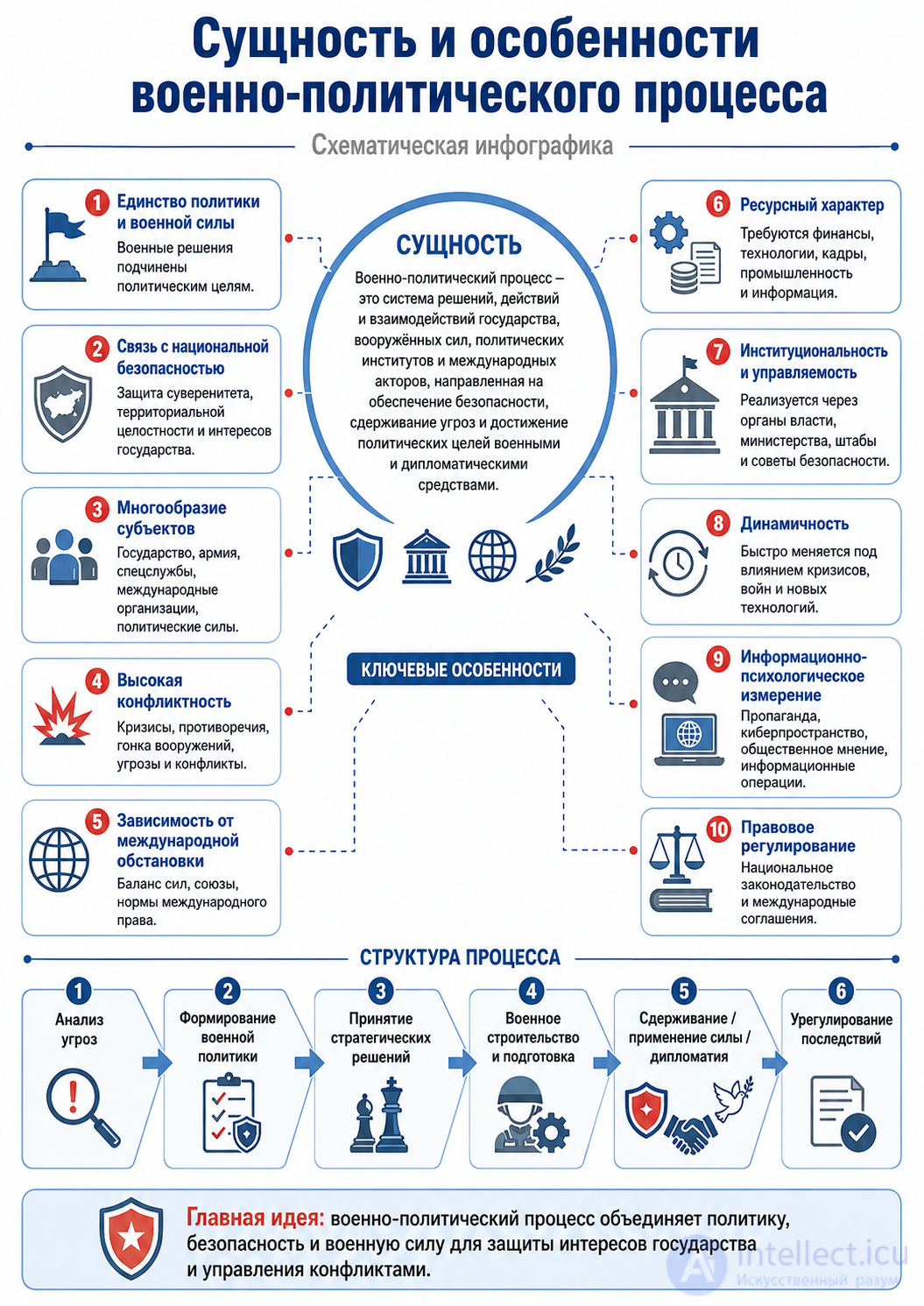
The phrase "military-political process" is used in everyday speech to denote the development and successive change of events of a political character connected with the use of military force. In military political science this concept is one of the basic ones, alongside such categories as "military policy", "military-political stability", "the military-political situation", "military-political activity" and so on.
Every state, irrespective of the particular system of prevailing social relations, elaborates, forms and pursues a military policy as a specific part of its domestic and foreign policy - a system of definite views, ideas and concepts and of corresponding social relations, activity and special public institutions, directly connected with the creation and use of the means of armed struggle in order to attain its aims.
In accordance with the state's vital interests in the sphere of its domestic and foreign policy, a "fan" of priority aims of this policy is also elaborated conceptually, and the means of their possible and actual realization are created (the army, its attributes, personnel, military equipment and armaments, military infrastructure and so on). But these means are set in motion not chaotically, but within the framework of a definite military organization, by means of systematically conducted activity that is directly and immediately connected with the preparation and use of the means of military violence in order to attain definite political aims.
The concept "military-political process" refers to the mechanisms by means of which military policy is "made". One speaks of military policy as a process when there is an interconnected sequence of actions or measures which begin with the origination and initial formulation of some idea, then continue with its discussion, analysis and evaluation, and conclude with the taking of decisions and their subsequent implementation.
The military-political process as a social phenomenon is inseparably connected with the policy of particular states in resolving the problems of war and peace. Millions of people participate in the military-political process, directly or indirectly, consciously or unconsciously. The principal subject of the military-political process, however, is the state or unions of states. As a result of their activity, carried out in time and space, stable ties and relationships are created which reflect all the diversity and contradictions of political interests in the sphere of military security.
On the whole, one of the essential features of the military-political process may be said to be the entire ordered totality of interactions connected with the waging of war or with the settlement of an armed conflict, in the course of which the actors of the military-political process act and interact, corresponding political institutions are reproduced or created, and its various aspects and functions are manifested.
On the basis of the foregoing, the military-political process may be defined as the unfolding in time and space of a totality of ordered actions and interactions of the subjects of military policy, directed at ensuring the military security of the individual, society and the state.
The military-political process may be considered from two points of view. In the first case, the military-political process should be understood as a certain resultant of the totality of actions of various subjects of military policy. In the second case, it is defined as a cycle of military-political changes, a successive change of states determined by the military policy of a state (or union of states). In essence, the difference here lies in the system of coordinates and the units of measurement of the military-political process adopted by the researcher.
The military-political process is, above all, a dynamic phenomenon representing the interconnection between the political process and military activity.
From the ontological point of view, the following essential features of the military-political process may be distinguished:
1. The military-political process is a natural and law-governed phenomenon of politics. In historical-genetic terms it is connected with the class differentiation of society, with the formation of the state and of one of its chief attributive institutions - politics - in response to the historical necessity of continuing it by the means of armed struggle. War, the army and military practice as a whole become the principal object of the military-political process.
As society grew more complex, as social contradictions sharpened and wars and armed conflicts escalated, the military-political process too evolved from epoch to epoch, ascending from simple forms and methods to more conscious and complex ones. A growth in the number of wars was especially observable over the last three centuries. Whereas in the eighteenth century there were 68 of them, and in the nineteenth 205, in the twentieth century there were 237.
2. The military-political process is a postulate of the proposition that "war is a means of policy and its direct continuation". The union of politics and military activity, whose highest expression is manifested in war, is ensured by a totality of law-governed and stable interconnections between them. First, this is a cause-and-effect connection. War begins when policy in one form or another demands the broad application of military violence, and the political forces opposing it are unable to prevent its application. Second, this is a connection between policy and war in terms of content. Policy determines the social orientation and historical meaning of a war - progressive or reactionary. It is precisely on this that the place and role of a war in social development depend, as does its relation to the prospects of social progress or regress. Third, this is the "managerial" connection between policy and war. The central link of this connection is the determining role of the political leadership in relation to military strategy. Policy and political aims exert a decisive influence on the character of the conduct of war and on its content, and are a factor in mobilizing all the forces and resources of society to achieve victory. And fourth, this is the "feedback" connection between war and policy. It consists in the fact that, once war begins, the fate of policy becomes dependent on the course and outcome of military operations, on victories or defeats. The actions of the political leadership are in many respects conditioned by the successes or failures of the armed forces.
3. The military-political process constitutes a specific part of the political process. In this connection one should distinguish the general and the particular between them. The common "territory" of the political and the military-political process consists in the fact that their aims and means often coincide, and this finds its manifestation in its final results - victories or defeats in wars and armed conflicts, military-political crises and other forms of military-force confrontation, and in the correlation of military-political forces attained. The differences consist, above all, in the methods and character of the impact on the object of military policy.
Whereas the political process is carried out (and sets as its priority task) predominantly by peaceful, non-military means, the military-political process (especially under wartime conditions) deals with the most extreme, acute means and methods, namely with actions presupposing the use of the means of armed struggle. One of the principal determinants of this process is military activity, which is used to attain aims and tasks vital to the physical existence of society itself, when other types of activity (political, diplomatic, peacekeeping and so on) have been practically exhausted.
The principal source of the military-political process is the constant process of resolving contradictions in the sphere of defence, while its driving forces are the motives, interests and aims of the secure existence and development of the individual, society and the state and of ensuring the territorial integrity of the country.
Thus, the category "military-political process" is on the whole intended to describe the formation, functioning and change of the policy of ensuring military security. The military-political process as such is composed of a vast multitude of the most varied actions of micro- and macro-actors of military policy, each pursuing its own interests.
The dynamics of the military-political process may, with a certain degree of convention, be compared to the circulation of air masses in the atmosphere, which "make" the weather on our planet. The "political weather" likewise takes shape out of the interaction of disturbing, vortical and relatively even, constant flows of political activity, which in the end give birth, out of the general chaos of divergent actions, to a certain political order.
The stability and durability of such an order are relative: just as for every stable anticyclone in the atmosphere there is always a mobile cyclone that displaces it, so too in politics existing structures periodically explode into reforms, revolutions, conflicts, crises and so forth. In this connection it is expedient to distinguish three basic modes in which political processes unfold: the mode of functioning, the mode of change (development) and the mode of decline.
The first mode is the mode of functioning. It is characterized by the stability of military-political institutions, the well-established use by state power of traditional means of political and military administration, quite predictable changes in the military-political situation and in the activity of the principal subjects of military policy, and the smooth operation of constitutional, legislative, electoral and other political procedures for taking decisions in the sphere of defence. In this case military-political processes reflect the simple reproduction of established, stable military-political relations. Tradition and continuity in the development of the ties among the participants in military-political processes thereby possess an indisputable priority over any innovative changes.
The second mode in which political processes unfold is the mode of change (development). Here the structures and mechanisms of the state's military policy are brought to a new level which makes it possible to respond adequately to the emerging challenges of the time, to military dangers and threats, and to the social demands of the population for protection against them. Such a character of military-political change means that the subjects of military policy transform the aims and methods of their activity in a way that corresponds to the changes taking place in the military-political situation and to the changing correlation of forces within the country and on the international stage.
In this case military-political development is accompanied by intensive interaction of macro- and micro-factors operating in the sphere of military security. Responding to them, the subjects of military policy enhance their capacity to apply flexible strategies and technologies for neutralizing and parrying military threats, taking into account the diverse interests of groups and citizens.
And finally, the third variety of the mode in which military-political processes function is the mode of decline, of the disintegration of military-political integrity. In this case military-political changes (in the ways interests in the field of ensuring military security are articulated, in the selection of the political and military elites, in the taking of military-political decisions and so on) are negative in character with respect to the norms and conditions of the integral existence of the system of military security. Entropy and centrifugal tendencies here prevail over integration.
Moreover, the atomization of the subjects of military policy and the disintegration of the regime for administering the provision of military security become irreversible. As a result, the decisions taken lose the capacity to direct and regulate military-political relations, while the political elite itself (and, as a rule, the military elite) loses stability and legitimacy.
An important parameter of the military-political process is its cyclical, phased character. Military-political processes, being diverse in nature, include various interconnected and distinctive features of one stage or another.
The distinctive features of a particular process make it impossible to single out any stages common to all types of military-political processes. Differences characterize, for example, the specific features of the development and the concrete manifestations of military-political processes. It is therefore expedient to single out particular stages with reference to one or another type of military-political process.
Two groups of factors of military-political processes are distinguished: internal and external. External factors include socio-economic, political, socio-cultural and other influences which determine the general character and orientation of military-political processes. Internal factors include the characteristics of the subjects of military policy, their aims and intentions, the distribution of power resources, and the logic and "plot" of the military-political process
Military-political processes differ from one another in scale, duration, orientation, the composition of the actors, the character of the interaction between them and so on. For example, from the standpoint of the condition of society, military-political processes of the stationary and transitional types are distinguished. The first is carried out within the framework of a single system and may be defined as "systemic". The second may be characteristic of a transitional process and may conventionally be designated as "inter-systemic".
Structurally, the military-political process includes the analysis of threats, the formation of military policy, the taking of strategic decisions, military development, the training of the armed forces, diplomatic support, the use of force or deterrence, and also post-war settlement.
Thus, the military-political process is a complex system of interaction between politics and military force. Its chief distinctive feature consists in the fact that military means are used not in and of themselves, but as an instrument for attaining political aims, ensuring security and influencing international relations.
The military-political process is neither a spontaneous nor an irrational process. It represents a logically unfolding sequence of interaction among the subjects of military policy and depends solely on the will and creative activity of people, above all of the military leadership. Although, as practice shows, other factors may also play a substantial role.

Comments